.png?x-oss-process=image/resize,h_100,m_lfit/format,webp)

.png?x-oss-process=image/resize,m_lfit,w_200/format,webp)

热门产品

Popular articles
Curious! How Does AB客's AI Super Marketer Pro Achieve Efficient Marketing by Replacing Basic Manpower with AI?
Utilizing Social Media for Foreign Trade Customer Development: Practical Strategies for 2025
AI-Driven Website Diagnosis: Practical Demo to Elevate Cross-Border B2B Site Performance
Can the sample fee be refunded in subsequent orders?
Foreign Trade SEO Essentials: How Beginners Can Quickly Master Keyword Research to Boost Google Rankings
AI intelligent translation: Overcoming language barriers and easily obtaining international orders
A must-read for newbies: The amazing secret to soaring customer response rates during the foreign trade inquiry stage!
Leverage AI to Boost Organic Traffic on B2B Foreign Trade Websites: A Deep Dive into Semantic HTML Structure Optimization and Intelligent Strategy Adjustment
How to Use Import-Export Data Tools for Smarter Global Business Decisions
Recommended Reading
.png?x-oss-process=image/resize,h_1000,m_lfit/format,webp)


.png?x-oss-process=image/resize,h_1000,m_lfit/format,webp)


I generate 500+ precise leads a year, and I rely on this "industry chain decomposition method"!
A 20-year veteran of foreign trade shares his practical experience: developing 500+ precise customer leads in a year through industry chain analysis. Includes real-world case studies, industry chain analysis steps, customer development techniques, and a guide to avoiding pitfalls, helping foreign trade professionals quickly master methods for acquiring high-quality customer leads.

Having worked in foreign trade for so many years, I've seen far too many people take the wrong path in developing clients:
Searching everywhere on Google, scouring platforms for customers, and scrambling to attend trade shows...
As a result, after a year, there were not enough inquiries, inaccurate customer data, and no direction for development.
The reason I was able to consistently generate 500+ targeted customer leads per year wasn't luck, but this method—
Industry-Chain Decomposition Method
In short:
Find customers by following the industry chain, instead of randomly developing clients.
Why is it so powerful? Because it helps you accurately target "people who genuinely have purchasing needs and happen to need your product."
Today I will give you the most complete and practical version, including:
-
Real Cases
-
Complete steps of industry chain disassembly
-
Tool-based gameplay
-
Email Development Techniques
-
Avoid pitfalls and minefields
Please save this.
I. How I entered the "packaging machinery" market from scratch and secured 148 targeted customers in 3 months
In 2018, I changed industries, switching from auto parts to packaging machinery, with zero resources.
The first thing I did was not to cast a wide net, but—
The industry chain of dismantling packaging machinery.
✔ 1) Who is upstream?
-
pneumatic components
-
motor
-
PLC control
-
knives
-
Self-adhesive materials
-
Packaging film
(Their customers are also potential customers)
✔ 2) Who is in the middle? (It's me)
-
Various packaging machinery
-
OPP/PE/PP sealing machine
-
Automatic bagging/labeling machinery
-
Buffer Packaging Machine
✔ 3) Who is downstream?
-
food factory
-
cosmetics factory
-
pharmaceutical factory
-
Industrial parts packaging
-
3C electronics
-
Daily chemical OEM factory
I find clients by focusing on this chain.
result:
In just three months, we accurately identified 148 real factories , all of which had clear needs: upgrading packaging production lines, replacing old machines, and expanding production.
This is the power of the industry chain approach:
You're not looking for customers who "might buy," but customers who "definitely will buy."
II. Industry Chain Decomposition Method: Complete and Replicable Standard Operating Procedures
It's easy to implement; I've condensed it into a 5-step structured process :
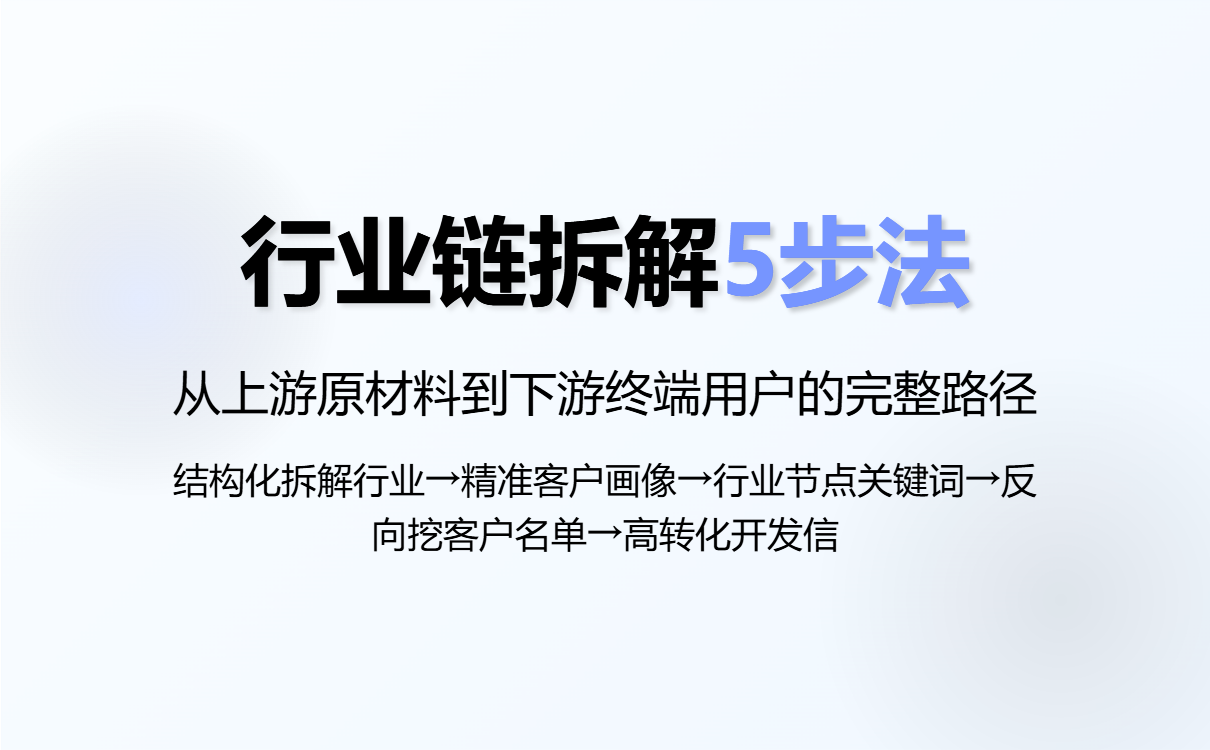
Step 1: Analyze your industry in a structured way (core)
Draw a simple industry diagram:
👉Example: You manufacture CNC parts.
-
Upstream : Steel and aluminum suppliers; heat treatment; surface treatment plants
-
Yourself : CNC machining, precision machinery
-
Downstream : Machinery manufacturers, automation equipment manufacturers, robot manufacturers, medical equipment manufacturers, auto parts manufacturers, agricultural machinery manufacturers, mining machinery manufacturers
Imagine this:
If you just focus on the "downstream industry list" and develop them one by one, wouldn't the accuracy be directly upgraded?
Step 2: Break down the "downstream industry" into actionable, actual customer profiles.
Let's continue with CNC as an example:
Downstream industry: Automation equipment → Continue disassembly:
| category | Customer characteristics | Procurement cycle |
|---|---|---|
| Automation equipment manufacturer (complete machines) | A large number of structural components and frame components are needed. | 2–6 months |
| Automation line integrator | Small batch custom parts, diverse products | 1–3 months |
| Robot Integrator | High-precision parts (high profit margin) | 3–12 months |
| OEM Customized Equipment Factory | Long-term cooperation, repeat orders | Stable repeat purchases |
You can create a precise customer database by searching for companies one by one according to this user profile.
Step 3: Use "industry-specific keywords" to search for customers across Google, Maps, and LinkedIn.
This is the most ruthless aspect of the industry chain method:
You're not searching for products (where competition is fierce), but rather for industry nodes (where no one is competing with you).
For example, if you are in the packaging machinery business, don't search for "packaging machine buyer".
Doing that will plunge you into a quagmire of competing with your peers worldwide for a single fish.
You should search for:
Keyword template:
-
"food factory + country"
-
"cosmetics OEM + city"
-
“pharmaceutical packaging line + company”
-
“assembly line manufacturer”
-
“automation equipment factory Germany”
-
“medical device contract manufacturing”
Then, list their official websites in a table and categorize them:
| Company Name | Industry nodes | nation | Procurement intensity | Contact information | Remark |
|---|---|---|---|---|---|
| ABC Foods | food factory | USA | ⭐⭐⭐⭐⭐ | Official website email | Old machines are ready to be replaced on the production line. |
| XYZ Pharma | pharmaceutical factory | India | ⭐⭐⭐⭐ | Oral liquid packaging |
Doing 500 customer leads a year?
Using the industry chain method, this is merely the passing grade.
Step 4: Dig up the "upstream supplier's customer list" (this is an extremely ruthless tactic).
This is a move by experts.
For example, if you are making CNC parts:
Upstream suppliers include metal material suppliers, bearing suppliers, and cylinder suppliers.
These suppliers' official websites typically include:
-
Case
-
Partner Client Logo
-
Downstream Industry Introduction
-
Success Project Stories
This means they've already screened out customers who genuinely need CNC machining for you.
What you need to do is:
Record these customer lists → Explore their email addresses one by one → Develop relationships with them one by one.
The essence of industry chain theory:
By leveraging other people's industry chains, we can find our own targeted customers.
Step 5: High-conversion sales email (industry-specific script)
Industry chain development doesn't require hard selling.
Because the clients you find are the natural demanders.
Related reading: Write a high-response-rate foreign trade development letter in 5 minutes: with English and Chinese templates for all industries.
template:
Subject: Regarding your [industry] production line upgrade
Hi [Name] ,
I'm reaching out because we've been working with several [industry-specific companies] such as [Company A/B] to supply [your product/solution] , especially for their [specific application] .
Noticed that companies in your industry are recently:
-
Upgrading old equipment
-
expanding capacity
-
Optimize production cost
If you are doing any of these, I can send you a reference solution from a similar factory we supported last quarter.
Would you like me to share the case?
Best regards
Your Name
Features:
-
No selling
-
Common problems in the industry
-
Offering enticing "peer case studies"
-
Response rates are typically 20–38%.
III. Four efficient tools I use in industry chain development (tested and proven to be effective)
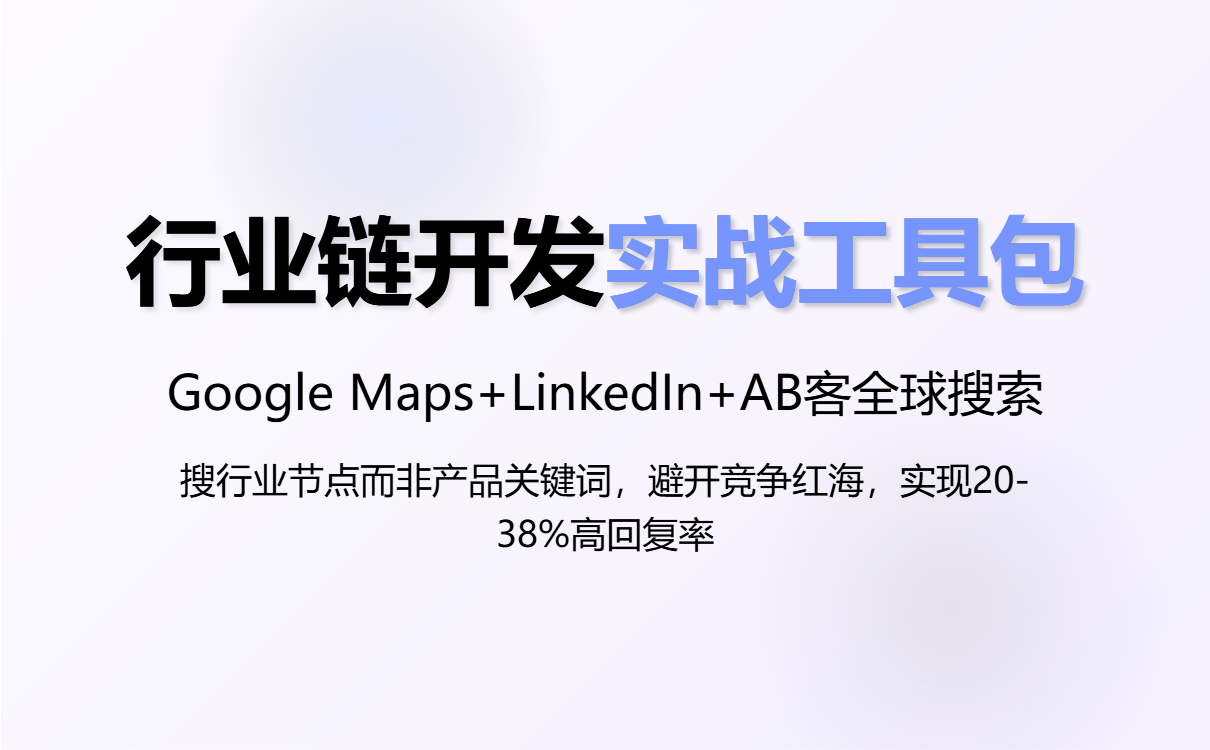
① Google Maps (Required)
Search directly
-
“Food manufacturer”
-
"Cosmetic factory"
-
"Automation equipment"
It can uncover a large number of real factories.
② LinkedIn Person-Oriented Search
Search function:
-
Purchasing Manager
-
Production Director
-
Maintenance Manager
-
Project Engineer
These are the key contact persons.
③ BuiltWith / Wappalyzer
Some large industrial companies have direct access to emails, organizational structure, and teams.
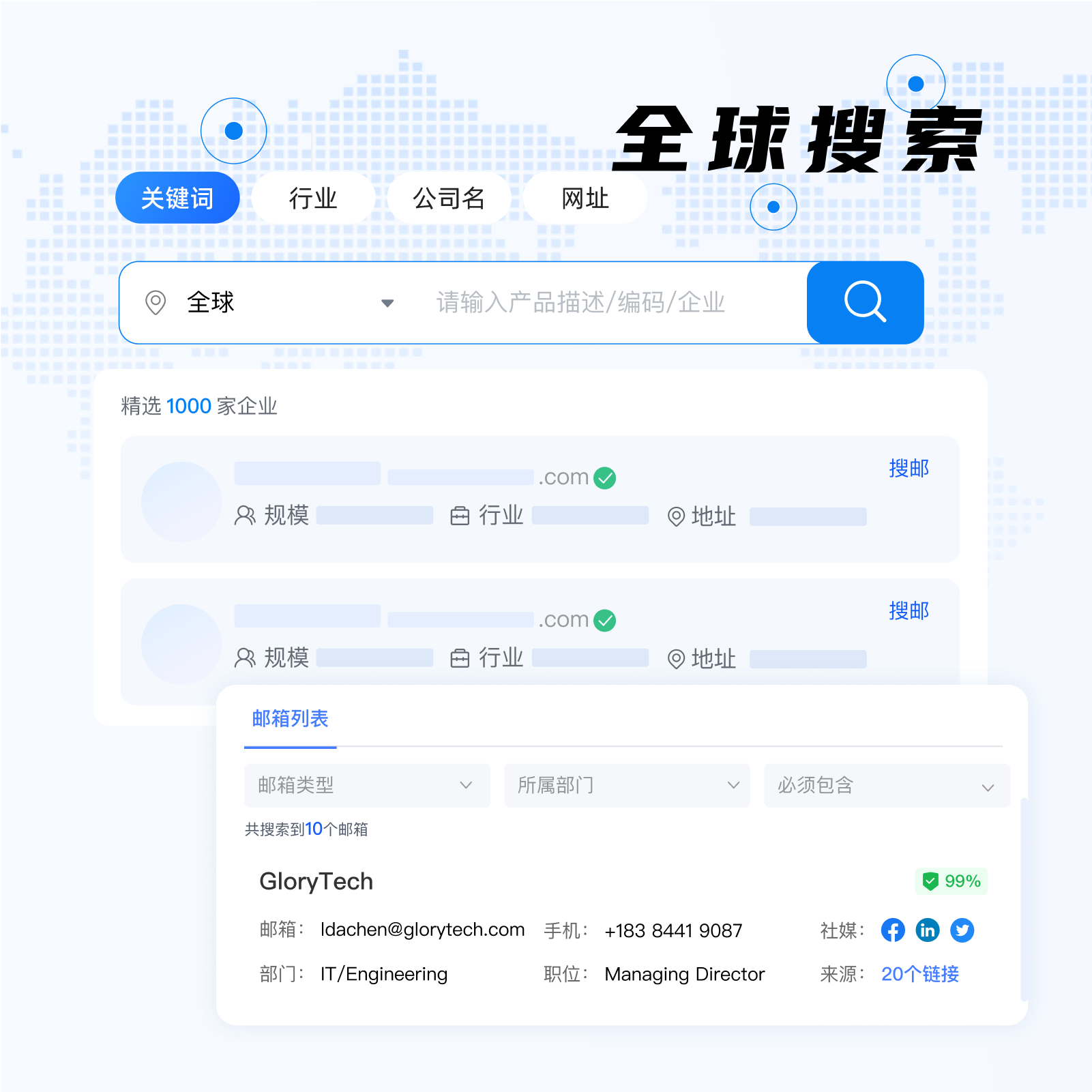
④ AB Global Search
In conjunction with industry chain lists, we will conduct in-depth analysis of customer emails and contact information to build a high-quality customer database.
IV. Common pitfalls in supply chain methods (to be avoided)
❌ Pitfall 1: Industry breakdown is too coarse
Simply listing "food industry" or "pharmaceutical industry" is called industry classification.
This is not a breakdown of the industry chain.
It must be disassembled to the scene level :
-
Dairy products → require filling and packaging
-
Frozen foods → require automated bagging
-
Sauce → Needs to be packaged in bags
-
Food OEM → Large-scale factories, intensive demand
❌ Pitfall 2: Sales emails only mention the product
Industry chain development should focus on telling "industry stories," not "product parameters."
❌ Pitfall 3: No customer data management form
Industry chain methods will give you access to a large number of targeted customers.
If you don't manage it, you'll waste half of it.
❌ Pitfall 4: A single letter can devastate the entire industry.
Different nodes have different pain points, so emails need to be sent in groups.
V. The Underlying Logic of Industry Chain Development: Allowing you to "acquire customers" instead of "begging for them."
In short:
The industry chain approach is not about finding customers, but about finding "demand nodes".
When you find the right point, you'll never lack customers.
You are making industrial products:
Each downstream industry corresponds to a real procurement chain.
You just need to connect to that chain, and customers will keep coming in.
Having worked in foreign trade for 20 years, the thing I'm most grateful for is—
Instead of focusing on competitors' performance, we are now following the industry chain.
The biggest fear in foreign trade is opening blind boxes, but the industry chain method allows you to...
✔ Precise
✔ Copyable
✔ Low competition
✔ High response rate
It's not difficult at all to actually acquire 500+ precise customer leads per year .
.png?x-oss-process=image/resize,h_100,m_lfit/format,webp)
.png?x-oss-process=image/resize,h_100,m_lfit/format,webp)

.png?x-oss-process=image/resize,h_100,m_lfit/format,webp)
.png?x-oss-process=image/resize,h_100,m_lfit/format,webp)
.png?x-oss-process=image/resize,h_100,m_lfit/format,webp)
.png?x-oss-process=image/resize,h_100,m_lfit/format,webp)
