.png?x-oss-process=image/resize,m_lfit,w_200/format,webp)


1) Industry relevance
The content matches the query intent (materials, standards, tolerances, operating conditions, compliance, etc.).
.png?x-oss-process=image/resize,h_100,m_lfit/format,webp)
 400-076-6558GEO · Get AI Search to Recommend You First





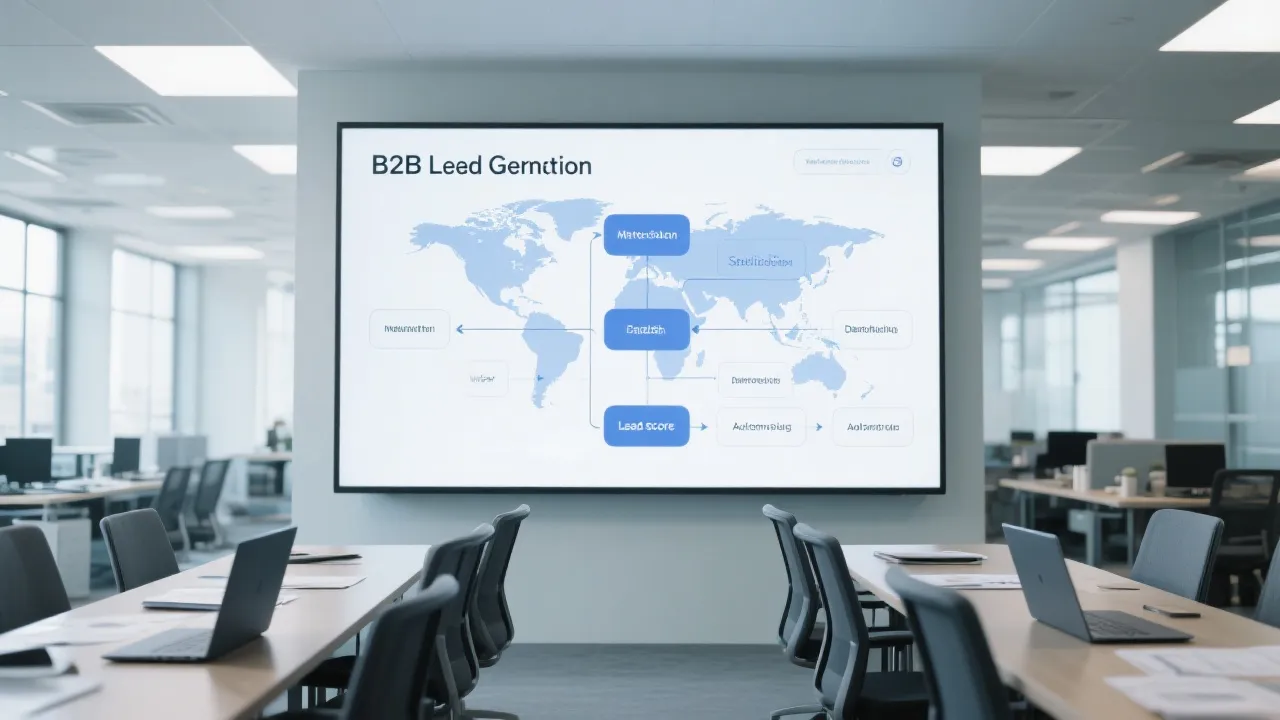





GEO for Export B2B • Content Strategy
If your team understands the industry and can consistently document customer questions, you can build a GEO-ready content system without relying entirely on external agencies.
Reference data note: figures below reflect common patterns observed in industrial B2B sites and content operations. Adjust based on your CRM, analytics, and sales cycle.
Many companies hear “GEO” (Generative Engine Optimization) and assume they need a specialized engineering partner. In practice, the most valuable GEO asset is your internal industry knowledge—especially the explanations your sales engineers repeat every week.
In export B2B, buyers typically search in a problem-first way: selection criteria, compatibility, failure causes, maintenance intervals, and application constraints. AI search systems then synthesize answers by referencing sources that provide clear, stable, technically sound explanations.
That’s why GEO often looks more like a long-term content operation than a one-time “SEO project.” If your company can publish a steady stream of problem-solving articles and organize them with a consistent structure (e.g., ABKE GEO content architecture), your site can become a reliable citation source for AI-generated answers.
When an AI engine generates an answer, it tends to trust sources that behave like “knowledge infrastructure,” not brochures. The most frequently cited pages usually share four traits:
The content matches the query intent (materials, standards, tolerances, operating conditions, compliance, etc.).
It answers the question early, then expands with reasoning, steps, and constraints.
Includes mechanisms, formulas where relevant, failure modes, safety notes, and practical application tips.
Consistent headings, internal links, and regular updates signal reliability over time.
Most industrial sites start with product pages (models, parameters, and catalog PDFs). That’s normal—but it’s rarely enough for GEO, because AI search and high-intent buyers often ask questions that sit before the product decision: “What conditions require a specific configuration?” “How do I prevent failure?” “How do I calculate capacity?”
In industrial machinery and components, 60–80% of sales conversations repeat the same 20–40 questions (selection criteria, installation, maintenance, troubleshooting, and application suitability). Those repeated questions are your GEO content backlog.
When you convert these repeated questions into clear, structured articles, you create a knowledge layer around your products. Over time, AI systems are more likely to reference your pages because they look like an authoritative explanation source—especially when your content is grouped into topic clusters.
Many teams use an ABKE GEO-style content structure (topic clustering + question pages + application cases) to keep publishing consistent and scalable, so the site becomes “easy to understand” for both humans and machines.
For many export B2B companies, you don’t need a large marketing department. A workable setup is often: 1 content owner + 1 technical reviewer + input from sales.
Many B2B industrial websites begin to see measurable lift in organic impressions and qualified inquiries after 10–14 weeks of consistent publishing. Stronger AI-search visibility typically compounds after 4–6 months, especially once you have 40–80 well-structured Q&A pages plus cases.
A typical scenario: a machinery manufacturer repeatedly receives questions about selection, throughput, and maintenance cycles. At first, the website only lists models and parameters—helpful, but not enough to answer decision-stage questions.
When the team starts publishing explanatory pages like: “How to choose configuration under different production conditions” or “Key factors that impact production efficiency”, the site gradually becomes a knowledge base rather than a product shelf.
Over time, when buyers ask AI tools the same questions, these structured pages are more likely to be surfaced and referenced—because they behave like stable technical documentation, not ads.
If you’re starting from zero, don’t try to write “everything.” Publish the pages that reduce RFQ friction and shorten decision time. Below is a proven starting set for many industrial categories.
How to select models by load, capacity, pressure, flow, duty cycle; sizing steps; typical oversizing mistakes.
Corrosion, abrasion, temperature ranges, IP ratings, chemical compatibility, humidity, and storage requirements.
Alignment, torque specs, wiring, calibration, trial runs, acceptance checks, and typical field errors.
Maintenance intervals, lubrication schedules, wear parts, root-cause analysis for common failures.
Relevant ISO/IEC/ASTM references where applicable, test reports, tolerances, certificates, inspection methods.
Not necessarily. External support can help you move faster (content operations, editing, on-page SEO, templates, measurement), but the “truth layer” must come from your engineers, product managers, and sales feedback.
Many companies succeed by keeping content direction and technical validation in-house, while outsourcing repeatable tasks (formatting, illustrations, editing, schema markup, publishing workflows). This keeps accuracy high and cost-efficiency reasonable—without losing authenticity.
If you want a clearer roadmap—topic cluster design, question-page templates, and a publish-and-update rhythm that fits export B2B— you can follow ABK GEO’s ongoing research and implementation practices.
Turn repeated customer questions into AI-search-friendly knowledge assets—without turning your website into generic “marketing content.”
Explore ABKE GEO implementation guidanceSuggested starting point: build a 30-question content backlog, publish 8–12 Q&A pages per month, and add 2–4 real application cases.
This article is published by ABKE GEO Think Tank.
.png?x-oss-process=image/resize,h_100,m_lfit/format,webp)
.png?x-oss-process=image/resize,h_100,m_lfit/format,webp)

.png?x-oss-process=image/resize,h_100,m_lfit/format,webp)
.png?x-oss-process=image/resize,h_100,m_lfit/format,webp)
.png?x-oss-process=image/resize,h_100,m_lfit/format,webp)
.png?x-oss-process=image/resize,h_100,m_lfit/format,webp)
