.png?x-oss-process=image/resize,h_100,m_lfit/format,webp)

.png?x-oss-process=image/resize,m_lfit,w_200/format,webp)

热门产品

Popular articles
Smart Website Builder Guide: How Foreign Trade Companies Achieve Zero-Code Multilingual Sites
How to Identify High-Frequency Spanish Market Procurement Words with AI Tools: Practical Methods for Multilingual Keyword Monitoring for Foreign Traders
Don't know how to use customs data? These 3 filtering methods are enough for foreign trade beginners (with example queries).
Unveiling the Customer Scoring Logic of a Global 200 - Million Enterprise Database to Boost Foreign Trade Lead - Generation Efficiency by 80%
How to Quickly Enter Overseas Markets with Foreign Trade Independent Websites
Essential Guide for New Foreign Trade Professionals: 5 Key Negotiation Scenarios and Techniques Revealed!
AB Ke Rapid Lead Generation Platform in-depth analysis: Revolutionizing B2B export business through intelligent customer acquisition
推荐阅读




.jpg?x-oss-process=image/resize,h_1000,m_lfit/format,webp)




In the AI era, how should content be written for foreign trade websites? A GEO content model that I've personally tested and found effective.
Is the lack of relevant content a challenge for foreign trade websites, making AI useful? This article breaks down the core logic of GEO (Generative Evidence-Oriented Development): transforming oral experience in foreign trade into structured knowledge, sharing three practical steps: reverse engineering of procurement problems, topic clustering, and semantic association, and combining them with intelligent tools to solve execution difficulties and help websites acquire customers.
.png?x-oss-process=image/resize,h_1000,m_lfit/format,webp)
If you ask me:
"What's the hardest part about rebuilding the official website now?"
My answer isn't technology, it's not budget, it's—
I don't know how to write content that is truly "useful for AI".
1. How did we answer customer questions in the past?
If you've been in foreign trade for a long time, you must have this feeling:
For many customer questions, you don't even need to look up information .
for example:
-
"Can this product be used in high-temperature environments?"
-
"What are the differences between your solution and that of Supplier A?"
-
What are the most common pitfalls to encounter with this type of application?
-
"With such a large price difference, are there any hidden risks?"
These are the problems we often encounter:
-
Reply in email
-
Say it via voice message in WhatsApp
-
Explaining casually in Zoom
This is the "hidden asset" of foreign trade professionals—verbal experience.
But the problem is:
These experiences:
-
Not recorded by the system
-
Not structured
-
Not available on the official website
Therefore, the result is:
Customers have heard it, but AI will never have.
Second, why can't AI see these "verbal experiences" at all?

This is something I only understood after I truly grasped GEO (Generative Engine Optimization).
AI doesn't disregard your experience, but rather—
AI can only understand “written and structured experiences”.
1️⃣ AI does not participate in the dialogue, but only in "text judgment".
-
A customer asks you 10 questions
-
No matter how professional your reply is
-
If it's not converted into content, it equals 0 from an AI perspective.
2️⃣ Scattered content ≠ applicable knowledge
Many foreign trade websites also include content, but the problem is:
-
One point at a time
-
No system
-
No context
-
No logical connection
The AI's judgment is:
"This is fragmented information, not a complete answer."
3️⃣ AI needs "reusable models," not improvisational solutions.
AI prefers this type of content:
-
Able to answer a class of questions
-
It can cover a complete decision-making path.
-
Can be cited multiple times
Instead of:
-
Single-point technique
-
occasional cases
III. The GEO content model (core structure) that I later used
When I later restructured the website content, I set a principle for myself:
Each item must answer "a key question in the procurement decision-making process".
It wasn't for writing an article, but for—
Enable AI to call upon me in "critical problem scenarios".
We discussed the specifics of how to write it in a previous article , " "GEO Content Creation: How to Create High-Quality Content That Attracts AI and Impresses Clients? , which you can refer to.
IV. The first step in the GEO practical model: the reverse engineering method for procurement problems (this is the core).

❶ Don't start writing with "What products do I have?"
This is the starting point for the failure of most foreign trade website content.
The starting point for GEO content is always:
What is the most important question a procurement officer wants to ask at any given stage?
❷ Where do procurement problems come from? (3 most practical sources)
Source 1: Customer issues you've actually encountered
My preferred method:
-
Go through all the customer emails from the past year
-
List the questions that are asked repeatedly.
-
No changes, no embellishments, just the original words.
AI really likes these kinds of questions.
Source 2: Industry "High-Risk Decision Points"
for example:
-
Common reasons for selection failure
-
Consequences of application mismatch
-
The parameters may seem the same, but the actual differences are huge.
These problems often:
-
The customer was too embarrassed to ask.
-
But AI will definitely mention it.
Source 3: The type of question you are best at "explaining"
Think about this question:
You can tell whether a customer is "knowledgeable" just by asking them a question.
This kind of question is extremely valuable in terms of content.
❸ Write the question as a title that can be understood by AI.
Error example:
Product Technical Introduction
Correct example:
Why do 80% of procurement decisions make the wrong product selection under these working conditions?
V. GEO Practical Model, Step Two: Industry Knowledge Theme Clusters
This was the watershed moment that I realized later.
The AI doesn't recommend "a specific article," but rather:
"Are you authoritative enough on this topic?"
1️⃣ What is a "topic cluster"?
Simply put:
-
A core theme
-
Breaking down multiple issues
-
The content is interconnected
For example:
Core topic: Product selection for a specific type
The following can be broken down as follows:
-
Differences in application scenarios
-
Common Misconceptions
-
Parameter understanding
-
Cost vs. Risk
-
Real failure cases
2️⃣ Why does AI prefer topic clusters?
Because from AI's perspective:
-
Single article content = viewpoint
-
Thematic clusters = professional fields
AI is more inclined to recommend "domain-specific information sources".
3️⃣ Practical suggestions (suitable for beginners)
-
Not aiming to finish writing it in one go
-
First, identify 1-2 core themes.
-
One key question to address each week
-
Forming a "problem network"
VI. GEO Practical Model, Step 3: How to build "semantic connections" between content?
This is the most easily overlooked, but extremely important step for AI .
Previously, when we created content:
-
Each one is an island.
-
Neither mentioned
-
Do not reference each other
Under the GEO logic, content must "know each other".
You need to do three things:
1️⃣ Using the same topic to reference each other's "questions"
For example, in article A:
"Regarding this issue, we have discussed the differences in the XX scenario in detail in another article."
This is giving AI directions .
2️⃣ Use "questions" instead of "keywords" for internal links.
AI understands better:
-
"An extension of this issue"
-
Instead of "links containing certain keywords"
3️⃣ Clearly define the hierarchical relationship between content.
For example:
-
Introductory questions
-
Decision-making problems
-
Risk issues
-
Comparison problem
From AI's perspective, this is a complete cognitive path .
7. What is the biggest challenge at the execution level? (And why many people give up)

To be honest, the problem isn't whether you "understand the method," but rather:
Can experience be transformed into content in a long-term and systematic way?
I've personally fallen into three traps:
-
I only wrote a few articles before stopping.
-
The content is becoming increasingly scattered
-
Extremely high maintenance costs
8. How did I later solve the "difficulty in enforcement"?
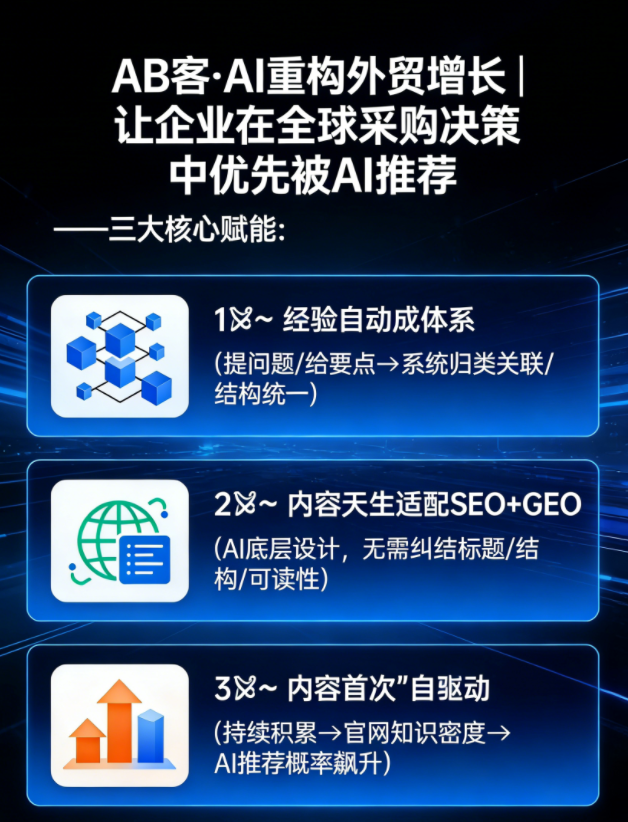
For this step, I used tools like AB Customer Intelligent Website Builder as "execution support".
What it truly solved for me wasn't "helping me write content," but rather three things:
1️⃣ Automatically organize scattered experiences into the content system.
All I need is:
-
Provide questions
-
Provide key experience points
The system will help me:
-
Classification of topics
-
Establish association
-
Ensure structural uniformity
2️⃣ Content is naturally compatible with SEO + GEO
I don't need to worry about it:
-
How to write a title
-
Is the structure reasonable?
-
Is it possible that "AI won't understand it"?
Because the underlying logic is:
Content structure designed for AI.
3️⃣ The content was able to "run smoothly" for the first time, instead of being sustained by people forcing it.
This is the most realistic point.
-
Content can be continuously accumulated
-
The official website is beginning to exhibit "knowledge density".
-
AI recommendation probability significantly improved
9. If you only remember 3 sentences from this article
I would suggest you remember these three points:
1️⃣ AI doesn't need you to be better at marketing, it just needs you to be better at "explaining the problem clearly".
2️⃣The essence of the content on a foreign trade website is to transform experience into "knowledge that can be cited".
3️⃣ GEO is not a writing technique, but a long-term content organization method.
.png?x-oss-process=image/resize,h_100,m_lfit/format,webp)
.png?x-oss-process=image/resize,h_100,m_lfit/format,webp)

.png?x-oss-process=image/resize,h_100,m_lfit/format,webp)
.png?x-oss-process=image/resize,h_100,m_lfit/format,webp)
.png?x-oss-process=image/resize,h_100,m_lfit/format,webp)
.png?x-oss-process=image/resize,h_100,m_lfit/format,webp)
