.png?x-oss-process=image/resize,h_100,m_lfit/format,webp)

.png?x-oss-process=image/resize,m_lfit,w_200/format,webp)

热门产品

Popular articles
AI Marketing Agent Service vs AI Writing Tools vs Outsourced Operations: Boundaries, Ownership, and Best-Fit Scenarios
GEO Service Provider vs SEO Company: What’s the Real Difference for B2B Growth?
From 0 to AI Recommendations: GEO Optimization Inquiry Growth Case Study (Method + Framework) — ABKE (AB客)
郑州企业如何选择本地GEO服务商?用“可验证、可复盘、可对比”建立中立测评体系(含评分表/对比维度/避坑清单)
What to Rebuild in a Foreign Trade Website Lead-Gen Upgrade: Module Responsibilities from Homepage to FAQ
GEO vs SEO for Exporters: Which One Fits Your B2B Growth Stage?
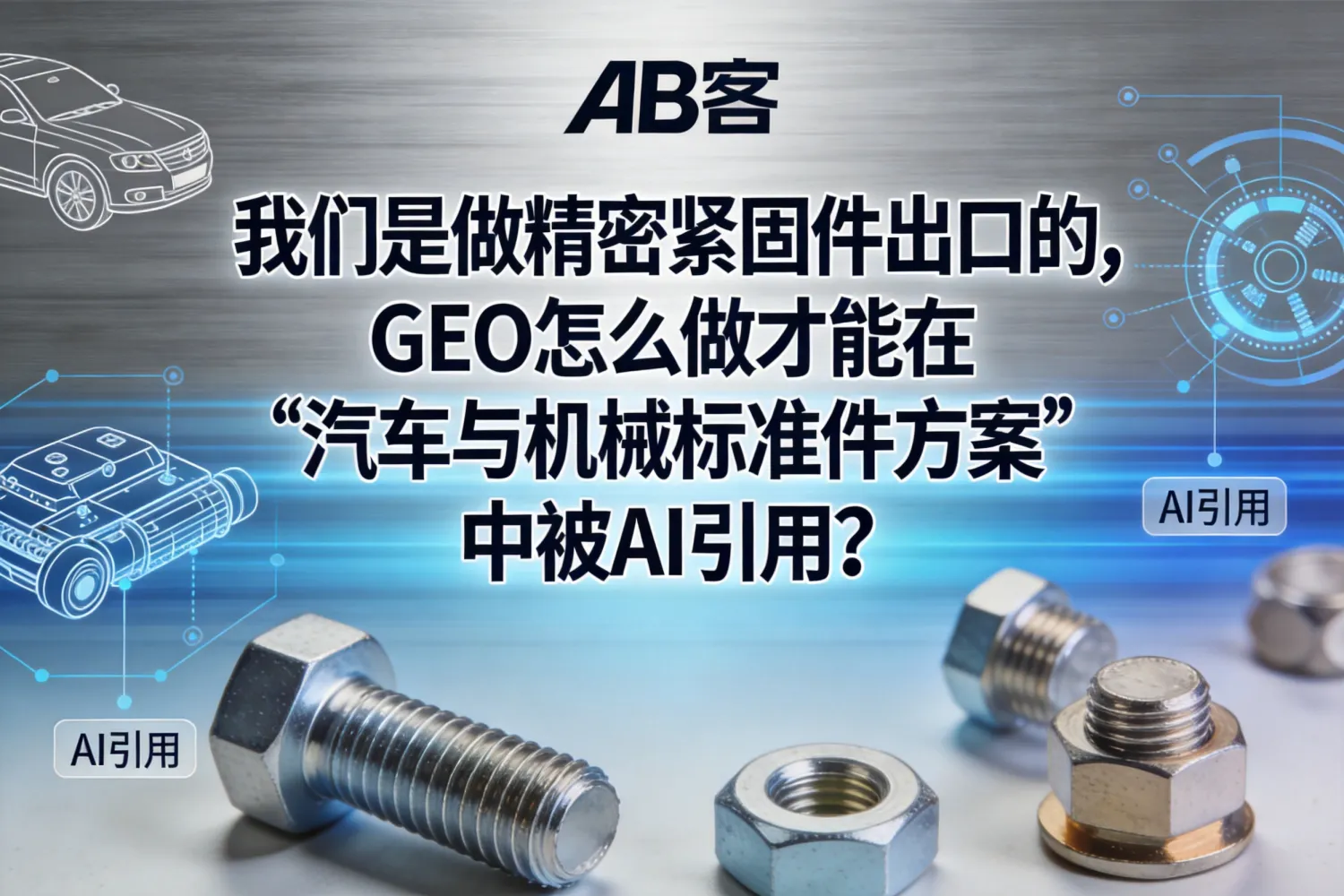
We export precision fasteners. How can GEO be included in the "Automotive and Mechanical Standard Parts Solutions" section for AI reference? | AB Guest
For Machinery Manufacturers, Should AI Search Optimization Start with Product Parameter Pages or Application Case Studies?
Recommended Reading




Industrial Parts AI Search Optimization: How to Make Specifications, Certifications, and Customization Easy for AI to Understand
Learn how industrial parts exporters can turn specifications, materials, certifications, testing, and customization capabilities into AI-friendly content structures. Powered by ABKE GEO growth infrastructure.
Industrial Parts AI Search Optimization: How to Make Specifications, Certifications, and Customization Easy for AI to Understand
In 2026, industrial parts exporters are no longer optimizing only for keywords. They are optimizing for how AI systems read, interpret, compare, and recommend suppliers. For manufacturing businesses, the winning strategy is to turn product specifications, materials, certifications, testing capabilities, and custom workflows into structured content that AI can trust.
Summary: In 2026, industrial parts exporters should not repeat phrases like “machined parts supplier” or “OEM components factory” endlessly. Instead, they should organize content around what AI actually needs to decide whether to recommend a supplier: materials, tolerances, process capability, certification scope, testing evidence, customization workflow, application industries, and export trust signals.
1. The New Pain Point for Industrial Parts Exporters: Too Much Data, But AI Still Doesn’t Know What You Can Really Make
Industrial parts companies usually sell engineering parts rather than consumer products. Typical categories include CNC machined parts, turned parts, milled parts, stamped parts, die-cast parts, forged parts, injection molded parts, sheet metal parts, shafts, gears, flanges, fasteners, connectors, pump and valve components, machine structural parts, automotive parts, and automation accessories.
The problem is not that these businesses lack data. The problem is that their data is often scattered, fragmented, and written for internal use rather than for AI interpretation. A website may show a lot of pictures, a few specs, and a short line saying “customized available,” but that is not enough for AI to understand capability depth.
Common website issues in industrial parts marketing
- Product pages look like galleries, not engineering reference pages.
- Specifications are listed without context, so AI cannot map them to real use cases.
- Certificates are uploaded as images or PDFs, but their meaning is not explained.
- Customization ability is described vaguely instead of through a step-by-step workflow.
Trend chart: how AI evaluates industrial suppliers
In 2026, industrial parts exporters also face stronger compliance pressure. For example, the EU Machinery Regulation (EU) 2023/1230 is already published and will apply from 20 January 2027, replacing the old Machinery Directive. That means suppliers serving Europe must pay more attention to technical documentation, compliance responsibility, and traceable quality information.
This makes 2026 the right time to organize product knowledge, certificates, and process details into AI-readable assets rather than leaving them in disconnected folders or hidden PDFs.
2. What AI Needs to Understand When Recommending an Industrial Parts Supplier
AI recommendation systems do not only ask whether you produce a part. They try to infer whether your company is a suitable supplier for a specific purchase scenario. That means AI looks for a supplier profile, capability boundaries, trust signals, and application fit.
3. Turn Specifications from Isolated Data into Clear Capability Signals
One of the most common mistakes in industrial parts websites is treating specifications as content by themselves. AI does not just need numbers; it needs meaning. A line such as “Tolerance: ±0.01 mm” is useful, but it becomes far more valuable when the page explains what kind of parts that tolerance supports and what industries it serves.
For example, instead of simply listing materials and dimensions, the content should connect the part to a real use case:
Less effective for AI:
Material: Aluminum 6061 / Tolerance: ±0.01 mm / Surface: Anodizing / Application: Machinery
More AI-friendly:
Aluminum 6061 CNC machined parts are suitable for lightweight mechanical structures, automation equipment, electronic housings, and precision fixtures. With CNC milling, turning, and anodizing support, these parts can achieve stable dimensional accuracy, corrosion resistance, and a clean industrial finish.
Recommended spec modules for each product page
- Product definition: what the part is and what equipment it serves.
- Material range: which alloys or polymers are available and why.
- Size range: max machining size, minimum feature size, and common dimensions.
- Tolerance capability: standard and precision tolerances, plus control methods.
- Surface treatment: anodizing, zinc plating, black oxide, polishing, painting, heat treatment.
- Inspection method: CMM, calipers, micrometers, hardness testing, salt spray testing.
- Applications: automotive, automation, robotics, pumps, valves, energy, medical devices.
- Purchasing data: MOQ, sample time, lead time, packing, file formats supported.
Data-to-capability flow
4. Build Material and Process Selection Guides Instead of Only Product Lists
Industrial buyers often ask AI not “Do you have stainless steel parts?” but “Which material is best for my application?” That is why a supplier website needs material and process guidance pages. These pages help AI understand not only what you sell, but also how you advise customers.
Material guide examples
- Aluminum parts: ideal for lightweight structures, automation equipment, robot parts, and electronic housings.
- Stainless steel parts: suitable for corrosion resistance, food equipment, medical devices, valves, and marine environments.
- Carbon steel and alloy steel parts: used for shafts, gears, load-bearing components, and mechanical assemblies.
- Brass and copper parts: preferred for conductivity, heat transfer, valves, connectors, and precision turning.
- Engineering plastic parts: used for insulation, wear resistance, low noise, and special environments.
5. Certifications Should Be Written as Trust Signals, Not Only as Certificate Images
Many industrial parts websites show certifications as separate image blocks. That is not enough for AI. A certificate image proves nothing unless the page also explains what the certification covers, why it matters, and what documentation can be provided to buyers.
A better practice is to write each certificate as certification name + scope + buyer value.
How to explain trust information
ISO 9001 quality management system: indicates the factory has a structured quality management process, but it does not automatically mean every part is suitable for every application.
IATF 16949: important for automotive supply chains because buyers need process control, consistency, and traceability.
RoHS / REACH: relevant for electronic, electrical, and EU-bound products where material compliance matters.
Material and inspection reports: help buyers verify dimensions, materials, hardness, surface treatment, and production quality.
Trust signal formula for AI-friendly pages
Certification name + what it proves + what documents can be provided + what markets or buyers it supports
6. Customization Ability Must Be Presented as a Workflow AI Can Follow
For industrial parts buyers, the main question is not simply “Can you customize?” The real question is “Can you translate my drawing into a stable, manufacturable, and repeatable part?” That is why customization must be explained as a process.
Customization workflow
Customization timeline example
Requirement review and feasibility check
Quotation, DFM, and sample planning
Sampling and first article inspection
Batch control, inspection, packaging, delivery
7. Build Industry Solution Pages So AI Knows Which Applications You Fit
Industrial parts websites should not only be organized by process. They should also be organized by application industry. This is because buyers ask AI in problem-solving language: which supplier is good for automation equipment, which factory can make valve components, or which manufacturer can support robot parts.
Priority solution pages to build
- Automation equipment parts: aluminum structures, fixtures, connectors, brackets, precision supports.
- Automotive parts: consistency, traceability, finish control, and supply-chain documentation.
- Pump and valve components: stainless steel, brass, sealing surfaces, threads, corrosion resistance.
- Medical device parts: precision machining, surface quality, clean packaging, and file traceability.
- New energy equipment parts: aluminum, copper, heat dissipation components, connectors, batch supply.
- Robot parts: lightweight, high precision, complex geometry, and assembly fit.
8. ABKE GEO: Turning Dispersed Factory Data into an AI-Readable Supplier Knowledge System
ABKE, operated by Shanghai Muke Network Technology Co., Ltd., focuses on B2B GEO growth infrastructure for export-oriented manufacturers. Its role is not limited to website building or SEO content writing. The real value is helping industrial companies transform product tables, certificates, inspection routines, equipment lists, and custom workflows into a structured knowledge system that AI can understand.
For industrial parts exporters, this matters because AI search systems need a supplier profile that is easy to parse and easy to trust. When an overseas buyer asks ChatGPT, Perplexity, or Google AI Search questions like “Which CNC machining supplier can make stainless steel parts with tight tolerance?” the answer is more likely to come from websites that present capability, proof, and use-case clarity in a clean structure.
ABKE GEO content system for industrial parts exporters
9. Recommended Website Structure for an AI-Friendly Industrial Parts Website
A strong industrial parts website should make it easy for both buyers and AI systems to understand what the company does, what it can produce, and why it is credible.
Recommended page framework
- Home: define your main manufacturing type, core capabilities, materials, industries, certifications, and custom services.
- Process capability pages: explain CNC machining, turning, milling, stamping, casting, sheet metal, and molding.
- Material pages: describe aluminum, stainless steel, carbon steel, brass, copper, and engineering plastics.
- Industry solution pages: organize content by automation, automotive, pumps, valves, medical, new energy, and robotics.
- Quality page: explain inspection equipment, QA process, traceability, and test reports.
- Customization page: show the workflow from drawing review to mass production.
- Case studies: use anonymized project examples to demonstrate capability without disclosing confidential data.
- FAQ page: answer the questions buyers and AI ask most often.
Website build sequence
Step 1: clarify company positioning and export target market.
Step 2: rewrite product capability pages around materials, tolerance, finish, and applications.
Step 3: create trust pages for certifications, testing, and documentation.
Step 4: build process and customization pages with clear steps.
Step 5: add industry solution pages and AI-friendly FAQs.
10. FAQ: Questions AI and Buyers Ask Most Often
Q1: What content should an industrial parts company improve first for AI search optimization?
Start with product specifications, materials, process capability, certifications, testing methods, customization workflow, and industry use cases. AI needs these signals to understand supplier fit.
Q2: Why is a simple spec table not enough?
Because AI must understand not only the numbers, but also what those numbers mean in real applications. Material, tolerance, and finish should be linked to actual parts and industries.
Q3: How should certifications be presented more effectively?
Do not only show certificate images. Explain the certification name, scope, buyer value, and supporting documents such as material certificates, dimensional reports, and compliance files.
Q4: How should customization ability be written?
Show the full workflow: drawing review, DFM analysis, quotation, sampling, first article inspection, mass production, shipping documents, and feedback-driven improvement.
Q5: Why do AI systems prefer structured industrial supplier pages?
Because industrial sourcing involves material risk, precision risk, compliance risk, and delivery risk. Structured content helps AI build a more accurate supplier profile and match it to buyer intent.
11. Execution Checklist for Industrial Parts AI Search Optimization
If you want to improve AI recommendation visibility systematically, use this sequence:
- Rewrite the company positioning to clearly define manufacturing type, main products, and target industries.
- Organize each core product’s material, size, tolerance, finish, testing, and use cases.
- Create one AI-ready definition sentence for each key product category.
- Build material selection guides explaining what each material is best for.
- Split process capability into separate pages for CNC, stamping, sheet metal, die casting, and injection molding.
- Add a quality and certification page with clear explanations of scope and buyer value.
- Publish a customization workflow page from drawing to delivery.
- Build industry solution pages for automation, robotics, automotive, pumps, valves, medical, and new energy.
- Create a FAQ page with direct answers that AI can easily extract and cite.
- Use structured data that matches visible page content and supports Organization, Product, FAQPage, Article, and BreadcrumbList logic where appropriate.
Conclusion: The Real Goal Is to Turn “We Can Make It” into Evidence AI Can Read
Industrial parts companies do not win AI search by repeating keywords more times. They win by making their capabilities understandable. Specifications show technical ability. Certifications show trust. Testing shows quality control. Customization workflows show engineering maturity. Industry solution pages show application fit.
When these elements are organized into a clear knowledge structure, a company website stops being a product gallery and becomes an AI-readable supplier knowledge base. That is exactly where ABKE GEO helps export manufacturers: not by creating empty traffic, but by building content systems that can be discovered, understood, trusted, and recommended in the AI search era.
ABKE GEO focus: helping industrial parts exporters turn product data, quality evidence, and customization capabilities into AI-friendly content that improves discovery, citation potential, and supplier recommendation visibility.
.png?x-oss-process=image/resize,h_100,m_lfit/format,webp)
.png?x-oss-process=image/resize,h_100,m_lfit/format,webp)

.png?x-oss-process=image/resize,h_100,m_lfit/format,webp)
.png?x-oss-process=image/resize,h_100,m_lfit/format,webp)
.png?x-oss-process=image/resize,h_100,m_lfit/format,webp)
.png?x-oss-process=image/resize,h_100,m_lfit/format,webp)
