.png?x-oss-process=image/resize,h_100,m_lfit/format,webp)

.png?x-oss-process=image/resize,m_lfit,w_200/format,webp)

热门产品

Popular articles
A Monthly “AI Mock Interview”: Ask Like a Buyer, Test Your GEO Coverage
How GEO Bridges the “Sales Can’t Understand the GEO Report” Communication Gap
From Indexing Web Pages to Understanding Entities: Why GEO Optimizes Your "Company Itself," Not Your Web Pages
What “AI Mention Rate” Really Measures (and Why It’s a GEO Leading Indicator)
Why Big Brands Are Losing Their Moat in AI Search—and How SMEs Can Win with GEO
Why GEO Must Use Reusable Delivery Templates (Instead of Rebuilding Every Time)
Search engines are "libraries," generative engines are "consultants": On the dimensionality reduction attack of GEOs
AI Puts Buyers on Stage: They Don’t Trust Ads—They Trust AI Attribution and Social Proof
Recommended Reading


Real-world case study: From a low-priced GEO costing 10,000 to a complete redesign costing 300,000, what pitfalls did they encounter?
HGLaser, a B2B export company specializing in industrial IoT sensors, initially opted for a "low-priced GEO" solution (10,000 RMB) using template websites and bulk content for quick results. However, after three months, the crawling rate only increased to 4%, the AI citation rate remained at 0%, inquiries plummeted from 5/month to 0, and domain trust dropped to spam, leading to a passive increase in subsequent repair costs. They then switched to ABK's professional GEO solution. Through a semantic FAQ knowledge base and knowledge atom system (1000+ atoms), content rewriting, authoritative endorsements and backlink repair, citation monitoring and closed-loop iteration, AI recommendations/citations significantly improved within 6 weeks (up to 68%), inquiries recovered and increased to 15/month, and the high-intent rate reached 44%. This article uses data comparison to analyze common pitfalls and stop-loss indicators of low-priced GEO, helping export companies drive "real inquiries" with "real citations" in the AI search era.

Real-world case analysis: From "low-cost, fast GEO" to "forced to redo," what exactly happened?
Many B2B foreign trade companies, when embracing AI-driven customer acquisition (GEO/generative search optimization), are initially attracted by low-cost solutions promising "quick deployment, batch generation, and widespread distribution." While seemingly cost-effective, these solutions are more likely to damage domain trust, content assets, and the data pipeline. This article, based on the real-world path of HGLaser, breaks down the problem using a reusable checklist : why low-cost solutions result in "traffic without inquiries," why AI isn't being utilized, and how to use professional systems like AB-Customer GEO to turn the tide.
In the article, you will see: actionable diagnostic indicators (including thresholds), content knowledge base structure templates, AI citation self-testing methods, external link/authoritative endorsement repair paths, and how to build the most critical "semantic anchors" in the B2B inquiry chain.
I. Client Background: A typical foreign trade B2B platform characterized by "abundant content, lengthy decision-making processes, and slow conversion rates."
HGLaser is a B2B export company specializing in industrial IoT sensors, with products covering multiple applications including high temperature, pressure, and liquid level sensors, and over 200 SKUs. Its target markets are primarily Europe and the Middle East. The procurement decision-making chain is long (technology selection—samples—small batch—certification—framework procurement). While traditional SEO provides exposure, the quality of inquiries is inconsistent, and the cost of ineffective communication ("inquiries without purchases") is high.
With generative AI becoming a new entry point, they hoped to use GEO to get their brand "recommended" in answers on ChatGPT, Gemini, and Perplexity, thereby generating more potential inquiries. However, due to a limited budget, they opted for a "fast GEO" service.
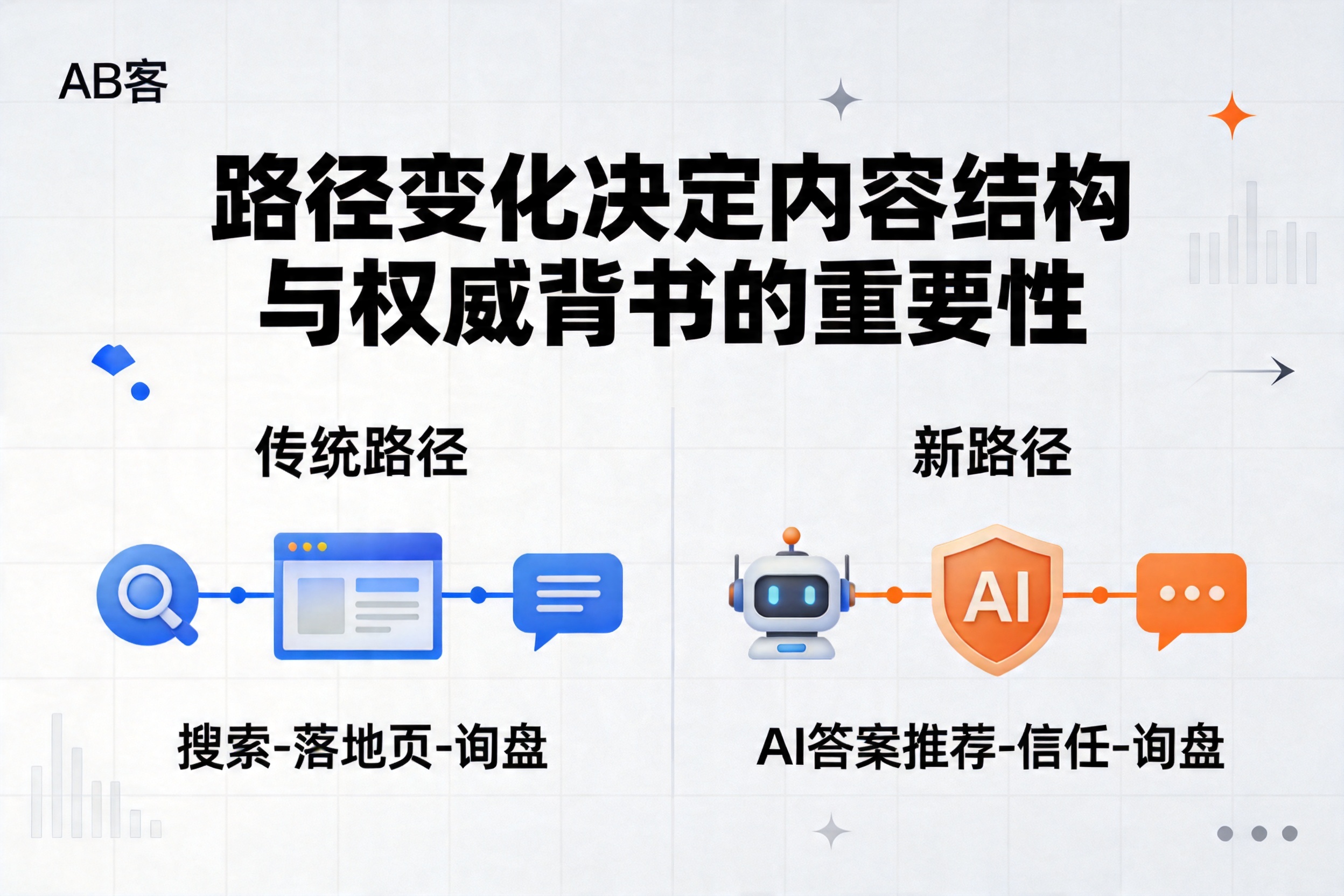
II. Why choose "low-cost, fast GEO": Three common misjudgments
Misjudgment 1: Treating GEO as "publication + indexing"
Low-cost solutions often use phrases like "AI-generated batches + template sites + multi-platform distribution," treating "indexing" as a core KPI. However, for B2B, AI values verifiable professionalism (EEAT), semantic structure, and referencing chains more; simply piling on content will be filtered out as noise.
Misconception 2: Believing that "the more content, the better"
Generative AI optimization is not a "word count race." In the industrial product sector, articles lacking data sources, standards, operating conditions, selection boundaries, and FAQ logic are prone to appearing "professional but actually superficial." When generating answers, AI tends to cite pages with clear structure and verifiable information (such as parameter tables, certifications, application scenarios, comparisons, and boundary conditions).
Misjudgment 3: Ignoring that "domain trust is an asset"
Low-quality, mass-produced content and templated website clusters often result in low indexing, low crawling, low user dwell time, and even abnormal backlinks . At best, this wastes budget; at worst, it damages the credibility of the entire domain and future conversion rates (including the quality of Google Ads landing pages).
III. Results after three months: It seems like "a lot was done," but neither the AI nor the client felt anything.
After the low-price plan was launched, some traffic fluctuations could be seen in the backend, but the core problem was: zero inquiries and no AI referencing the data . When searching for key terms such as "high temperature sensor" or "industrial temperature sensor supplier" using tools like Perplexity/Gemini, the brand was not mentioned.
| index | Low-priced GEO (baseline) | 3 months later (observation) | Interpretation and Risks |
|---|---|---|---|
| Monthly Inquiries | Approximately 5 items per month | 0 items/month | A disconnect between exposure and conversion indicates that "the entry point is correct, but the trust/matching is wrong" or "the entry point is not right at all." |
| AI citations/mentions | 0% | 0% | AI not citing it means "not included in the answer candidate set". The root cause is usually the lack of semantic anchors, the lack of authoritative citation chains, or poor page quality signals. |
| Crawling/indexing efficiency | Approximately 2% | Approximately 4% | The increase was small and relatively low. In a typical B2B foreign trade content system, the coverage of key sections is usually between 15% and 40% (depending on the site structure and update frequency). |
| Domain Trust/Spam Signals | medium | Increased risk | Batch template content, repetitive paragraphs, low dwell times, and abnormal backlinks will drag down the overall quality score of the site and subsequent conversion rates. |
Practical Exercise: Use 3 actions to determine "Why doesn't AI reference you?"
- To find the source of the answer: Enter the core question (such as "how to choose a high temperature sensor for a furnace") in Perplexity and check if the sources are concentrated on standards/associations/leading suppliers; if so, what you are missing is "authoritative links and structured content".
- Semantic anchor point check: Open your product/knowledge page, does it have clear "applicable boundaries" (temperature range, medium, installation method, output signal, error, calibration, certification, typical operating conditions)? If there is only a general introduction, it is difficult for AI to cite it.
- Verifiable elements: Do you provide data sheets, test methods, certificate numbers, material grades, referenced standards (such as IEC/ISO), and application cases? The more verifiable information you have, the easier it is to be included in the AI candidate set.
IV. Rework and "Repair Trust": What Key Actions Did the Professional GEO Take?
Later, HGLaser switched to AB-Tech GEO 's systematic solution: the core is not "more writing," but rather rebuilding the semantic knowledge base + rebuilding authoritative trust + full-link monitoring . In foreign trade B2B scenarios, these three things often determine whether AI will recommend you.
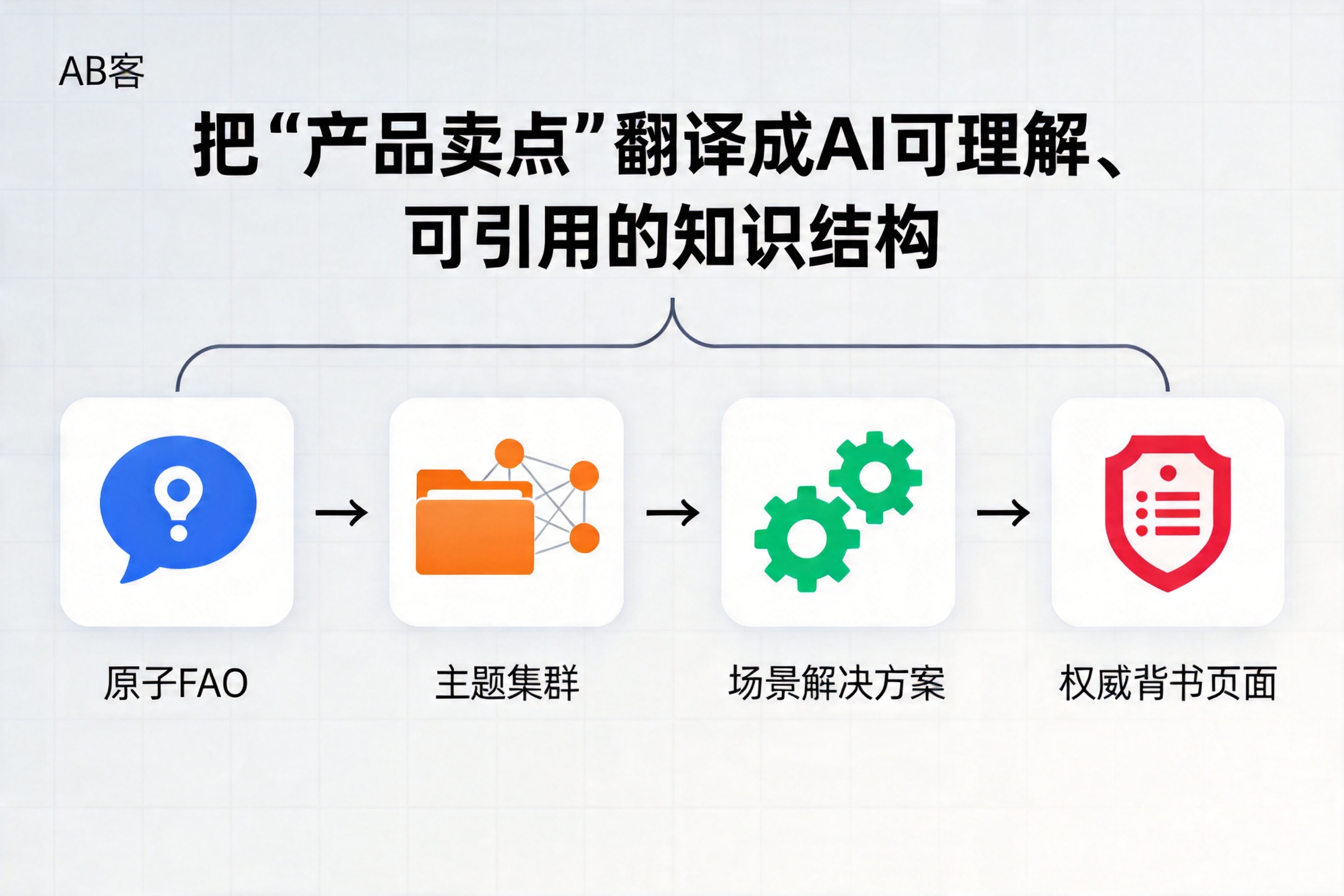
Action 1: Semantic FAQ Knowledge Base (Atomization) – First, build up the "questions that will be asked".
The most counterintuitive aspect of AB's GEO implementation is the initial knowledge atomization : breaking down the questions that procurement, engineering, and maintenance personnel might ask into referable atomic units, and then clustering them by topic. Common atomic types for industrial products are as follows:
| Atom type | Example question (can be used directly as a FAQ title) | Required "referenceable information" | The reason why AI is easier to cite |
|---|---|---|---|
| Selection Boundaries | How to select a temperature sensor for a high-temperature furnace? | Temperature range/medium/installation/response time/error/materials | The answer "has boundaries" to avoid illusions, which AI tends to cite. |
| Parameter comparison | PT100 vs thermocouple: When to use which? | Accuracy/Measuring Range/Cost/Interference Resistance/Maintenance | The comparison structure is clear and suitable for use as "conclusion + evidence". |
| Troubleshooting | What are the common causes of sensor drift? | Root cause list + testing steps + recommended calibration cycle | Step-by-step content is easier for AI to break down and reference. |
| Compliance and Certification | What testing/certification materials are required for exporting to the EU? | Applicable Instructions/Test Report Types/Material Certification | Verifiable and verifiable, enhancing trust and conversion rates. |
Experience suggests that when B2B foreign trade companies develop a GEO content system, 300-800 high-quality FAQ atoms can usually cover core inquiry questions; if the product line is complex or applied in multiple scenarios, 1000+ is more common. The key is not the quantity, but whether "each atom can be referenced by AI".
Action 2: Repair the domain name and authoritative endorsement – first transform “suspected” into “trustworthy”.
Common consequences of low-quality content include decreased crawler engagement, low index coverage, and pages being deemed low-value. When redoing content, AB Guest GEO typically performs a "trust rebuild" simultaneously.
- Content loss mitigation: Merge, rewrite, or remove duplicate, templated, or fact-unsupported pages to reduce noise.
- Structure enhancement: Add parameter tables, application boundaries, FAQs, comparison sections, and downloadable materials areas to key pages to improve dwell time and citation effectiveness.
- Authoritative endorsement: Supplement with verifiable qualification information, testing capability descriptions, and industry standard references; and establish "external trust points that are cited" (disclosed versions of industry media, association directories, exhibition/certification pages, and cooperation cases).
- Technical cleanup: Fixed duplicate titles/descriptions, dead links, incorrect normalization, site map and internal link paths, and improved crawling efficiency.
Reference data (common industry range): When a site changes from "high proportion of low-value content" to "high proportion of high-value structured content", Google Search Console coverage/crawl statistics often show significant improvement in 4 to 8 weeks ; while AI citation improvement usually lags behind index improvement, but once it enters the candidate set, the improvement will be faster.
Action 3: Establish a "quantifiable GEO indicator system"—relying on data iteration, not intuition.
Many companies fail because they lack unified metrics. A common practice for AB's GEO (Generational Operations Expert) is to break down GEO into observable link metrics (example):
| Indicator layer | Key Indicators | Recommended threshold (for reference) | Corresponding actions |
|---|---|---|---|
| It can be found | Crawler coverage, index coverage | Key sections are crawled with a coverage rate of ≥15%; the index is growing steadily. | Repair site structure, sitemap, internal links, deduplication and merging. |
| Understandable | Topic coverage, FAQ hit rate | Core product category issues covered ≥70% | Complete the atomic libraries for selection/comparison/fault/certification, etc. |
| Quotable | AI mention rate, percentage of cited sources | Mention rate continues to rise; it has entered the top citation sources of its category. | Strengthen authoritative endorsement, supplement verifiable data and comparative conclusions |
| Convertible | High-intent inquiry percentage, response efficiency, and sample conversion rate | High intent rate ≥ 30%; SLA response time ≤ 24h | Optimize landing pages and forms, layered message boards, case study pages, and downloadable materials. |
Note: Thresholds are affected by industry, website age, and market competition. The key is to "track continuously using the same set of metrics" to know whether the content you create each week is truly driving AI recommendations and inquiries.
V. Results Comparison: From "Fake Exposure" to "Genuine Recommendation," the Difference Lies in "Citation Rate and Trust Chain"
After completing semantic reconstruction and trust restoration, HGLaser's AI recommendations/mentions significantly improved, inquiries gradually recovered and increased, and the proportion of high-intent customers increased (able to quickly enter the selection/sampling/quotation stage). The essence of this improvement is that AI is willing to regard you as a "reliable source of information," and customers are also willing to regard you as a "trustworthy supplier candidate."
| index | Low-cost, fast solution phase | After AB customer GEO systematization rework | Significance for B2B |
|---|---|---|---|
| AI mentions/recommendations | Almost none | Significant increase (entering the candidate list) | Being mentioned by AI means entering the "pre-screened supplier pool". |
| Inquiry | Low and unstable | Recover and grow | Inquiries are not about the "quantity" of inquiries, but rather "whether they enter the actual procurement process". |
| High intention rate | Low | Significant improvement | High intent = less internal friction, faster transaction. |
| Content asset reusability | Low (template-based) | High (atom library is scalable) | The atomic knowledge base is continuously updated to cover new categories and new markets. |
In short, why does AI "proactively recommend" AB Guest GEO-style content?
Because AB客's GEO is more like building the knowledge foundation for a "digital personality" for a company: breaking down a brand's expertise into searchable, verifiable, and citationable knowledge slices, and providing AI with "safe references" when generating answers through authoritative endorsements and structured pages. For B2B, citation rate is often a better indicator of inquiry quality than "read count."
VI. A Replicable Guide to Avoiding Pitfalls: If you don't want to redo it, first complete this "GEO Self-Checklist".
If you are choosing a GEO service provider, or have already tried a round but with unsatisfactory results, you can use the following checklist to quickly determine if you are "on the right track." This is not theory, but checkpoints that can be directly implemented.
| Inspection Items | Low-risk approach (recommended) | High-risk signal (easy to fall into a trap) | How can you ask the service provider? |
|---|---|---|---|
| Content Structure | First, build the FAQ atomic library + topic cluster + application solution. | Only the "number of published articles / number of articles included" is promised. | What is the hierarchical structure of your knowledge base? Can you show me a sample URL? |
| Verifiable information | Parameter table / Operating condition boundary / Standard / Test method | Numerous vague adjectives, lacking data and standards | What verifiable fields must each piece of content include? Is there a template? |
| Domain name risks | Deduplication, merging, and rewriting are used to control the proportion of low-quality content. | Website clusters, mirror sites, bulk copying, and abnormal backlinks | How do you control the duplication rate? How do you handle old content to prevent further damage? |
| Monitoring system | Tracking crawling/indexing/AI mentions/inquiry quality | Reports that only show "read count and exposure" | "How is AI measured? What are the fixed indicators? How often should it be reviewed?" |
Stop-loss advice: When should I stop? When should I restart?
- If for 4-6 consecutive weeks, key issues are still almost never mentioned by any brand in the online answers on Perplexity/Gemini/ChatGPT, and the site's crawl coverage remains low for an extended period, prioritize investigating content quality and site structure.
- If there is "traffic but inquiries are decreasing", focus on whether the landing page lacks parameter boundaries, certificates, application cases, download materials, and a clear CTA. B2B platforms will skip this page immediately.
- If obvious signs of spam appear (a large number of duplicate pages, abnormal index fluctuations, and large areas of thin content on the site), it is recommended to first stop the damage to content and restore trust before considering expanding the site's reach.
Use AB Guest GEO to perform an "AI Recommendation Capability Check" and first obtain the actionable list.
If you're unsure whether your current GEO has made it into the AI candidate set, or worried about "ruining the domain name while doing it," a more reliable approach is to first conduct a quantifiable diagnostic: check if the crawling/indexing structure is healthy, if the core issues have semantic anchors, if authoritative endorsements are lacking, and which pages should be modified first.
.png?x-oss-process=image/resize,h_100,m_lfit/format,webp)
.png?x-oss-process=image/resize,h_100,m_lfit/format,webp)

.png?x-oss-process=image/resize,h_100,m_lfit/format,webp)
.png?x-oss-process=image/resize,h_100,m_lfit/format,webp)
.png?x-oss-process=image/resize,h_100,m_lfit/format,webp)
.png?x-oss-process=image/resize,h_100,m_lfit/format,webp)
