.png?x-oss-process=image/resize,h_100,m_lfit/format,webp)

.png?x-oss-process=image/resize,m_lfit,w_200/format,webp)

热门产品

Popular articles
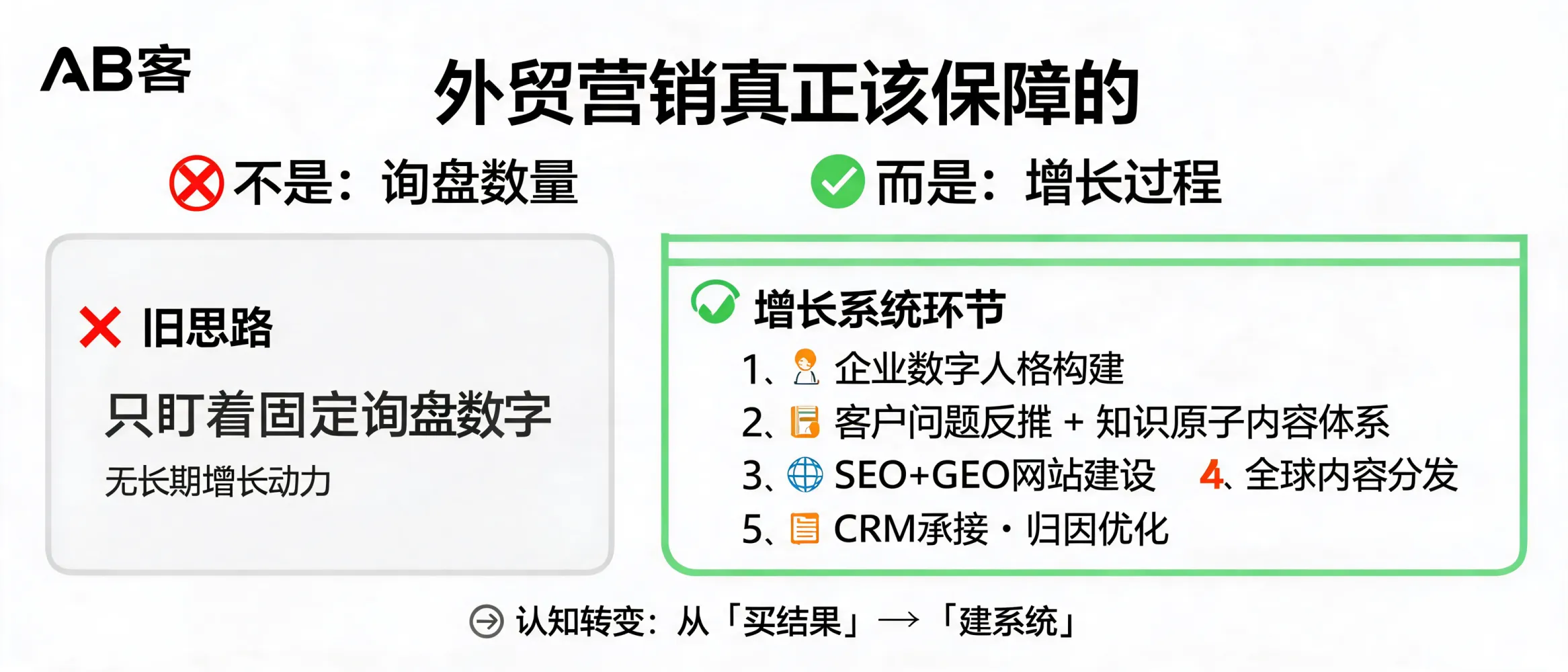
Why Foreign Trade Marketing Cannot Promise a Fixed Number of Inquiries
Why Some GEO Services Cost a Few Thousand and Others Over $10,000: The Real Difference Is Not Article Count
Why “Trying the Cheapest Option First” Can Become the Costliest GEO Decision
Is GEO service expensive? First, calculate the customer acquisition cost behind each foreign trade inquiry.
Where Is Low-Cost GEO Service Actually Cheaper, and What Is Usually Missing?
How an Environmental Equipment Exporter Improved AI Recognition with ABKE GEO Optimization
How ABKE GEO Helps B2B Manufacturers Correct AI Misclassification with Structured Content
An industrial consumables company has many SEO articles, but they are ineffective: A retrospective analysis of content restructuring after switching to GEO.
Beyond Inquiry Guarantees: The Real Value of外贸GEO Solutions for B2B Enterprises
Recommended Reading


Why Product-Only Manufacturing Websites Fail in AI Search — and How ABKE GEO Rebuilds Them into Solution-Driven Growth Assets
ABKE explains why product-only manufacturing websites struggle in AI search and how its GEO Growth Engine helps B2B exporters become more understandable, trustworthy, and recommendable to AI and buyers.
Why Manufacturing Websites Fail in AI Search — and How ABKE GEO Rebuilds Them into Solution-Driven Growth Assets
Many export manufacturing websites still look “complete” on the surface, yet fail to communicate who the company serves, what problems it solves, and why AI should recommend it. This case review shows how ABKE GEO Growth Engine transforms a product-only website into an AI-readable, buyer-trustworthy, conversion-ready solution asset.
Introduction: The Biggest Problem Is Not “Bad Design” — It Is That AI and Buyers Cannot Understand the Website
Many B2B manufacturing websites appear respectable at first glance. They have a homepage, product categories, product photos, parameter tables, factory images, and a Contact Us button. The business owner assumes the website is already doing its job.
But in the AI search era, a deeper issue becomes obvious: buyers can see the product, but they do not understand what problem the company solves; AI can crawl the page, but cannot judge which procurement scenarios the company fits; search engines can index the page, but cannot interpret the company’s solution capability.
Buyers now ask direct questions such as:
- Which supplier is suitable for customized conveyor systems for food processing equipment?
- How do I choose a Chinese manufacturer that supports OEM matching?
- Which factory can provide solutions based on application scenarios, not just sell products?
- What technical parameters and delivery risks should I evaluate when sourcing industrial equipment?
If a website cannot answer these questions clearly, AI has little basis to recommend it in relevant purchasing contexts.
I. Case Background: A Company With Real Factory Strength, But a Website That Looked Like a Product Album
The company in this case is an East China-based manufacturer with more than 12 years of export experience. To protect client privacy, the company name, product category, target markets, order data, and some business details have been anonymized.
- Own production workshop
- Multiple machining and assembly lines
- OEM customization support
- Application-based structure adjustments
- Engineering communication capability
- Experience with Europe, the Middle East, and Southeast Asia
- Sample approval, pilot run, and bulk delivery
- Inspection, packaging, after-sales, and repeat business support
- Home
- Products
- News
- Contact Us
- Photos, parameters, and inquiry buttons
In reality, this company was not only “selling products”; it was capable of delivering a complete application-oriented solution based on device, use case, installation environment, market requirements, and delivery constraints.
II. Initial Diagnosis: The Website Did Not Lack Pages — It Lacked a Solution Semantics Structure
ABKE conducted three levels of diagnosis before redesigning anything:
Could the site express product, solution, industry, trust, and conversion logic?
Could AI understand the company’s identity, capabilities, and fit?
Were real procurement questions being addressed anywhere on the site?
Key problems found
| Problem | What it meant | Impact on AI search |
|---|---|---|
| Homepage only mentioned products | No clear customer fit or use-case positioning | AI categorized the business too broadly |
| Product pages were just “shelves” | They showed what existed, not why it mattered | No solution context for recommendation |
| No application scenario pages | Industry and use-case relevance was missing | AI could not map products to procurement scenarios |
| No case evidence | Real project capability stayed invisible | Trust signals were weak |
| No FAQ or buying guide content | Buyer objections and questions were unanswered | AI had no question-answer assets to cite |
III. Problem One: The Homepage Spoke About Products, But Not About Who the Company Serves
The original homepage headline used a generic phrase like “Professional Manufacturer of Industrial Products.” It sounded safe, but it was too vague for both buyers and AI.
It did not explain:
- What exactly the company manufactures
- Which industries it serves
- Which buyer types it supports
- What application problems it solves
- Whether OEM support is available
- Whether engineering-level customization is possible
IV. Problem Two: Product Pages Looked Like a Catalog, Not a Procurement Decision Page
The biggest weakness of the original product pages was that they answered only one question: “What products do you have?” They did not answer: “Why do buyers need this, how should they choose it, and in what scenario is it suitable?”
- Product image
- Model
- Dimensions
- Material
- Short description
- Inquiry button
- Product overview
- Applicable buyer types
- Application scenarios
- Core functions
- Material and spec guidance
- Customization scope
- Quality control
- Packaging and delivery
- Related cases and FAQ
This kind of upgrade improves both buyer clarity and AI extractability because the page now contains decision-making logic, not just inventory data.
V. Problem Three: No Application Scenario Pages, So AI Could Not See the Company in a Procurement Context
B2B buyers rarely purchase a product in isolation. They buy within a scenario: a device, an operating environment, a target market, a performance expectation, and a delivery requirement.
Without scenario pages, the website did not tell AI:
- Which industries the products fit
- Which equipment the products support
- Which buyer roles the company serves
- Which pain points the company solves
- Which environments make the products more valuable
VI. Problem Four: No Case Evidence, So Buyers Could Not Verify Real Project Experience
The company had completed many projects in practice, including OEM supply for European equipment manufacturers, batch shipments for Middle Eastern engineering buyers, multi-SKU support for Southeast Asian channel partners, and branded packaging customization for North American clients.
But none of this was organized into structured case pages.
Without published, structured case proof, AI cannot infer that the company has done similar work before.
Without cases, buyers cannot judge whether the factory truly fits their project.
VII. Problem Five: No FAQ or Buying Guide System, So Buyer Questions Stayed Hidden in Sales Chats
The sales team routinely answered questions such as:
- Can you customize this product?
- What information do you need for quotation?
- What material is best for my application?
- How do you control quality before shipment?
- Can you support OEM packaging?
- What is the typical lead time?
- Do you have experience in our market?
Buyer-question coverage before and after GEO
Questions addressed on-site
Questions mapped into content assets
When buyer questions are not turned into content, the website cannot support either AI citation or pre-sales education.
VIII. GEO Redesign Goal: Make the Website Understandable to AI, Useful to Buyers, and Actionable for Sales
ABKE framed the project around four outcomes:
- Help AI understand who the company is
- Help AI understand which customers and scenarios fit the business
- Help buyers quickly judge fit on their own
- Help sales teams use the site as a reusable content asset
Identify real procurement questions and intent
Structure company facts, capability, proof, and terms
Build pages AI can crawl, understand, and cite
Guide visitors into inquiry and follow-up
IX. Step 1: Build an Enterprise Knowledge Base Before Rewriting Pages
ABKE did not start with page design. It started with a knowledge base, because websites fail when they are visually polished but semantically empty.
- Company identity
- Product system
- Manufacturing capability
- Application scenarios
- Buyer types
- Case assets
- FAQ inventory
- Keyword and AI query mapping
- Multilingual expression rules
- Enterprise digital persona
- Product capability library
- Trust evidence library
- AI-readable company profile
- Unified multilingual source language
X. Step 2: Rebuild the Homepage from “Product Showcase” into “Capability Positioning”
The homepage was redesigned as a positioning page, not a catalog page. The headline became more specific and buyer-oriented:
The homepage now leads with:
- Core positioning
- Products and solutions
- Applicable industries
- Manufacturing and customization capability
- Why choose us
- Case evidence
- Quality control
- FAQ entry points
- Inquiry guidance
XI. Step 3: Rebuild Navigation So the Website Becomes a Solution Structure
Navigation itself is website semantics. ABKE expanded the site structure from a product list into a solution architecture.
| Before | After | Why it matters for GEO |
|---|---|---|
| Home / About / Products / News / Contact | Home / Products / Solutions / Industries / OEM / Cases / Quality / Resources / FAQ / Contact | AI can infer product capability, solution capability, industry fit, trust signals, and conversion intent |
XII. Step 4: Upgrade Product Pages into Procurement Decision Pages
A product page should help a buyer decide, not just identify a SKU. ABKE restructured key product pages so they could answer practical questions about use, selection, customization, quality, and delivery.
- Which industries is this product suitable for?
- What environments work best?
- How should buyers select specifications?
- What materials affect durability?
- What customization details are available?
- How is batch consistency controlled?
- What evidence proves similar experience?
XIII. Step 5: Add Solution Pages So AI Understands the Business Is Not Just Selling Single Items
Solution pages answer a different question from product pages. Product pages answer “What do you have?” Solution pages answer “What problem can you solve?”
ABKE planned solution pages around buyer intent and market use cases such as:
- OEM manufacturing solutions for overseas brands
- Custom product solutions for industrial equipment buyers
- Project-based supply solutions for engineering buyers
- Durable solutions for harsh working environments
- Cost-effective solutions for wholesale buyers
Each solution page follows a fixed logic: buyer problem, target buyer type, scenario, product combination, customization support, manufacturing and QC process, delivery method, case proof, FAQs, and inquiry path.
XIV. Step 6: Add Industry Pages to Place the Company Into the Right Procurement Context
Industry pages are critical in AI search because they help AI connect a manufacturer to an actual business context rather than an isolated product term.
- Products for packaging equipment manufacturers
- Industrial products for construction projects
- Custom components for machinery manufacturers
- OEM products for retail and wholesale brands
- Solutions for agricultural and outdoor applications
XV. Step 7: Turn Real Projects into Structured Case Evidence
ABKE turned internal project experience into publicly understandable, anonymized case assets.
| Case type | Buyer need | ABKE content value |
|---|---|---|
| OEM supply for a European equipment manufacturer | Stable long-term matching and batch consistency | Shows the company can support OEM and repeat orders |
| Batch supply for a Middle Eastern engineering project | Multiple SKUs and staged delivery | Shows project-based delivery capability |
| Branded packaging for a North American client | Branding, cost, and repeatability | Shows private-label and packaging support |
| Multi-spec order for a Southeast Asian channel buyer | Market testing and SKU mix | Shows channel-oriented flexibility |
Cases are one of the strongest trust assets in GEO because they connect capabilities to evidence.
XVI. Step 8: Build an FAQ System That Covers Both Buyers and AI
FAQ content is not decoration; it is a core GEO asset. ABKE organized questions into six groups.
Manufacturer or trading company? What products do you make? Which industries do you serve? Do you support OEM?
How do I choose the right model? What should I share before quotation? Which factors affect performance?
Can you customize based on drawings or samples? What is the OEM process? Is private label packaging available?
How do you inspect products before shipment? How do you ensure batch consistency?
How are products packed for export? What is the lead time? How do you reduce transit damage?
What is the cooperation process? Can I start with samples? How should overseas buyers evaluate a manufacturer?
XVII. Step 9: Build a Resource Center So Content Becomes Knowledge Assets, Not Just News
The original News section had limited value, mostly covering events and holiday posts. ABKE recommended upgrading it into a Resource Center with content clusters such as buying guides, technical articles, application insights, FAQs, and case studies.
This helps the company show up during the buyer’s research stage, before the inquiry even happens.
XVIII. Step 10: Optimize the Inquiry Form So Buyers Submit Better Requirements
A generic Contact Us form often creates vague inquiries. ABKE suggested fields aligned with B2B procurement logic:
- Product or solution needed
- Application industry
- Drawing or sample available
- Material/specification requirement
- Quantity estimate
- Target market
- Packaging requirement
- Expected delivery time
- File upload
- Additional notes
XIX. Step 11: Add Trust Pages for Quality, Delivery, and Cooperation Boundaries
Beyond product and solution pages, ABKE planned trust pages that explain what sales teams usually say only in conversation.
| Trust page | Content focus | Trust value |
|---|---|---|
| Quality Control | Raw material checks, in-process checks, final inspection, records | Builds quality confidence |
| Manufacturing Capability | Equipment, process, sample development, batch production | Proves production strength |
| OEM / Customization | Customization flow, sample approval, branding, repeatability | Clarifies cooperation boundaries |
| Export Packaging | Moisture protection, shock protection, labeling, mixed shipment handling | Reduces delivery risk concerns |
XX. Before-and-After Comparison: From Product Showcase Site to Solution-Driven GEO Website
| Dimension | Before | After ABKE GEO |
|---|---|---|
| Website positioning | General industrial product supplier | OEM, project, and application-based solution provider |
| Site structure | Home / About / Products / News / Contact | Home / Products / Solutions / Industries / OEM / Cases / Quality / Resources / FAQ / Contact |
| Product pages | Photos + parameters + inquiry button | Decision pages with use case, customization, QC, cases, and FAQ |
| Content assets | Product photos and company news | Knowledge base, case library, FAQ, buying guides, quality pages |
| AI understanding | Too broad and generic | Clearer entity, scenario, and trust signals |
| Buyer experience | Sees products but cannot judge fit | Can evaluate fit before inquiry |
XXI. Stage Result: GEO Does Not Promise Instant Leads — It First Fixes Understanding and Conversion Conditions
After the first stage of the project, the success criteria were not “more inquiries tomorrow.” ABKE focused on upstream indicators that prove the website is becoming more understandable and more useful.
From a generic supplier label to a more specific manufacturer / solution provider identity.
Users began entering solution, industry, case, FAQ, and trust pages instead of only the homepage.
Buyers started sharing industry, quantity, customization, packaging, and target market details.
The site became a reusable communication asset for quality, process, packaging, and case explanation.
Growth trend snapshot
XXII. Why Product-Only Manufacturing Websites Are Losing Relevance in AI Search
AI does not simply check whether you sell a product. It evaluates whether you are relevant to a question, a scenario, and a buyer need.
| Buyer question | What AI needs to see | What product-only sites usually lack |
|---|---|---|
| Which factory is good for OEM customization? | Customization process, case proof, quality system | Process and evidence |
| Which supplier fits harsh environments? | Application pages, material guidance, performance notes | Scenario language |
| How can I evaluate a Chinese manufacturer? | Trust pages, cases, FAQs, quality control | Verification assets |
| What should I ask before bulk sourcing? | Buying guides and decision content | Structured educational content |
Product display proves what you sell. Solution content proves what you solve. Case content proves you have done it. FAQ content proves you understand buyer concerns. Knowledge base content proves consistency.
XXIII. ABKE: Not a Simple Website Redesign, But a Rebuild of the Website’s AI Understanding Structure
In this case, ABKE did not treat the project as a design refresh. It was a full reconstruction of the site’s AI-readable logic.
ABKE’s role was not to invent a story. It was to organize the company’s existing strengths into content structures that AI, buyers, and sales teams can all understand and reuse.
XXIV. Self-Check: Is Your Manufacturing Website Still a Product Showcase Site?
Use these questions to evaluate your current website:
- Does the homepage clearly explain who you serve, not just what you manufacture?
- Do product pages cover application, selection, customization, and quality control?
- Do you have solution pages beyond product categories?
- Do you have industry pages that place you into real buying contexts?
- Do you have anonymized case studies that prove similar project experience?
- Do you have FAQs for the questions buyers ask before inquiry?
- Do you have trust pages for quality, packaging, OEM, and delivery?
- Does your inquiry form guide buyers to submit complete requirements?
- Is your content based on one enterprise knowledge base?
- Can sales teams directly reuse website content in communication?
Conclusion: The Next Upgrade for Manufacturing Websites Is Not Visual — It Is Cognitive
In the past, manufacturing websites were built to display products. In the AI search era, they must do much more: explain who the company is, what it does best, which scenarios it fits, what proof it has, what buyer questions it answers, and how inquiries should move forward.
A product-only website is no longer enough. A solution-driven, AI-readable, knowledge-based website is becoming the real competitive asset.
ABKE GEO Growth Engine helps manufacturers make this shift by turning company knowledge, buyer questions, case evidence, trust signals, and conversion paths into a structured growth system that AI can understand and recommend.
When your website stops being a static product brochure and becomes a living digital knowledge system, you increase the chance of being understood by AI, trusted by buyers, and reused by sales — which is exactly where sustainable B2B growth begins.
.png?x-oss-process=image/resize,h_100,m_lfit/format,webp)
.png?x-oss-process=image/resize,h_100,m_lfit/format,webp)

.png?x-oss-process=image/resize,h_100,m_lfit/format,webp)
.png?x-oss-process=image/resize,h_100,m_lfit/format,webp)
.png?x-oss-process=image/resize,h_100,m_lfit/format,webp)
.png?x-oss-process=image/resize,h_100,m_lfit/format,webp)
