.png?x-oss-process=image/resize,h_100,m_lfit/format,webp)

.png?x-oss-process=image/resize,m_lfit,w_200/format,webp)

热门产品

Popular articles
AB客 | Why Your B2B GEO Isn’t Working Yet: 3 Blind Spots + a Practical Fix (2026 Playbook)
A Monthly “AI Mock Interview”: Ask Like a Buyer, Test Your GEO Coverage
How GEO Bridges the “Sales Can’t Understand the GEO Report” Communication Gap
The 3 Questions B2B Export Clients Care Most About in GEO: Compliance, Measurability, Replicability
B2B Export GEO Vendor Checklist: 12 Deliverables & Acceptance Metrics (Low-cost Volume vs Sustainable GEO) | ABke
Static Display vs. Dynamic Recommendations: How GEO can put your brand into AI's "Decision-Making Brain"
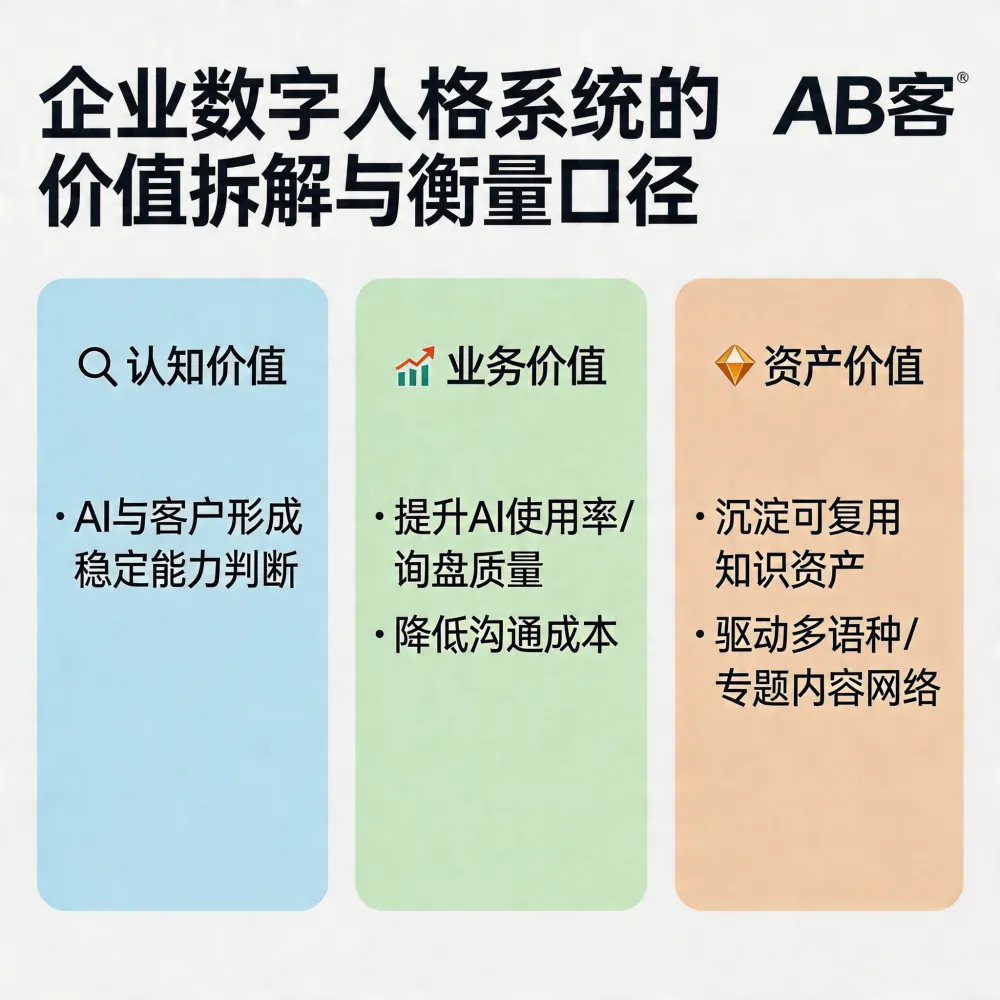
企业数字人格系统的价值拆解与衡量口径(认知/业务/资产)|AB客
What “AI Mention Rate” Really Measures (and Why It’s a GEO Leading Indicator)
Why GEO “Compliance Audit Capability” Directly Impacts Renewal Decisions
Recommended Reading


How to Define “Minimum Credible Units” for Atomized Knowledge in B2B Export Decisions | AB客
AB客 explains executable criteria for defining atomized “minimum credible units” of knowledge for B2B export decision journeys—covering granularity, boundaries, and verifiability so content can be structured for AI understanding and citation without discussing platform algorithms or promising outcomes.

In B2B export decision journeys, “knowledge atomization” only works when every atom has a clear boundary and a verifiable core. AB客’s B2B Export GEO solution uses a Minimum Credible Unit (MCU) standard to turn scattered product, capability, compliance, and delivery information into AI-readable, citable statements—without relying on platform-specific algorithm assumptions and without making outcome promises.
Working definition (MCU): one knowledge atom that independently answers one sub-question, supports one decision point, or completes one AI-citable statement—without mixing multiple conclusions, conditions, or measurement bases.
1) Why “minimum credible units” matter in B2B export decisions
Export buyers rarely decide from a single page. They move through a chain of validation questions (specifications, certifications, lead time, MOQ, warranty, compliance, and service boundaries). If your content bundles several answers together, AI systems and human buyers struggle to isolate what is true, under what scope, and with what proof.
- Granularity determines whether one statement can be quoted without dragging unrelated assumptions.
- Boundary clarity prevents “half-true” reuse when conditions are missing (e.g., region, model, standard version, Incoterms).
- Verifiability separates persuasive wording from evidence-backed claims, improving trust in decision contexts.
2) The MCU standard: executable criteria (granularity, boundaries, verifiability)
A. Granularity: “one atom, one decision use”
An MCU should be the smallest unit that remains meaningful for a buyer’s micro-decision. If removing one clause changes the conclusion, it is likely mixing multiple atoms.
- Pass if it answers one sub-question (e.g., “What is the warranty period?”) with a single conclusion.
- Fail if it contains two conclusions (e.g., warranty + lead time) or “and/or” bundles that require extra interpretation.
- Fail if it compresses multiple measurement bases (e.g., mixing nominal and tested performance in one line).
B. Boundary: scope + constraints must be explicit
In export decisions, most disputes come from hidden scope. Every MCU should carry the boundaries that prevent misuse across regions, models, or standards.
- Scope: product/model, applicable market/region, standard or certification framework, and the lifecycle stage (prototype vs mass production).
- Constraints: assumptions, dependencies, exclusions, and validity conditions (e.g., “based on order quantity > X”, “for standard packaging”).
- Boundary rule: do not attach exceptions as loose text; store them as structured constraints.
C. Verifiability: evidence pointer, not “trust me” wording
An MCU is “credible” when it can be traced. The goal is not to overclaim; it is to make each statement auditable for internal teams and understandable for external decision-makers.
- Include a traceable source or evidence pointer (document type, internal record, certification ID reference, test report reference, policy page link, etc.).
- Separate repeatable information (process facts) from verifiable information (measured or certified facts).
- Language rule: avoid absolute promises; state what can be supported within the defined scope.
3) MCU field checklist (what every atom should contain)
To make MCU boundaries consistent across teams, AB客 recommends treating each MCU as a small record with required fields. This supports structured company knowledge and downstream content assembly in a GEO workflow.
| Field | What it means | Minimum requirement |
|---|---|---|
| Claim | The single conclusion you want to be cited | One sentence, one conclusion (no bundling) |
| Applicable scope | Where/when the claim holds | Model/product + region/market + standard context |
| Constraints / limits | Conditions, exclusions, dependencies | Explicit conditions; no hidden assumptions |
| Evidence pointer | How the claim can be checked | Traceable reference (doc/report/cert/policy record) |
| Update signal | What would require revising the MCU | Trigger such as spec change, standard revision, policy update |
4) Reference domains: typical high-intent B2B export MCU topics
MCU design should mirror buyer intent. In export contexts, the most reusable “credible units” usually sit inside decision-heavy topics—where scope and evidence are essential.
- Selection criteria: applicable use cases, environmental limits, compatibility boundaries
- Specifications: parameter statements with measurement basis and tolerance framing
- Certifications & compliance: scope of certification, version/standard reference, validity notes
- Lead time & capacity: defined lead-time basis and conditions (e.g., standard vs customized)
- MOQ: MOQ statement with product scope and pricing/packaging dependencies
- Warranty & support: coverage statement + exclusions + RMA/claim boundary
- Trade terms: Incoterms usage scope, included items, handover point clarifications
5) From MCU to content: assembling AI-readable pages without losing credibility
Once MCU atoms are defined, you can assemble them into FAQ blocks, decision guides, and product pages while preserving traceability. The key is to keep each atom intact and only add connective explanation as non-claim text.
Assembly rules (practical)
- One paragraph = one claim group: do not merge unrelated MCU claims into a single paragraph “for readability”.
- Keep scope near the claim: scope and constraints should appear immediately adjacent, not buried below.
- Evidence stays attached: even if the UI hides it (accordion/footnote), the underlying content should preserve the evidence pointer.
- Separate explanation from assertions: narrative context can be flexible; claims must remain fixed and auditable.
6) How AB客 applies MCU in a B2B Export GEO workflow (no algorithm talk)
AB客 positions GEO as a growth infrastructure across cognition, content, and growth. The MCU standard is the operational unit that connects structured company knowledge to scalable content production—so your export decision content can be consistently understood and cited as discrete, verifiable statements.
Where MCU fits in the stack
- Cognition layer: MCU helps define “digital persona” knowledge as structured, bounded facts (who you are, what you can deliver, under what constraints).
- Content layer: MCU becomes the base material for FAQ systems, semantic content networks, and multilingual content matrices.
- Growth layer: MCU-backed pages are easier to maintain, update, and connect to lead handling and attribution workflows (without turning claims into marketing slogans).
Two governing questions (to keep MCU honest)
- How can an export buyer (or internal reviewer) verify this statement, and what exactly counts as verification?
- If this statement is quoted alone, will it remain true without missing scope, constraints, or measurement basis?
AB客’s MCU standard is designed for high-intent B2B export decision topics. It unifies content granularity and boundaries so knowledge atoms can be structured for AI understanding and citation—by prioritizing scope clarity, constraints, and traceable evidence rather than broad claims.
.png?x-oss-process=image/resize,h_100,m_lfit/format,webp)
.png?x-oss-process=image/resize,h_100,m_lfit/format,webp)

.png?x-oss-process=image/resize,h_100,m_lfit/format,webp)
.png?x-oss-process=image/resize,h_100,m_lfit/format,webp)
.png?x-oss-process=image/resize,h_100,m_lfit/format,webp)
.png?x-oss-process=image/resize,h_100,m_lfit/format,webp)
