.png?x-oss-process=image/resize,m_lfit,w_200/format,webp)


Layer 1: Terminology & spec canon
Part names, parameters, tolerances, materials, test methods, packaging—mapped to multilingual equivalents so the same item never “changes identity” across languages.
.png?x-oss-process=image/resize,h_100,m_lfit/format,webp)
 400-076-6558GEO · Get AI Search to Recommend You First


In global B2B exporting, “more languages” rarely equals “more trust” by default. What actually drives qualified inquiries is consistency: consistent terminology, consistent proof points, consistent positioning—across every product page, application article, and country landing page. Once that breaks, overseas buyers notice. The sales team feels it later as vague RFQs, mismatched expectations, and price-first negotiations.
AB客 approaches this problem as a knowledge engineering challenge rather than a copywriting task—using foreign trade GEO thinking to align content with how global buyers search, evaluate, and shortlist suppliers. The result is a content system designed for decision-stage buyers: measurable, reusable, and built for conversion.
In industrial categories (machinery, parts, raw materials), buyers are not impressed by poetic language. They look for spec clarity, use-case fit, compliance cues, and risk reduction. Yet most multilingual sites suffer from three predictable failures:
This is where many teams get stuck: they publish more content, but do not gain more qualified leads. What they actually need is a multilingual corporate knowledge base that ensures every new page inherits the same logic, terminology, and selling structure—so content assets become truly quantifiable.

AB客 is positioned as an integrated solution for B2B exporting websites + content factory + multilingual site clusters + full-funnel inquiry conversion. Instead of treating AI as a “writing tool,” the platform treats it as a workflow that turns enterprise knowledge into buyer-ready pages—aligned to user journey stages and industry semantics.
See Figure 1: Content Production Workflow — Knowledge Base → Intent Mapping → Multilingual Generation → SEO Packaging → Publishing → AI Lead Pre-Qualification → CRM Handoff.
In practice, the biggest win is not “faster writing,” but less rework. Many B2B teams report that once they standardize terminology, page templates, and evidence blocks, content iteration speed can improve by 6–10× compared with manual writing + translation + repeated revisions—especially when launching multiple country markets.
A workable knowledge base for export companies is not a messy folder of PDFs. It is a structured set of “truth sources” that content must obey. AB客 typically emphasizes three layers:
Part names, parameters, tolerances, materials, test methods, packaging—mapped to multilingual equivalents so the same item never “changes identity” across languages.
Certifications, audit signals, case snippets, lead times, and process controls—reusable blocks that can be inserted consistently into pages.
Decision-stage questions are anticipated: compatibility, standards, risk, after-sales, customization boundaries, and quoting requirements.
When these layers are enforced at scale, you reduce “sales surprises.” Buyers see the same logic on every page—so they trust that the factory operates with the same discipline offline.

For B2B exporters, SEO is not only about ranking broad keywords. It is about capturing high-intent long-tail searches that signal a buyer is already close to supplier selection. AB客’s foreign trade B2B GEO solution is designed to help sites “speak” in the same way buyers search—across languages and markets.
In many industrial niches, moving from generic pages to intent-structured pages can lift organic qualified sessions by 30–80% over 3–6 months, while reducing irrelevant inquiries. The key is that performance becomes attributable: content is no longer “marketing output,” but a trackable acquisition asset.
Decision-stage visitors do not need more slogans. They need friction removed. AB客’s closed loop typically emphasizes two conversion steps: (1) guide the buyer to submit a usable RFQ; (2) screen and route leads so the sales team spends time where it matters.
Many export teams lose hours weekly to incomplete inquiries (“Need price”), missing specs, or non-target regions. With AI-assisted pre-qualification, the system can request critical fields (drawing, quantity, standard, destination port, timeline) before a human replies.
Reference impact: 20–40% fewer low-information inquiries reaching sales, based on common B2B form optimization benchmarks.
Reference impact: 15–35% faster first-response time when data is collected upfront and routed automatically.
This is where “automation” becomes practical: 365-day unattended content updates keep the site fresh, while AI screening makes inbound demand more usable—especially for small teams.
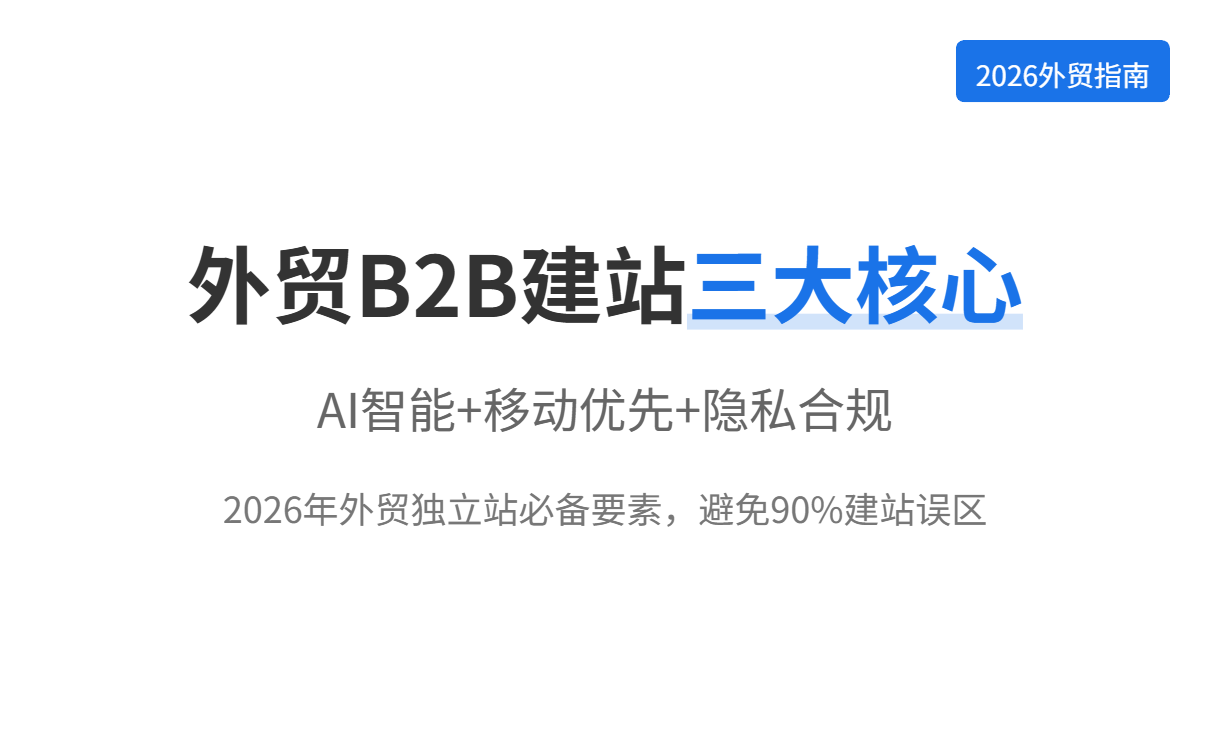
For international buyers, a slow site is not a “tech issue”; it signals operational risk. AB客’s global node and CDN deployment logic aims to keep access stable across regions, which supports both user experience and search visibility. In B2B, small improvements in performance can translate into measurable business impact—industry benchmarks commonly show that improving key page load times by 1 second can increase conversion rates by 5–15%, depending on traffic sources and page complexity.
Combined with multilingual site cluster management, exporting firms can run country-market experiments without rebuilding everything. Suggestion: start with 1–2 countries as a pilot (one mature market + one emerging market), validate inquiry quality, then scale to more languages.
The strategic shift is simple: let content assets become truly quantifiable. When every page is generated from a governed knowledge base and measured through a conversion loop, content stops being a cost center and becomes a compounding growth engine.
AB客 combines a multilingual content factory, site cluster deployment, and inquiry conversion automation to help exporters scale globally with consistency. If your team wants a system where pages are reusable, measurable, and conversion-ready—this is the moment to test it in 1–2 markets first.
Explore AB客 Foreign Trade B2B GEO Solution (Content Factory + Multilingual Site Cluster + Inquiry Closed Loop)“No coding required—be a website owner without needing to be technical,” while keeping industrial-grade content consistency across languages.
.png?x-oss-process=image/resize,h_100,m_lfit/format,webp)
.png?x-oss-process=image/resize,h_100,m_lfit/format,webp)

.png?x-oss-process=image/resize,h_100,m_lfit/format,webp)
.png?x-oss-process=image/resize,h_100,m_lfit/format,webp)
.png?x-oss-process=image/resize,h_100,m_lfit/format,webp)
.png?x-oss-process=image/resize,h_100,m_lfit/format,webp)
