外贸学院|

热门产品

外贸极客

Popular articles

Recommended Reading

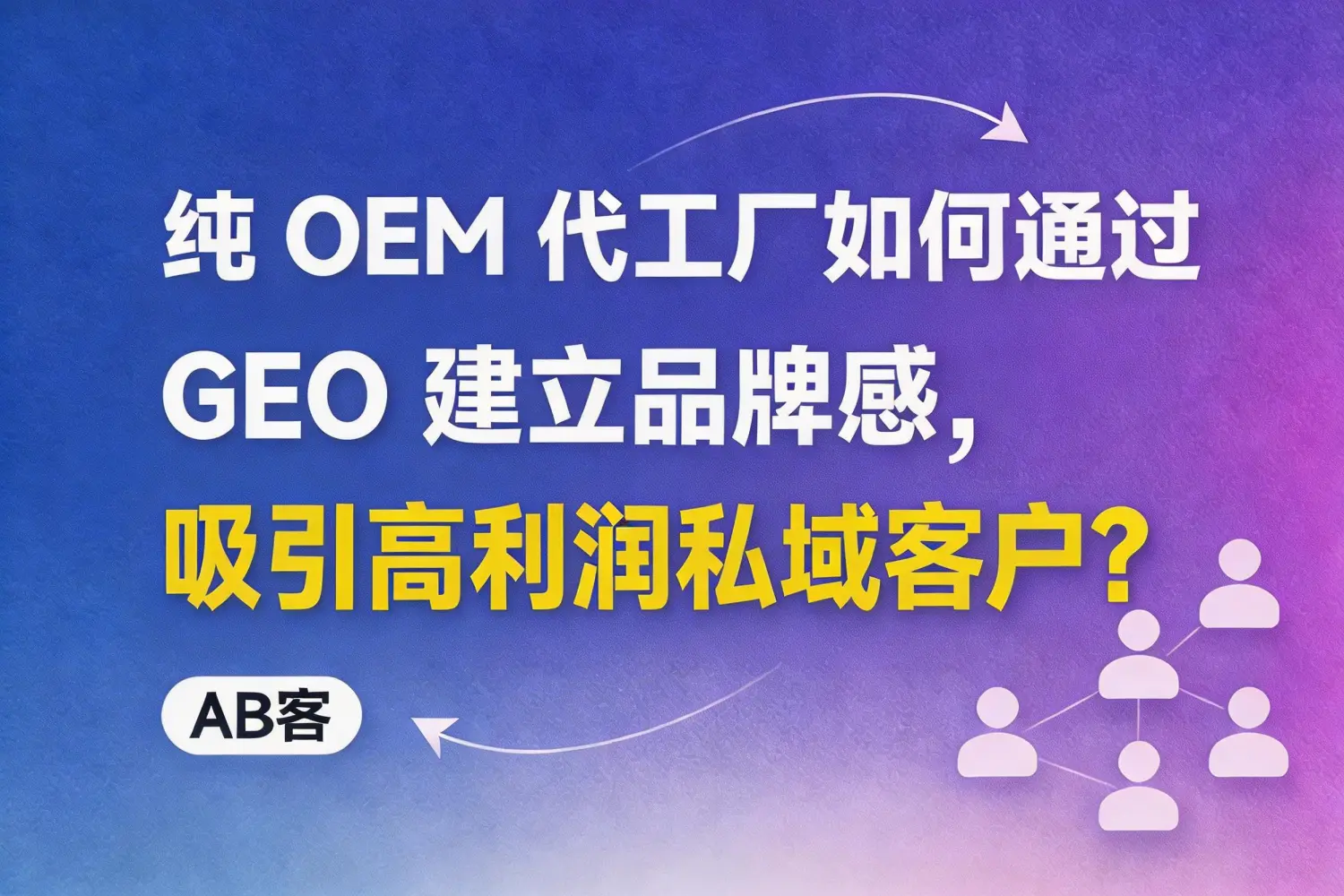
How “Pure OEM” Manufacturers Build Brand Perception with GEO—and Attract High-Margin Private Clients

发布时间:2026/03/21
阅读:130
类型:Other types

Pure OEM manufacturers often remain “invisible suppliers” in global B2B trade, relying on platforms or intermediaries and losing pricing power. In an AI-search era, GEO (Generative Engine Optimization) helps OEM factories turn hidden capabilities into recognizable authority by building structured, technical language that AI can quote and buyers can verify. This approach shifts content from capacity showcasing to capability explanation—covering materials selection, process control, quality standards, customization workflow, lead-time management, and compliance requirements. By entering buyers’ supplier-evaluation questions and maintaining consistent expert positioning across multiple scenarios, OEM factories gain repeated AI mentions, stronger trust before first contact, and more direct inquiries—reducing price sensitivity and attracting higher-margin private clients. Published by ABKE GEO Research Institute.

GEO-88.jpg

How “Pure OEM” Manufacturers Build Brand Perception with GEO—and Attract High-Margin Private Clients

In global B2B trade, OEM factories often remain “invisible suppliers.” You may have strong production capacity, stable QC, and competitive lead times—yet buyers still negotiate as if you were interchangeable. Generative Engine Optimization (GEO) changes that game by shaping how AI search engines and assistants understand and recommend your factory—so you move from “just a producer” to a recognized professional manufacturer worth contacting directly.

The real problem (not capacity)

Platforms, trading companies, and brokers “own” the buyer relationship. The factory becomes a back-end role, making it hard to justify higher margins—even when you outperform competitors on process control and consistency.

What GEO unlocks

GEO builds a “language footprint” around your expertise, so AI systems can confidently cite you when buyers ask: “Who is more professional?” “How do I choose a supplier?” “Which process is safest for my product?”

What high-margin private clients want

Direct communication, fewer risks, and technical clarity. When your factory is perceived as a decision partner (not merely a quoting machine), price sensitivity drops and conversion quality rises.

Why AI Search Changes OEM Branding

Traditional SEO rewards pages that rank. GEO rewards content that can be used in answers. In practice, that means: AI engines tend to quote and synthesize from sources that provide clear technical explanations, validation signals, and decision-ready frameworks—not just factory photos and capacity lists.

When buyers research supply chains, they increasingly ask AI tools questions such as: “What tolerances are realistic for CNC aluminum housing?” or “How do I prevent anodizing color variation?” If your site consistently answers those questions with manufacturer-level specificity, you earn a new identity: the technical manufacturer buyers trust.

The GEO Principle: Brand Is Built by Repeated Understanding

OEM “brand perception” in AI search is not built by slogans. It’s built when your factory is repeatedly understood in multiple contexts. In GEO, three forces create that effect:

Three building blocks of OEM brand perception in GEO
  1. Capability made visible: Turn implicit know-how into explainable, verifiable information (process windows, tolerances, QC checkpoints, failure modes).
  2. Decision participation: Publish content that appears in supplier selection and engineering decision steps—not only “About Us” pages.
  3. Consistent multi-scenario mentions: Your brand name, engineering language, and proof points should recur across different questions and applications, forming stable recognition.

What to Publish: A Practical GEO Content System for OEM Factories

If your website currently focuses on equipment lists and workshop photos, that’s not wrong—but it’s incomplete for AI-era buyer journeys. The shift is simple: move from showing capacity to explaining capability.

1) “Explain the craft” pages (technical + human)

Create pages that engineers would bookmark. Examples: CNC machining tolerance guidelines, surface finishing decision trees, material selection comparisons, DFM checklists, assembly risk prevention, packaging standards for export.

2) Process transparency content (the trust accelerator)

Buyers pay more when risk feels lower. Publish your process as a series of controlled steps: incoming inspection, in-process QC, final inspection, traceability, calibration routines, and corrective-action logic. Even modest factories can win trust by being precise.

3) Problem-led content (the GEO “entry point”)

Build articles around buyer questions. Not “Our services,” but: “How to control lead time for custom parts?” “What quality standard is realistic for mass production?” “How to prevent color mismatch in anodizing?” “What are common failure modes in die casting and how to avoid them?”

4) Unified brand expression (so AI recognizes you consistently)

Across your site, keep your identity stable: “We are a professional manufacturer specializing in …” Use consistent phrasing for your strengths (e.g., “tight-tolerance CNC,” “export-grade QC,” “complex assemblies,” “fast NPI support”), and repeat them across pages, case studies, and FAQs.

Reference Metrics: What “Good” Looks Like (Data You Can Benchmark)

GEO outcomes differ by industry, but OEM exporters often see measurable improvements when technical content and decision tools are in place. Based on common B2B inbound performance patterns across manufacturing websites:

Indicator Before GEO-style content After 8–16 weeks of consistent GEO execution What drives the change
Qualified inquiry rate (inquiries that match your target) 10%–25% 25%–45% Problem-led pages attract buyers with real specs and budgets
Direct-to-factory contacts (bypassing intermediaries) Low / inconsistent +30%–80% AI citations + trust content reduces perceived risk
Price sensitivity during negotiation High Moderate to lower Buyers pre-qualify you as “expert manufacturer,” not a commodity
Sales cycle length (from first contact to sample order) 4–10 weeks 3–7 weeks Fewer “basic explanation” calls; better preparedness

Note: these are reference ranges for industrial B2B inbound systems; your baseline, product complexity, and region will affect results.

Three Mini-Case Patterns (OEM → Recognized Manufacturer)

Case Pattern A: Hardware OEM factory

By publishing machining process parameters and QC checkpoints (what gets measured, how often, and why), the factory starts appearing in AI answers for queries like “How do I evaluate a hardware supplier?” The outcome is fewer low-value RFQs and more conversations with buyers who already understand the factory’s standards.

Case Pattern B: Consumer electronics contract manufacturer

The factory replaces generic “OEM/ODM service” pages with step-by-step customization content: NPI timeline, engineering change flow, reliability testing, and packaging compliance. Buyers arrive with clearer expectations, and negotiations focus more on execution and risk control than on unit price.

Case Pattern C: Precision machining shop

The key is consistent “semantic identity.” Across multiple articles—tolerance guidance, surface finish selection, and fixture design—the factory uses the same expert language and proof points. Over time, AI tools recognize a stable expertise profile and recommend the brand across multiple scenarios.

FAQ Buyers Ask (And What Your GEO Pages Should Answer)

“We have no brand foundation. Can GEO still work?”

Yes. In B2B manufacturing, trust is often built through clarity and verification, not fame. If you can clearly articulate your process capability, quality logic, and delivery controls, you can become “trusted” before you become “well-known.”

“Do we need a huge amount of content?”

Not necessarily. A focused set of 10–20 high-quality pages—each designed to answer a specific buyer decision question—often outperforms hundreds of generic posts. GEO rewards structure and usefulness: definitions, comparisons, process steps, and measurable checkpoints.

“What should we avoid publishing?”

Avoid vague claims without proof (“best quality,” “top factory”), and avoid pages that only list machines without explaining outcomes. Instead, share what you can support: inspection methods, control points, defect prevention, and realistic capability ranges.

High-Value CTA: Turn OEM Capability into AI-Recognized Authority

Want AI search to introduce your factory as the expert—not the subcontractor?

Start by mapping your “invisible” manufacturing strengths into a clear GEO language system: process explanation pages, problem-led decision content, and consistent brand semantics. This is how private, high-margin buyers find you earlier—and contact you directly.

 Explore ABKE GEO’s manufacturer GEO framework

Tip: bring 3 competitor URLs and your product list—so the GEO positioning can be built around real buyer questions.

GEO Reminder for OEM Exporters

  • Make capability understandable: translate manufacturing know-how into decision-ready language.
  • Enter the selection process: publish content that answers real engineering and procurement questions.
  • Earn repeat mentions: show up consistently across multiple scenarios so AI forms stable recognition.

This article is published by ABKE GEO Zhiyan Institute.

GEO Generative Engine Optimization OEM factory branding B2B AI search optimization private B2B leads

AI 搜索里,有你吗?

外贸流量成本暴涨,询盘转化率下滑?AI 已在主动筛选供应商,你还在做SEO?用AB客·外贸B2B GEO,让AI立即认识、信任并推荐你,抢占AI获客红利!
了解AB客
专业顾问实时为您提供一对一VIP服务
开创外贸营销新篇章,尽在一键戳达。
开创外贸营销新篇章,尽在一键戳达。
数据洞悉客户需求,精准营销策略领先一步。
用智能化解决方案,高效掌握市场动态。
用智能化解决方案,高效掌握市场动态。
全方位多平台接入,畅通无阻的客户沟通。
全方位多平台接入,畅通无阻的客户沟通。
省时省力,创造高回报,一站搞定国际客户。
个性化智能体服务,24/7不间断的精准营销。
多语种内容个性化,跨界营销不是梦。
多语种内容个性化,跨界营销不是梦。
https://shmuker.oss-accelerate.aliyuncs.com/tmp/temporary/60ec5bd7f8d5a86c84ef79f2/60ec5bdcf8d5a86c84ef7a9a/thumb-prev.png?x-oss-process=image/resize,h_1500,m_lfit/format,webp