.png?x-oss-process=image/resize,h_100,m_lfit/format,webp)

.png?x-oss-process=image/resize,m_lfit,w_200/format,webp)

热门产品

热门文章
外贸网站建设工具综合分析:如何选择支持多语言切换和跨境SEO合规性的平台?
如何避免信用证申请被拒:出口商分步指南(包含清单和实际案例)
GEO vs SEO:深度剖析两者在策略、目标及效果上的区别!
出口企业必备利器:多支付集成方案助力高效收款、风险隔离
避坑指南:外贸新手最常见的50 个贸易陷阱和应对指南!
一天一个外贸建站小知识:内容排版黄金法则,让访客愿意读下去的 5 个技巧
一天一个外贸建站小知识:404页面自定义,把失误变成访客留存机会
干货:不同类别、突出产品优势的外贸开发信写作技巧!
揭秘外贸企业B2B客户管理痛点:AB客CRM智能AI完美解决
出口退税流程指南:从申报到收款步骤
Recommended Reading

(1).png?x-oss-process=image/resize,h_1000,m_lfit/format,webp)

(1).png?x-oss-process=image/resize,h_1000,m_lfit/format,webp)





Popular Product Selections in the Chemical & Raw Materials Industry in 2026: Which Products Are More Likely to Be "Selected by Buyers"?
Is the chemical and raw materials export business still viable in 2026? Which products are more likely to be selected by overseas buyers? Based on authoritative industry data, this article analyzes five common characteristics of products with a high probability of successful transactions, details product selection strategies for companies at different stages, and uses a "technical content reverse deduction method" to determine whether selected products are truly suitable for export, helping chemical companies avoid pitfalls and close deals quickly.

I. Why select products from the perspective of "being selectable by the buyer"?
Foreign trade isn't about pushing every marketable item onto the global market; it's about prioritizing products that are easily identified and quickly purchased by buyers. Buyers (OEMs, distributors, brand owners, lab purchasers) are essentially making rapid judgments when selecting products: is this batch of goods stable, compliant, marketable, and can it reduce their procurement/logistics/quality risks? If your product doesn't have an advantage in these dimensions, foreign trade promotion will be extremely costly and slow to close deals. Industry fundamentals are expected to remain volatile until 2026, making a focus on products with a "high probability of closing a deal" more realistic.
AB Customer Recommendation:
Customs data for chemicals and raw materials Website building for the chemical and raw materials industry Customer acquisition in the chemical and raw materials industry | Social Media Operations in the Chemical & Raw Materials Industry | CRM specifically designed for the chemical and raw materials industry | Promotion and lead generation for the chemical and raw materials industry
II. Products More Likely to be Selected by Buyers in 2026

Based on market growth, procurement characteristics, and compliance/logistics barriers, the following types have a greater chance of success in the 2026 foreign trade environment (not exhaustive):
-
Electrolyte solvents for batteries and energy storage, battery chemical intermediates such as LiPF6 (demand continues to rise, high technical barriers).
-
Specialty chemicals/functional additives (coatings/adhesives/surface treatment agents, polymer additives, flame retardants, etc.) are purchased at a premium due to downstream customization and performance-driven demand.
-
Bio-based and biodegradable materials (PLA, renewable solvents, green additives) are growing due to regulations and the influence of sustainable sourcing by brands.
-
Surfactants, dispersants, and thickeners (required in both consumer and industrial applications; standardized specifications facilitate cross-border procurement).
-
Agricultural intermediates and fine chemicals (high requirements for channels and compliance, but long-term repurchase and high added value).
III. Five Common Characteristics of Products with High Transaction Probability

The following five points are key dimensions that directly determine whether a buyer is "willing to place an order quickly." Each item is followed by quantifiable verification criteria.
1) High degree of standardization in specifications (can be directly connected to the buyer's BOM/part number)
-
This means: a single CAS/main component, a clearly defined content range (e.g., 99% ± 0.5%), and clearly defined key parameters such as particle size, viscosity, and acid value.
-
Inspection items: Can the "5 key parameters" be clearly presented on the product page/technical data? Can consistency data between different batches be provided?
-
Note: Standardized specifications reduce buyer sample testing costs and shorten procurement decision time.
2) Able to reliably provide COA / MSDS / TDS (and necessary tests: heavy metals, moisture content, etc.)
-
This means that each batch can be provided with a batch COA (Certificate of Analysis) , a Safety Data Sheet (SDS/MSDS), and a Technical Data Sheet (TDS).
-
Inspection items: Whether there is a laboratory number, testing institution, and batch traceability; whether third-party or buyer factory/sample inspection is supported.
-
Note: The purchaser regards the Certificate of Authorization (COA) as a "quality assurance and compliance ticket"; without a batch COA, it is generally impossible to enter the formal procurement process.
3) Storage and transportation risks are controllable (dangerous goods are clearly classified, and packaging and customs clearance are smooth).
-
Meaning: Low risk or clearly defined dangerous goods classification (UN number, etc.), meets international transport requirements such as IMDG/IATA/ADR, and has complete packaging/labeling.
-
Inspection items: Whether a transport declaration, dangerous goods classification, compliant packaging plan, and experience with designated dangerous goods carriers can be provided.
-
Note: Transportation uncertainty is a major taboo in foreign trade – if a shipment cannot be delivered, is detained by customs, or is refused by the carrier, the losses can be enormous.
4) Price fluctuation range is relatively transparent (buyers can predict costs).
-
This means that the raw materials are less affected by fluctuations in a single major commodity or have stable upstream and downstream contracts; the price range (e.g., the past 6–12 months) can be explained on the product page or in the price list.
-
Inspection items: Price fluctuations over the past 6 months, whether FOB/CIF scenario prices can be provided, and whether small-batch trial orders and long-term contract pricing schemes are allowed.
-
Note: Buyers prefer suppliers with controllable prices or the ability to negotiate prices over the long term, especially for medium- to long-term projects. Market reports indicate that macroeconomic uncertainty may discourage new buyers from trying their luck.
5) There is a long-term repurchase scenario (consumable raw materials or short replacement cycle)
-
This means that the product has entered the other party's production BOM or daily consumption (such as catalysts, solvents, additives, and common intermediates), and has high long-term value.
-
Inspection items: downstream industry usage, typical purchase frequency, and whether it can be matched with small packaging and bulk delivery.
-
Explanation: Repeat purchases lead buyers to spend more time conducting due diligence on suppliers, but once a supplier is selected, it is difficult to easily replace them, resulting in a high LTV (Lifetime Value).
IV. Product Selection Focus of Enterprises at Different Stages
Enterprises should have different "product selection baskets" at different stages of development.
Early stage (small team, limited funding)
-
Key focus: Single specification, universal raw materials, and broad demand . Reasons: Controllable production, low sample and testing costs, ability to quickly generate quotations, and capacity to meet the inspection needs of a large number of potential buyers.
-
Recommended product category examples: basic solvents (compliant processing), standardized surfactants, and industrial-grade additives (single-function).
-
Operation tips: First, perform in-depth optimization of 1-2 SKUs (COA template, TDS, standard packaging) to resolve the "inspection/customs declaration pain points" in advance.
Growth stage (beginning to build a foreign trade/technical support team)
-
Focus: Serialization and application scenario segmentation (for example, subdividing "surface treatment agent" into "metal rust prevention/plastic lubrication/textile finishing").
-
Recommended approach: Create a "product line page + scenario-based application white paper" and break down case studies for 2-3 industries (including usage, process conditions, and formula examples).
-
Benefits: Contextualized materials can improve search hit rate and help procurement engineers quickly find you during the technical evaluation phase.
Mature stage (with stable customers and technical capabilities)
-
Focus: Customized specifications / industry solutions (collaborative development, formula optimization, long-term supply agreements).
-
Recommended approach: Offer small-batch trial production, joint certification, and long-term pricing mechanisms (quarterly/annual contracts).
-
Benefits: Shifting from "single transaction" to "project-based cooperation" results in more stable gross profit and higher customer switching costs.
V. Using "Technical Content" to Determine Product Feasibility
"Technical content" refers to the "searchable and retrieval-enabled technical information" that you can provide on product pages, in quotes, and in emails. This is crucial in the B2B search/procurement process (procurement engineers use parameters and application scenarios to search for suppliers).
step
-
List the key parameters (Top-6 parameters, such as content, viscosity, impurities, pH, particle size, and packaging specifications).
-
Upload and structure the COA and TDS (provide a downloadable PDF for each SKU, and display key values in a table format on the page).
-
Provide standardized transportation and storage instructions (hazard code, storage temperature, moisture protection measures, and packaging instructions).
-
Present 2–3 industry application case studies (including examples of formulation/dosage/cost savings) , preferably with pictures or small test reports.
-
SEO/Search Engine Optimization : Use “Buyer’s Language” on the page (e.g., “COA available for download”, “SDS/UN number: XXXXX”, “Applicable to: Battery electrolytes/coating formulations/pesticide intermediates”).
-
Compliance Entry FAQ : List the specific requirements of your target market (EU/US/Southeast Asia) for this product and the supporting documentation you can provide (e.g., REACH, RoHS, import licenses). (If you cannot meet these requirements, clearly state them and provide alternative solutions.)
Note: Products that can present the complete chain of "parameters → testing → application scenarios" will see a significant increase in foreign trade conversion efficiency.
VI. How to apply "technical content" to specific product categories
-
Electrolyte solvent / LiPF6 (battery material)
-
Essential technical information: Moisture content (ppm), impurities (halogens, phosphate residues), COA, drying/nitrogen sealing packaging instructions, hazardous materials classification, transportation restrictions, and monthly production capacity stability.
-
Conditions for high product feasibility: Ability to provide low-moisture batch COAs, dedicated modified atmosphere/nitrogen-filled packaging, and ability to explain long-term production capacity plans and contingency plans.
-
-
Water-based coating additives/surfactants
-
Essential technical information: active ingredient content, emulsification index, pH, recommended dosage, compatibility test, TDS, and sample packaging.
-
The conditions for high feasibility of product selection are: clear purpose, available construction or performance comparison (weather resistance/adhesion) data, and transportation is not high-risk.
-
-
PLA / Bio-based polymers
-
Essential technical requirements: MFI (melt flow index), density, molecular weight distribution, thermal properties (Tg, Tm), biodegradability standard certification (such as EN 13432), and COA.
-
Conditions for high product feasibility: certification, stable particle quality, and downstream processing plant case studies.
-
VII. Common Misconceptions About Product Selection Failure
-
Focusing only on gross profit, ignoring compliance and logistics
-
Misconception and consequences: The product may appear to have a high profit margin, but the order may be rejected due to its hazardous material status or inability to provide a Certificate of Account (COA).
-
Avoidance: Make "compliance costs (testing, packaging, certification)" a fixed item in product accounting.
-
-
Ignoring price transparency and volatility strategies
-
Misconception and its consequences: Frequent price changes lead to the loss of buyers.
-
Mitigation: Introduce a "futures/contract price" option or a quarterly floating formula.
-
-
The product description is too engineering-oriented and lacks keywords related to the purchasing side.
-
Consequences of this misconception: Your product will not be visible in buyer searches (buyers are accustomed to searching by function/scenario).
-
Avoidance: On the technical page, list the "function + scenario + parameter" three-line description side by side.
-
-
The sampling strategy is unclear (samples are too expensive or the sampling process is complicated).
-
Consequence of this misconception: The purchasing party is unwilling to spend time on evaluation.
-
Avoidance: Provide small-package samples, paid samples, and rapid test reports.
-
8. Implementation of the "Product Selection Feasibility Assessment Form"
For each candidate SKU, score it with 0–5 points (5 being the best). For example, a total score ≥ 20 (out of 25) is recommended for priority export.
-
Standardization of specifications (0–5)
-
COA/MSDS/TDS Availability (0–5)
-
Transportation/storage risk (0–5; the lower the risk, the higher the score)
-
Price volatility transparency (0–5)
-
Downstream repurchase probability (0–5)
Procedure: Fill in the table with the scores of your 10 candidate SKUs, and prioritize the top 3 with the highest scores for export implementation (product page, samples, and one small batch export). This is a method for rapid screening and resource concentration.
VIII. Conclusion
Whether a product is suitable for foreign trade largely depends on your ability to clearly present parameters, testing methods, and application scenarios to professional buyers searching for it. Mastering the "technical content" is key to placing yourself on the purchasing engineer's desk—this is the core difference between "someone seeing" and "someone wanting" your product. Standardizing, making the technical content downloadable and traceable, and presenting it on the product page in language familiar to buyers are all measures that can significantly improve the speed and rate of foreign trade transactions. ABK Intelligent Website Builder already has mature modules for building "parameterized product pages + COA/TDS management + multilingual technical content factories" for B2B companies, making it a natural fit for companies that want to quickly convert "technical content" into foreign trade leads.
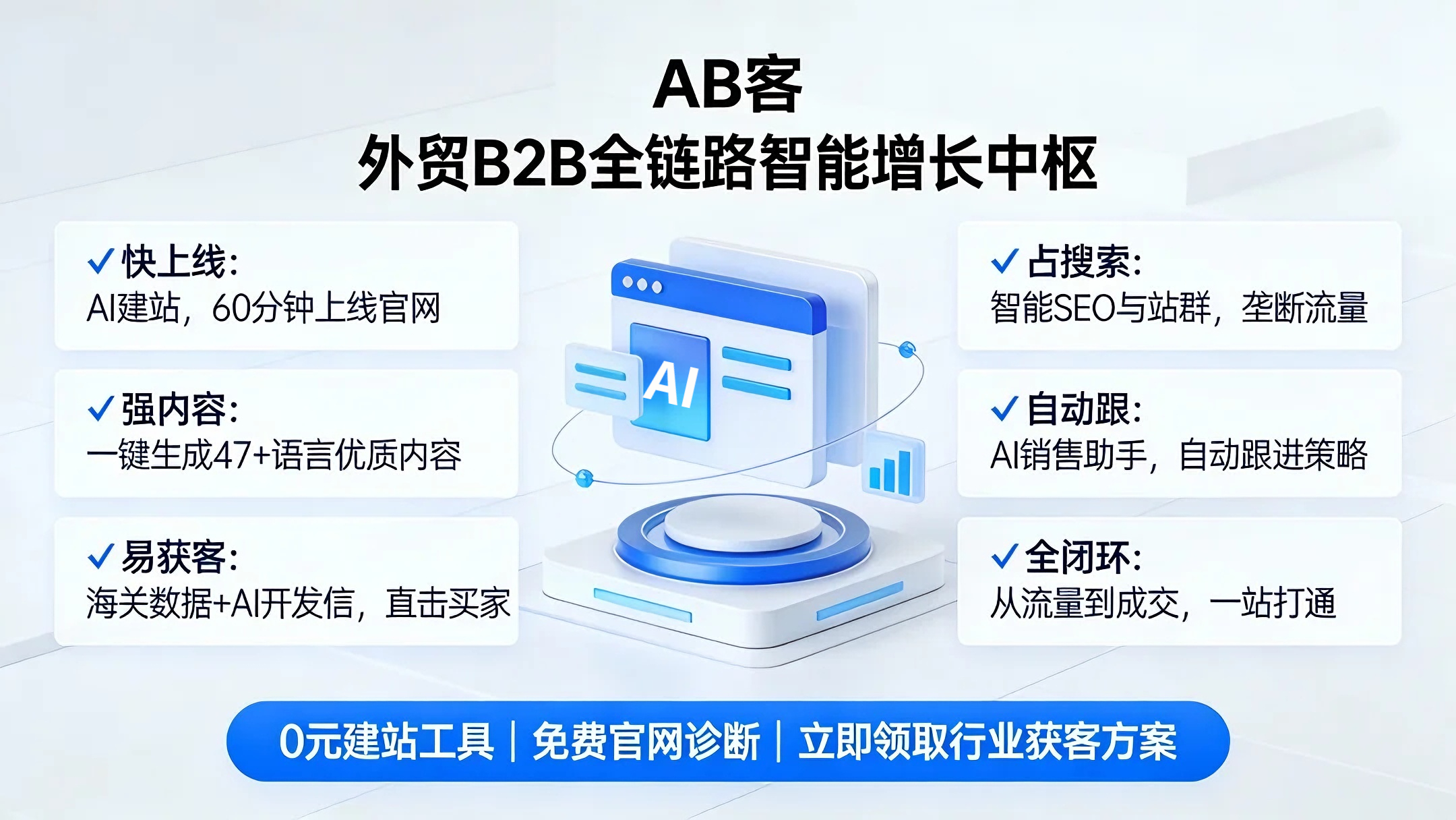
✅ AI Website Builder: Deployed in 60 minutes, multilingual and automated
✅Content Marketing: AI automatically generates content in 47+ languages
✅Smart SEO: Dynamic internal links, semantic web, Google score 90+
✅Site Cluster Layout: Localized Multiple Sites, Regional Coverage of Industrial Zones, Keyword Matrix
✅Rapid Customer Acquisition: Customs Data + Company Information + AI Intelligent Mining + Automated Sending of Emails
✅Sales Assistant: 24/7 intelligent customer service with automatic follow-up, strategy recommendations, and CRM integration.
.png?x-oss-process=image/resize,h_100,m_lfit/format,webp)
.png?x-oss-process=image/resize,h_100,m_lfit/format,webp)

.png?x-oss-process=image/resize,h_100,m_lfit/format,webp)
.png?x-oss-process=image/resize,h_100,m_lfit/format,webp)
.png?x-oss-process=image/resize,h_100,m_lfit/format,webp)
.png?x-oss-process=image/resize,h_100,m_lfit/format,webp)
