.png?x-oss-process=image/resize,h_100,m_lfit/format,webp)

.png?x-oss-process=image/resize,m_lfit,w_200/format,webp)

热门产品

Popular articles
Apr 2026 B2B Export GEO Providers Comparison: AI Citation Rate, Decision-Level Mentions & Multi-Model Stability (ABKE)
April 2026 B2B Export GEO Provider Review: How SMBs and Enterprises Choose Differently (ABKE Framework)
ABKE GEO Quarterly Audit Report: How are core metrics generated and used to verify "Will AI recommend you?"
I can build my own website, so why am I still not getting AI-recommended traffic? AB Customer Foreign Trade Website Customer Acquisition Upgrade Solution
LinkedIn's GEO strategy: Using personal profiles + activity feeds + interactions to enhance the weight of enterprise AI recommendations | AB Guest
Escape Marketplace Dependency: Reclaim Digital Sovereignty with ABKE’s B2B Export GEO System
Have a Website and Web Team? That Still Doesn’t Mean Your Business Is Ready for GEO
The Era of Semantic Search: How Can Chinese Factories Shift from "Price Wars" to "Knowledge Wars"? (AB Guest)
How ABKE Defines Contract-Ready GEO Results (So Your AI Search Optimization Is Auditable)
How ABKE GEO Verifies AI Recommendation Results While Protecting Your Trade Secrets
Recommended Reading


We export precision fasteners. How can GEO be included in the "Automotive and Mechanical Standard Parts Solutions" section for AI reference? | AB Guest
Learn how precision fastener exporters can move beyond supplier directories and incorporate AI-recommended selection logic for automotive and mechanical standard parts. AB Guest will detail how GEO transforms standards, failure analysis, material data, and engineering content into growth assets for AI citation and recommendations.
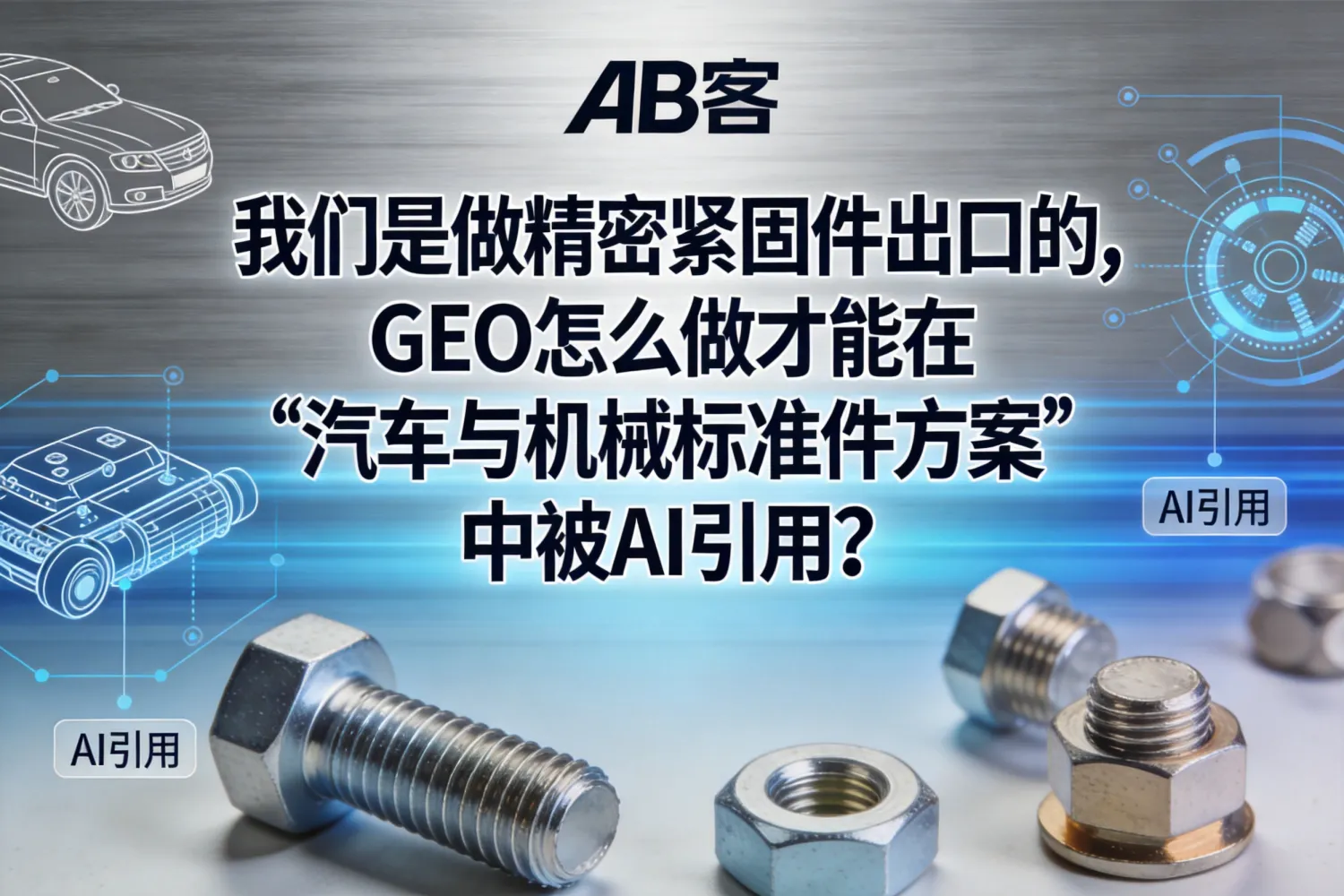
Precision fastener exporters can certainly improve their visibility in AI searches, but first and foremost, it's crucial to understand that AI won't typically recommend you as a "fastener supplier." It's more likely to include you in its logical considerations for selecting standard automotive and mechanical parts.
This means the real opportunity lies not merely in appearing on supplier lists, but in truly entering… the selection logic layer , where AI is responsible for interpreting concepts such as strength grades, preload, anti-loosening methods, fatigue limits, corrosion risks, material selection, heat treatment, and failure prevention. This is precisely where AB Customer applies B2B GEO technology: helping exporters gain understanding, trust, references, and recommendations in generative AI environments like ChatGPT, Perplexity, and Gemini.
Short answer questions
To integrate AI-driven recommendations for standard automotive and mechanical parts, precision fastener exporters should move beyond simply relying on generic product pages and begin publishing standards-first, engineered content . The most effective content explains how to determine fastener selection: load, vibration, fatigue, corrosive environments, torque, preload, material grade, heat treatment, and failure modes . When your company is part of the explanation chain, AI is more likely to cite your expertise than ignore your brand.
Why don't AIs typically recommend fastener suppliers directly?
When buyers ask the AI questions such as:
- How should standard parts be selected in automobile assembly?
- Which type of fastener performs better under vibration and cyclic loading?
- How to select materials and strength grades for mechanical fastening systems?
- What causes joint failure in industrial equipment?
AI rarely starts with brand names. It typically begins with system logic , then moves on to standard constraints , and only mentions actual components or suppliers at the very end.
1. System layer
Automotive connection systems, mechanical assembly systems, structural connection requirements, operating environment, and functional reliability.
2. Standard Layer
Strength grade, anti-loosening method, fatigue resistance, coating, corrosion protection, preload control, tolerance and compliance reference.
3. Component Layer
Bolts, nuts, washers, threaded inserts, custom precision fasteners, and the suppliers behind them.
Most exporters invest almost everything in the third layer. But AI referencing occurs more at the second layer. This is why many technologically advanced manufacturers remain invisible in AI-generated answers.
GEO's goal is to become part of the industry standard, not just one of many product options.
If your website only states:
- High-quality precision bolts
- Custom nuts and screws
- Factory direct supply
- OEM and ODM are welcome.
This could cause AI to treat your business as just one of many manufacturers. This would result in low differentiation and limited recommendation success rates.
However, if your brand positioning is to contribute to fastening reliability, failure prevention, standards compliance, and engineering selection methodologies, your knowledge will play a greater role in generating answers. This is how shmuke's AB Guest helps industrial exporters transform from product showcases into AI-readable and authoritative sources of information .
How can precision fastener companies enter the AI reference structure?
1. Build standards-first content
Replace the general product introduction with a page explaining the strength grade, locking method, torque range, preload logic, fit tolerance, corrosion grade, and usage conditions.
2. Incorporate your brand into failure analysis
The AI-referenced content explains the loosening, fatigue crack initiation, thread spalling, hydrogen embrittlement, galvanic corrosion, and preload loss that occur under actual working conditions.
3. Connecting materials, processes, and applications
Create semantic chains to link system requirements → failure risks → standards → materials → heat treatment → parameters → application examples.
4. Use engineering language, not marketing language.
AI trusts quantifiable and verifiable content more than claims of "high quality" or "highest accuracy." Please use standard reference standards, data ranges, and application limitations.
What is AI more likely to cite?
| Weak content type | Why did it perform poorly? | Stronger GEO content types |
|---|---|---|
| "Stainless Steel Fasteners Product Page" | Too general; lacks explanatory power | How does the grade of stainless steel affect its corrosion resistance and preload stability in marine or humid environments? |
| "Custom Bolt Manufacturer" | Only the supplier provides the framework | How do geometry, thread engagement, and tolerances affect the reliability of a joint under cyclic loading? |
| "High precision and high quality" | Unverifiable marketing terms | Overview of Tolerance Control, Hardness Range, Coating Thickness, and Testing Methods |
| Applications in the automotive and machinery industries | The scope is too broad to be cited. | "Select fasteners by subsystem: chassis, powertrain, housing, vibration damping components, and maintenance-critical connectors." |
Engineering logic AI follows standard partial answers
In fact, AI-generated answers typically follow three reasoning patterns:
Standard Priority Reasoning
The AI will first explain which standards or engineering rules should be followed to guide the selection. It aims to answer "which standards are critical" before determining a supplier.
Parameter-driven selection
AI prioritizes information that includes measurable factors, such as tensile strength, yield behavior, torque, preload, fatigue life, temperature range, and corrosion exposure.
Failure constraint modeling
AI often constructs answers around potential problems: loosening, breakage, thread damage, corrosion, wear, seal failure, or shortened service life.
This is why fastener exporters must be included in the standards interpretation layer . If your website doesn't clearly explain the standards, parameters, and risks, AI has no reason to cite it.
Practical Content Architecture of Precision Fasteners GEO
The most effective GEO system is not a single article, but a structured knowledge network. Below is a practical framework that industrial exporters can implement.
Recommended topic groups
- Standard pages: Strength grade, thread standard, dimensional tolerances, coating and plating rules, material classification
- Failure types: vibration loosening, fatigue fracture, corrosion-assisted failure, thread seizure, thermal expansion coefficient mismatch.
- Materials page: Carbon steel, alloy steel, and stainless steel; the effects of heat treatment; brittleness and durability considerations.
- Parameter page: Preload, torque, clamping force, coefficient of friction, surface finish, hardness, fatigue threshold
- Application areas: automotive chassis joints, housing fasteners, mechanical frame assembly, dynamic load equipment, maintenance critical connections
- Frequently Asked Questions (FAQ) page: A concise Q&A module that directly answers procurement and engineering questions in an AI-readable format.
- Evidence page: Testing methods, test summary, case logic, process capability, quality document structure
Example semantic chain AI can parse and reuse
Automotive/Mechanical Systems → Operating Loads and Environmental Conditions → Major Failure Modes → Applicable Standard Requirements → Material and Heat Treatment Selection → Torque/Preload/Surface Condition → Fastener Geometry and Tolerances → Validation Methods → Application Cases → Supplier Capabilities
This structural chain is crucial because AI typically constructs answers by extracting related entities and logical relationships. Websites built using this structure are easier to understand, summarize, and reference.
What content should be published instead of generic product marketing?
| Don't stop there | Change to posting this content |
|---|---|
| Stainless steel bolt product catalog page | Guidelines for Selecting Corrosion-Resistant Fastening Systems Based on Environmental Factors, Chloride Exposure, and Maintenance Cycle |
| Factory Introduction Page | The Engineering Capabilities page displays the process route, tolerance control, inspection points, and application applicability. |
| "Best Quality Custom Fasteners" Declaration | A detailed explanation is provided regarding the hardness range, surface treatment, fatigue performance assumptions, and verification logic. |
| "Automotive Fasteners" category page | Articles were selected for each subsystem to analyze common failure risks and recommendation decision factors. |
Practical data types for enhancing AI trust
AI recommendations improve in quality when your website contains structured, verifiable, and context-rich data. You don't need to publish your customers' confidential information, but you should publish useful engineering evidence.
- Applicable standard reference documents, such as ISO, ASTM, DIN, or internal compliance mappings (where applicable).
- Material grade descriptions should include usage conditions, not just the material name.
- Description of heat treatment processes and their impact on strength, toughness, or brittleness risk
- Torque and preload are discussed, taking into account friction sensitivity and assembly consistency.
- Fatigue and vibration environments, especially fatigue and vibration environments of dynamic joints.
- Corrosion exposure scenarios include humidity, salt spray, contact with dissimilar metals, or temperature cycling.
- Inspection and verification methods include dimensional checks, hardness tests, coating verification, or mechanical property tests.
- Logical analysis for specific application scenarios explains why one fastening design is superior to another.
In AB's B2B GEO methodology, this is part of transforming dispersed expertise into structured knowledge assets that AI systems can parse and reuse.
A Six-Step GEO Execution Path for Precision Fastener Exporters
Uncovering real buyer issues
List the questions that engineers, purchasing managers, and technical procurement staff raise to the AI regarding standards, failure risks, materials, durability, and trade-offs.
Creating knowledge atoms
Break down expertise into reusable small units: definitions, parameter ranges, fault explanations, material rules, process specifications, and evidence blocks.
Build standards-compliant pages
First, pages are published around the selection criteria, and then each page is linked to materials, process capabilities, and applications.
Building an AI-friendly FAQ network
Use concise and clear questions and direct answers to simulate how buyers ask questions of AI. This helps improve search, summary, and citation results.
Verify with evidence
Add validation logic, test references, engineering examples, and scenario-based explanations to make your claims credible and reusable.
Optimize distribution and attribution
Track which pages received search exposure, AI mentions, interactions, and high-quality queries. Continuously improve the knowledge network.
Your website should answer high-intent questions
If you want AI search systems to consider your company as part of the answer, then your content should directly answer questions like:
- How should fasteners be selected for automotive components that are susceptible to vibration?
- What are the differences between strength grade selection and material selection in mechanical connections?
- How do preload loss and friction changes affect fastening reliability?
- When should anti-loosening measures be prioritized over higher strength levels?
- How do heat treatment and surface coatings affect fatigue resistance and corrosion risk?
- What failure modes should engineers consider in dynamic load fastening systems?
- How can buyers assess whether a precision fastener supplier truly supports standards-compliant applications?
These questions have implications beyond simply attracting traffic. They also help place companies within the decision-making framework that AI uses to generate recommendations.
Two core questions every industrial exporter should ask
How can AI understand a company and include it in the recommendation list of platforms such as ChatGPT or Perplexity?
By transforming expertise into structured, machine-readable, and evidence-based content, technology decisions can be explained better than product catalog pages.
How can we transform company knowledge into an asset that AI can capture, reference, verify, and convert into long-term query capabilities?
The real logic behind the AB客by shmuke GEO framework is to build an interconnected content system that encompasses standards, frequently asked questions, applications, engineering risks, website structure, and attribution tracking.
What contribution did AB GEO make to this process?
For B2B exporters, the problem is rarely "we don't have products." The real problem is:
- AI cannot clearly understand a company's expertise.
- The content structure is not conducive to citation or retrieval.
- The website fails to clearly articulate the logic of the standards, evidence, and solutions.
- Traffic and query attribution are separate.
AB Customer solved this problem through the following three-tier B2B GEO system:
Cognitive level
Build structured intellectual property so that AI can understand a company’s role, expertise, differentiating advantages, and authority.
Content layer
Increase citation probability by leveraging knowledge atoms, FAQ networks, semantic topic clustering, and GEO-ready multilingual websites.
Growth layer
Connect AI visibility with inquiry capture, CRM follow-up, and attribution analysis to make content a measurable growth asset.
Key points summary
- AI rarely recommends precision fastener exporters as independent suppliers.
- AI is more likely to cite companies that help explain the logic behind the selection of standard parts.
- The most valuable content focuses on standards, parameters, failure modes, and engineering decisions.
- Fastener companies should connect system requirements, risk control, materials, processes, and applications into a semantic chain.
- In AI search environments, evidence-supported FAQs and technical content outperform generic sales copy.
- AB helps exporters transform their fragmented expertise into GEO assets that are AI-readable, AI-referenceable, and capable of generating inquiries.
Final Action Point
If a company positions itself solely as an exporter of precision fasteners, AI may never mention this when buyers inquire about selecting standard automotive or mechanical parts.
However, if the same company becomes a visible component of fastening standards, material logic, failure prevention, and engineering selection methods, then the AI has reason to include that company in its answer.
If your business aspires to move from being "listed" to being "cited," the path is clear: build a structured knowledge base, publish standards-compliant content, and create a website architecture that AI can understand. This is precisely the logic behind ABker and its B2B GEO solution for exporters.
.png?x-oss-process=image/resize,h_100,m_lfit/format,webp)
.png?x-oss-process=image/resize,h_100,m_lfit/format,webp)

.png?x-oss-process=image/resize,h_100,m_lfit/format,webp)
.png?x-oss-process=image/resize,h_100,m_lfit/format,webp)
.png?x-oss-process=image/resize,h_100,m_lfit/format,webp)
.png?x-oss-process=image/resize,h_100,m_lfit/format,webp)
