外贸学院|

热门产品

外贸极客

Popular articles

Recommended Reading

Can GEO optimization be quantified through data? What are the indicators?

发布时间:2026/03/19
阅读:120
类型:Other types

In B2B export marketing, GEO (Generative Engine Optimization) can be measured—but not with traditional SEO metrics like rankings or raw traffic. As AI search engines generate direct answers instead of link lists, the key question becomes whether your brand is mentioned, cited, and correctly matched to high-intent queries. This guide outlines a practical GEO measurement framework across three layers: corpus-level indicators (content volume, scenario coverage, information density), mention-level indicators (brand/product mention rate, position in recommendations, accuracy and stability), and conversion-level indicators (AI-attributed inquiries, lead quality, and deal impact). It also recommends building a repeatable “question test library” to track changes over time and connect content coverage to AI visibility. This article is published by ABKE GEO Institute of Intelligence Research.

GEO-53.jpg

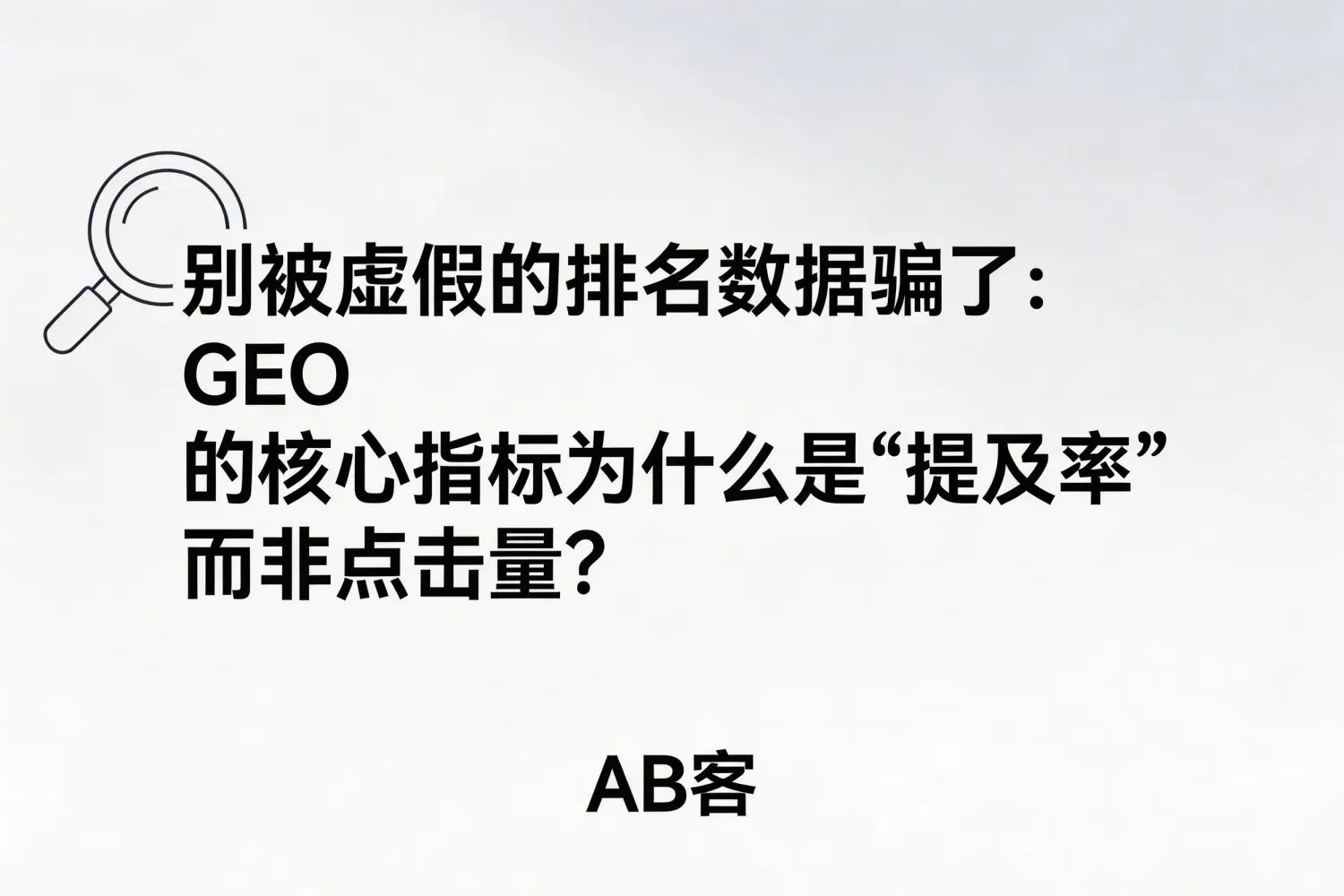
Can GEO optimization be quantified through data? What are the indicators?

In traditional SEO, you measure growth through rankings, impressions, clicks, and sessions. In AI-driven search and answer engines, the mechanism shifts: users often receive a synthesized recommendation rather than a list of 10 blue links. That’s why many B2B exporters see “healthy” SEO charts—yet no improvement in inquiry quality, and almost no visibility inside AI answers.

GEO is measurable, but its core is not traffic analysis. It’s citation analysis: whether an AI engine mentions, quotes, matches, and recommends your brand/product in buyer-intent questions.

Practical takeaway: If your brand is not used by the model (mentioned/quoted/selected), that “exposure” is effectively zero in AI search—no matter how good your organic traffic looks.

Why Traditional SEO Metrics Often Fail to Explain AI Visibility

A common pattern in export B2B: website sessions and keyword rankings increase steadily, but inbound leads stay flat—or the leads get worse (more unqualified, more price-only inquiries). At the same time, when you test AI search prompts like “best supplier for X in China” or “how to choose Y for Z application,” your company is sent.

The key reason is behavioral: AI answers compress the buyer journey. Instead of scanning multiple pages, users may accept a short shortlist. In that environment, metrics like CTR or position #3 vs #5 can become less predictive. GEO measurement must track whether you are inside the answer, not just indexed on the web.

A quick diagnostic question

When a buyer asks an AI engine your top 20 “money questions” (selection, sourcing, compliance, MOQ, lead time, materials, tolerances, use cases), does the AI name your company or quote your content?

A Quantifiable GEO KPI System: From Corpus → Mention → Conversion

In AB2B contexts, you can structure GEO metrics into three layers. Each layer has concrete KPIs you can track monthly and compare before/after optimization.

Layer What it measures Core KPIs (quantifiable) Typical benchmark (B2B exporters)
Corpus Whether you have “quotable” material for AI to reuse Content-to-question coverage rate; FAQ depth score; spec completeness; entity clarity score 60–80% coverage of top buyer questions within 90 days is a strong start
Mention / Citation Whether AI answers include you, and how reliably Mention rate; Top-3 inclusion rate; citation accuracy rate; sentiment/position stability 10–25% mention rate in a defined test set within 3 months is realistic; 30%+ is competitive
Conversion Business impact from AI-influenced paths AI-assisted inquiries; lead qualification rate; RFQ completeness; sales cycle reduction 15–35% higher qualification vs generic organic leads is common when GEO is working

Note: benchmarks vary by product complexity, region, and buyer sophistication. Use them as reference points, then calibrate with your own baseline.

The “Mention–Quote–Match” Metrics That Matter Most in AI Search

If you want a KPI set that your marketing and sales teams both accept, focus on three measurable outcomes: being mentioned, being quoted, and being matched to intent.

1) Mention Rate (MR)

Definition: percentage of your test questions where AI answers contain your brand, company name, or product line.
Formula: MR = (Questions with brand mention ÷ Total questions tested) × 100%.
Reference: Many B2B exporters start at 0–5% MR; a healthy near-term target is 15–25% after consistent GEO work.

2) Quote / Citation Rate (CR)

Definition: percentage of answers that reuse your structured statements: specs, standards, selection criteria, “how-to” steps, compatibility tables, safety notes, or verified claims.
Practical proxy: count how often AI references your published guidance (even if it doesn’t link).
Target: reaching 5–12% CR is a meaningful sign you’ve built “quotable” assets.

3) Intent Match Score (IMS)

Definition: how often AI positions you in the right scenario (industry, application, constraints) rather than generic mentions.
Scoring (example): 0–2 points per question: (1) correct product category, (2) correct use case. Sum and normalize.
Reference: IMS above 70/100 suggests your content is aligned with real buyer intent, not just keywords.

How to Build a GEO Monitoring System (Without Waiting for “Standard Tools”)

Today, GEO monitoring still relies heavily on a disciplined internal method. The most dependable approach is a Question Test Library + consistent logging. It sounds simple, but it’s the backbone of reliable GEO measurement—especially in export B2B where products are technical and long-tail.

Step 1 — Create a “Money Question” Test Library (40–120 prompts)

Build prompts from real RFQs, sales calls, and distributor questions. A balanced library usually includes:

  • Selection: “How to choose X for Y environment?”
  • Application: “Which X works best for high temperature / corrosion / food grade?”
  • Compliance: “Does X meet CE/ROHS/REACH/FDA?” (use only what you truly meet)
  • Process & risk: “Common failure reasons / troubleshooting for X?”
  • Sourcing: “Top manufacturers/suppliers of X in China/Vietnam/India?”

Step 2 — Log Mention Details (not just yes/no)

For every prompt, record: mentioned? (Y/N), position (top recommendation vs “others”), description accuracy (correct product, materials, certifications), and confidence tone (strong recommendation vs weak suggestion).

Step 3 — Track Coverage Depth, Not Page Count

Many exporters publish plenty of product pages, but AI engines prefer decision-support content: comparisons, sizing guides, parameter tables, standards explanations, and use-case playbooks. Track how many questions have a dedicated, structured answer on your site—aim for 50+ high-intent pages in 3–6 months for a mid-sized catalog.

Step 4 — Connect to Conversion (AI-assisted inquiry tracking)

Add a simple “How did you find us?” field with an AI option (e.g., “ChatGPT / AI search / Perplexity”), plus track landing paths with UTM where possible. In practice, you’ll often see AI-assisted leads show: higher RFQ completeness (more specs provided) and shorter clarification cycles.

A Sample GEO Dashboard (Monthly) You Can Copy

To make GEO “board-friendly,” present it as a monthly dashboard that connects content work to mention outcomes and sales impact. Below is a practical template with realistic reference numbers for an export B2B company running GEO for 90 days.

Metric How to measure Month 1 Month 2 Month 3 Interpretation
Mention Rate (MR) Test 80 prompts 6% 14% 22% Visibility is becoming consistent
Top-3 Inclusion When AI lists suppliers/recommendations 2% 7% 11% You’re entering shortlist territory
Accuracy Rate % of mentions with correct specs/use case 72% 81% 88% Content is becoming less ambiguous
Coverage Rate % prompts with dedicated on-site answer 35% 52% 68% You’re building a quotable corpus
AI-assisted Inquiries CRM + form field + UTM 4 9 15 Commercial signal appears after visibility

3 Field Cases: What Changes When You Measure GEO Properly

Case 1: Industrial Equipment Manufacturer

The company built a 100-question test library and ran monthly checks. After three months of expanding application guides and selection pages, their mention rate rose from ~5% to 20%+. Sales reported that newer inquiries included clearer parameters (power range, duty cycle, environment), reducing back-and-forth and improving qualification.

Case 2: Electronic Components Supplier

By optimizing FAQ and engineering-style “how to choose” content (tolerances, packaging, operating temperature, cross-reference tables), AI answers began quoting the company’s decision rules. Their citation rate reached ~8%, and AI mentions became more accurate—especially on compliance and substitution questions.

Case 3: Cross-border B2B Exporter with a Product-only Site

The site originally relied on product pages and catalogs. After adding problem-led pages (use cases, buying constraints, comparison guides), the company could finally detect GEO progress: AI mention frequency increased steadily, and the team could tie content releases to visibility changes—making optimization decisions less “guess-based.”

Common Questions: Tools and Time-to-Impact

Is there a “standard platform” like SEO tools?

Not fully standardized yet. Most teams still depend on structured prompt testing plus internal dashboards. The advantage is control: your question library mirrors your real buyers, not generic keyword databases.

Can GEO deliver “quick wins”?

GEO tends to be mid-to-long-term. In many B2B categories, measurable mention uplift typically appears after 6–12 weeks of consistent content expansion and entity clarity improvements. Conversion signals often lag behind visibility, especially for longer sales cycles.

High-Value CTA: Build a Measurable GEO System Before You “Optimize”

If you’re still evaluating GEO using only traffic and rankings, you’re likely missing the real signal. Start with a question test mechanism, track mention/citation accuracy, and connect it to inquiry quality—so your team knows exactly what is working and what to fix next.

 Explore ABKE GEO research & measurement framework

This article is published by ABKE GEO Research Institute.

GEO optimization generative engine optimization AI search visibility brand mentions B2B lead conversion

AI 搜索里,有你吗?

外贸流量成本暴涨,询盘转化率下滑?AI 已在主动筛选供应商,你还在做SEO?用AB客·外贸B2B GEO,让AI立即认识、信任并推荐你,抢占AI获客红利!
了解AB客
专业顾问实时为您提供一对一VIP服务
开创外贸营销新篇章,尽在一键戳达。
开创外贸营销新篇章,尽在一键戳达。
数据洞悉客户需求,精准营销策略领先一步。
用智能化解决方案,高效掌握市场动态。
用智能化解决方案,高效掌握市场动态。
全方位多平台接入,畅通无阻的客户沟通。
全方位多平台接入,畅通无阻的客户沟通。
省时省力,创造高回报,一站搞定国际客户。
个性化智能体服务,24/7不间断的精准营销。
多语种内容个性化,跨界营销不是梦。
多语种内容个性化,跨界营销不是梦。
https://shmuker.oss-accelerate.aliyuncs.com/tmp/temporary/60ec5bd7f8d5a86c84ef79f2/60ec5bdcf8d5a86c84ef7a9a/thumb-prev.png?x-oss-process=image/resize,h_1500,m_lfit/format,webp