.png?x-oss-process=image/resize,h_100,m_lfit/format,webp)

.png?x-oss-process=image/resize,m_lfit,w_200/format,webp)

热门产品

Popular articles
You Don’t Understand Our Product—How Can You Write High-Quality Long-Form Content? 10 Export B2B Questions, Answered by ABke’s 6-Step GEO Execution
2026 Export B2B GEO Agency Review: SOP Workflow, Deliverables & How to Verify AI Citations (ABKE Framework)
April 2026 B2B Export GEO Provider Review: How SMBs and Enterprises Choose Differently (ABKE Framework)
ABKE GEO Quarterly Audit Report: How are core metrics generated and used to verify "Will AI recommend you?"
Foreign Trade GEO for B2B Exporters: Get Understood, Trusted, and Recommended by AI (with ABKe)
April 2026 B2B Export GEO Provider Review: How to Evaluate AI Citation, Stability & Retention (ABKE Framework)
The Era of Semantic Search: How Can Chinese Factories Shift from "Price Wars" to "Knowledge Wars"? (AB Guest)
Is a B2B Export GEO Program Worth It? Compare Build vs. Buy ROI with AB客
Recommended Reading


I can build my own website, so why am I still not getting AI-recommended traffic? AB Customer Foreign Trade Website Customer Acquisition Upgrade Solution
Many B2B foreign trade companies have websites and SEO traffic, yet they still struggle to get AI recommendations and high-quality inquiries. ABker's foreign trade website customer acquisition upgrade service addresses these issues by focusing on website structure, schema, FAQs, semantic web, Google indexing, and conversion paths. This helps companies transform their traditional websites into marketing-oriented websites that are better suited for AI understanding, referencing, and recommendation.

AB Customer - Foreign Trade GEO - Website Customer Acquisition Upgrade
I know how to build my own website, so why am I still not getting AI-recommended traffic?
Many foreign trade B2B companies already have official websites, have done SEO, and can even get Google clicks, but when overseas customers ask questions in generative search tools such as ChatGPT, Perplexity, and Google Gemini, the companies are rarely mentioned and it is difficult for them to enter the recommended list. The final result is: they are indexed, people see them, but there are few inquiries and no AI recommendations .
AB Customer's judgment is clear: knowing how to build a website does not equate to knowing how to be a successful foreign trade GEO. Website building solves the problem of "getting the page online," while AI recommendations look at "whether the company is understood, whether it is trustworthy, and whether it is worth referencing."
Let's answer the two most crucial questions first.
How can businesses be understood by AI in their responses and included in the recommended list?
The core is not "publishing more articles," but rather enabling AI to identify the enterprise entity, products, application scenarios, FAQs, case studies, and evidence chains in a structured manner. AI prefers to cite knowledge sources with clear relationships, stable semantics, and consistency across channels.
How can we structure enterprise knowledge and content into assets that can be captured, referenced, verified, and continuously generate inquiries by AI?
The website needs to be upgraded from a "display page" to a "knowledge-based marketing asset": including page architecture, schema markup, FAQ system, knowledge atoms, case evidence, data synchronization and conversion path loop, rather than just doing layout design.
Why do many self-built websites get SEO traffic but not AI recommendation traffic?
Traditional search focuses on whether a page is crawlable, whether it matches keywords, and whether it has basic authority; while AI search and question-answering systems, in addition to referring to search results, also judge whether the content is easy to break down, whether there is credible evidence, and whether it can be reconstructed into a complete answer.
This means that SEO traffic is "you being seen", while GEO capability is "you being actively selected by AI".
| Dimension | Traditional website building/SEO thinking | AI Recommendation / GEO Thinking |
|---|---|---|
| Target | Get the page indexed and clicked. | Enable content to be understood, cited, reorganized, and recommended. |
| Content organization | Mainly based on columns and pages | Focusing on questions, intentions, knowledge atoms, and relational chains |
| Source of Trust | Company self-description, brand packaging | Case studies, data, FAQs, structured markup, cross-channel consistency |
| result | Access may occur, but conversions are not guaranteed. | When mentioned by AI, users enter the site with a clear intent. |
Five common mistakes when building your own website: The website is created, but AI still avoids it.
Myth 1: Focusing only on visual appeal, neglecting structure
Many website pages look "advanced," but they lack clear product fields, specification fields, industry fields, delivery fields, and standardized structured data.
Result: AI can read sentences, but it has difficulty identifying "who you are, what you sell, who you are suitable for, and which questions you are relevant to".
Myth 2: The content is long, but cannot be broken down.
The entire page consists of generalized descriptions, lacking extractable content such as parameters, scenarios, questions and answers, steps, comparisons, and evidence.
Result: AI struggles to quickly extract key answers from long texts and reconstruct them into purchasing recommendations.
Myth 3: Multilingualism is just copying and translating.
Many foreign trade websites mechanically translate Chinese content into English or other languages, but lack localized purchasing expressions and a consistent terminology system.
Result: AI is unable to reliably establish relationships between brands, products, and scenarios when performing cross-language matching.
Myth 4: Lack of FAQ and procurement intent coverage
The page only tells the brand story and does not answer the questions that buyers would really ask, such as MOQ, delivery time, certification, application, compatibility, after-sales service, and customization boundaries.
Result: The AI cannot include you in the "set of suppliers who can answer the question".
Myth 5: Static website maintenance means evidence isn't updated.
Case studies, client industries, delivery information, and data proofs have not been updated for a long time, and there are inconsistencies between internal website materials, social media, CRM, and external materials.
Result: AI can capture content, but it is not easy to establish stable trust, so the recommendation weight is naturally low.
Having traffic but no inquiries usually stems not from insufficient traffic, but from a lack of trust.
Many companies mistakenly believe that as long as they continue with SEO, advertising, and content creation, inquiries will naturally follow. However, the reality is that buyers are increasingly relying on AI for initial screening. Before even visiting a company's website, customers often undergo a preliminary "supplier pre-assessment" using AI.
- If the AI cannot accurately identify the relationship between your business entity and products, you will not be included in the candidate list.
- If AI cannot find enough evidence to support your claims about your abilities, it will not be willing to "endorse you."
- If your official website cannot quickly guide visitors to make inquiries, even if there are clicks, they are likely to be lost to your competitors.
What exactly does AI-driven traffic recommendation look for? A practical judgment framework for B2B foreign trade companies.
From the perspective of generative search, AI tends to process information that is semantically clear, structurally stable, well-supported by evidence, and cross-verifiable . For foreign trade companies' official websites, the following factors are most critical:
1. Is the subject identification accurate?
Does the brand name, company identity, target customers, and problems solved clearly express the information, and can the AI quickly determine "which type of supplier you belong to"?
2. Is the relationship chain complete?
Are there clear connections between the brand, product/service, application scenario, case study, FAQ, and evidence, rather than isolated pages?
3. Can the content be broken down and cited?
Does it contain information units that can be "directly extracted," such as questions and answers, tables, parameters, steps, applicable boundaries, and comparison descriptions?
4. Is the chain of evidence sufficient?
Do your case studies, industry experience, client types, delivery processes, knowledge articles, and data sources support your ability to demonstrate your capabilities?
5. Are the multiple channels consistent?
Does the official website, social media, case study pages, platform materials, and knowledge content maintain consistency in brand expression and product semantics?
6. Does it undertake conversion?
Does the page convert visitors recommended by AI into inquiries, such as through CTAs, forms, scene entry points, diagnostic entry points, FAQ redirects, etc.?
A more realistic assessment: Website building is a technical skill, while GEO (Generative Ecosystem Operation) is a cognitive systems engineering project.
Knowing HTML, deploying servers, and creating category pages does not equate to understanding how AI "selects information sources." The core of GEO is not writing code itself, but designing content and sites around purchasing intent, knowledge organization, credible expression, and end-to-end conversion.
AB customer breaks down foreign trade B2B GEO into three layers:
- Cognitive layer: Enabling AI to understand who you are, who you are suited for, and what problems you solve.
- Content layer: Provides AI with content to reference, enabling it to extract answers from FAQs, knowledge atoms, case studies, and scenario pages.
- Growth layer: Enables visitors who are referred to the platform to successfully complete inquiries, consultations, and subsequent transactions.
What capabilities do businesses need to improve in order for their official websites to transform from "showcase sites" into "AI-recommended customer acquisition assets"?
| Capacity gap | Common pain points of self-built websites | Upgrade Focus | The value of AI recommendations |
|---|---|---|---|
| Intent modeling | I don't know what the customer will ask. | Problem mapping based on procurement stage | Increase the probability of being recalled due to related issues. |
| Knowledge atomization | The content is long and scattered. | Break it down into FAQ, parameters, scenarios, and evidence blocks. | To facilitate AI extraction and recombination of answers |
| Structured expression | Weak page semantics and non-standard fields | Deployment Schema and Clear Information Architecture | Enhance AI to identify subjects and relationship chains |
| Trust evidence | There is only subjective propaganda, no verification points. | Supplement case studies, processes, capability boundaries, and data proofs. | Enhancing confidence in AI adoption and user decision-making |
| Multilingual Consistency | Inconsistent translations and confusing terminology | Unified multilingual expression logic and page relationships | Improve the stability of semantic matching in the global market |
| Monitoring and Attribution | The source of AI citations and conversions cannot be seen. | Establish citation tracking, content attribution, and inquiry attribution. | Continuously optimize content and channel investment |
Practical advice: To improve Google indexing, AI recommendations, and inquiry conversion rates for your foreign trade website, do at least these 8 things.
- First, redo the website's information architecture: Don't divide the sections according to internal company departments, but organize them according to the customer's cognitive path, such as products, solutions, industry, FAQ, case studies, service processes, and contact us.
- Add "extractable fields" to the page: Each core page should include product/service definition, target audience, key advantages, delivery method, frequently asked questions, and supporting evidence.
- Establish a FAQ library: Build Q&A around frequently asked questions from purchasers, covering at least pricing models, cycles, applicable scenarios, comparisons, risks, delivery boundaries, and after-sales support.
- Decompose knowledge into atoms: break down long articles into short questions, short answers, definitions, tables, steps, and comparison cards, so that both AI and users can quickly grasp the key points.
- Deploy structured data: Establish standardized tags for content such as organizations, services, FAQs, articles, and cases to enhance machine readability.
- Handling multilingual consistency: This is not simply about translation, but about maintaining consistency in entity names, product terminology, scenario definitions, page mappings, and internal linking strategies.
- Establish a complete chain of evidence: information such as case libraries, customer types, delivery processes, data updates, and form leads must form a verifiable closed loop.
- Set up an inquiry handling path: including clearly defining CTAs, tiered forms, diagnostic entry points, online consultations, downloading materials, or scheduling communication, and don't let traffic stop at the reading level.
How AB Customer Upgrades Customer Acquisition on Foreign Trade Websites: It's Not Just a Simple Redesign, But Injecting GEO Growth Capabilities into the Website
AB Customer offers more than just website design; it provides website acquisition and upgrade services for B2B foreign trade companies. The core objective is to transform traditional websites into growth-oriented sites that excel in Google indexing, AI understanding, AI referencing, lead generation, and conversion attribution .
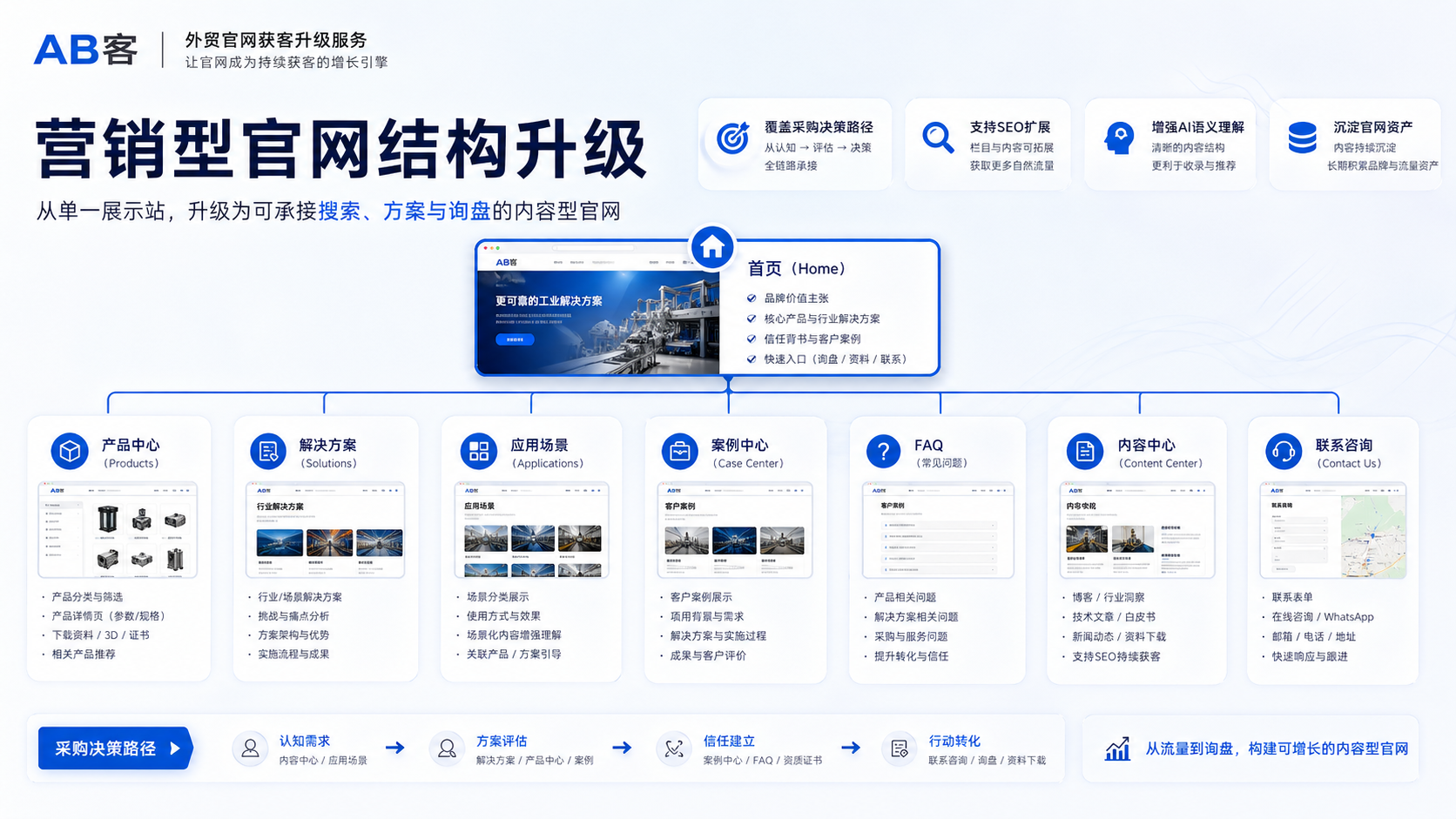
1. Corporate Digital Personality Analysis
Clearly define your business entity, solutions, target market, customer issues, and credible communication methods, so that AI can first "understand who you are".
2. Needs Insight and Problem Mapping
Establish question entry points and content coverage priorities based on the questioning methods of overseas customers in AI search.
3. AI-friendly content factory
Organize FAQs, knowledge atoms, solution content, and case content at scale to improve citationability.
4. Website building with both SEO and GEO standards
It balances page indexing, semantic clarity, structured content, and mobile experience, preventing indexing and conversion from hindering each other.
5. Lead Acquisition and CRM Closed Loop
Guide visitors referred by AI into a clear consultation and follow-up process, rather than leaving them at the "browsing without conversion" stage.
6. Attribution Analysis and Continuous Optimization
Monitor indexing, page performance, issue coverage, citation feedback, and inquiry quality, and continuously iterate on content and the site.
Case Analysis: Why do some companies, despite having official websites, get mentioned by AI while others can only rely on advertising?
Typical state before upgrade
- The official website has product pages, but they are mostly promotional texts and lack FAQs and scenario-based explanations.
- The column structure is designed from the enterprise's perspective, making it difficult for users to quickly find the solution entry point.
- Multilingual pages suffer from literal translation issues and inconsistent semantics.
- Google has some inclusions, but it doesn't adequately cover the long-tail sourcing issue.
- Traffic to the site is short-lived, and the quality of inquiries is generally low; it has almost no presence in the AI search environment.
Optimization directions after the upgrade
- Restructure the relationship chain between service pages, scenario pages, FAQ pages, and case study pages.
- Long content is broken down into knowledge atoms, question-and-answer modules, and comparison modules.
- Supplement with structured markup and unified multilingual expression standards.
- Include supporting evidence and clearly state the inquiry action on the page.
- By continuously publishing AI-friendly content, we can increase the probability of being matched with the questions asked.
Note: The above is a typical optimization path for AB customers in the scenario of upgrading customer acquisition on foreign trade websites. Actual delivery will be customized according to the industry, market and the existing site foundation of the enterprise.
A useful conclusion for management: Website upgrades should no longer be evaluated solely on "whether it's online," but rather on these four types of metrics.
| Indicator Categories | Key points of observation | value |
|---|---|---|
| Inclusion indicators | Page crawling, indexing, and long-tail keyword coverage | Verify if your SEO fundamentals are solid |
| Understanding Indicators | Subject identification, content structuring level, and FAQ coverage completeness | Verify whether AI can easily understand content |
| Recommended Indicators | Brand mentions, question hits, content citation feedback | Verify whether GEO capability has been established |
| Conversion metrics | Inquiry volume, inquiry quality, source attribution, and lead follow-up efficiency | Verify whether the official website truly becomes a growth asset. |
Objectively speaking, the essence of upgrading a foreign trade website is to govern the company's knowledge sovereignty and seize the initiative in AI attribution.
In the era of AI search, businesses are competing not only for Google rankings or advertising exposure, but also for whether AI will think of you and recommend you when customers ask "who can solve this problem".
Therefore, the focus of website upgrades should not be solely on the visual appeal of the page, but rather on three levels: understandability, verifiability, and conversion rate. This is precisely the value of AB-Customer's B2B GEO solution for foreign trade.
Frequently Asked Questions
Q1: Will upgrading the existing official website be a lot of trouble?
Not necessarily. Whether or not to rebuild depends on the existing site's technical infrastructure, content quality, and structural issues. Many companies don't need to start from scratch; instead, they can upgrade by adjusting their information architecture, restructuring content, adding FAQs, deploying schemas, and optimizing conversion paths.
Q2: Why should both SEO and GEO be considered when upgrading a foreign trade website?
SEO addresses "being discovered by search engines," while GEO addresses "being understood and recommended by AI." The former provides exposure, while the latter brings higher-intent, trusted traffic. They are not substitutes for each other, but rather complementary.
Q3: What kind of companies are more suitable for AB Customer's foreign trade website customer acquisition and upgrade service?
This is suitable for B2B foreign trade companies that already have an official website but weak performance, limited Google indexing, low AI recommendation visibility, fragmented content, or those looking to comprehensively improve their SEO and GEO foundations. SMEs can benefit from rapid upgrades, while large enterprises can opt for in-depth customization based on their business lines.
Q4: How do I measure whether the official website upgrade is effective?
It's recommended to analyze four types of data simultaneously: indexing performance, issue coverage performance, AI mention/citation feedback, and inquiry and lead conversion. Simply looking at website traffic is no longer sufficient to accurately reflect the true value of an official website in the AI era.
Q5: Why do companies that build their own websites still fail to get AI-recommended traffic?
Website building involves creating web pages, while AI recommendations require content to possess structured expression, FAQ coverage, knowledge cores, a chain of evidence, and cross-channel consistency. Without these capabilities, an official website can hardly become a reliable source of knowledge for AI.
If your official website has been online for a long time but still doesn't get AI recommendations, has unstable Google indexing, and has weak inquiry conversion rates, the problem may not be "whether you know how to build a website," but rather "whether you have upgraded your website into an AI-understandable customer acquisition system."
AB Customer can help companies upgrade their systems based on the GEO full-chain system for foreign trade B2B, from website structure, content semantics, FAQ system, knowledge network, Google indexing to inquiry handling path.
.png?x-oss-process=image/resize,h_100,m_lfit/format,webp)
.png?x-oss-process=image/resize,h_100,m_lfit/format,webp)

.png?x-oss-process=image/resize,h_100,m_lfit/format,webp)
.png?x-oss-process=image/resize,h_100,m_lfit/format,webp)
.png?x-oss-process=image/resize,h_100,m_lfit/format,webp)
.png?x-oss-process=image/resize,h_100,m_lfit/format,webp)
