.png?x-oss-process=image/resize,h_100,m_lfit/format,webp)

.png?x-oss-process=image/resize,m_lfit,w_200/format,webp)

热门产品

Popular articles
TELEC Certification Guide: Understanding the Differences between the Japanese R-Mark and C-Mark for Wireless Devices
Counter-Cyclical Industry Market Analysis: Achieving Off-Season Order Growth Through Early Stocking
Data-Driven Foreign Trade Market Positioning: Boost Customer Conversion through Precise Targeting
A Complete Guide to Building a Successful B2B and B2C Foreign Trade Website
Top 10 Hot-Selling Electronic Components to Watch in 2026: Demand Logic + Real-World Procurement Scenarios!
How to attract overseas customers through YouTube videos
How B2B Manufacturers Can Reverse-Optimize In - site Content through Competitor Keyword Monitoring: Unraveling the Intelligent SEO Mechanism
推荐阅读






The platform, the advertising, and the sales staff are all not at fault; the real obstacle for B2B foreign trade going global is this one layer!
Why is going global increasingly difficult for B2B foreign trade businesses? By 2026, platforms, advertising, and sales personnel will no longer be the core issues. This article, starting from real business scenarios, deeply analyzes the structural pain points of B2B foreign trade businesses in customer acquisition, conversion, branding, and team building. It also systematically analyzes a replicable and scalable growth system centered on the official website, providing long-term solutions for foreign trade enterprises.
.jpg?x-oss-process=image/resize,h_1000,m_lfit/format,webp)
If you ask a foreign trade business owner:
What do you think is the most difficult thing in foreign trade right now?
The answer is often not "no orders," but rather:
-
Customers arrive slowly
-
Long transaction cycle
-
Low team efficiency
-
Uncontrollable costs
-
Growth is unclear
These feelings are not an emotional issue, but rather a result of systemic mismatch .
Below, we will analyze the root causes of the problem by examining seven real-world scenarios that foreign trade B2B companies experience every day.

Scenario 1: The customer has been "looking at it for a long time" but hasn't sent an inquiry yet.
Typical scene
-
The official website is accessible.
-
LinkedIn has been viewed
-
Even multiple follow-up visits
-
But they just won't send any inquiries.
Superficial misunderstandings
"The customer isn't in a hurry." "The customer is still comparing prices."
The real problem
It's not that the customer isn't interested, but rather:
-
I wasn't convinced that it was the "right choice".
-
Fragmented information makes it difficult to quickly build trust.
-
I can't see your differences or depth of expertise.
In the B2B overseas expansion environment of 2026,
Being seen is only the first step; being understood is what will lead to inquiries.
System Solution Approach
What's needed isn't more advertising, but rather:
-
Contextualized content (application/industry/problem-solving)
-
A clear professional path is presented.
-
Content structure that allows customers to "persuade themselves"
This is why more and more companies are upgrading their official websites from "display pages" to professional information hubs .
Scenario 2: There are many inquiries, but most are "invalid inquiries".
Typical scene
-
Disappeared after asking the price
-
As long as the lowest price
-
Clearly mismatched customers
Superficial Misunderstandings
"Poor data quality"
The real problem
It's not that the traffic is bad, but rather:
-
You did not "screen customers" before receiving inquiries.
-
The value, positioning, and capabilities were not clearly explained in advance.
-
This led everyone to "give it a try".
turn out:
Salespeople spend a lot of their time on customers who are unlikely to make a sale .
System Solution Approach
High-quality inquiries are never a matter of "luck," but rather:
-
Content first, complete value filtering
-
Complete "expectation management" before quoting a price.
-
Keep unsuitable customers out.
This is precisely the underlying logic of "pre-sale".
Scenario 3: Salespeople are getting increasingly overworked, and it's becoming harder to train new employees.
Typical scene
-
One person single-handedly supported the majority of the business.
-
Even after six months of training, a newcomer still can't talk to clients.
-
The risk of leaving a job always exists.
Superficial Misunderstandings
"Young people these days aren't good enough."
The real problem
The problem is not with "people," but with:
-
Businesses lack standardized customer acquisition and conversion paths
-
All judgments rely on personal experience.
-
There is no "learnable system".
When a company's growth potential resides in individuals, rather than in the system...
Without this, human efficiency cannot be stable, let alone scaled up.
System Solution Approach
Mature B2B foreign trade companies are doing three things:
-
Write the sales logic into the content
-
Accumulate experience into the system
-
Instruct newcomers to "follow the system."
This is precisely the significance of the existence of the "Growth Operating System".
Scenario 4: The boss is becoming increasingly anxious, but doesn't know where to optimize.
Typical scene
-
The website is investing
-
The advertisement is running
-
Content is being made
-
But it's unclear which part is truly effective.
Superficial misunderstandings
"The data is too complex; I can't understand it."
The real problem
It's not that the data is complex, but rather:
-
Data is scattered across different tools
-
No unified growth view
-
Unable to guide decision-making
The boss sees the "actions," but not the "growth structure."
System Solution Approach
The truly valuable data is not reports, but:
-
What kind of content generates inquiries?
-
Which market has the highest conversion rate?
-
Which stage has the highest churn rate?
Growth requires a systemic feedback mechanism .
Scenario 5: The product is clearly good, but it can never be sold at a premium.
Typical scene
-
Quality is no less than that of its competitors
-
More stable service
-
But customers will always use you to lower prices.
Superficial misunderstandings
"Overseas customers only care about price."
The real problem
It's not that customers are unwilling to pay a premium, but rather:
-
You haven't systematically explained "why it's worthwhile".
-
Without long-term brand trust building
-
From the purchasing manager's perspective, you are still a "substitute".
System Solution Approach
B2B pricing power stems from long-term, visible professional output:
-
Industry Insights
-
Application Cases
-
Solution Logic
A brand is not an advertisement; it is a consistent and professional expression over a long period of time .
Scene Six: "Starting Over" Every Year
Typical scene
-
Switch platforms
-
Change promotion methods
-
Change team structure
-
But the core issue remains.
Superficial Misunderstandings
"We haven't found the right method yet."
The real problem
It's not that the method is wrong, but rather:
You've been using "tactics" to solve "system problems."
There is no growth foundation that can be solidified, reused, and amplified.
Scenario 7: The boss begins to realize that "change is necessary," but doesn't know where to start.
This is the most critical and also the most dangerous stage.
-
Knowing that you can't rely solely on platforms
-
Knowing that you need to build a brand and create content
-
But we don't know what to do first, how to do it, or who should do it.

In conclusion: The next stage of foreign trade B2B will not be about hard work.
If we were to summarize the essence of competition in the 2026 foreign trade B2B sector in one sentence:
Whoever completes the transformation from "experience-driven to system-driven" first will have certainty for the next 5-10 years.
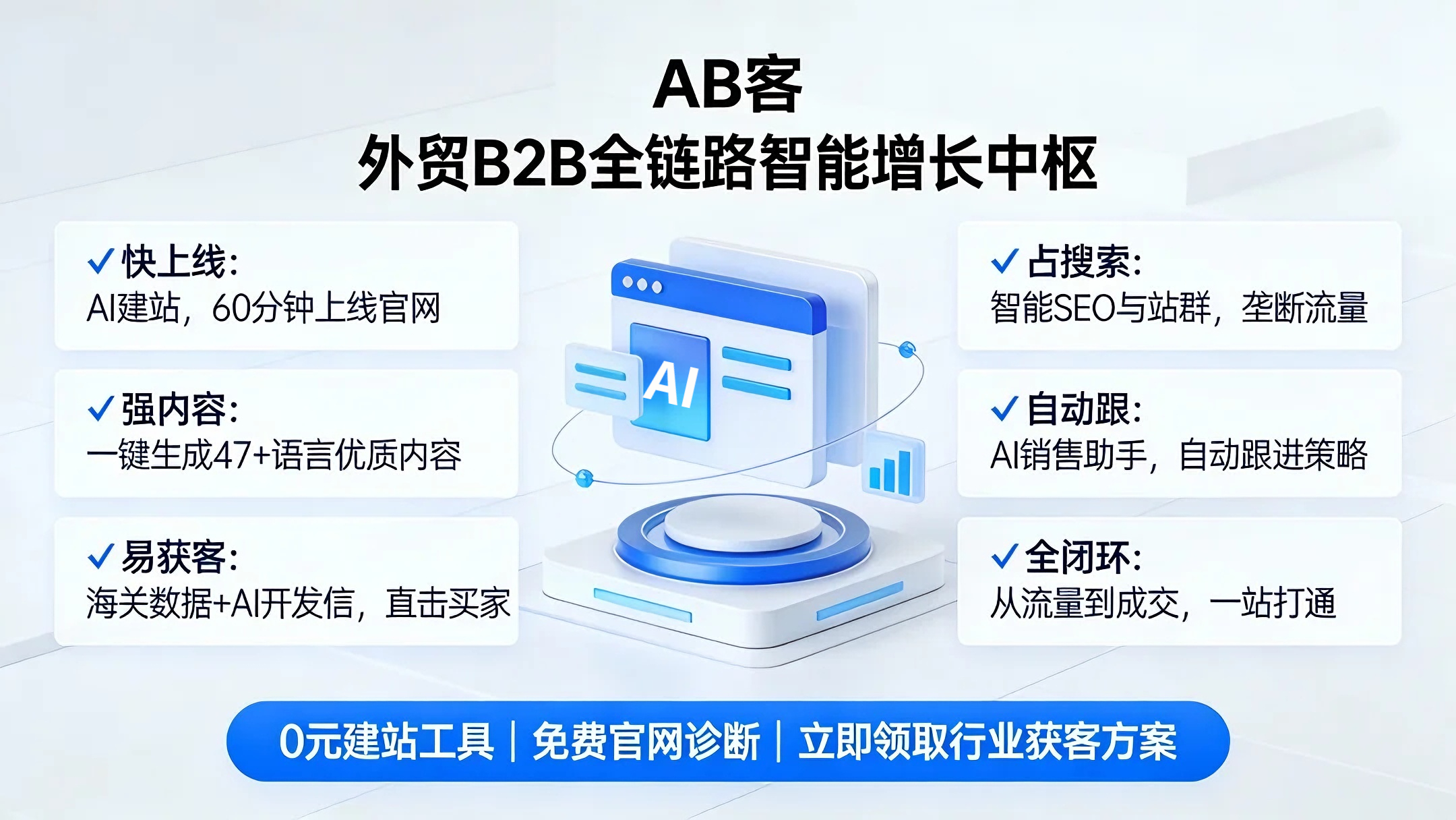
The role of AB customers is not to "do marketing" for companies.
Instead, it helps businesses build a system:
-
Centered on the brand's official website
-
Sustainable content output
-
Customer acquisition path is replicable
-
Data can be fed back for optimization
A smart customer acquisition and brand growth operating system for foreign trade B2B (Growth OS) .
When growth becomes a systemic capability, foreign trade will become controllable, predictable, and scalable again.
.png?x-oss-process=image/resize,h_100,m_lfit/format,webp)
.png?x-oss-process=image/resize,h_100,m_lfit/format,webp)

.png?x-oss-process=image/resize,h_100,m_lfit/format,webp)
.png?x-oss-process=image/resize,h_100,m_lfit/format,webp)
.png?x-oss-process=image/resize,h_100,m_lfit/format,webp)
.png?x-oss-process=image/resize,h_100,m_lfit/format,webp)
