.png?x-oss-process=image/resize,h_100,m_lfit/format,webp)

.png?x-oss-process=image/resize,m_lfit,w_200/format,webp)

热门产品

Popular articles
What is International Trade?International Trade: Definition, Core Activities, and Global Significance
The five "trillion-level hot spots" in foreign trade in 2025, seize them and you will be the next "hot-selling king"!
Green supply chain construction for small and medium-sized enterprises: the key to sustainable compliance management!
Cracking the Tough Nuts of Australia's RCM Certification: Why Must an Australian Local Company Hold the Certificate?
Why Independent Websites Are the Top Choice for Cross - border E - commerce and Their Advantages
Unlocking Opportunities: ABK AI Content Factory Tackles Global B2B Trade Content Marketing Localization Challenges with Business Growth
A guide for new foreign trade professionals: how to attract overseas customers through email (with practical tool tutorials)
Google's algorithm update is designed to kill AI-based drafts! 7 tips to keep your rankings (with a detailed self-help list)
Recommended Reading






.jpg?x-oss-process=image/resize,h_1000,m_lfit/format,webp)
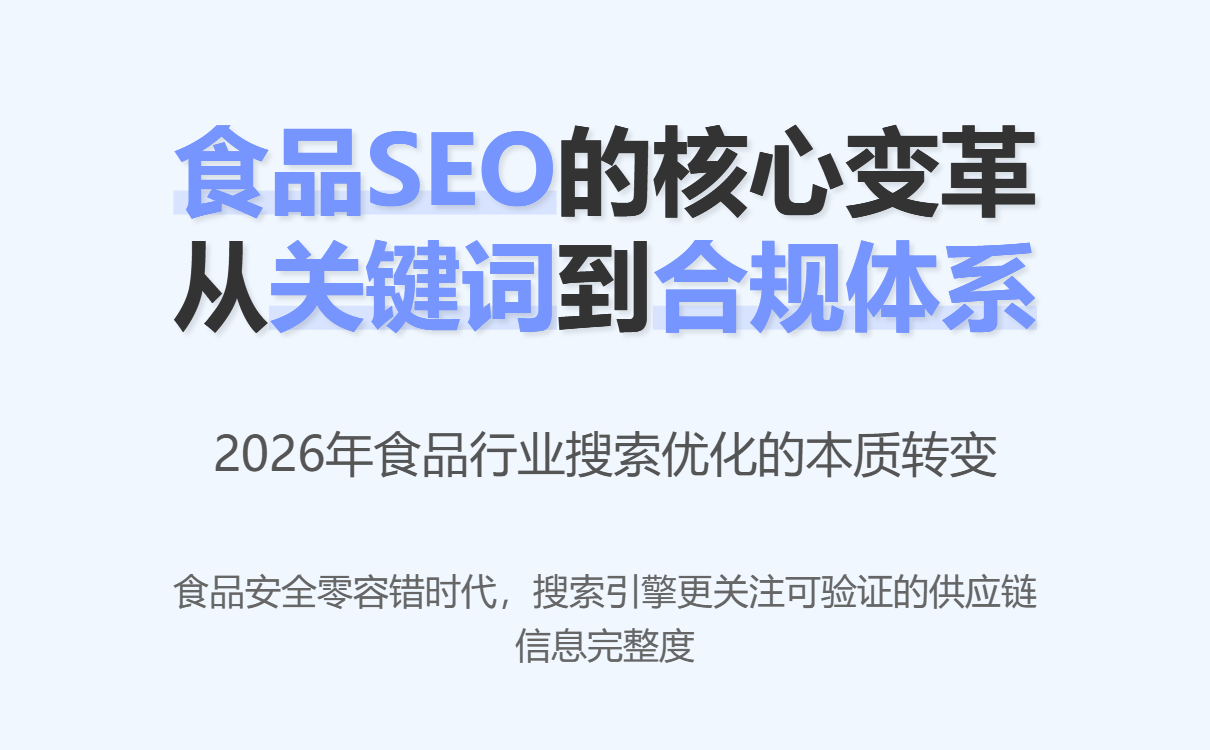
The real core of food & agricultural product SEO is not keywords, but the "completeness of compliance information".
Many food companies struggle to generate inquiries despite implementing SEO, and the problem isn't with keywords, but rather with a lack of compliance information. This article delves into the fundamental differences between food industry SEO and industrial product SEO, details the content structures that Google and AI search will prefer in 2026, and teaches you how to create high-quality, sales-driven food SEO using real-world examples from HACCP, ISO, and FDA standards.

For a long time, foreign trade SEO was simply understood as three things:
-
Find keywords
-
Writing articles
-
Post Page
However, if you are in the food and agricultural products industry and have entered a growth stage, you will increasingly feel a reality:
While some websites are doing SEO, the inquiries they receive are becoming increasingly precise, while others, despite having traffic, consistently struggle with conversion rates.
The problem often lies not in the level of execution, but in the underlying logic.
This article will start from the essence of procurement in the food industry and systematically break down a conclusion:
The core of food and agricultural product SEO has never been "keyword coverage," but rather "the completeness of compliant information."
This is also the most realistic and brutal screening standard that Google and AI search will use for food websites in 2026.
1. Why are food SEO and industrial product SEO completely different?
Many food companies unconsciously "copy the logic of industrial products" when doing SEO, often resulting in doing things the opposite of what they intended.
1. Underlying Assumptions of Industrial Product SEO
Industrial product procurement typically has the following characteristics:
-
Technical parameters are complex
-
Long procurement cycle
-
The safety risks are relatively controllable.
Therefore, SEO for industrial products tends to favor:
-
Parameter Page
-
Model Comparison
-
Application scenarios
The role of keywords is very obvious.
2. The underlying logic of food SEO is completely different.
Food and agricultural products have three irreversible properties:
1️⃣ Zero tolerance for food safety errors
2️⃣ Compliance responsibility is brought forward to the procurement stage
3️⃣The purchaser bears the direct risk
This means that the first judgment in food procurement is not:
What model are you selling?
Instead:
"Are you a supplier that can be audited, held accountable, and trusted for long-term cooperation?"
The role of SEO here is not exposure, but risk screening .
Practical tools for food and agricultural products:
Food & Agricultural Products Customs Data Inquiry ⎪ Food & Agricultural Products Email Mining ⎪ Food & Agricultural Products Website Building ⎪ Food & Agricultural Products Customer Management ⎪ Food & Agricultural Products Email Marketing
II. In 2026, what kind of food content will Google/AI search prefer?
1. Search engines no longer "trust single points of content".
Entering 2026, the core capabilities of search engines and AI have changed:
-
Able to understand the logical relationships between pages
-
Able to determine whether information is complete and reliable
-
Able to comprehensively assess "whether a company is professional".
For the food industry, it is becoming increasingly difficult to get sustained recommendations for a single product page.
2. Search and AI prefer "verifiable content systems".
The term "verifiable" does not refer to the amount of writing, but rather to:
-
Is the information closed loop?
-
Do the contents corroborate each other?
-
Does it conform to the logic of a real food supply chain?
Therefore, the following five types of content are becoming the core sources of authority for food SEO.
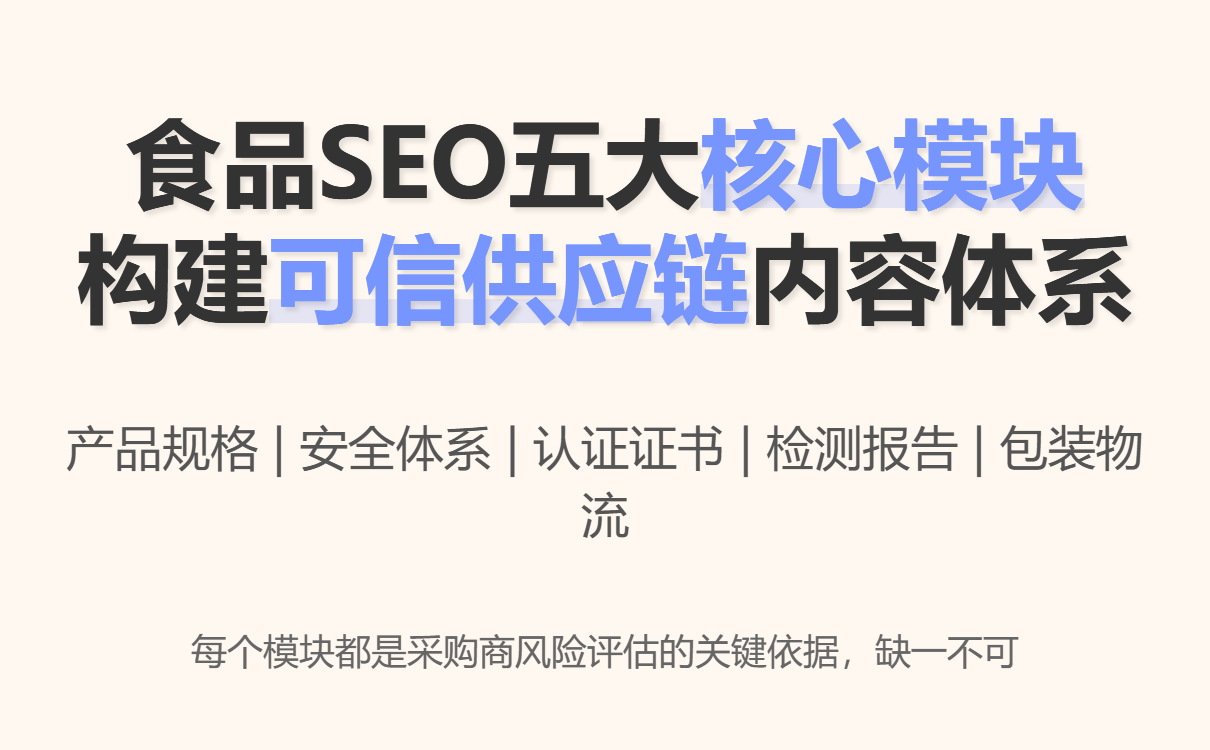
III. Five Core Content Modules for Food SEO (None Can Be Missing)
1. Product Specification
This is the most basic and also the most easily underestimated aspect.
Food product pages must clearly present:
-
Product Name and Scientific Name
-
Grade/Specification
-
Moisture/Impurity
-
MOQ
-
Application scenarios (retail/wholesale/processing)
Fuzzy specifications = unprofessional signal.
2. Food Safety System
For search engines and buyers,
These types of pages are answering a core question:
"Do you possess continuous, stable, and replicable quality control capabilities?"
Common structures include:
-
Raw material control
-
Process control
-
Batch Management
-
Internal testing process
This isn't marketing content; it's trust infrastructure .
3. Certifications
In the food industry, certification is not a bonus, but rather a "certificate of qualification".
Common high-weight certifications include:
-
HACCP
-
ISO 22000
-
FDA Registration
-
Halal / Kosher
The key is not in quantity, but in:
-
Is it true?
-
Is it traceable?
-
Does it match the product?
4. Testing Reports
Testing reports are the most undervalued SEO content asset in the food industry.
It simultaneously satisfies:
-
Search engine's judgment of authenticity
-
Buyer's risk control
Suggested structure:
-
Testing agency description
-
Testing items
-
Qualified conclusion
-
Applicable Products
5. Packaging & Logistics
Many companies overlook this module, but for international buyers, it is:
-
Is it executable?
-
Is it feasible to land?
-
Does the company have export experience?
This is an important basis for judgment.
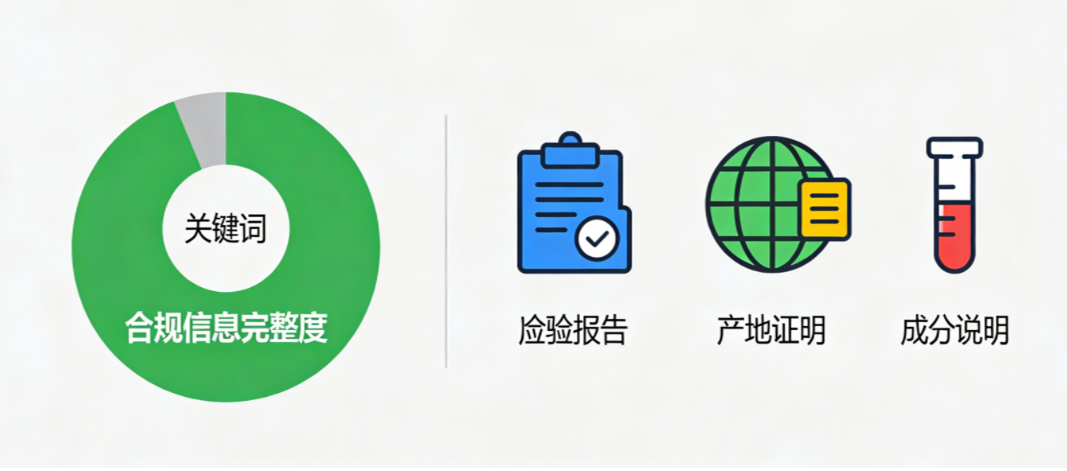
IV. Example of Keyword Structure for Food SEO (Applicable to 2026)
In the food industry, keywords must be associated with "compliance semantics".
1. Product + Specifications
-
walnut kernel halves
-
dried ginger slices
2. Product + Place of Origin
-
Xinjiang walnut supplier
-
Yunnan coffee bean exporter
3. Product + Certification
-
HACCP certified peanut supplier
-
FDA registered garlic manufacturer
4. Product + Role
-
sesame seeds manufacturer
-
canned food supplier
Keywords are just the entry point; content structure determines the sales.
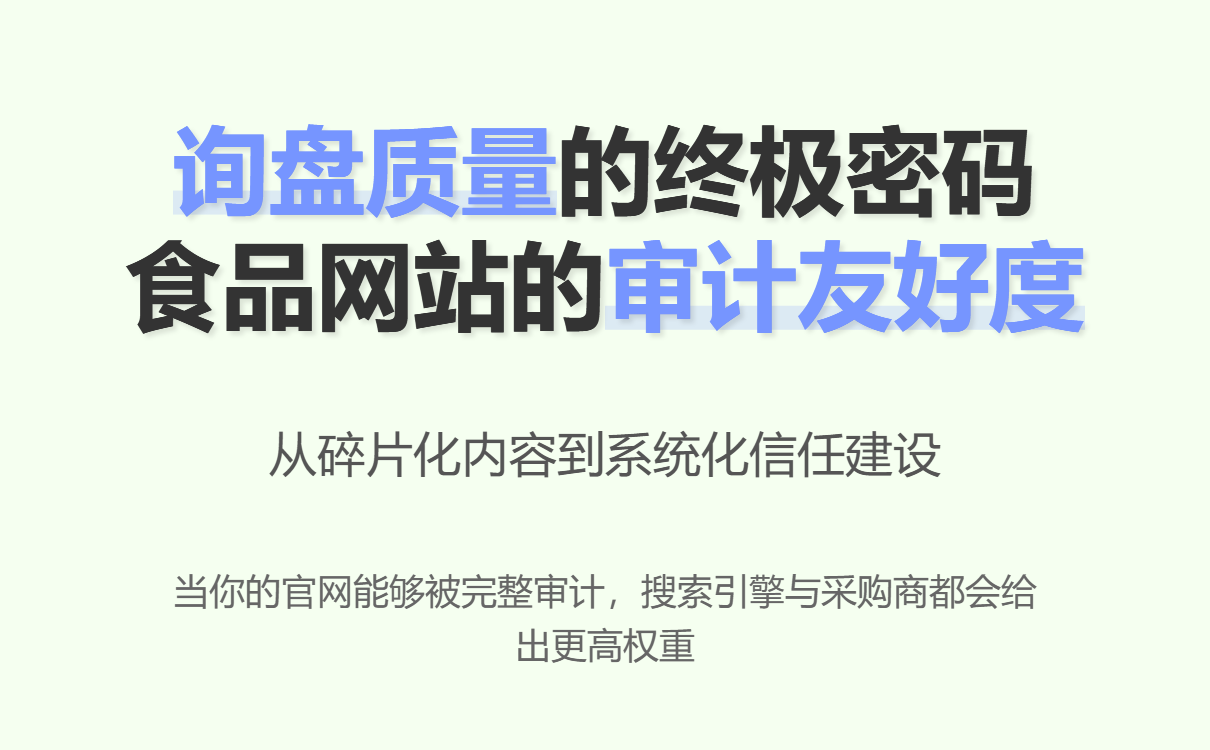
V. Case Comparison: Why do websites with "compliant systems" generate more accurate inquiries?
Case A: Websites with a compliance system
-
Independent Authentication Page
-
Clear test report
-
Product page and certification are strongly linked
result:
-
The number of inquiries is not necessarily the highest.
-
However, the buyer is clear and communication is extremely efficient.
Case B: Websites without a compliance system
-
Only product images and prices
-
Compliance information is scattered or even missing.
result:
-
Inquiry miscellaneous
-
Price comparison is serious
-
Low transaction rate
SEO doesn't bring about a difference in traffic, but rather a difference in customer quality.
VI. Truly effective food SEO must be a "systematic project".
If we consider food SEO as a long-term asset, then three issues must be addressed:
1️⃣ Is the content systematic?
2️⃣ Are the pages related?
3️⃣ Was the search intent fully captured?
Writing articles in a fragmented manner will only bring fragmented inquiries.
From "piling up content" to "building a system"
Truly mature food SEO typically possesses the following characteristics:
-
Product page ↔ Compliance page ↔ Place of origin page are linked together
-
For each keyword, you can find a "trust support page".
-
Content continues to accumulate as the business grows.
This is why an increasing number of growing food companies are starting to use intelligent website building and growth systems like ABK .
From the outset, the content structure, SEO logic, and industry templates were planned in a unified manner.
Avoid repeatedly investing time and effort only to remain at the stage of low-quality inquiries.
.jpg)
In conclusion: The ultimate goal of food SEO is to be "chosen with confidence".
If early SEO was about who could write better articles,
So, what will food SEO be all about in 2026?
Which one is more like an "auditable supply chain company"?
When your official website can display the following:
-
product
-
Origin
-
Compliance
-
process
Both search engines and buyers will give the same answer:
This is a food supplier that deserves serious consideration.
.png?x-oss-process=image/resize,h_100,m_lfit/format,webp)
.png?x-oss-process=image/resize,h_100,m_lfit/format,webp)

.png?x-oss-process=image/resize,h_100,m_lfit/format,webp)
.png?x-oss-process=image/resize,h_100,m_lfit/format,webp)
.png?x-oss-process=image/resize,h_100,m_lfit/format,webp)
.png?x-oss-process=image/resize,h_100,m_lfit/format,webp)
