.png?x-oss-process=image/resize,h_100,m_lfit/format,webp)

.png?x-oss-process=image/resize,m_lfit,w_200/format,webp)

热门产品

Popular articles
How B2B Companies Can Expand into International Markets
Case analysis: How do excellent foreign trade B2B companies manage their customers with high quality?
6 effective ways and methods to develop foreign trade B2B customers: practical tutorial
ABKe: Integrating Massive Data for 24/7 AI-Powered Precision Client Acquisition in B2B Foreign Trade
Top Free Automation SEO Tools to Boost Google Rankings & Improve Landing Page Conversions
A must-read for new foreign trade professionals: A complete guide to EU CE certification and analysis of common problems
How Foreign Trade Enterprises Navigate Exchange Rate Risks Post-LME's Non-USD Options Suspension
Recommended Reading






Trade Shows vs. SEO vs. Platforms: How to allocate channel budgets most cost-effectively in the machinery industry in 2026?
How should customer acquisition budgets be allocated in the machinery and industrial equipment industry in 2026? This article delves into three core channels: trade shows, SEO-enabled official websites, and B2B platforms. Combining the latest industry trends, purchasing habits, and budget models for companies at different stages of development, it provides the most practical channel combinations and cost-return analysis. This is suitable for machinery manufacturers, automation equipment companies, construction machinery exporters, and foreign trade teams developing their 2026 marketing budgets.

Competition in the foreign trade machinery industry in 2026 will be more "calculated" than in any previous year.
Stabilizing shipping costs, changes in tariff structures in some regions, and accelerated de-risking in global manufacturing are making procurement chains more transparent, longer-cycled, and more technically demanding .
This means:
👉 The choice of which customer acquisition channel you allocate the same amount of money directly determines whether you can secure high-quality projects and enter the customer's supply chain.
However, in practice, many machinery companies share a common confusion:
Which is the most cost-effective: trade shows, SEO, or B2B platforms? How should the budget be allocated?
Based on 2026 trends, industry development patterns, and the actual transaction paths of numerous machinery companies , the following is an immediately implementable channel budgeting strategy. Recommended reading: 2026 Global Machinery and Industrial Equipment Industry Outlook: 5 Opportunities and 3 Risks
Why is "channel mix" more important than budget in the machinery industry?
Mechanical equipment is a typical high-value, long-cycle, multi-person decision-making (MDM) product.
Whether you're selling packaging machines, machine tools, conveyor lines, construction machinery, or pumps and valves, the procurement chain generally involves:
Requirements confirmation → Solution comparison → Budget approval → Technical evaluation → Prototype/site visit → Business negotiation → Order placement
Therefore, your channels must do three things:
-
Discovered by customers early on (SEO / platform)
-
Building trust in the medium term (case studies, technical materials, videos)
-
It was approved in the final stage (exhibition/on-site experience).
This is why the machinery industry is not suited to a "single channel" approach, but must use a combination of strategies.
II. Budget proportions should be completely different at different stages of development.
The following budget refers to the marketing budget (excluding sales staff salaries).

① Start-up companies (0-3 years)
Suitable for: small machine shops, small trading companies, and startup automation companies
Budget Suggestion: Platform 45% | Trade Shows 25% | SEO 10% | Email/Directory 15% | Other 5%
Why allocate it this way?
✔ The platform generates inquiries the fastest (Alibaba/Made in China/EC21/Taiwan platform)
✔ You must participate in at least one exhibition to establish credibility in the industry.
✔ SEO requires less investment, but it cannot be stopped, because search exposure affects later growth.
✔ Directory + email marketing can expand reach at a low cost
Key logic: What startups lack most is "opportunity" and "exposure"—and platforms are the fastest way to break through.
② Growth stage enterprises (3-8 years)
Suitable for: Medium-sized machinery factories, automation equipment companies, and construction machinery exporters
Budget Suggestion: Trade Shows 30% | SEO 20% | Platforms 25% | Email/Directories 10% | Advertising 10%
Why allocate it this way?
✔ The exhibition brings "high-quality project visitors"
✔ SEO and technical content improve inquiry quality
✔ The platform will still exist, but it will no longer be dominant.
✔ Appropriate advertising (Google Ads/LinkedIn) can expand brand reach.
Core logic: Growth-stage companies pursue higher quality customer sources, rather than simply quantity.
③ Mature enterprises (large machinery groups, industry leaders)
Budget Recommendation: Trade Shows 40% | SEO + Brand Search 25% | Agency System 20% | Platform 5% | Advertising 10%
Why allocate it this way?
✔ Large orders are usually signed at trade shows.
✔ High brand search volume naturally brings in targeted customers.
✔ The agency system/regional branches are the core growth driver
✔ The platform merely "supplemented its presence".
The core logic is that the main battleground for mature companies is not online, but in the "offline decision-making chain" and "brand influence".
III. 2026: Trade Shows vs. SEO vs. Platforms - How to Allocate Resources Most Cost-Effectively?
The adaptability is analyzed from three dimensions: (sales chain length, product type, and enterprise development stage).

1) Exhibitions: Suitable for high-value, large-scale decision-making, and project-based equipment.
Applicable products: construction machinery, machine tools, packaging lines, automated production lines, heavy equipment, and turnkey solutions.
In 2026, the influence of major global industrial exhibitions will further increase:
✔ Industry restores investment confidence
✔ Large corporations and major engineering projects will be given priority for on-site visits.
✔ The Middle East, ASEAN, and Latin America are areas of opportunity.
Why do trade shows have a high ROI?
Because there is an ironclad rule in the machinery industry:
For truly large projects, 80% are confirmed offline.
Advantages of the exhibition:
-
The decision-maker will come
-
It can directly display the prototype, structure, and process.
-
One-stop access to peers, buyers, and agents
-
High-value projects are easier to facilitate.
Suitable for companies that want to focus their budget on trade shows:
-
There is a prototype
-
Technical strength
-
The goal is to secure "whole-line projects" or "engineering orders".
2) SEO: Suitable for products with high technical content and requiring comparative data.
Applicable products: Automation equipment, testing equipment, industrial instruments, machine tool parts, non-standard equipment, pumps and valves, and industrial system integration products.
Potential customers for machinery and equipment will check at least the following before making a formal inquiry:
-
Technical data
-
parameter
-
Operation video
-
Case
-
Factory size
-
Comparison of brands
These types of users are most likely to find your official website through Google search .
In 2026, the Google ecosystem will place even greater emphasis on:
✔ Technical depth
✔ Original process description
✔ Video/3D rendering
✔ Product Comparison Page
✔ Technical White Paper
Therefore , SEO can improve the quality of inquiries and reduce customer acquisition costs .
Apprentice-type customers are on the platform, engineer-type customers are on Google.
3) B2B platform: suitable for small and medium-sized equipment, standard parts, and products with easily comparable prices.
Applicable products: Packaging machines, marking machines, small machinery, general equipment, spare parts, tools, accessories, and mature product categories with high sales volume.
Platform advantages:
-
Fast exposure
-
Large number of inquiries
-
Easy to place orders
-
Suitable for new product validation markets and customer base expansion
However, the problems are also obvious:
-
Severe homogenization
-
Intense price competition
-
The procurement chain is often short (end-user engineers are not necessarily found on the platform).
Platforms are always the "traffic pool" of the machinery industry, but not the final "transaction pool".
IV. The "Most Cost-Effective" Combination Strategy: A Three-Pronged Approach for the Machinery Industry in 2026
Drawing on the experience of industry leaders:

① The "Exhibition + SEO + Platform" Golden Triangle Model (Most Effective)
This is the most mainstream and stable model in the industry.
-
The platform is responsible for "casting a wide net".
-
SEO is responsible for "targeting precise users".
-
The exhibition is responsible for securing big projects.
Suitable for 80% of machinery companies.
② A high-quality customer acquisition model combining "exhibitions + SEO + content system + self-built website"
This is targeted at companies with high technological content and strong brand requirements.
What businesses need to do is not to pile on traffic, but to build a "trustworthy technical content system":
-
Technical White Paper
-
Industry Customer Cases
-
Equipment operation video
-
Process Explanation
-
Online selection tool
-
FAQ Technical Library
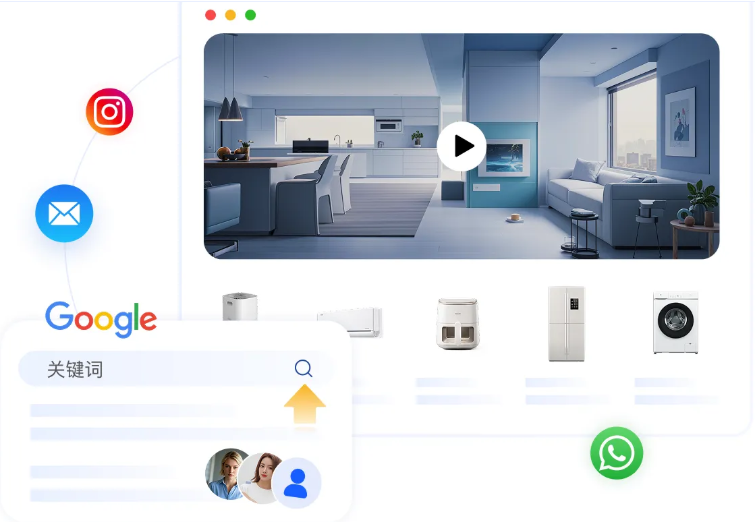
AB Customer's intelligent website building has a clear advantage in this area:
-
Automated SEO
-
Automatic generation of multilingual technical articles
-
Structured product library
-
Automatic tracking of inquiry forms
-
Page layout adapted to engineering industry display standards
This is ideal for growing machinery manufacturers, allowing them to improve the quality of inquiries through "technical content".
③ "Platform + Email Development + Light SEO" Cost-Sensitive Model
Specifically for small factories with tight budgets
-
Relying on the platform to generate inquiries
-
Email Development to Expand Reach
-
Light SEO for basic exposure
It can start generating orders at the lowest cost.
V. How will the budget proportions be determined in 2026?
Just remember one sentence:
The more expensive the equipment and the more complex the project, the more exhibitions are needed.
The higher the technical content, the more SEO is required;
The lower the unit price and the stronger the standardization, the more suitable it is for the platform.
Summarize in a table below 👇
| Condition | Most suitable channel |
|---|---|
| Unit price: $50,000 - $1,000,000 | Trade Shows > SEO > Platforms |
| Unit price: $5,000-$20,000; technical skill: intermediate. | SEO = Platform = Exhibition |
| Unit price $1,000-$10,000, standard parts | Platform > Email > SEO |
| The target countries are the Middle East, Southeast Asia, and Africa. | Exhibition priority |
| The target customers are engineers/OEMs | SEO is absolutely essential |
| The target customers are distributors. | Platform + Exhibition |
| Budget | Platform + Email Development |
VI. Conclusion: The most cost-effective and stable channel strategy for the machinery industry in 2026
If you could only remember one sentence, please remember this one:
Trade shows secure large projects, SEO helps acquire technical clients, and platforms help secure small to medium-sized orders.
Budgets should change as the company progresses; don't blindly copy others.
The best model for most machinery companies:
✔Initial Stage: Platform → Exhibitions → Email → (Light SEO)
✔Growth Stage: Trade Shows → SEO → Platforms → Advertising
✔Maturity Stage: Trade Shows → Brand SEO → Agency System
When budget is limited, the following priority order is recommended:
SEO (Long-term Assets) > Trade Shows (High-Quality Transactions) > Platforms (Traffic Entry Points)
.png?x-oss-process=image/resize,h_100,m_lfit/format,webp)
.png?x-oss-process=image/resize,h_100,m_lfit/format,webp)

.png?x-oss-process=image/resize,h_100,m_lfit/format,webp)
.png?x-oss-process=image/resize,h_100,m_lfit/format,webp)
.png?x-oss-process=image/resize,h_100,m_lfit/format,webp)
.png?x-oss-process=image/resize,h_100,m_lfit/format,webp)
