.png?x-oss-process=image/resize,h_100,m_lfit/format,webp)

.png?x-oss-process=image/resize,m_lfit,w_200/format,webp)

热门产品

Popular articles
B2B Foreign Trade SEO Practical Guide: Building an Efficient Optimization System to Achieve Global Traffic Breakthrough
How to Identify High-Frequency Spanish Market Procurement Words with AI Tools: Practical Methods for Multilingual Keyword Monitoring for Foreign Traders
How to Successfully Host an Online Trade Show on Facebook and Secure International Orders
Use AI to control customers and turn a small inquiry into a 1 million dollar order!
Can you use the packaging method specified by us?
How to use SEO technology to accurately acquire global customers in foreign trade SOHO
How to Precisely Target Overseas B2B Customers on LinkedIn: Market Insights & Practical Strategies
Zero-Code Website Builder for Global Trade: Build a Multilingual B2B Site in 3 Hours with AI Architecture & SEO Optimization
How to get the logistics tracking number after delivery?
Recommended Reading








.jpg?x-oss-process=image/resize,h_1000,m_lfit/format,webp)
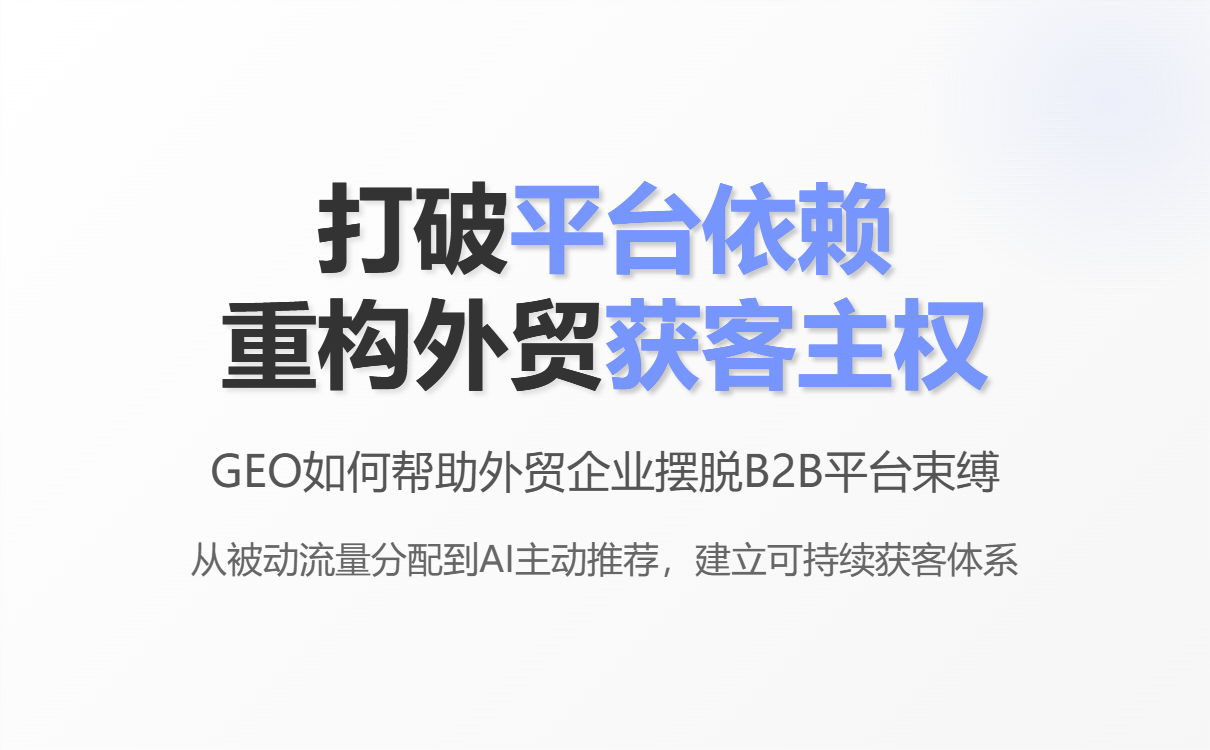
Traditional Platforms VS GEO! How does GEO break the "platform dependence" of traditional foreign trade customer acquisition?
With the platform dividend gradually fading and customer acquisition costs continuing to rise, foreign trade B2B enterprises are facing serious risks of platform dependence. This article, from the perspective of enterprise decision-makers, deeply compares the underlying customer acquisition logic of traditional foreign trade platforms and GEO (Generative Engine Optimization), analyzes how GEO, through AI recommendation mechanisms, helps enterprises build an independent customer acquisition system that does not rely on third-party platforms, and naturally leads to ABker's GEO intelligent customer acquisition solution for foreign trade B2B, helping enterprises take control of customer acquisition in the AI search era.

Foreword: As the "platform dividend" disappears, what are the real risks for foreign trade enterprises?
Over the past two decades, the growth of foreign trade B2B enterprises has been almost inextricably linked to two types of platforms: B2B e-commerce platforms (such as Alibaba.com) and search engine platforms (represented by Google) . At a certain stage, they did indeed solve the problem of "where to find customers" and shaped the customer acquisition path for a generation of foreign trade enterprises.
However, as we enter 2026, an undeniable reality is emerging:
-
The platform's rules are highly opaque, and traffic allocation is uncontrollable.
-
Customer acquisition costs continue to rise, and ROI is being diluted.
-
Customer assets are held on the platform, not by the company itself.
-
AI search and recommendation are reshaping the procurement decision-making process.
The real risk is not that "the platform is not easy to use," but that the company has lost control over its customer acquisition system.
This article will systematically break down the issue from the perspective of corporate decision-makers:
-
Why is "platform dependence" becoming a structural risk for foreign trade B2B enterprises?
-
How does GEO (Generative Engine Optimization) break this dependency from its underlying logic?
-
How can foreign trade enterprises regain control of their customer acquisition capabilities in the era of AI recommendation?
I. Limitations of reliance on traditional platforms: Where are foreign trade enterprises "locked"?
1. A platform is not the same as a channel; rather, it is a "traffic allocation mechanism."
Whether it's Alibaba, Google, or other third-party platforms, they are not essentially "customer acquisition systems" for businesses, but rather the platforms' own business systems . How much exposure a business can gain, what kind of customers it attracts, and under what conditions it is seen all depend entirely on the platform's algorithms, rules, and business strategies.
For businesses, this means:
-
You cannot control whether a customer sees you.
-
You cannot control how your customers perceive you.
-
You cannot accumulate complete customer perception and behavior data.
Once the rules change, all past investments may become invalid instantly.
2. Intensified platform competition is pushing businesses into a cycle of homogenization and involution.
Under the platform logic:
-
Products were displayed in a standardized manner.
-
The solution is compressed into a parameter comparison.
-
Corporate differentiation is difficult to perceive
There is usually only one final result:
Price competition + low-quality inquiries + decreased sales efficiency
This is not due to a lack of corporate capability, but rather because the platform mechanism is inherently unfavorable for expressing complex B2B decisions.
3. Customer relationships do not belong to you, but to the platform.
In platform mode:
-
Customers trust the platform first, not the company.
-
Businesses cannot fully grasp the customer decision-making process
-
Customers may be recommended to your competitors by the platform at any time.
In the long run, this is a structurally unsustainable customer acquisition model .
II. Traditional Platforms vs. GEO: The Fundamental Differences in Customer Acquisition Logic for Foreign Trade B2B
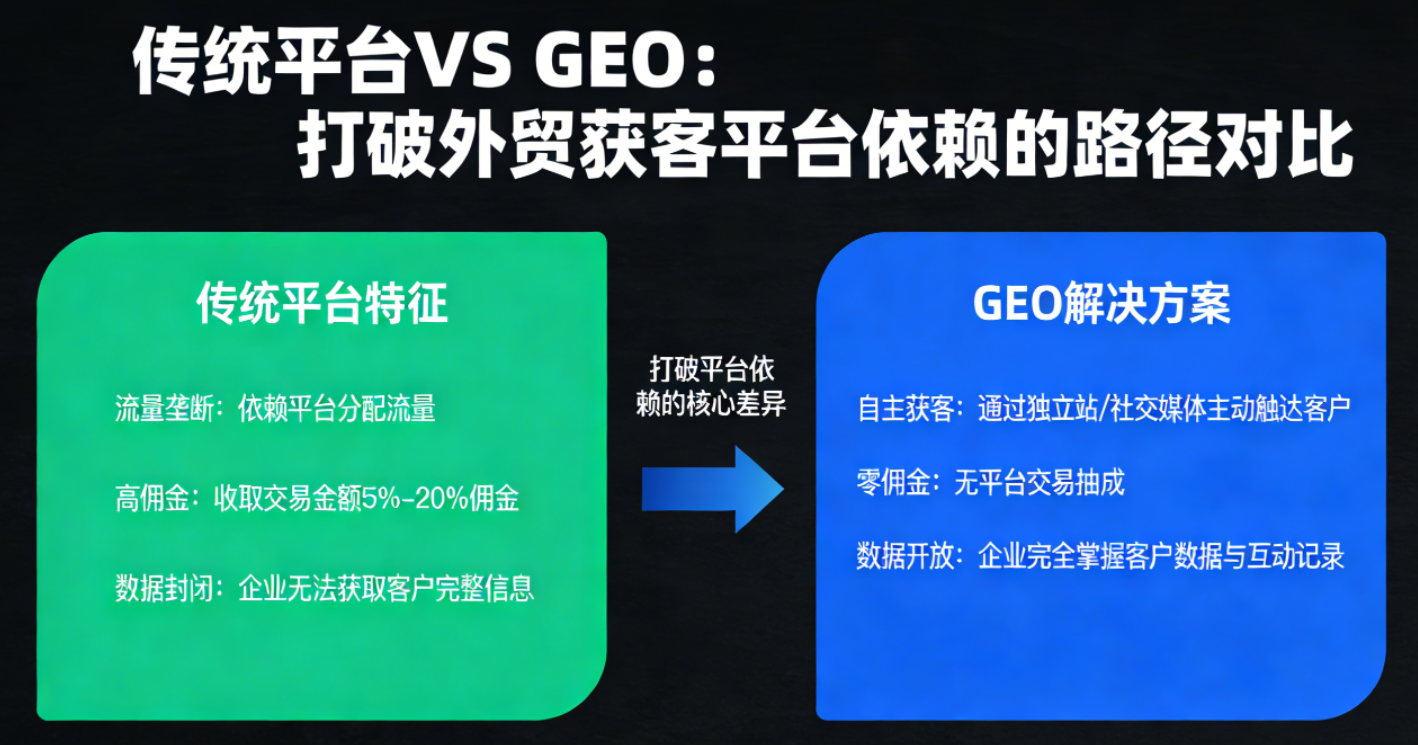
Below, we will conduct a comprehensive comparison between traditional platforms and GEO from the perspectives that are most important to enterprise decision-makers:
| Comparison Dimensions | Traditional platform model | GEO (Generative Engine Optimization) |
|---|---|---|
| Traffic attribution | The platform owns the rights, and businesses passively acquire them. | Enterprise content assets can be reused in the long term. |
| Recommendation Logic | Auction + Rules-driven | Semantic understanding + professional credibility |
| Customer perception | Look at the price, look at the rankings | See if it is "most suitable for solving the problem". |
| Differential expression | Extremely limited | It can systematically express products, solutions and capabilities. |
| Customer acquisition cost | Continued rise, uncontrollable | Initial construction costs decrease with diminishing marginal costs later on. |
| Customer quality | Primarily inquiry-based and comparison-based. | High interest, strong match |
| Data assets | Settled on the platform | wholly owned by the company |
| Risk resistance | Extremely low | Extremely high |
This is not a "tool upgrade," but a transfer of customer acquisition sovereignty.
III. How can GEO help foreign trade B2B companies achieve "independent customer acquisition"?
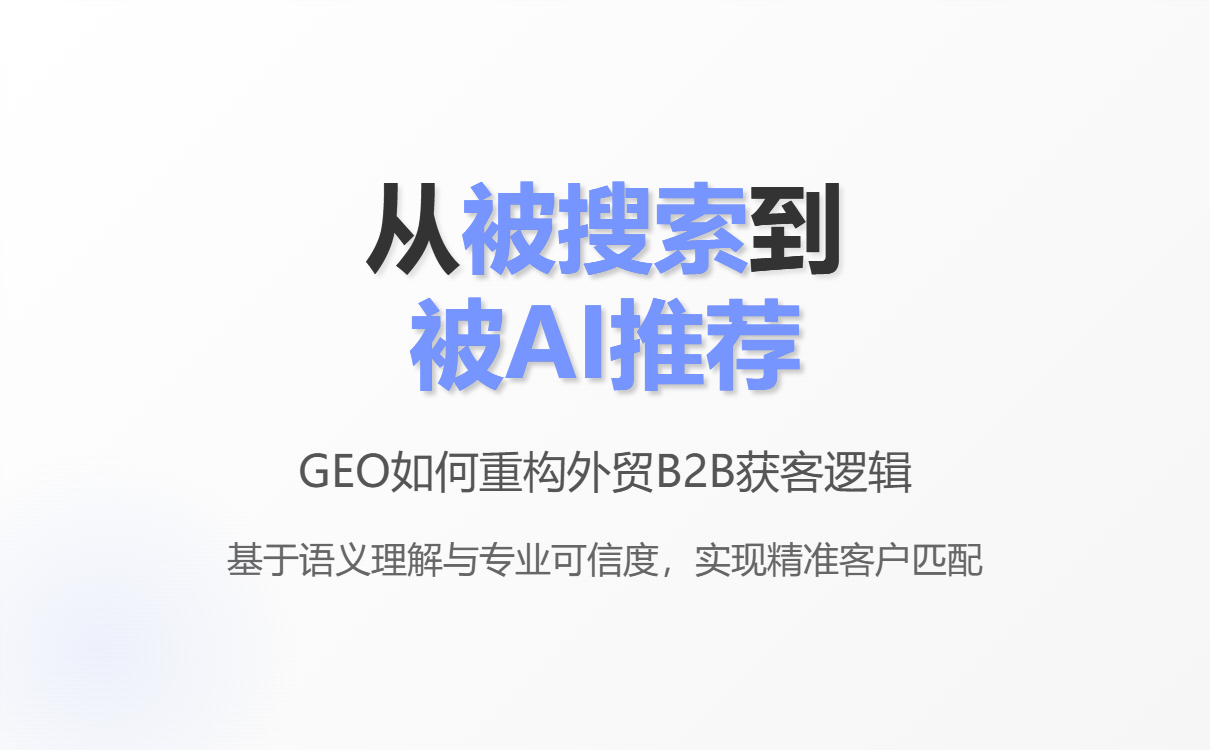
1. From being "searched" to being "proactively recommended by AI"
With generative AI becoming the entry point for procurement information, customers are no longer just searching for keywords, but directly describing their needs to the AI:
Who can provide a solution suitable for a specific scenario?
GEO's core value lies in:
-
Let AI know exactly who you are
-
Define what problems you are good at solving.
-
Actively recommend you in the appropriate purchasing context.
This is a customer acquisition method that is completely different from traditional SEO and platform exposure.
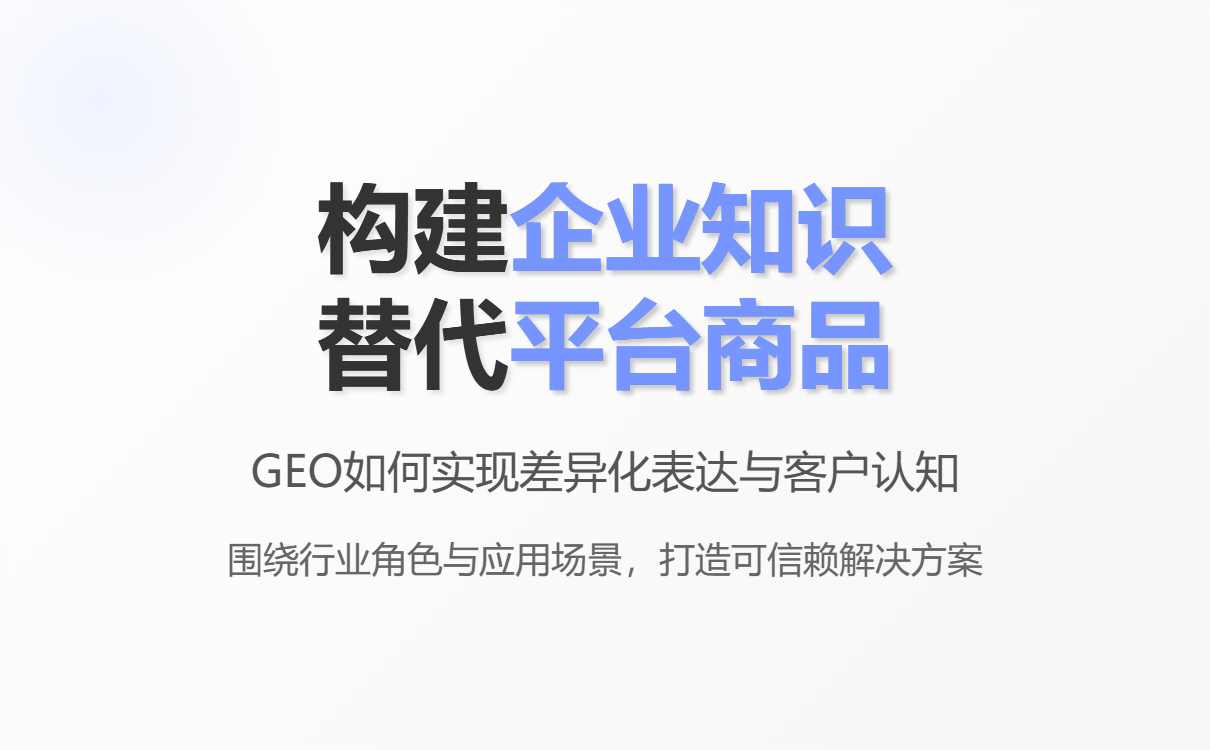
2. Replace "Platform Product Structure" with "Enterprise Knowledge Structure"
GEO doesn't pile up keywords around a single product, but rather focuses on:
-
Industry Role
-
Application scenarios
-
Solution
-
Customer decision-making logic
Build an enterprise-level knowledge system so that AI can recognize you as:
A trusted solution provider in a specific niche market.
This is precisely the content format that complex B2B decision-making truly requires.
3. Customers gain their understanding through you, rather than comparing prices on other platforms.
When customers access a company's website or content system through AI recommendations:
-
Corporate control of narrative
-
Brand, capabilities, and case studies are systematically understood.
-
Customers are more likely to enter into in-depth communication stages.
Customer acquisition is no longer about "grabbing traffic," but about "being selected."
IV. AI-driven precision recommendations: How can foreign trade enterprises break free from third-party platforms?
GEO's real breakthrough lies in:
-
Not dependent on a single platform
-
Not bound by a single algorithm
-
Effective for all mainstream generative AI
By using structured content and semantic anchors, businesses can:
-
ChatGPT
-
Gemini
-
Claude
-
Perplexity
It is repeatedly and stably recommended in various AI scenarios.
This is a decentralized customer acquisition network, with enterprises as the central nodes.
V. Establish a diversified and sustainable customer acquisition system through GEO.
For corporate decision-makers, the significance of GEO lies not in "replacing the platform," but in:
-
The platform will be downgraded from the "sole entry point" to a "secondary channel".
-
Build a long-term controllable customer acquisition infrastructure
-
Enhancing enterprises' resilience in the AI era
In practice, an increasing number of foreign trade enterprises are forming:
Platform customer acquisition + official website GEO + AI recommendation exposure + private domain conversion
A diversified customer acquisition structure.
Conclusion: The window of opportunity is closing, and customer acquisition sovereignty cannot be outsourced.
History has proven this time and again:
-
The first wave of benefits belonged to foreign trade platforms.
-
The second wave of benefits belongs to search engines
-
The third wave of benefits belongs to independent websites.
The fourth category consists of companies that can be proactively recommended by AI.
The fourth Golden Window (GEO) has opened. How can foreign trade enterprises quickly seize this opportunity? What practical methods are available? This article provides insights: " How can foreign trade enterprises 'seize' AI recommendation slots and reap the benefits of the fourth Golden Window (GEO)? "
GEO is not an "optional" capability, but a fundamental capability that foreign trade B2B companies must develop in advance in the AI era.
Based on this underlying logic, systematic solutions focusing on foreign trade B2B scenarios and centered on enterprise knowledge structure and AI recommendation mechanisms have begun to emerge in the market. For example, ABke's Foreign Trade B2B GEO Intelligent Customer Acquisition Solution was created to help enterprises build long-term, sustainable, and independent customer acquisition capabilities without relying on platforms.
When the platform's initial benefits fade, what truly determines a company's future is whether it possesses its own "recommendation capability."
.png?x-oss-process=image/resize,h_100,m_lfit/format,webp)
.png?x-oss-process=image/resize,h_100,m_lfit/format,webp)

.png?x-oss-process=image/resize,h_100,m_lfit/format,webp)
.png?x-oss-process=image/resize,h_100,m_lfit/format,webp)
.png?x-oss-process=image/resize,h_100,m_lfit/format,webp)
.png?x-oss-process=image/resize,h_100,m_lfit/format,webp)
