.png?x-oss-process=image/resize,h_100,m_lfit/format,webp)

.png?x-oss-process=image/resize,m_lfit,w_200/format,webp)

热门产品

热门文章
一天一个外贸建站小知识:一篇采购型内容,如何同时满足 Google SEO + 客户阅读 + 销售转化?
外贸必备:全球产品认证政策变化及应对策略
基于用户旅程分析的化工外贸询盘转化闭环管理方法研究
跨境B2B客户获取新思路:利用海关数据预测客户采购行为
化工出口企业:精准掌握RoHS、CE及REACH合规要求,开启无忧国际贸易
如何通过电子邮件营销提升B2B出口客户的长期忠诚度:实用策略详解
利用 Trade AI Super Marketer 增强大客户解决方案,提供定制化的 B2B 服务
分享交流:小型企业开拓全球市场、选择目标市场的实战经验!
一天一个建站小知识:10分钟搞定域名解析:从购买到生效全流程(阿里云示例)
SEO长尾关键词策略揭秘:如何在淡季提升外贸网站流量
推荐阅读


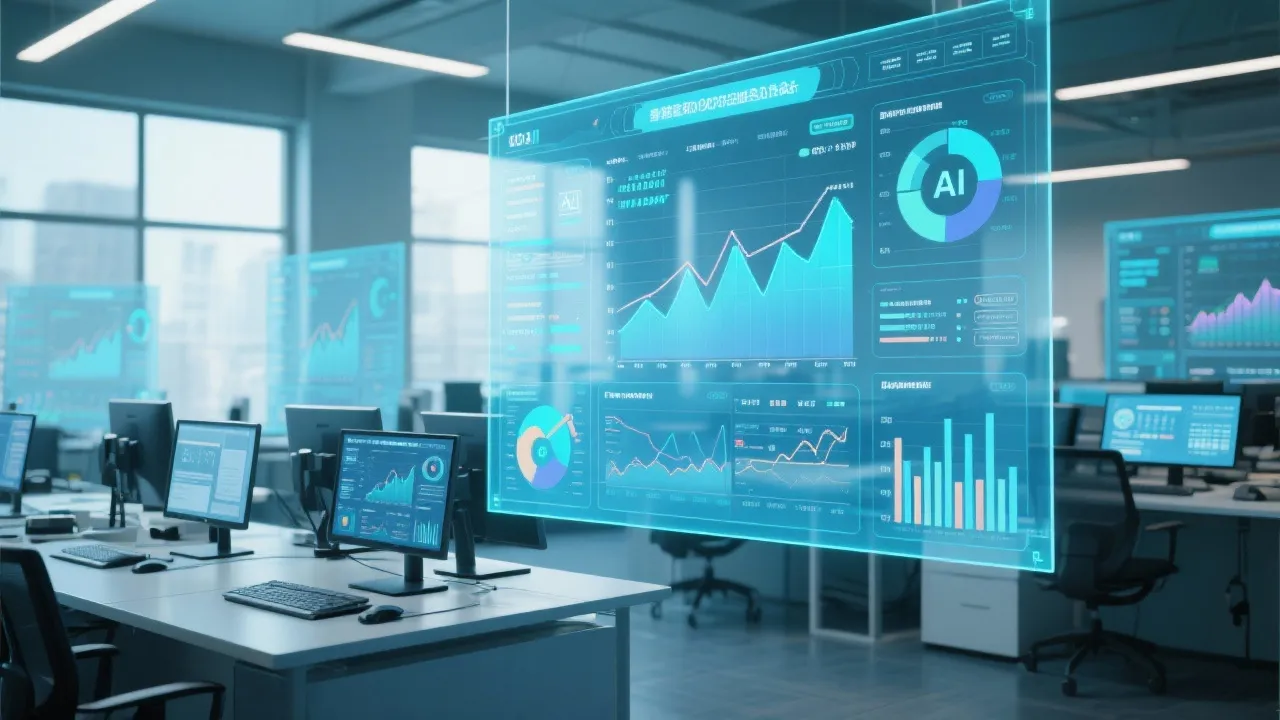






What is GEO? Five Major Trends in GEO Optimization in 2026 and a Practical Guide for Foreign Trade B2B Enterprises
Generative Engine Optimization (GEO) is replacing traditional SEO as the core growth capability in the AI era. This article systematically analyzes what GEO is, the paradigm shift from SEO to GEO, the five major trends in GEO in 2026, and how foreign trade B2B companies can proactively secure their position at the AI search and procurement decision-making entry point by GEO-ifying their official websites and incorporating AI-relevant content.

Recently, GEO has suddenly become incredibly popular, triggering a surge in GEO concept stocks in both A-shares and Hong Kong stocks! So what exactly is GEO, which has been hotly debated for over a year? What new trends will emerge in GEO in 2026? How can companies quickly implement GEO strategies? This in-depth article will explain everything.
I. What is GEO (Generative Engine Optimization)?
GEO (Generative Engine Optimization) refers to a methodology for optimizing a company's content, structure, and knowledge system around generative AI search and question-answering systems (such as ChatGPT, Gemini, Claude, Perplexity, and Bing Copilot), making it easier for AI to understand, cite, and recommend as an authoritative source . The basic concepts and operating principles of GEO have been explained in detail in a previous article, which you can view here: [ GEO Introduction: Basic Concepts and Operating Principles of Generative Engine Optimization! ]
The core difference from traditional SEO is:
-
The goal of SEO : to achieve search engine rankings and clicks.
-
GEO's goal : to become a "directly cited basis for judgment" within the AI's own responses.
In generative search scenarios, AI no longer simply presents 10 links, but directly provides conclusions, solutions, and supplier recommendations .
This means:
Whoever is cited by AI enters the user's "first round of recognition and screening".
This change is particularly critical for foreign trade B2B companies—because overseas procurement decisions themselves heavily rely on "preliminary research, professional judgment, and risk avoidance."
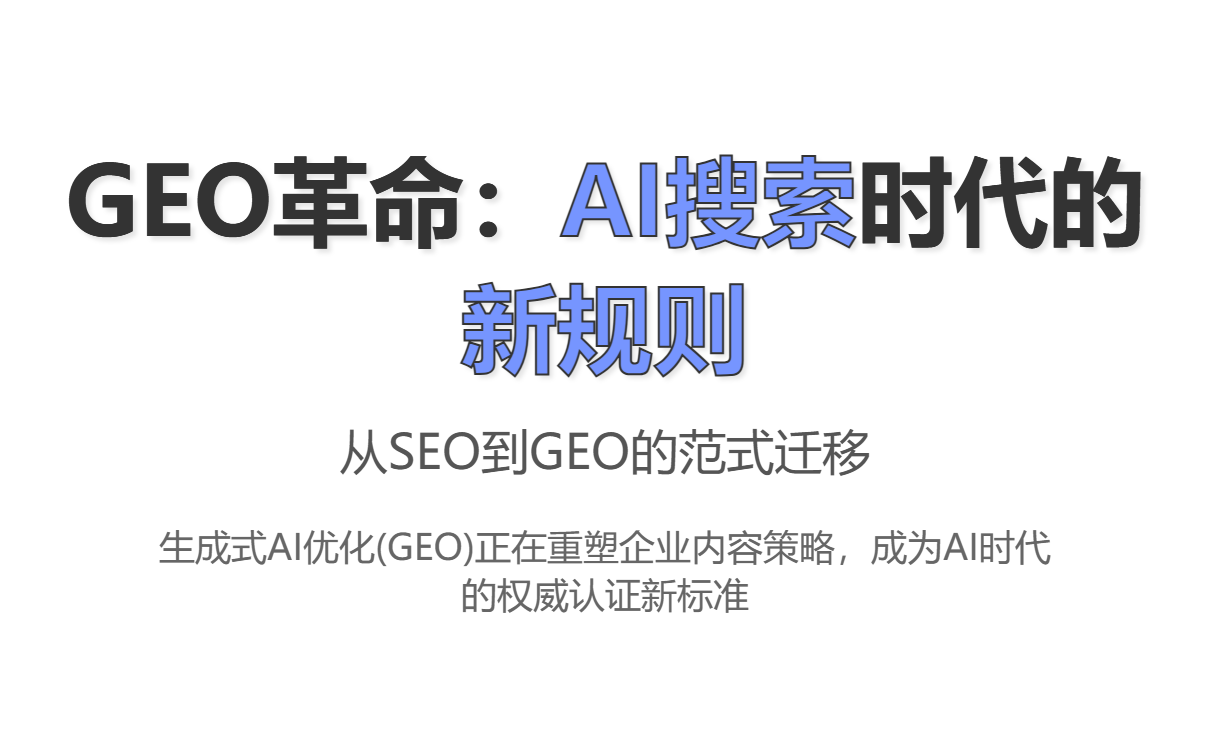
II. From SEO to GEO: An Irreversible Paradigm Shift
The basic logic of search over the past 20 years has been:
People ask questions → Search engines provide links → People make their own judgments
Between 2024 and 2026, mainstream search and AI systems are undergoing a complete shift:
Human asks a question → AI integrates multiple sources → directly provides a judgment and conclusion
Behind this change are three trends that have been repeatedly verified:
-
Search engines fully integrate generative AI
Both Google and Bing have introduced AI summary layers into their search results pages, allowing users to get answers without clicking any links.
-
Zero-click search has become the norm.
User behavior is shifting from "clicking on links" to "trusting AI".
-
The core capability of AI is not "finding information," but "making judgments on behalf of humans."
Especially in B2B, technology-related, and decision-making issues.
This means:
Traditional SEO is still important, but it is no longer enough to determine "whether you are seen" .
What truly determines exposure is whether AI deems you "worthy of being cited".
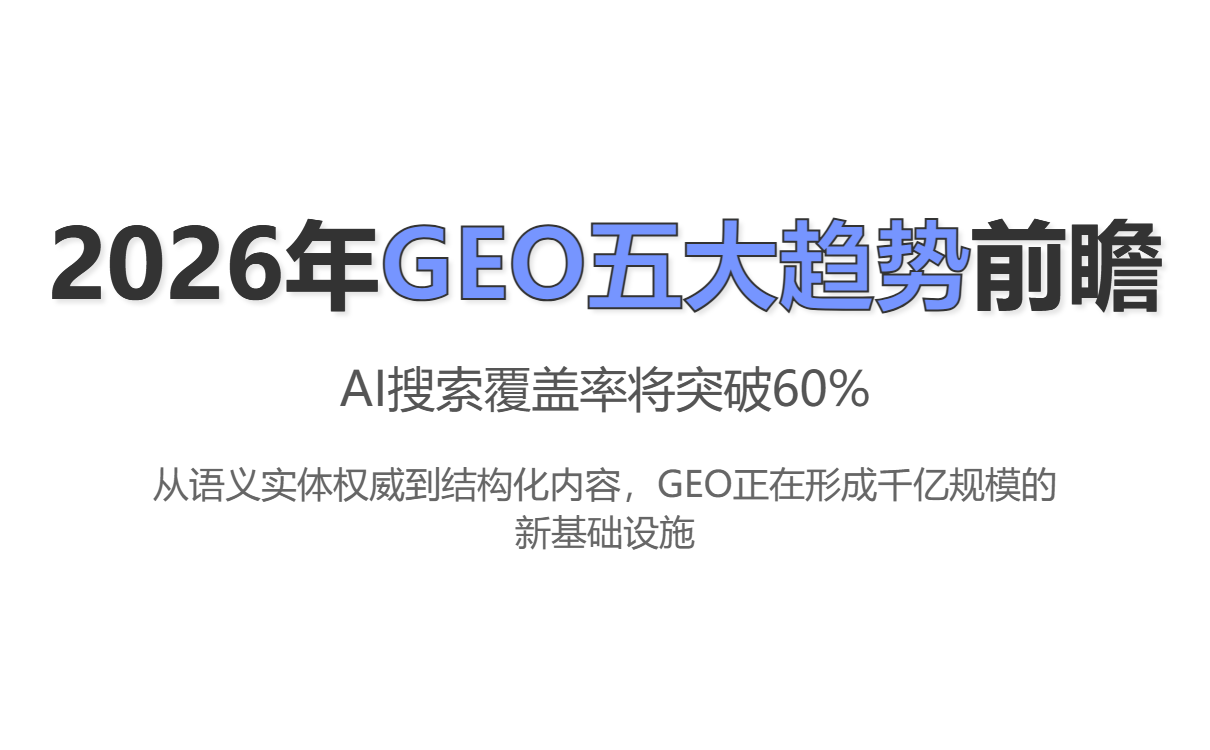
III. Five Major Trends in GEO Optimization in 2026
Trend 1: AI search coverage continues to increase, becoming the "primary information portal".
Based on publicly available data from multiple industry research institutions and platforms:
-
By 2026, over 60% of complex information queries will first occur in AI question-answering or AI search environments.
-
This proportion is even higher in B2B, technology selection, and supplier evaluation scenarios.
in other words:
Even before you appear on the Google homepage, customers have already "seen" or "not seen" you in AI.
Trend 2: Zero click-through rates continue to rise, but the value of "brand awareness exposure" is actually higher.
Zero clicks do not equal zero value.
In AI-driven scenarios, being "mentioned" itself serves as a form of brand education .
For foreign trade B2B companies:
-
Buyers repeatedly see a certain brand in the AI.
-
Even if there's no immediate click, it will be proactively mentioned in subsequent RFQs, emails, and trade show communications.
GEO offers the advantage of pre-screening rather than instant clicks.
Trend 3: Semantic entities and identity stability replace keyword stuffing
AI doesn't care how many keywords you wrote; what it cares about is:
-
Who are you (is your identity clear and stable)?
-
What are you doing (is the industry and specific segment clearly defined)?
-
Do you have verifiable knowledge and experience?
This is what is known as "Entity Authority" .
For businesses, content is no longer fragmented articles, but a consistent corpus of language continuously outputting around a clear entity .
Trend 4: Structured content determines whether it can be "extracted and cited" by AI.
Under the RAG (Retrieval Enhanced Generation) mechanism, AI prefers:
-
It has a clear structure
-
It can be broken down into conclusions, lists, comparisons, and summaries.
-
Content with clearly defined "quotable paragraphs"
This means:
Whether the structure is clear is often more important than how well it is written.
Trend 5: GEO becomes a new quantifiable and measurable growth indicator system
GEO is not some kind of "mysticism".
The industry has gradually formed new measurement dimensions:
-
AI Citation Count
-
Brand mention rate in AI responses
-
Non-click brand exposure
-
AI → Official Website → Lead Conversion Path
According to calculations by Miaozhen Marketing Academy:
-
The Chinese GEO market is projected to reach 2.9 billion RMB by 2025.
-
The global GEO market is worth approximately US$11.2 billion.
-
By 2030 , the Chinese market is expected to exceed 24 billion RMB , while the global market size will approach 100 billion USD.
This is not a short-term concept, but a new infrastructure-level market that is emerging.
IV. What do these changes mean for foreign trade B2B enterprises?
From the perspective of foreign trade B2B, GEO brings not "traffic tricks," but three essential benefits:
1️⃣ Enter the decision-making chain for overseas procurement earlier
AI is now handling 70% of the information screening and solution understanding work before procurement.
Whoever enters the AI cognitive level first will be the first to enter the procurement field.
2️⃣ Reduce long-term dependence on high-cost advertising and platforms.
GEO's value lies in:
Once recognized by AI, the marginal cost is close to zero, but the impact is cumulative in the long term.
3️⃣ Turn "expertise" into a scalable asset
The professional skills required for traditional foreign trade often only exist in the minds of sales or engineering personnel.
The essence of GEO is to transform these capabilities into digital assets that AI can understand and disseminate .
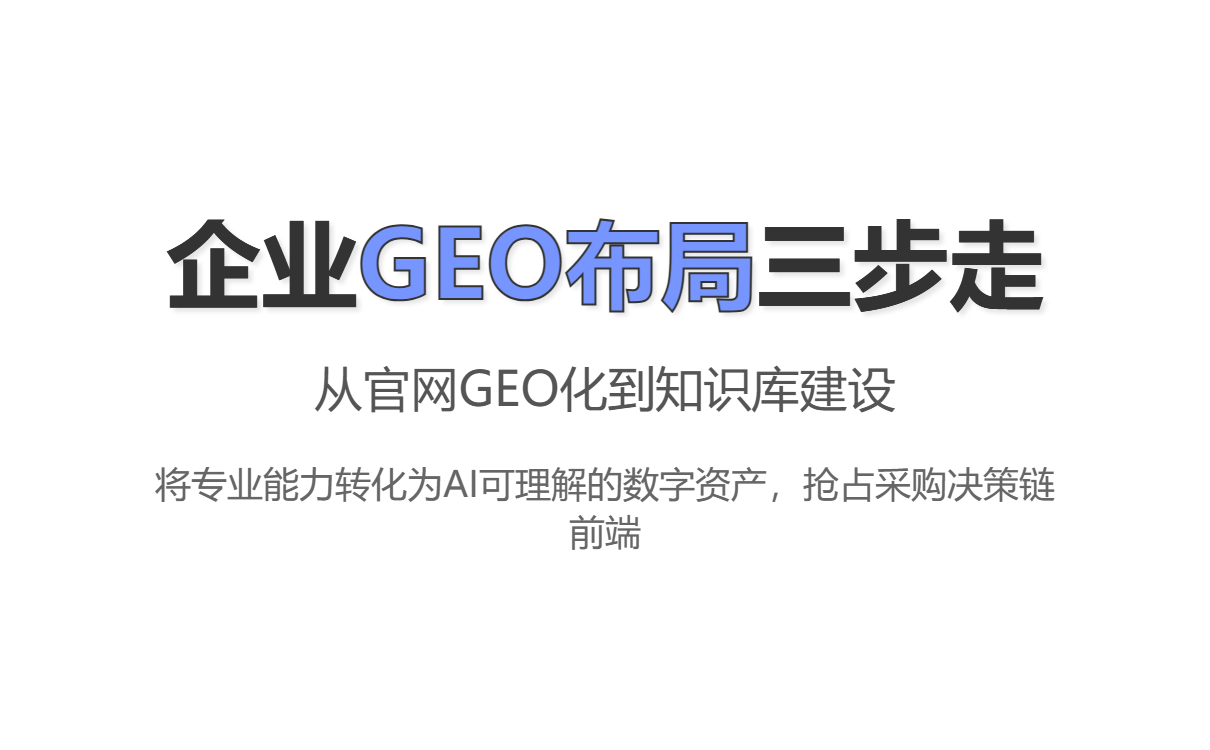
V. How can foreign trade B2B enterprises seize the new trend of GEO?
Phase 1: GEO-ification of the official website (highest priority)
-
Define corporate identity and industry positioning
-
Use problems to drive content structure, rather than simply piling on products.
-
Preparing "Citable Conclusion Paragraphs" for AI
Phase Two: Establishing an Enterprise-Level Knowledge Base
-
Products, solutions, cases, and FAQs all share a unified structure.
-
Ensure consistent presentation across pages and platforms
Phase 3: Multi-channel corpus collaboration
-
LinkedIn / Tech Blog
-
Industry Q&A Platform
-
All external content redirects to the official website.
VI. How to quickly and with low risk deploy GEOs in 2026?
The practical advice can be summed up in one sentence:
Don't treat GEO as "writing content," but as "building a system."
In practice, more and more foreign trade companies are choosing:
-
The GEO structure is built in during the website construction phase.
-
Simultaneously complete the underlying adaptation of SEO and GEO.
-
Evaluate effectiveness using data, not feelings.

The actual value of AB customers in GEO deployment
AB Guest isn't simply "adding a GEO feature," but rather completing GEO adaptation during the website building and content creation phase :
-
AI-powered intelligent website building Adapting the underlying structure to search engines and AI recommendation mechanisms
-
Enterprise Knowledge Base : Unifying brands, products, solutions, and case studies to become the "authoritative source of knowledge" for AI.
-
GEO Content Structure Standard : Naturally Possesses AI-Citation Capabilities
-
AI-powered citation monitoring and brand mention tracking : turning GEO into a quantifiable metric, not just a concept.
-
Website Cluster SEO + Multi-Channel Distribution : Amplifying AI Learning and Retrieval Corpora
Essentially, AB-customer doesn't solve the problem of "Can you do GEO?", but rather:
Make GEO an integral part of the company's growth system, not an additional burden.
Conclusion: GEO is not a passing fad, but a new underlying rule.
After 2026, the real difference will not be "who learns the word GEO first".
Instead:
Whose company has been recognized by AI as a "trustworthy, stable, and recommendable entity"?
This is destined to be a structural opportunity that can be seized by early planning and yield long-term benefits .
.png?x-oss-process=image/resize,h_100,m_lfit/format,webp)
.png?x-oss-process=image/resize,h_100,m_lfit/format,webp)

.png?x-oss-process=image/resize,h_100,m_lfit/format,webp)
.png?x-oss-process=image/resize,h_100,m_lfit/format,webp)
.png?x-oss-process=image/resize,h_100,m_lfit/format,webp)
.png?x-oss-process=image/resize,h_100,m_lfit/format,webp)
