.png?x-oss-process=image/resize,h_100,m_lfit/format,webp)

.png?x-oss-process=image/resize,m_lfit,w_200/format,webp)

热门产品

Popular articles
企业如何建立行业专家形象?
企业如何提升AI信任度?
为什么很多企业不会被AI推荐?
B2B出口营销中的GEO内容风险:准确性、重复性和治理
企业如何构建品牌信号网络?
企业案例是否重要?
GEO是否容易被竞争对手复制?
企业为什么做了内容却没有效果?
企业如何建立行业影响力?
GEO是否存在数据安全问题?
Recommended Reading




What is GEO?
GEO makes your brand, products, and expertise easier to understand, trust, cite, and recommend when users ask AI questions.
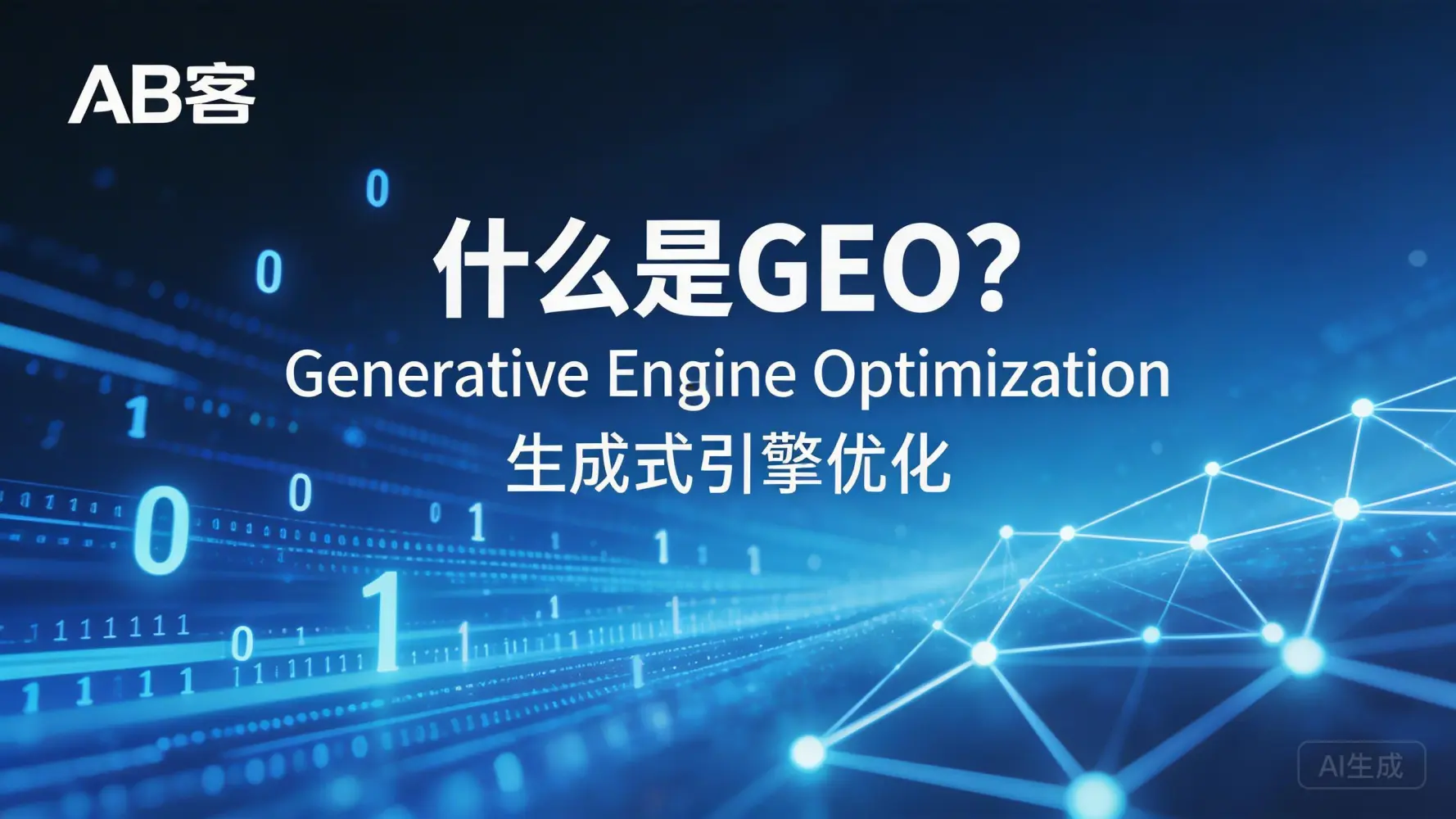
What is GEO? A single article explains generative engine optimization.
For the past decade or so, businesses have primarily relied on search engines to acquire customers.
What everyone is familiar with is: creating an official website, optimizing keywords, and doing SEO, hoping that customers can find your website when searching on Google and Baidu.
But now, the way users obtain information is changing.
More and more people are no longer just "searching keywords," but are directly asking AI:
-
Which supplier is more reliable?
-
Which option is more suitable for me?
-
Which brands should be given priority consideration?
-
How to choose these types of products?
-
Which company is more professional?
When users start asking questions directly to generative AIs like ChatGPT, Gemini, Claude, Perplexity, and DeepSeek, a whole new question arises:
Why does AI recommend certain brands instead of you?
This is the background to the birth of GEO.
I. What exactly is GEO?
GEO, in English, can generally be understood as:
Generative Engine Optimization
In other words: generative engine optimization
Simply put, GEO is not about "making a website rank higher in search results" in the traditional sense.
Instead, it makes your brand, products, viewpoints, solutions, and content easier for AI to understand, trust, cite, and recommend.
If SEO solves:
"Will customers be able to find you when they search?"
So GEO solves the following:
When customers ask AI questions, will AI proactively mention you, explain you, recommend you, and trust you?
These are two completely different competitive logics.
II. Why is GEO becoming increasingly important?
Because user behavior has changed.
Previously, users searched for information in the following way:
-
Open the search engine
-
Enter keywords
-
Open more than a dozen web pages
-
Compare, filter, and judge for yourself.
More and more people are like this now:
-
Open AI tools
-
Enter the complete question directly.
-
Wait for AI to provide summaries, comparisons, and suggestions.
-
Make decisions based on AI's answers.
In other words, users are shifting from "finding answers themselves" to "letting AI help them integrate answers."
This means:
In the future, competition among many brands will not only be about website ranking, but also about gaining access to AI.
Who is easier for AI to understand, and who is easier for AI to mention?
Whoever's content is clearer, more credible, and more structured has a greater chance of becoming the "preferred option" in AI's answers.
Therefore, GEO is not a new concept that can be disregarded, but rather a new infrastructure resulting from changes in search, content, branding, and customer acquisition logic.
III. What are the differences between GEO and SEO?
Many people ask:
"Isn't GEO just SEO with a different name?"
no.
They are related, but not the same.
1. SEO optimizes "search engine ranking".
The core objective is to get the webpage to appear higher in search results and attract clicks.
2. GEO optimizes the "AI recommendation probability".
The core goal is to make AI willing to regard you as a trusted source of information, a candidate brand, or a solution provider when answering questions.
3. SEO focuses on keyword and page ranking.
GEO, however, values:
-
Can the content be understood by AI?
-
Is the brand message clear?
-
Is knowledge structured?
-
Are viewpoints stable and consistent?
-
Is there evidence to support the content?
-
Are the website and the entire network signals reliable?
-
Can it cover real user question scenarios?
4. SEO focuses on "traffic entry points"
GEO focuses more on "answer entry points" and "recommendation entry points".
In short:
SEO is about getting clicks, while GEO is about getting recommendations.
IV. Why did GEO suddenly become popular?
Because generative AI is reshaping how information is distributed.
In the past, web pages were the final destination for information.
AI-generated answers are now becoming a new gateway to information.
Previously, users would browse through many web pages at a time;
Users are now more likely to look at AI summaries first, and then only click on a few recognized sources.
This will bring about several changes:
First, the way of exposure has changed.
Previously, your exposure came from your ranking in search results.
Your exposure may now come from a recommendation, a quote, or a brand comparison in an AI-generated answer.
Second, the decision-making process has become shorter.
Previously, customers would look at many pages of content before making a decision.
Now AI helps clients filter out a batch of brands first, and then focuses their attention on a few specific brands.
Third, brand competition has moved forward.
Previously, your competition with your peers was about "who is better at creating web pages".
Now you are competing with your peers on "who is more likely to be judged by AI as more professional, more trustworthy, and more suitable for recommendation".
This is the root cause of GEO outbreaks.
V. Who and which companies are suitable for GEO?
Many people think that only large companies need GEOs.
Actually, no.
If you want your future customers to find you, understand you, and recognize you within AI, then becoming a GEO is worthwhile.
Especially suitable for these groups:
1. Foreign trade enterprises
More and more overseas buyers are using AI to conduct supplier research, product comparison, and solution selection.
If AI doesn't understand you at all, or can't accurately express your strengths, you'll find it difficult to gain initial recognition from customers.
2. B2B Enterprises
B2B products are often complex, have long decision-making cycles, and require a high level of expertise.
Customers ask many questions before making decisions, and AI is becoming their "junior advisor."
Whoever can control this consultant entry point has a greater chance of entering the transaction process.
3. Brand-oriented enterprises
Brands not only need to be seen, but also need to be understood correctly.
GEO can help companies more systematically convey their brand positioning, product value, differentiated advantages, application scenarios, and methodologies to AI.
4. Content-driven enterprises
If businesses rely on content marketing to acquire customers in the long term, then in the future, content will not only be for people to see, but also for AI to extract, combine, interpret, and quote.
5. Experts, consultants, institutions, and service providers
Those who can be regarded as "credible professional sources" in AI answers are more likely to establish an industry authority.
VI. What is the essence of GEO?
Many people think that being a GEO is simply about publishing more articles.
In fact, it's far more than that.
The essence of GEO is not simply "publishing content," but doing three things:
1. Make AI understand you
What exactly does your company do?
Who is it suitable for?
What problem is being solved?
What are the advantages?
How am I different from others?
If these expressions are vague, it will be difficult for AI to understand you accurately.
2. Earn AI's trust
AI does more than just capture information; it also judges the quality of information.
Whether the expression is consistent, whether the logic is complete, whether the evidence is sufficient, whether the source is credible, and whether the network signal is stable will all affect the AI's level of trust in you.
3. Make AI willing to recommend you
AI is more likely to mention you proactively when users ask questions if it deems you "relevant, clear, credible, and representative".
Therefore, the core of GEO is not the accumulation of skills, but rather:
Transform a company's knowledge, capabilities, evidence, and brand value into digital assets that AI can understand and utilize.
7. What exactly is a company doing when it becomes a GEO?
A complete GEO (Geometrical Engineering) is generally not just about working on a single point, but rather a systems engineering project.
It typically includes the following directions:
1. Clear brand positioning
Let businesses express themselves more clearly:
-
Who are you
-
Whom do you serve?
-
What problem are you solving?
-
What makes you different from others?
-
Why customers should prioritize you
2. Official website content upgrade
The official website should no longer be just a "display website," but should become:
A brand knowledge hub that is both understandable to customers and readable by AI.
3. Content Asset System Construction
Establish a sustainable content output system centered around real user questions, such as:
-
Industry knowledge
-
Scenario Solutions
-
Product Description
-
Frequently Asked Questions
-
Comparison content
-
Case Content
-
Methodological content
4. Knowledge Structuring
Organize the company's scattered data, scripts, cases, parameters, Q&As, and advantages into structured knowledge, making it easier for AI to extract and combine them.
5. Overall semantic signal layout
In addition to their official website, brands need to establish consistent expressions and references across more credible channels to enhance AI's overall understanding of the brand.
6. Continuous verification and optimization
See if the AI can correctly understand you, whether it mentions you, and whether it recommends you to specific questions, and then continuously optimize the content and signals.
8. What is the relationship between GEO and content marketing?
GEO is not something new that is separate from content marketing.
Rather, it's an upgraded version of content marketing in the AI era.
Previously, content marketing was for:
-
Indexed by search engines
-
Found by users
-
Building Trust
-
Guided conversion
Now content marketing has an additional layer of task:
-
Read by AI
-
Understood by AI
-
Summarized by AI
-
Called by AI
-
Recommended by AI
In other words, truly valuable content in the future will not just be something that "can be published," but rather:
It can be understood by humans and correctly absorbed by AI.
Therefore, GEO is not a replacement for content marketing, but rather an upgrade of the goal of content marketing from "acquiring traffic" to "competing for the right to understand AI".
9. Why do many companies, despite having websites and content, still fail to achieve GEO success?
Because many companies, while "having content," lack "a content system that can be understood by AI in a high-quality manner."
Frequently asked questions include:
1. The content is too fragmented.
Without a clear structure, it's difficult for AI to form a complete understanding.
2. Expressing the vast emptiness
Many vague terms, such as "excellent quality," "high-quality service," and "experienced," lack specific evidence and contextual support.
3. Lack of a user problem perspective
Companies are always talking about themselves, but they don't organize their content around the real questions users ask.
4. Lack of knowledge accumulation
The company's key experiences, sales techniques, and case logic are all in the minds of its employees, but have not been transformed into systematic digital assets.
5. Inconsistent signal across the entire network.
The official website says one thing, social media says another, and platform data tells yet another story, making it difficult to establish stable trust in AI.
6. This website is only suitable for display, not for understanding.
Many websites look good, but their information structure is unclear, making it difficult for AI to accurately extract their core value.
Therefore, having a website does not equate to being a GEO.
Having content doesn't necessarily mean it will be recommended by AI.
The key is whether your content and knowledge have been organized into a format that AI can understand and reference.
10. How should ordinary people understand GEO?
You can think of GEO as:
Let your brand learn to "talk to AI".
In the past, you mainly dealt with search engine rules;
Now you also need to make generative AI able to understand you, remember you, and relay your thoughts.
To put it more simply:
-
SEO is about getting your product/service listed higher in search results.
-
GEO aims to appear in the answers.
In the future, users may not remember the ranking of a particular webpage.
But I will remember:
“I asked the AI, and it recommended these companies, including yours.”
This is the value of GEO.
11. Will GEO replace SEO?
It won't replace it immediately, but it will become increasingly important.
More accurately:
GEO is not a replacement for SEO, but rather adds a higher level of competition on top of SEO.
Because for a long time to come:
-
Search engines will not disappear
-
The official website is still important
-
Content remains important
-
Inclusion and ranking remain important
But at the same time:
-
AI-powered question answering will become increasingly widespread.
-
AI recommendations will increasingly influence decision-making.
-
The ability of brands to be understood and referenced by AI will become increasingly important.
Therefore, a more reasonable strategy for the future is not to "only do SEO" or "only do GEO".
Instead:
SEO lays the foundation, GEO secures the future.
12. Should companies start implementing GEO now?
The answer is: the earlier the better.
Because GEO is not a short-term speculative move that will yield immediate and complete results.
It's more like building long-term digital assets for businesses in the AI era.
The earlier you do it, the more advantages you'll have:
1. Enter the AI cognitive system earlier
Enable AI to recognize, understand, and learn from you earlier.
2. Early accumulation of content and signal advantages
Content and brand awareness both require time to develop; the earlier you start, the more significant the compounding effect will be.
3. Establish an industry position earlier
When competitors haven't yet systematically implemented GEO, pioneers are more likely to gain a cognitive advantage.
4. Reduce future customer acquisition costs earlier
Once a business can consistently receive recommendations from AI, its customer acquisition efficiency, brand awareness efficiency, and communication efficiency will all improve.
Therefore, from a business perspective, GEO is not essentially a "hot trend".
Rather, it is a proactive measure for enterprises to prepare for future changes in customer access points.
Thirteen, in short: What is GEO?
If we were to explain it in just one sentence:
GEO makes your brand, products, and expertise easier to understand, trust, cite, and recommend when users ask AI questions.
It represents:
-
From search rankings to answer recommendations
-
From Keyword Competition to Cognitive Competition
-
From webpage exposure to AI-powered entry point exposure
-
From content publishing to knowledge assetization
-
From "found" to "selected"
In conclusion: In the future, customers will not only search for you, but are more likely to ask AI first.
Many companies haven't truly realized this yet:
In the future, customers may get to know you not necessarily by visiting your website first.
And AI may form a first impression of you first.
First impressions often determine future opportunities.
Therefore, the significance of GEO is not just about adding another marketing term.
Instead, it helps businesses answer an increasingly practical question:
When a customer asks AI "Who should I choose?", why should you be among the answers?
This is GEO.
.png?x-oss-process=image/resize,h_100,m_lfit/format,webp)
.png?x-oss-process=image/resize,h_100,m_lfit/format,webp)

.png?x-oss-process=image/resize,h_100,m_lfit/format,webp)
.png?x-oss-process=image/resize,h_100,m_lfit/format,webp)
.png?x-oss-process=image/resize,h_100,m_lfit/format,webp)
.png?x-oss-process=image/resize,h_100,m_lfit/format,webp)
