.png?x-oss-process=image/resize,h_100,m_lfit/format,webp)

.png?x-oss-process=image/resize,m_lfit,w_200/format,webp)

热门产品

热门文章
企业如何建立行业专家形象?
GEO是否会影响SEO?
GEO会受AI算法更新影响吗?
企业如何构建品牌信号网络?
企业内容是否会影响品牌?
什么是 GEO?以后客户不一定先搜你,而是先问 AI
外贸B2B企业如何建立行业话语权?
企业为什么做了内容却没有效果?
GEO是否存在技术门槛?
企业如何成为AI推荐的企业?
Recommended Reading





What is GEO? How to do GEO in foreign trade?
GEO (Generative Engine Optimization) represents a new online growth capability for businesses in the AI era. It's not just about making a business "searchable," but more importantly, about enabling AI to understand, trust, utilize, and recommend it. For foreign trade companies, the core of GEO isn't simply about generating traffic, but about building "recommendability." Those who can first complete content structuring, knowledge assetization, and brand credibility will have a greater chance of acquiring customers in future AI search and generative question-answering scenarios.
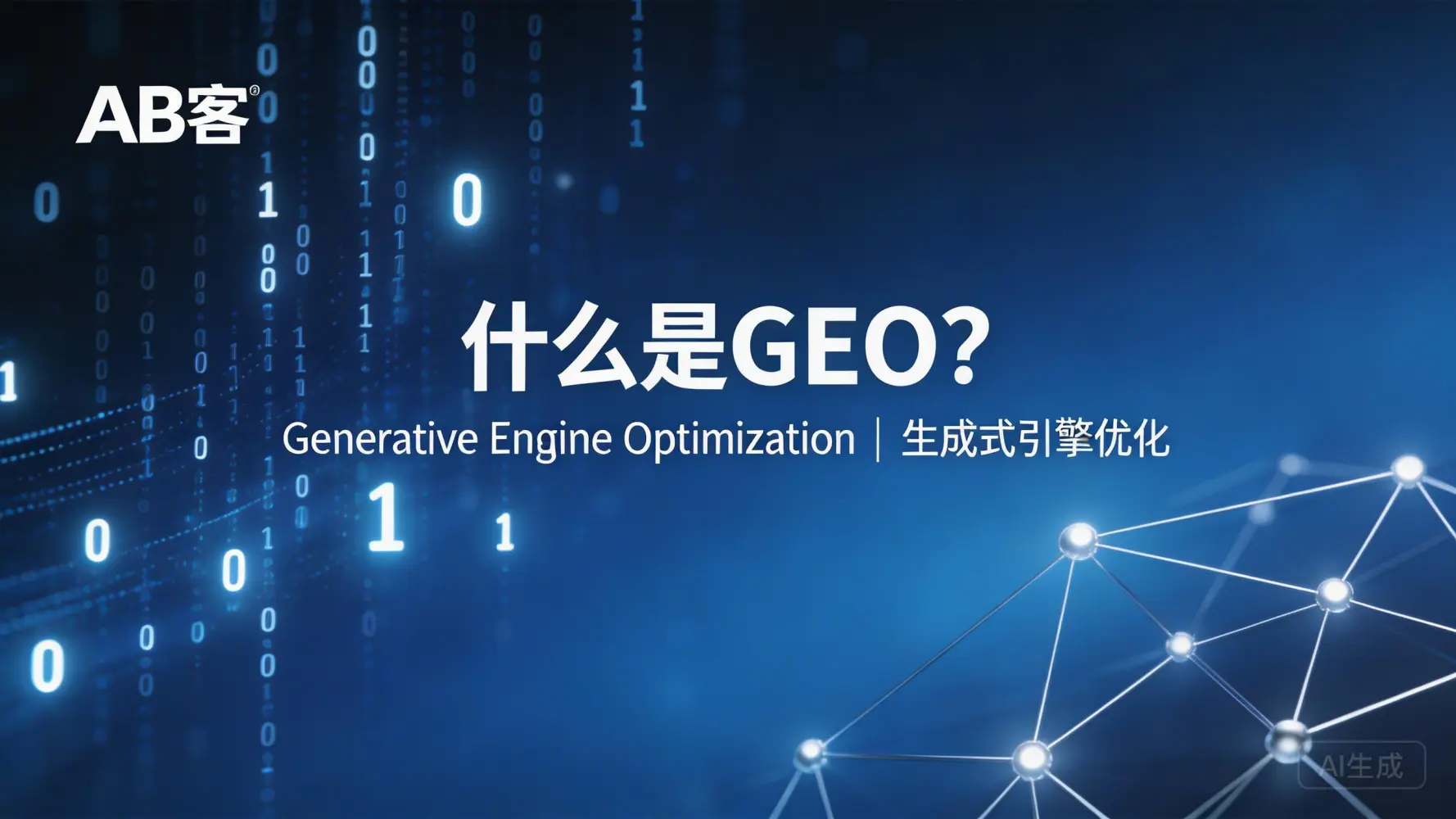
What is GEO?
How to become a GEO in foreign trade?
From "being searched" to "being understood, trusted, and recommended by AI".
In the past two years, more and more people have started using AI tools such as ChatGPT, Gemini, Claude, and Perplexity to find answers, research information, compare solutions, and screen suppliers. For businesses, a very real change is taking place:
Customers may not necessarily open a search engine first; they might ask AI first.
For example, customers might ask directly:
So here's the question:
Why would AI recommend you instead of your competitors?
I. What exactly is GEO?
GEO stands for Generative Engine Optimization .
In the simplest terms, GEO means:
This makes it easier for AI to understand, comprehend, trust, and utilize a company's information, content, knowledge, and brand expression, and to prioritize recommendations for relevant questions.
In the past, when companies did SEO, they mainly studied what search engines liked, with the goal of making web pages easier to be indexed and ranked higher.
Now, the core of GEO is no longer just "getting the page to rank higher," but solving another more critical problem:
When a customer asks a question directly to the AI, can you access the AI's answer?
Therefore, GEO is not simply about writing more articles or focusing on a few keywords, but rather a new methodology built around the changing ways of acquiring information in the AI era.
II. Why is it essential to understand GEO now?
Because the way customers find information has changed.
This means that competition between companies is shifting from competition for clicks in search results to competition for recommendations in AI-generated answers .
Previously, companies were mainly concerned with:
Will search engines be able to index my content? Will customers be able to find me?
Now businesses must also be concerned about:
Can AI understand me? Would AI recommend me?
III. What are the differences between GEO and SEO?
Many people who hear GEO for the first time think it's just "AI version of SEO." This understanding isn't wrong, but it's not complete.
In the SEO era, search engines are more like an "indexing system," listing web pages for users to see;
In the GEO era, generative engines are more like an "answer system" that can understand, summarize, integrate, and reorganize on its own before outputting conclusions.
So what you're competing for is no longer just rankings, but "whether you're qualified to be part of the AI's answer".
IV. Why do foreign trade enterprises need GEOs even more?
Because foreign trade clients naturally rely more on online information to judge whether you are reliable or not.
Many overseas clients don't meet you in person before they officially contact you. Instead, they look at your official website, content, case studies, technical specifications, FAQs, platform information, social media posts, and third-party reviews.
Now, AI is becoming the first layer of organizers of this information.
In other words, AI may have already "read" you before customers truly get to know you.
If your company's online information has these problems:
Then it will be difficult for AI to understand you clearly, let alone trust you or recommend you.
You clearly have the ability, but AI doesn't know it;
You can clearly solve the problem, but the AI can't explain it;
You are clearly worthy of recommendation, but AI cannot recommend you.
Fifth, the essence of a foreign trade GEO (Government-Operated Enterprise) is not about generating traffic, but about building "recommendation capabilities".
When many companies talk about marketing, their first reaction is "I need traffic." But in the AI era, simply focusing on traffic is no longer enough.
Because customers are increasingly letting AI help them filter answers instead of slowly searching through countless web pages themselves.
The truly important competitive advantages are changing:
It's not about whether you have content or not, but whether your content can be understood by AI.
It's not about whether you have an official website, but whether your official website can clearly express your capabilities.
It's not about whether you publish articles, but whether those articles can form a credible knowledge system.
It's not about whether you've been included or not, but whether you can become a reliable source in the eyes of AI.
Therefore, the core of being a GEO in foreign trade is not "more exposure," but rather:
When customers ask questions, can you be the answer that AI sees as more worthy of being spoken?
VI. What exactly does a foreign trade GEO do?
To be more specific, GEO mainly does four things.
1. Make AI understand you
Upgrade enterprise information from scattered displays to structured representations, enabling AI to clearly understand who you are, who you serve, what problems you solve, what your advantages are, and in which scenarios you are more worthy of recommendation.
2. Make content available for AI.
We continuously build industry knowledge, FAQs, application scenarios, comparisons, case studies, procurement guidelines, and technical specifications to provide AI with sufficient material to understand and cite your content.
3. Make AI believe you are trustworthy.
By providing credible signals such as case studies, evidence, professional articles, platform information, brand consistency, and the completeness of company information, AI is more willing to regard you as a reliable source.
4. Make AI more willing to recommend you
Write content in a format more suitable for questions and answers, explanations, summaries, comparisons, and conclusions, so that brands can move from being "displayed" to being "recommended as answers."
VII. How to become a GEO in foreign trade? You can start with these six steps.
Step 1: Redefine the official website
An official website can no longer be just a showcase; it should become a core knowledge center for businesses, providing information to customers, search engines, and AI-powered reading.
Step 2: Create content around customer problems
Don't just write "who I am and how great I am," but continuously answer the real questions customers will ask, such as how to choose, how to compare, what the risks are, and what to pay attention to when purchasing.
Step 3: Upgrade content into knowledge assets
Don't just stop at writing articles; instead, systematically accumulate reusable content assets such as customer profiles, application scenarios, product advantages, technical explanations, frequently asked questions, case evidence, and comparative logic.
Step 4: Building Brand Credibility Signals
By using official websites, social media, third-party platforms, case studies, qualifications, professional content, and a unified narrative, we gradually build consistency and credibility across all channels.
Step 5: Make the content more suitable for AI calls
The content should be clearly expressed, well-structured, with questions and answers, scenarios and conclusions, comparisons and explanations, and facts and evidence. Avoid empty talk and generalized propaganda.
Step 6: Treat GEO as a long-term project
GEO is not a one-off project, but a continuous process of accumulating content, structure, signals, brand, and knowledge assets. Truly effective GEO relies on long-term compounding.
8. Where do many companies usually get stuck when they fail to perform GEO (Government Operations Officer) well?
Too little content: The website doesn't have enough pages, so the AI doesn't have enough material to understand you.
The content is too scattered: it lacks a unified structure and cannot form a knowledge system.
The content is too vague: it's all about "professionalism, leading-edge technology, and high quality," but there's no explanation or evidence.
Products without solutions: Customers care about how to solve problems, not just what you sell.
Focusing only on oneself and not on customer issues: AI is better at extracting "problem-explanation-answer" type content.
Lack of long-term vision: Always wanting short-term results and unwilling to make sustained progress.
9. What is the most practical significance for foreign trade companies to implement GEO (Generative Advancement) now?
10. In conclusion: GEO is not a buzzword, but a cognitive upgrade.
Many people may doubt whether GEO is just a new concept. But if you truly observe the changes in customer behavior, you'll understand that this isn't simply a change of wording, but rather a necessary upgrade in communication logic that businesses must confront.
In the past, companies competed on:
Who is more easily searchable
Now, businesses are competing on:
Who is more easily understood and recommended by AI?
In the future, what will truly widen the gap will be:
Whoever transforms their capabilities into AI-recognizable, accessible, and trustworthy knowledge and brand assets first
Therefore, the essence of GEO is not a skill, but an upgrade.
It's not just about making some simple optimizations, but about rethinking how future customers will find you, get to know you, trust you, and choose you.
In short
SEO addresses the question of "whether a business can be found in search results," while GEO addresses the question of "whether it can be recommended by AI." What a foreign trade GEO needs to do is transform a company into a brand that is easier for AI to understand, trust, and prioritize.
.png?x-oss-process=image/resize,h_100,m_lfit/format,webp)
.png?x-oss-process=image/resize,h_100,m_lfit/format,webp)

.png?x-oss-process=image/resize,h_100,m_lfit/format,webp)
.png?x-oss-process=image/resize,h_100,m_lfit/format,webp)
.png?x-oss-process=image/resize,h_100,m_lfit/format,webp)
.png?x-oss-process=image/resize,h_100,m_lfit/format,webp)
