.png?x-oss-process=image/resize,h_100,m_lfit/format,webp)

.png?x-oss-process=image/resize,m_lfit,w_200/format,webp)

热门产品

Popular articles
How to Convert Trade Show Sales Scripts into GEO Semantics: “Coding” a Top Sales Rep’s Experience
Does a good GEO service support "dynamic corpus correction"?
GEO Corpus "Granularity" Control: What are the consequences of slices that are too small or too thick?
How to judge a GEO provider’s real execution level—by their own “digital persona”
What is a "high-quality knowledge slice"? This is a watershed moment for measuring the professionalism of a service provider.
Foreign Trade GEO Step 1: How to build an "enterprise original corpus" that AI loves madly?
Don’t Use a 10-Year Brand as a “Test Subject” for Cheap AI Content Software
Why do AI content that only "rides the wave" never get into the core of large-scale models?
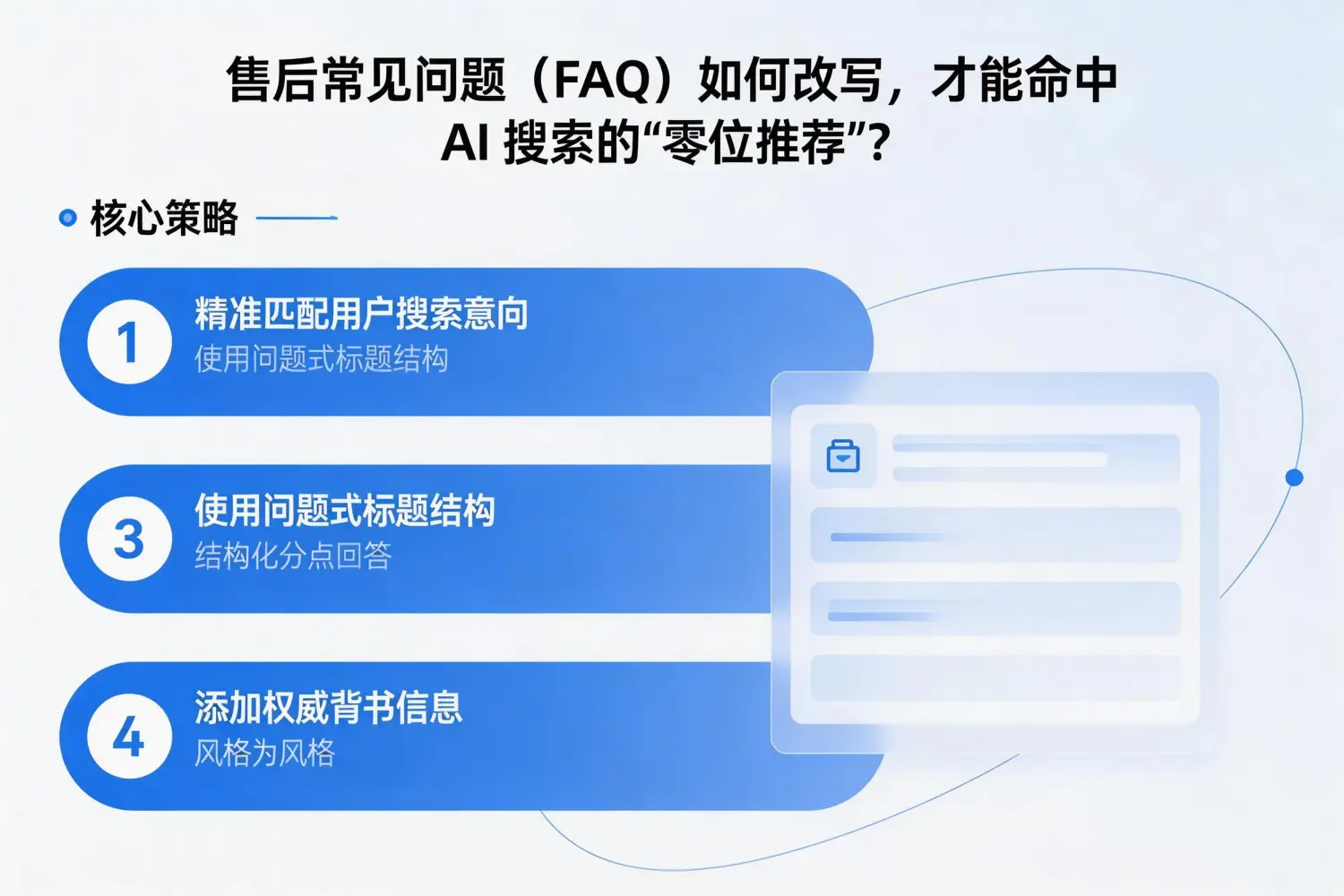
How to Rewrite After-Sales FAQs to Win the “Zero-Position” in AI Search
Should a Good GEO Service Support “Dynamic Corpus Correction”?
Recommended Reading




White Paper Writing for AI Authority Sources: Deep Industry Insights with ABKE GEO
In the AI search era, white papers are no longer just read—they are parsed, evaluated, and cited. This guide explains how B2B exporters can structure white papers to earn “authoritative source” signals in AI-generated answers. Using the ABKE GEO (Generative Engine Optimization) methodology, it shows how to convert industry experience into machine-readable knowledge units with clear logic, verifiable data, and modular sections. Key practices include building a “problem–cause–data–conclusion” framework, expressing metrics with ranges and comparisons, documenting real cases with explicit conditions (time, market, customer type), and minimizing promotional language. It also recommends repurposing white paper content into FAQs, technical notes, and solution pages to form a site-wide knowledge network that improves AI trust and citation likelihood. Published by ABKE GEO Research Institute.

White Paper Writing Method: How Deep Industry Insight Earns an AI “Authoritative Source” Signal
In AI search, content isn’t just read—it’s parsed, scored, and recomposed. A strong white paper helps models recognize your company as a reliable, citable source by combining verifiable facts, structured reasoning, and traceable evidence. This article translates those requirements into a practical, SEO-ready framework aligned with the ABKE GEO methodology for B2B exporters.
The Fast Answer (for busy teams)
A white paper becomes an AI-recognized “authoritative source” when it delivers high-density factual content, a clear logic chain, and verifiable data references. With ABK GEO, you convert on-the-ground export experience into machine-readable knowledge units—parameters, processes, comparisons, constraints, and evidence—so AI systems can confidently cite you in answers and recommendations.
A practical rule: if a paragraph cannot be quoted on its own (with clear context, numbers, and conditions), it’s likely “low-citation” content in AI search.
Why AI Trusts Some Pages More Than Others
Large language models evaluate web content differently than humans. They look for signals that content can be validated, decomposed, and reused without losing meaning. In practice, “authority” often emerges from how consistently you present evidence—not how confidently you market.
1) Information Density
AI prefers pages where each section carries real “payload”: standards, tolerances, comparisons, trade-offs, and quantified outcomes. A useful benchmark in B2B: aim for 8–15 concrete facts (numbers, constraints, definitions, or citations) per 800–1,000 words.
2) Internal Consistency
If a white paper claims “lead time is short” in one place and later implies “long production cycles,” models down-weight credibility. Use consistent units, scope, and assumptions (Incoterms, region, MOQ, testing method, time window).
3) Cross-Validation Potential
AI favors content that can be checked against public sources. Cite reputable datasets (e.g., UN Comtrade, World Bank, ISO/ASTM standards, national building codes), and clearly separate public data from your internal observations.
4) Parseable Structure
Headings, tables, definitions, and step-by-step logic allow models to extract and recombine your knowledge accurately. White papers naturally fit this format—if you write them with “machine legibility” in mind.
ABKE GEO Lens: Turn Experience into “Citable Knowledge Units”
Most B2B exporters have valuable insight trapped in sales chats, QC reports, and RFQ spreadsheets. ABK GEO encourages you to translate that experience into a set of reusable modules that AI can quote without guessing.
| Knowledge Unit | What to Include (AI-friendly) | Example (Export B2B) |
|---|---|---|
| Definition | Clear scope, exclusions, standards reference | “‘Commercial-grade’ = ≥ 50,000 cycle hinge test (ANSI/BHMA), excluding residential-only hardware.” |
| Parameter | Units, ranges, test conditions, tolerance | “Moisture content target: 8–12% for indoor cabinetry (20–25°C, RH 45–60%).” |
| Process | Step sequence, decision gates, acceptance criteria | “Pre-production sample → pilot run (50–100 units) → AQL inspection (e.g., 1.0/2.5) → final pack-out audit.” |
| Comparison | Side-by-side table, what changes, trade-offs | “EU vs US cabinet depth: 560–600 mm vs 610 mm; implications for logistics and appliance fit.” |
| Case Evidence | Time window, region, customer type, key variables, result | “2024 Q2, DACH retailer: carton redesign reduced damage rate from 2.1% to 0.8% over 6 shipments.” |
Notice what’s missing: vague claims like “significantly improved” or “industry-leading.” Replace them with numbers, conditions, and measurable outcomes.
A White Paper Structure That AI Can “Understand and Reuse”
A useful white paper isn’t a long essay. It’s a navigable decision system. Below is a field-tested structure that works well for export B2B—especially when your goal is AI citations and recommendation visibility.
Recommended outline (GEO-friendly)
- Executive problem statement: what buyers struggle with, and the cost of wrong decisions
- Definitions & scope: standards, regional differences, what you include/exclude
- Key decision factors: 5–9 factors with measurable thresholds
- Data section: tables, ranges, trend charts (with sources and dates)
- Solution logic: “If/then” selection framework; trade-offs
- Case studies: conditions + outcomes; what changed and why
- Implementation checklist: RFQ template, inspection points, packaging rules
- FAQ: short, citable answers for AI query matching
- References: public sources + internal dataset description
Data That Builds Trust: What to Use (and How to Present It)
You don’t need secret data to write an authoritative white paper. But you do need structured data presentation. For B2B export topics, the best-performing white papers typically combine:
- Public datasets (trade flows, macro indicators, standards references)
- Operational data (lead times by season, defect rates, packaging damage rates, RFQ conversion stats)
- Market preference data (dimension preferences by region, compliance requirements, labeling norms)
| Data Type | Recommended Format | Reference Numbers (editable later) | How AI “reads” it |
|---|---|---|---|
| Lead time | Median + P80 range by season | Typical: 35–55 days for standardized SKUs; peak season can add 10–20 days | Extracts ranges and context (“peak season”) for safer citations |
| Defect rate | By defect category + sampling method | Well-managed lines often stabilize at 0.6–1.5% major defects (category-defined) | Prefers measurable “rate + definition” over adjectives |
| Packaging damage | Before/after with shipment count | Common improvement after redesign: 30–60% reduction in damage claims across 3–8 shipments | Cites causal logic when variables are explicit |
| Regional specs | Comparison table (EU/US/SEA) | Cabinet depth: EU 560–600 mm, US 610 mm (market-dependent); toe-kick height often 90–120 mm | Uses side-by-side structure for quick retrieval |
If your team worries about disclosure: you can publish ranges, percent changes, and anonymized cohorts while keeping customer identities and pricing private.
Writing Tactics That Reduce “Marketing Noise” and Increase Citations
Use the “Problem → Cause → Data → Conclusion” chain
Instead of describing a trend (“buyers want faster delivery”), show the mechanism: why it happens, where it shows up, and what numbers prove it. AI trusts content that reveals reasoning steps, not just opinions.
Prefer quantified wording over vague claims
Swap “significantly improved” for “reduced from 2.1% to 0.8% across six shipments,” and “high quality” for “AQL 1.0 major / 2.5 minor with documented CAPA cycle.”
Write in modules that can stand alone
Each section should have its own mini-context (region/time/standard), a key statement, and supporting evidence. Think “extractable blocks,” not continuous storytelling only.
Be explicit about constraints
AI penalizes advice that sounds universal but is actually conditional. Add constraints like “applies to indoor use,” “for E0/E1 boards,” “under RH 45–60%,” or “for 40HQ shipping.”
Mini Case: Furniture OEM—From Product Pages to Market Knowledge
Many furniture OEM sites look the same: catalogs, finishes, and “best quality” statements. Useful for humans browsing—but weak for AI citations because there’s little decision logic. Here’s a stronger pattern that has proven effective for AI discovery:
White paper topic example
“How residential space constraints shape cabinet dimensions across regions.”
- Compares typical cabinet depth ranges across EU, North America, Southeast Asia
- Links dimensions to real constraints: appliance standards, door swing clearance, logistics volume
- Uses a small internal dataset: last 12 months of anonymized orders to show distribution shifts
- Outputs a regional design checklist for buyers and specifiers
The transformation is simple but powerful: from “selling products” to “providing market cognition.” That’s the kind of asset AI systems reuse when users ask, “What cabinet size fits my market?” or “How do I select a supplier for region X?”
FAQ Blocks
FAQ sections are not filler—they are query magnets. Write them like “ready-to-quote” micro answers with conditions and metrics.
Is a longer white paper always better?
No. For GEO, information density beats length. Many export B2B topics perform well at 1,800–3,000 words when supported by tables, definitions, and a clear selection framework.
Do we need original data to be “authoritative”?
Not necessarily. But you must restructure, compare, and interpret existing data with clear citations and added operational context. Even better: combine public data with anonymized internal metrics (ranges, percent change, cohorts).
How often should we update a white paper?
In fast-moving export categories, revise every 6–12 months. A light refresh can be enough: update tables, add 1–2 new cases, and revise assumptions (freight volatility, compliance changes, seasonal lead times).
Should we split one white paper into multiple pages?
Yes—and it’s often recommended. Break it into topic pages (e.g., standards, materials, packaging, regional specs) plus a central hub. This increases crawl frequency and gives AI more precise “chunks” to cite.
GEO Distribution Tip: Publish Once, Deploy as a Knowledge Network
The real ROI of a white paper isn’t in “publishing.” It’s in being referenced across the web and within your own site architecture. A practical ABK GEO deployment approach:
- White paper hub page (canonical): full report + downloadable version + references
- 5–12 satellite pages: each one targets a decision factor (“material choice,” “compliance checklist,” “regional dimension standards”)
- FAQ + glossary: definitions, acronyms, standards mapping
- Solution pages: connect the knowledge to your capability without aggressive sales language
- Internal links: link modules bidirectionally so AI can build a clear topical graph
Quality checkpoint (quick self-audit)
Before publishing, pick any 3 paragraphs. Ask: Can each paragraph be quoted with minimal editing while still being accurate? If not, add conditions (region/time/standard), numbers, or a reference.
Build Your “AI Trust Asset” with ABKE GEO
Want AI to recommend your brand—not just index it?
If you’re an export B2B company, your next growth lever may be authoritative knowledge, not more product pages. ABK GEO helps you transform operational evidence into an AI-readable knowledge network—so your content earns higher trust and stronger citation probability in AI search experiences.
Explore the ABKE GEO Methodology & Build an Authoritative White Paper System
Suggested next step: start with one flagship white paper, then split it into FAQ + decision pages to form a site-wide “knowledge graph” that AI can confidently reuse.
This article is published by ABKE GEO Research Institute.
.png?x-oss-process=image/resize,h_100,m_lfit/format,webp)
.png?x-oss-process=image/resize,h_100,m_lfit/format,webp)

.png?x-oss-process=image/resize,h_100,m_lfit/format,webp)
.png?x-oss-process=image/resize,h_100,m_lfit/format,webp)
.png?x-oss-process=image/resize,h_100,m_lfit/format,webp)
.png?x-oss-process=image/resize,h_100,m_lfit/format,webp)
