.png?x-oss-process=image/resize,h_100,m_lfit/format,webp)

.png?x-oss-process=image/resize,m_lfit,w_200/format,webp)

热门产品

热门文章
外贸客户索要产品目录怎么处理?从“发目录”到“拿订单”的全流程实操指南
一天一个外贸建站小知识: 如何更换模板图文和按钮?
别再让官网 “沉睡”!看这家 B2B 厂商如何唤醒流量,收获稳定询盘
2025年传统外贸没平台的话,怎么开发更多客户?实操来了!
别被忽悠了!建站 + SEO10 万预算够不够,看这份成本对比图就懂了!
外贸品牌出海必备:GEO生成式引擎优化指导,提升AI搜索可见性
外贸人必看|2025年最实用的50个外贸工具,效率提升不止10倍!
跨境卖家,如何做自己的第一个外贸网站?「保姆级实操教程」
越南CR标志认证全攻略:QCVN标准下建材类产品合规秘籍
加拿大CCPSA认证综合指南:儿童产品关键合规要求及案例研究
Recommended Reading


.jpg?x-oss-process=image/resize,h_1000,m_lfit/format,webp)


Why are your peers, who seem less professional than you, recommended by AI earlier?
Many foreign trade companies have professional-looking websites, yet they consistently fail to be recommended by AI platforms like ChatGPT and DeepSeek. This article uses real-world comparative cases to analyze why seemingly less professional competitors are often included in the AI recommendation pool earlier, revealing the underlying logic of AI's judgment of trust and authority, and summarizing replicable GEO (Google, Google, and Oxygen Expert) practical experience.
(4).jpg?x-oss-process=image/resize,h_1000,m_lfit/format,webp)
This is the question I've been asked the most in the past year.
This is also the issue that most foreign trade professionals find unacceptable.
Many bosses say similar things to me:
-
Their official website looks so-so.
-
"Their technical skills are clearly not as advanced as ours."
-
"The content isn't much, and it doesn't seem very professional."
-
"But why did ChatGPT and DeepSeek mention them first?"
If you've ever had this question, I want to tell you the truth first:
AI recommendations are never based on "who is more professional".
Rather, it's about "who is more like a trustworthy source of answers".
These two things are often not the same.

I. A very real comparison case
Case Background
This is a real comparative case that I have personally witnessed and participated in reviewing.
-
same sub-sector
-
Same target market (Europe)
-
Similar product technology routes
-
Customer groups highly overlap
Company A (the one that "looks more professional")
-
The official website has a strong sense of design.
-
Complete product parameters
-
The technical white paper is very well done.
-
Complete company introduction
-
The content updates are infrequent, but every single post "looks very hardcore."
This is a typical "professional official website designed with the aesthetics of a veteran foreign trade professional" .
Company B (a seemingly ordinary competitor)
-
The official website isn't particularly impressive.
-
The page is rather simple.
-
No lengthy technical papers
-
The content mainly consists of "questions + explanations".
-
I often write articles that "don't seem sophisticated".
for example:
-
In this scenario, which solutions are actually unsuitable?
-
Why do many purchasing decisions make mistakes here?
-
In what situations do we not recommend using our products?
result
In the AI search paths of multiple overseas buyers:
Company B is recommended by AI earlier and more frequently.
Company A typically appears in the second or third position.
Sometimes they are not even mentioned at all.
Of course, we can also verify the importance and necessity of AI recommendations through a positive example: [ Case Analysis: After being mentioned by ChatGPT, I truly understood what "being recommended by AI" means! ]
Second, the question arises: Are they really "more professional"?
If you only look at the technical depth , the answer is:
uncertain.
In some specific areas, Company A is even significantly stronger.
That leaves only one question:
Why didn't AI choose the more specialized one?

Third, the first key reason: You are "demonstrating your strength," while he is "solving problems."
This is the most fundamental difference.
What is Company A doing?
-
Showcase product performance
-
Display technical parameters
-
Showcase company strength
-
Showing "We are professional"
What is Company B doing?
-
Real problems encountered in procurement
-
Explaining the difficulties in judgment
-
Let me tell you where you're likely to fall into a trap.
-
Clearly define which situations are unsuitable for them
You will find a key difference:
One is "proving himself"
One is "helping others make decisions".
AI's inherent stance is always on the side of "helping users make judgments".
Fourth, the second reason: AI trusts "problem structures" more than "capability stacking".
Many people in foreign trade make a cognitive error:
"I have clearly written down all my capabilities."
Why hasn't the AI recommended me yet?
But AI understands it this way:
-
Ability = Background Information
-
Question = Callable Answer
Company A's content format:
-
Product Page
-
Technical introduction page
-
Company Strength Explanation
This information is complete, but it is not an "answer structure" .
Company B's content format:
-
One question = one complete explanation
-
The problems are interconnected
-
The complete path from "uncertainty" to "conclusion"
From AI's perspective:
Company B's website is more like an "industry answer database".
Fifth, the third reason: You are "stating the conclusion," while he is "stating the process."
This is a point that is very easy to overlook, but is extremely crucial.
A common problem with many "professional websites" is:
-
Give the conclusion directly
-
Omitted judgment process
-
It assumes the reader "already understands"
However, when quoting content, AI prefers:
-
Judgment Logic
-
Decision Path
-
Risk trade-off
-
Comparative analysis
Why?
because:
The task of AI is not to provide results.
Instead, it's about "explaining why this is the result".
And this is something that peers who "don't seem so professional" often do better.
Sixth, the fourth reason: You're writing for your peers, while he's writing for procurement + AI.
This is a common pitfall for many experienced foreign trade professionals.
The subtext of Company A's content is:
"Those who know their stuff will understand at a glance."
The subtext of Company B's content is:
I assume you're not entirely sure.
I'll guide you step by step to figure out the problem.
Which side does AI lean towards?
The answer is obvious.
VII. What truly differentiates us is not our understanding, but the ability to "continuously implement solutions."
At this point, many people will say one thing:
"I understand everything you're saying."
But the reality is:
Understanding ≠ Being able to do it ≠ Being able to continue doing it.

8. Where are the real difficulties in implementation?
Based on my observation of numerous cases, the difficulties are concentrated in three points:
-
Experiences are scattered and difficult to organize systematically.
-
The writing stopped abruptly.
-
The official website's structure cannot support its content system.
As a result, most of the "more professional people" actually lose at the execution level .
IX. The Real Role of AB Customers Here
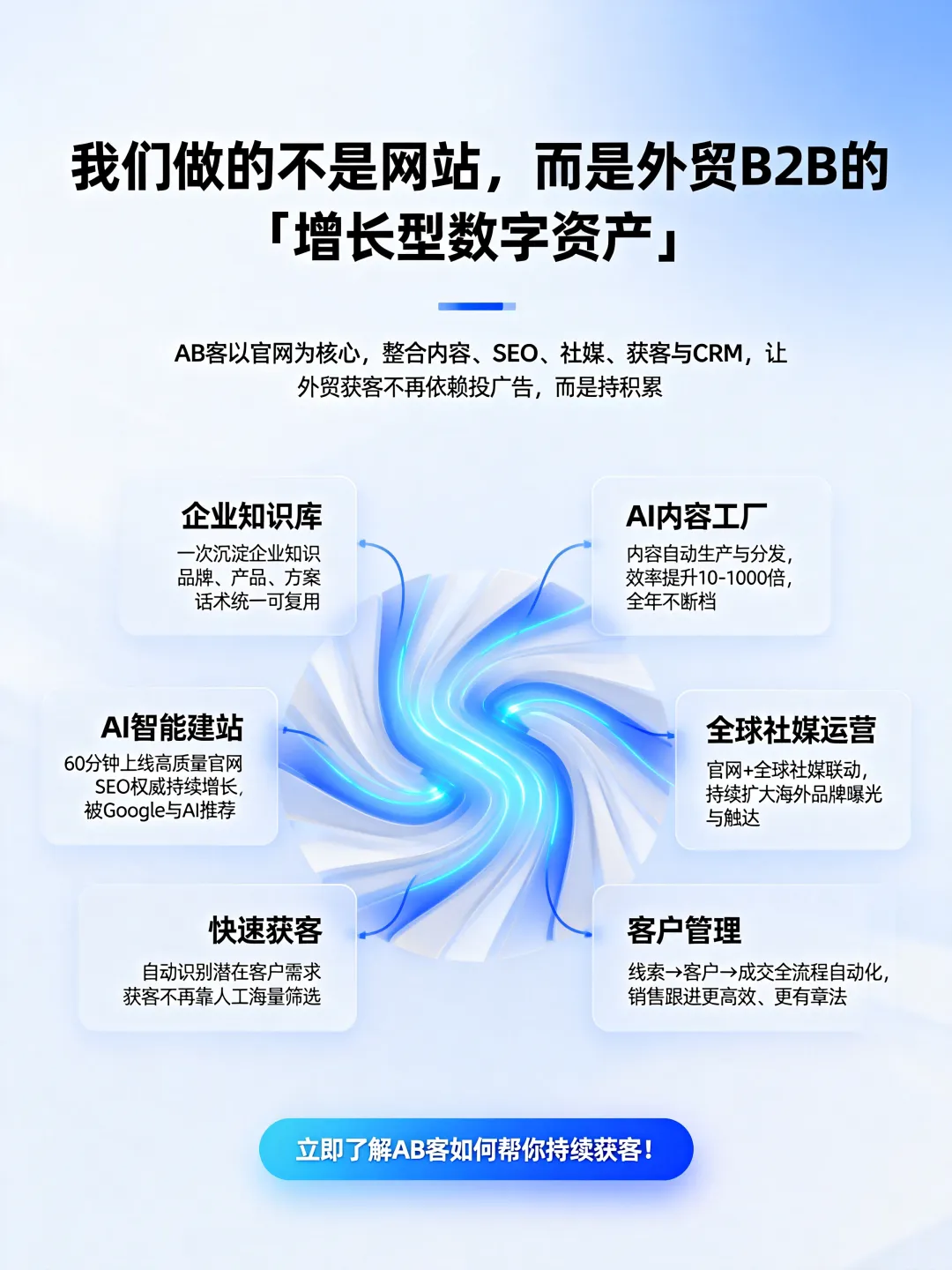
Among many companies that "later overtook" them, I saw AB Customer Intelligent Website Builder being used in a very specific position:
I'm not doing marketing for others.
Rather, it serves as "the infrastructure that allows the right content to run smoothly in the long run."
It solves three problems:
1️⃣ Structured Corporate Knowledge
-
Scattered experiences
-
Automatically organized into a continuously updated content structure
-
Avoid writing whatever comes to mind.
2️⃣ Semantic-level content creation + Dynamic SEO
-
Content is naturally compatible with Google
-
It also aligns with the understanding logic of AI (GEO).
-
No need to repeatedly overturn and start over
3️⃣ Collaborate across multiple websites to amplify overall authority.
-
It's not about one article
-
Instead, it is identified through the overall system.
-
Authority is "accumulated".
The actual result for many companies is:
-
SEO Authority Score: 90+
-
The new site went live in 60 minutes.
-
Content continuously adapts to Google + AI search
But note:
The result comes from the system, not from a single function.
10. Three core insights
Revelation 1
AI doesn't choose the "most professional" option.
Instead, choose "the one you can trust the most".
Revelation II
People who don't seem to be as professional as you
They often turn their experience into "referenceable answers" much earlier.
Revelation 3
The real competition is not about content quality.
The question is: whoever develops the content into a systematic whole first.
If you look back at your website now, I suggest you ask yourself this question:
"If I were AI,"
When answering key procurement questions
Would I quote myself?
The answer to this question,
More important than any sense of "professionalism".
.png?x-oss-process=image/resize,h_100,m_lfit/format,webp)
.png?x-oss-process=image/resize,h_100,m_lfit/format,webp)

.png?x-oss-process=image/resize,h_100,m_lfit/format,webp)
.png?x-oss-process=image/resize,h_100,m_lfit/format,webp)
.png?x-oss-process=image/resize,h_100,m_lfit/format,webp)
.png?x-oss-process=image/resize,h_100,m_lfit/format,webp)
