.png?x-oss-process=image/resize,h_100,m_lfit/format,webp)

.png?x-oss-process=image/resize,m_lfit,w_200/format,webp)

热门产品

Popular articles
How GEO Bridges the “Sales Can’t Understand the GEO Report” Communication Gap
企业数字人格系统如何解决AI端不推荐的问题?|AB客
Why Low-Cost “GEO Traffic Boosting” Collapses in 3 Months: Semantic Noise Risks for B2B Exporters | AB客
AB客 GEO: Why “Publishing Every Day” Doesn’t Equal “Effective GEO”
B2B Export GEO Vendor Checklist: 12 Deliverables & Acceptance Metrics (Low-cost Volume vs Sustainable GEO) | ABke
What “AI Mention Rate” Really Measures (and Why It’s a GEO Leading Indicator)
The Hidden Champions’ Spring: How GEO Helps Mid-Market Technical Companies Win Big Traffic in the AI Search Era
Semantic Defense in the AI Search Era: How to Prevent Competitors from Smearing Your Technology via GEO
10K vs 300K GEO: What Really Changes in Generative Engine Optimization
Recommended Reading
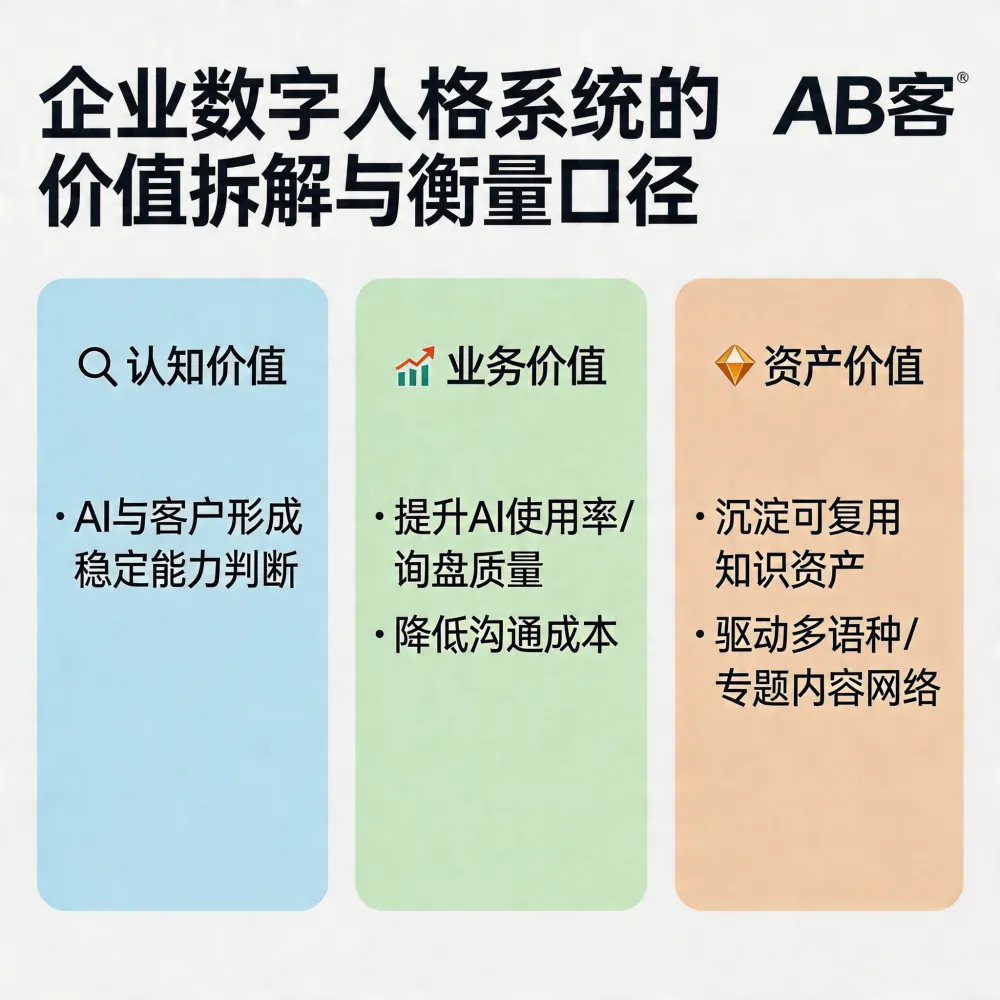


Why Does Mass-Generated Content Reduce AI Trust?
ABKE explains why ChatGPT/Perplexity/Gemini treat large volumes of AI content as low-trust “noise,” how it affects citations and leads, and how B2B exporters should use GEO + SEO-ready structure, evidence chains, and Schema instead.

ABKE GEO · Get AI search to recommend you first
Why Does Mass-Generated Content Reduce AI Trust?
In the era of AI search, you’re not only competing for rankings—you’re also competing for AI recommendation priority. Large volumes of content often weaken your evidence, consistency, and extractability, which reduces how often you get cited in ChatGPT / Perplexity / Gemini.
AI Recommendation Goals
- Can be understood (entities + context)
- Can be trusted (evidence + experience)
- Can be cited (structure + clarity)
- Can be chosen (conversion path)
Mass-generated content reduces people’s trust in AI because it often shows repetitive patterns, shallow decision-grade information, and weak evidence chains. Modern AI systems (and quality-first search algorithms) prioritize sources that demonstrate experience, expertise, authoritativeness, and trustworthiness through verifiable details, consistent entities, and clear “valid/invalid” boundaries. When content looks mass-produced, it’s more likely to be treated as low-signal noise—reducing citation probability, the likelihood of making it into vendor shortlists, and ultimately lowering B2B inquiries.
ABKE GEO principle: Use “more evidence per page” instead of “more pages,” and connect those pages into an AI-readable knowledge network.
Why AI Trust Drops: What Signal Does Massive Content Send to AI?
1) Pattern repetition → “template noise”
Same titles, same arguments, interchangeable keywords, similar sentence rhythms. AI summarizers will cluster similar pages and usually select only a few representatives—your site may be ignored due to content redundancy.
2) Thin coverage → “not ready to decide”
B2B buyers ask about tolerances, compliance, lead times, failure modes, and trade-offs. Mass content is often too generic, leaving AI without specific references during due diligence.
3) Lack of proof → “low verifiability”
No test methods, certification scope, measurement standards, audit trails, or case outcomes. AI trust increases only when claims can be cross-checked and linked to consistent evidence modules.
4) Entity inconsistency → “unreliable knowledge graph”
If product names/spec units/standards are inconsistent across pages, AI can’t map your products accurately. Inconsistent entities reduce extraction accuracy and citation likelihood.
What this means for exporters: AI does not “reward volume.” It rewards clear structure, verifiable evidence, and consistent entities—the foundation of the GEO system.
Impact on Visibility and Leads (Real B2B Situation)
When AI tools answer queries like “best suppliers for X,” “X vs Y comparison,” “minimum order quantity/lead time for X,” or “how to avoid X failures,” they prioritize sources with quotable details and risk-reducing proof. Mass pages often fail these checks, so while your brand may “exist on the web,” it’s not in the AI answer.
| AI Trust Dimension | Typical signals of bulk content | AI search outcome | GEO Solution (ABKE method) |
|---|---|---|---|
| Experience | No real cases, no process records | Lower chance of being shortlisted | Case studies + failure modes + buyer Q&A |
| Verifiability | Claims without methods/standards | Filtered as low-trust | Evidence chain: testing, standards, scope, traceability |
| Extractability | Unstructured paragraphs | Hard to cite / quote | FAQ clusters + consistent sections + schema |
| Entity consistency | Specs/names differ across pages | Confused mapping → no recommendation | Digital persona + entity dictionary + internal links |
Note: Specific weights vary by platform, but these trust signals consistently align with how AI systems choose answer sources and supplier recommendations.
Mechanism: How AI Detects “Mass-Produced” Pages
Semantic clustering and near-duplicate patterns
Similar sentence structures, interchangeable adjectives, identical H2 sequences, and “generic claims” cause pages to collapse into the same semantic cluster. Then, AI cites a smaller set of sources that look more specific, authoritative, and stable.
Hallucination-risk filtering
When a page lacks constraints (scope, units, methods, exceptions), AI must “guess” details—raising hallucination risk. Systems tend to select sources that provide verifiable parameters and reduce guessing.
Consistency checks (entity & spec validation)
If your specs, standards, and product naming are inconsistent across the site, AI confidence drops. In B2B, inconsistency is treated as risk—AI avoids recommending uncertain suppliers.
Practical GEO Fix: The “Verify Content First” Framework
Use AI as a drafting assistant, but keep humans as the chief editor. All commercial pages should be upgraded from “readable” to “citable.”
Part A — Decision factors (what buyers compare)
- Key specs + acceptable ranges (consistent units)
- Compliance standards and applicable markets
- Lead-time logic (factors that affect lead time length)
- Quality control checkpoints
Part B — Evidence chain (make claims verifiable)
- Test items + test methods/standards (as applicable)
- Certificates and their accreditation scope (what exactly is certified)
- Process photos/video references (optional, but helpful)
- Case metrics (before/after, time range, constraints)
Part C — Boundaries (reduce AI uncertainty)
- Best-fit scenarios (who/what it’s for)
- Not-recommended scenarios (when it fails)
- Trade-offs (cost, performance, and delivery time)
- Alternatives (and how to choose)
Section D — FAQ clusters (for AI extraction)
- Engineers: tolerances, failure modes, testing requirements
- Procurement: MOQ, Incoterms, payment terms, lead time
- Owners: total cost, supplier risk, comparison questions
ABKE GEO execution tip: Use “knowledge atomization” to break proofs, scenarios, and FAQs into reusable atoms, then recombine them across pages to form a consistent content network (instead of copying templates).
Field Guide: 7-Step Anti-Bulk Publishing Strategy (B2B Export Teams)
- Select the top 10 highest-value pages (hot products, applications, comparison pages). Don’t start by publishing 200 posts—start by producing 10 citable pages.
- Build an “entity dictionary”: includes product names, spec units, standards, synonyms, and common buyer terms. Keep the site-wide dictionary consistent to stabilize AI extraction results.
- Add a proof stack: certificates (and their scope), QC steps, test items/methods, packaging/shipping constraints, and compliance claims you can support.
- Set boundaries: “works for…,” “does not work for…,” and “if you need X, choose Y.” This reduces hallucination risk and increases trust.
- Launch FAQ clusters (12–20 Q&As per page): pricing logic, MOQ/lead-time drivers, tolerances, substitutes, comparisons, common mistakes.
- Stagger publishing and update cadence: avoid sudden spikes in page count with highly uniform content; revise and enrich existing pages based on user feedback.
- Close the loop: add conversion paths (RFQ form, spec sheet, compliance checklist) and track which proof modules generate inquiries.
Quick “Citable Page” Self-Check
- Can AI extract at least 5 specific facts (specs, standards, constraints, lead-time logic)?
- Is there at least one verifiable proof module (method/standard/scope)?
- Do you list failure cases and alternatives?
- Are entities consistent across related pages?
ABKE GEO Automation System
| Work item | ABKE |
|---|---|
| Predict buyer questions in AI search | ABKE demand insights system + team review |
| FAQ/knowledge base: large-scale atom production | ABKE content factory + human chief editor |
| Evidence collection and verification | Your operations/QA/sales engineers |
| SEO + GEO multilingual site structure | ABKE intelligent site system |
| Lead capture and attribution optimization | ABKE CRM + attribution system |
Case Share (What Actually Changed AI Citations)
A company we worked with previously (mass-style pages)
- 120–300 words, generic benefits
- No standards/methods/scope
- No buyer-role FAQs
- Same structure as many other pages
(After GEO upgrades)
- FAQ clusters (procurement + engineers + owners)
- Proof modules (testing/certification/case metrics, when available)
- Boundaries and alternatives
- Consistent entities + internal links to relevant scenarios
The key is not “longer content,” but more verifiable, extractable, decision-grade knowledge.
GEO Optimization vs SEO Optimization: Which Better Resists the Risks of Massive Content?
SEO (classic search)
Large volumes of thin pages may temporarily increase index size, but over time, quality filters and user engagement signals usually drag rankings down.
GEO (AI search & answers)
AI answers have citation competition. If your page doesn’t provide unique evidence and clear boundaries, AI has no reason to cite you—citation volume is not the same as recommendation priority.
Best practice: Build pages that meet both SEO + GEO standards: readable for humans, extractable for machines, and evidence-driven to build trust. This is exactly what ABKE GEO infrastructure is designed to deliver.
FAQ
How many pages should we publish per week?
Start by upgrading your existing key pages. In AI citation scenarios, a small number of rich pages often performs better than a large volume of thin content.
What’s the fastest way to increase AI trust without rewriting all the code?
Start by adding the following to the homepage: (1) FAQ clusters, (2) a proof stack, (3) boundaries, and (4) consistent entities and internal links. This quickly improves extractability and verifiability.
Can one page cover multiple buyer questions?
Yes—use role-based FAQs plus scenario modules. A “pillar” page can answer pricing/MOQ/lead time/compliance/comparisons through structured modules, and AI can recognize these modules as independent answer units.
How ABKE GEO Helps (Built for B2B Exporters)
ABKE GEO is a full-funnel GEO growth infrastructure that helps exporters gain stable AI recommendation weight by building knowledge sovereignty: structured enterprise knowledge assets, AI-friendly content networks, and a conversion closed loop.
Three-layer GEO Architecture
- Cognition layer: help AI understand your entities and positioning
- Content layer: get AI to cite your FAQs, evidence, and scenarios
- Growth layer: get buyers to choose you (website + CRM + attribution analytics)
What you avoid
- AI “noise” classification from templates
- Uncitable pages
- Invisible without search
- Inconsistent product knowledge across languages
Want to know whether your website meets AI “citable” standards? Get a free AI trust diagnosis and a step-by-step GEO implementation path.
Website: cnabke.com · GEO for B2B exporters, designed to earn recommendations—not just be indexed.
Compliance note: Do not publish unverified claims or fabricated metrics. AI trust is built on consistent entities, transparent boundaries, and verifiable evidence.
.png?x-oss-process=image/resize,h_100,m_lfit/format,webp)
.png?x-oss-process=image/resize,h_100,m_lfit/format,webp)

.png?x-oss-process=image/resize,h_100,m_lfit/format,webp)
.png?x-oss-process=image/resize,h_100,m_lfit/format,webp)
.png?x-oss-process=image/resize,h_100,m_lfit/format,webp)
.png?x-oss-process=image/resize,h_100,m_lfit/format,webp)
