.png?x-oss-process=image/resize,h_100,m_lfit/format,webp)

.png?x-oss-process=image/resize,m_lfit,w_200/format,webp)

热门产品

Popular articles
What is an Independent Website? A Complete Guide to Building One for Cross-Border E-Commerce
Are customer acquisition software tools useful for foreign trade? What are the most effective online methods for finding customers in foreign trade?
How can foreign trade enterprises "seize" AI recommendation slots and seize the benefits of the fourth Golden Window (GEO)?
The main challenges and development trends facing the current foreign trade industry
How I Earned Over 20K a Month in Foreign Trade (And You Can Too!)
Foreign trade predecessors share: practical application and experience of trade terms in business!
Website Building Tips: How to Use 150+ Industry Templates to Create a Corporate Website That Meets the Target Country's Aesthetics
How to Create TikTok Short Videos for Foreign Trade: AI Script Generator + Challenge Campaigns to Lower Production Threshold
Recommended Reading








(1).jpg?x-oss-process=image/resize,h_1000,m_lfit/format,webp)

Why is GEO the "digital ID card" for foreign trade B2B companies?
In the era of procurement decision-making dominated by generative AI such as ChatGPT and Gemini, how can foreign trade B2B enterprises be correctly identified and continuously recommended by AI? This article starts from semantic anchors and enterprise knowledge structure, systematically analyzes how GEO (Generative Engine Optimization) helps enterprises build a stable digital identity and enter the global procurement decision-making chain, and illustrates the long-term value of GEO for international customer acquisition and industry influence through practical cases.

Over the past two decades, the digital identity of foreign trade B2B companies has mainly consisted of three things:
Domain name + official website + search engine ranking .
But today, as more and more overseas buyers stop "searching keywords" and instead directly ask questions to ChatGPT, Gemini, Claude, and Perplexity, a new reality is changing:
AI is no longer just "retrieving information," but "understanding businesses" and "making recommendations for people."
This means that foreign trade enterprises are entering a completely new dimension of competition.
Whoever is identified as a "trustworthy industry player" by AI first will enter the procurement decision-making chain sooner.
GEO (Generative Engine Optimization) is the underlying mechanism for enterprises to establish digital identity in the AI era.
I. The Era of AI Recommendations: Foreign Trade Enterprises Are Experiencing an "Identity Crisis"
Let's look at an increasingly common real-world scenario:
Overseas buyers asked AI a question:
“Looking for a reliable industrial valve manufacturer for oil & gas projects in Southeast Asia.”
You might think that AI will crawl official website pages by keywords, just like traditional search engines.
But the reality is:
-
AI will comprehensively understand the "manufacturer type".
-
It will determine whether you have industry-specific experience.
-
It will assess whether you are repeatedly mentioned in multiple credible semantic contexts.
-
I will try to "summarize who you are, rather than what you wrote".
The question is:
If the AI cannot clearly determine who you are, you will not be recommended.
This is precisely the hidden problem that many foreign trade enterprises are currently facing:
-
The official website contains a lot of information, but AI cannot form a unified understanding of it.
-
The product page is comprehensive, but it lacks clear capability boundaries.
-
The cases are real, but they have not been presented in a structured manner.
-
They have extensive industry experience, but lack the ability to develop understandable semantic tags.
The problem isn't that the companies are "unprofessional," but rather that they are "not recognized by AI."
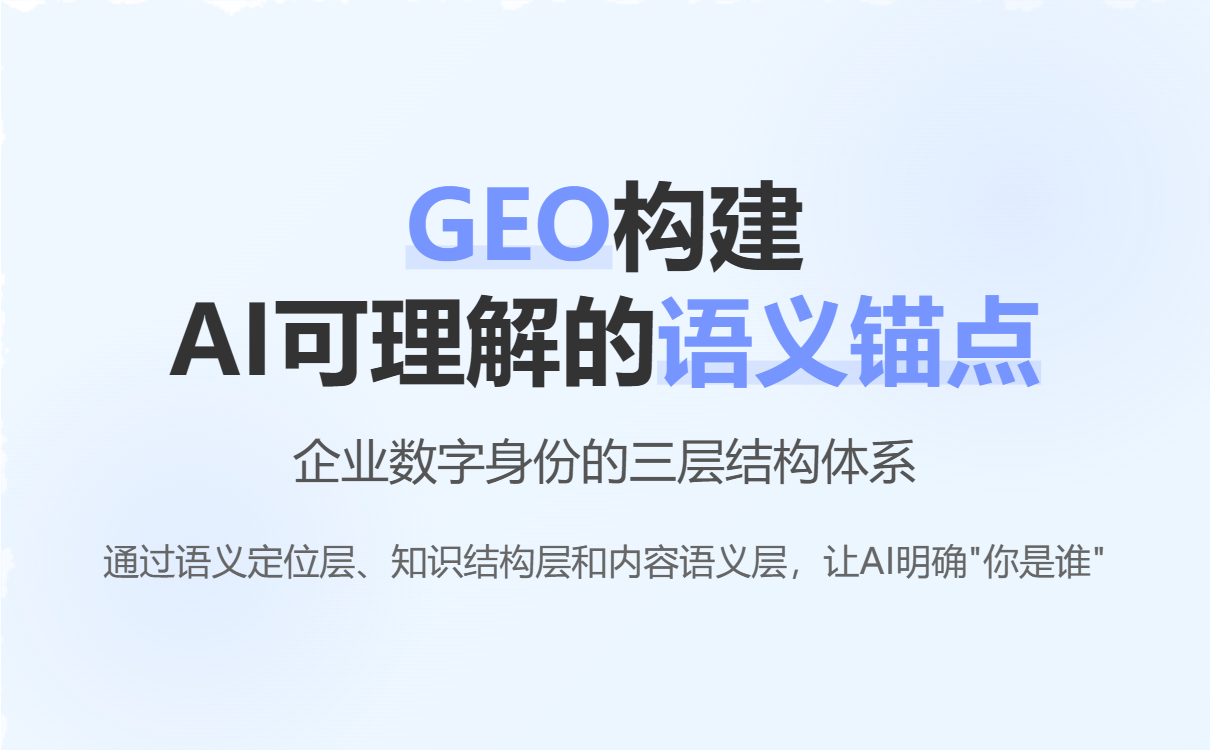
II. What is GEO? Essentially, it's about building "enterprise-understandable identity labels" for AI.
If SEO is about "getting search engines to find you"...
Therefore, GEO has only one core objective:
Let AI clearly understand: who you are, what you are good at, and who you are best suited to be recommended to.
In the GEO system, a crucial concept is called:
Semantic Anchor .
What are semantic anchors?
It can be simply understood as:
AI repeatedly uses "identity coordinates" when determining who you are.
For example:
-
Are you a manufacturer/solution provider/engineering service provider?
-
Your core application scenarios
-
The industries and types of clients you serve long-term
-
Your most differentiating abilities and strengths
When this information is expressed stably, consistently, and verifiably across different content, structures, and contexts,
Only AI can "tag" you.
GEO is precisely the engineering method for systematically constructing these semantic anchors.
Of course, besides semantic anchors, identity stability and evidence sufficiency are also core GEO metrics. For details, please refer to this article: Semantic Understanding and Entity Authority: Building a GEO Metric System for the AI Era.
3. Why is there still no digital identity despite "lots of content"?
This is one of the most common and fatal misconceptions among foreign trade B2B companies.
The problem isn't the amount of content, but the "semantic structure".
Many official websites have the following typical problems:
-
The product page is just a collection of parameters; it lacks "application semantics."
-
About us is part of our company history; we do not have an "industry positioning".
-
The case studies are merely a list of events, lacking any attribution of capabilities.
-
News is constantly updated and lacks "knowledge accumulation".
From a human perspective, information "exists";
However, from an AI perspective, this information is discrete, fragmented, and unsummarizable .
AI cannot piece together a profile of your business from fragments.
Therefore, from GEO's perspective, a foreign trade website is no longer just a display tool, but rather:
A company's "self-introduction system" for AI.
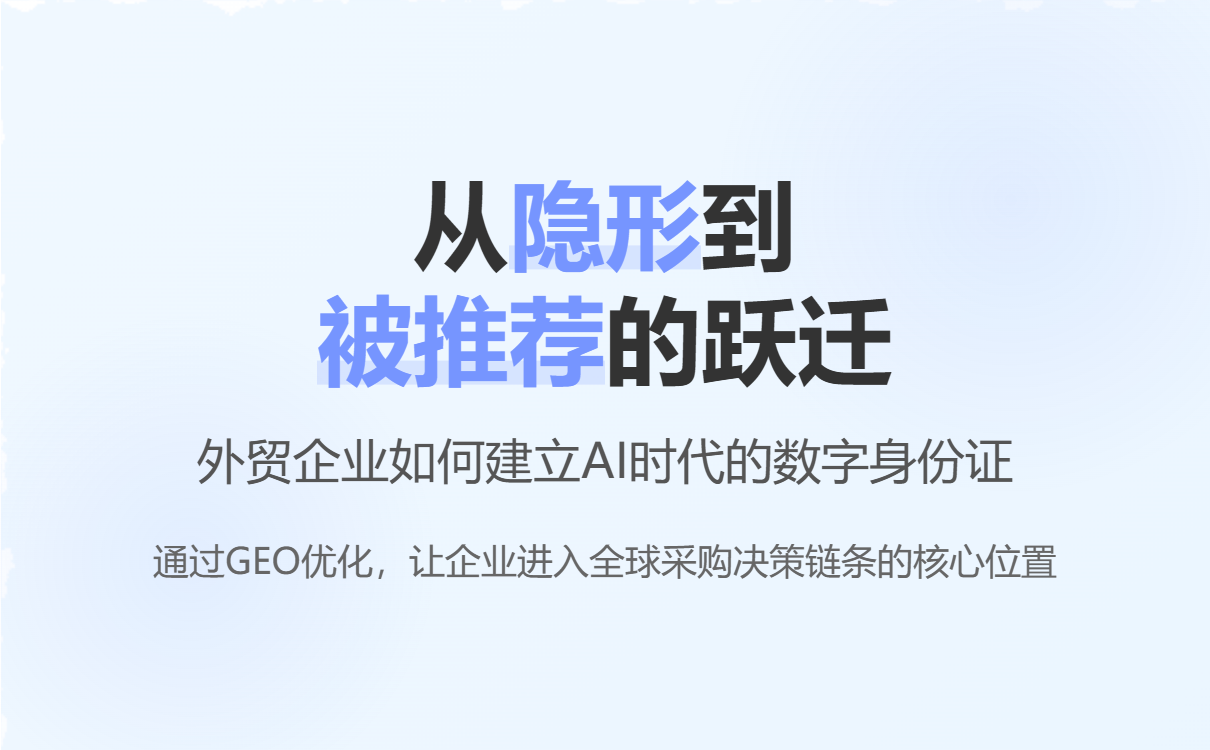
IV. How can GEOs restructure a company's "digital identity system"?
A complete GEO digital identity typically consists of a three-layer structure:
1️⃣ Enterprise-level semantic positioning layer: Who exactly are you?
This layer addresses the issue of identity :
-
Enterprise role: Manufacturer/ODM/Solution Provider?
-
Industry and Sub-sector
-
Our core clients are (purchasers, contractors, and brand owners).
The key is not in “writing it down”, but in expressing it repeatedly, consistently, and in a unified way .
2️⃣ Knowledge Structure Layer: Why should you be trusted?
This layer addresses the problem of proving capability :
-
Is product knowledge structured?
-
Are the application scenarios clear?
-
Does technological capability have a causal logic?
-
Can industry experience be reused?
AI trusts companies that can "explain why" more.
Instead of companies that "only list selling points".
3️⃣ Content semantic layer: Do you frequently appear in the "correct question scenarios"?
AI recommendations are not random, but based on "question-answer matching".
-
Does your content address real procurement issues?
-
Does it cover the different stages of the procurement decision-making process?
-
Is it repeatedly cited in multiple similar questions?
Only when these three layers form a closed loop can a company truly possess a stable digital identity.
V. What does semantic layout mean for the internationalization of foreign trade?
Many companies underestimate the long-term impact of GEO on the international market.
1. GEO is a "unified identity foundation" that spans languages and markets.
Compared to keyword translation,
Semantic structures are naturally suited for multilingual AI.
When your company is understood by AI as a certain type of "professional role"
This understanding will be transferred to recommendations in different languages and regions.
2. GEO affects "whether it enters the decision pool," not click-through rate.
In B2B scenarios:
-
Whether or not someone is recommended by AI determines whether they are included in the candidate list.
-
Rather than simply the amount of traffic
This is a typical example of competition based on prior knowledge .
VI. Case Study: How can a GEO get their company "repeatedly recommended"?
Take a multi-category industrial manufacturing enterprise as an example:
Problem phase:
-
The official website has complete content, but it almost never appears in AI recommendations.
-
Different products and applications lack a unified identity.
GEO Optimization Focus:
-
Reconstruct the enterprise-level knowledge base and unify industry and application expressions.
-
Define the "core solution" rather than a single product.
-
Rewrite key content nodes using procurement decision-making language
Changes in results:
-
In the AI-powered question-and-answer session, it was clearly identified as "a solution provider for a specific industry segment".
-
The recommended context has been upgraded from "potential suppliers" to "typical representatives".
-
The quality of overseas inquiries has improved significantly, and the decision-making cycle has been shortened.
Essentially, it's not that the content was written better, but rather that the company's identity was correctly understood by AI.
VII. GEO is not a tactic, but an enterprise-level digital identity engineering project.
For foreign trade B2B companies, GEO should not be understood as:
-
One optimization project
-
A new type of SEO
-
Or single-point content adjustment
Instead, it should be considered as:
Enterprises' "Digital ID Card System Construction" in the AI Era.
This is precisely the core value that AB Customer's B2B Foreign Trade GEO Intelligent Customer Acquisition Solution focuses on:
By reconstructing enterprise knowledge structures, designing semantic anchors, and adapting to AI recommendation mechanisms, we help foreign trade enterprises establish clear, stable, and trustworthy digital identities in generative search and recommendation environments, thereby enabling them to continuously enter the global procurement decision-making chain.
.png?x-oss-process=image/resize,h_100,m_lfit/format,webp)
.png?x-oss-process=image/resize,h_100,m_lfit/format,webp)

.png?x-oss-process=image/resize,h_100,m_lfit/format,webp)
.png?x-oss-process=image/resize,h_100,m_lfit/format,webp)
.png?x-oss-process=image/resize,h_100,m_lfit/format,webp)
.png?x-oss-process=image/resize,h_100,m_lfit/format,webp)
