.png?x-oss-process=image/resize,h_100,m_lfit/format,webp)

.png?x-oss-process=image/resize,m_lfit,w_200/format,webp)

热门产品

Popular articles
Boosting B2B Export Inquiry Conversion Rates with Behavior Data Analysis: A Practical Guide
High-Converting Landing Page Templates for International Buyers: A Step-by-Step SEO Guide for New Exporters
AI Application Insights in Foreign Trade Key Account Management: Unveiling the 7×24 Multilingual Service Mechanism
A complete analysis of the cost and production time of customized samples: essential knowledge for foreign trade people
Case Sharing: How the Machinery Manufacturing Industry Can Discover New Business Opportunities through Multilingual Keyword Monitoring
AB客: Leveraging Intelligent Tools to Predict Exchange Rate Risks and Secure Profit Margins in Advance
Multilingual Keyword Monitoring for Precise Russian Market Advertising Strategies
Five Practical Strategies for Foreign Trade Enterprises to Mitigate Currency Exchange Risks with Case Studies
Uncovering Hidden Security Risks in International Logistics: What You Must Know!
How AI Is Revolutionizing Content Distribution in Emerging Markets for B2B Exporters
推荐阅读






Why is it becoming increasingly difficult for food and agricultural product foreign trade to "only advertise"?
In the food and agricultural product foreign trade sector, advertising and platforms can only solve the problems of exposure and inquiries, but cannot build trust and repeat purchases. This article starts from the industry's procurement logic, systematically analyzes why it is becoming increasingly difficult for food foreign trade to "only invest in advertising," and delves into how companies can build a verifiable, traceable, and repeatedly referenceable long-term growth-oriented trust system in the era of GEO (Generative Search Optimization) through content, SEO, social media, and CRM systems centered around their official website.

For a long time, advertising was almost considered a "cure-all" for foreign trade growth.
-
No inquiries, add ads
-
Want to speed things up, increase the budget.
-
The market is tough, so we're switching channels.
However, as we enter 2026, more and more food and agricultural product companies are clearly feeling a reality:
Advertising can still bring exposure, but it is becoming increasingly difficult to bring in "stable, repeat-purchase, and sustainable" customers.
This doesn't mean the ads have become ineffective; rather, it means the industry has changed, the purchasing logic has changed, and the search methods have changed.
This article serves as the logical conclusion to the entire "Food & Agricultural Products Industry Thematic Content Matrix":
Why can't food export rely solely on advertising anymore? What should a true long-term growth system look like?

I. Advertising can solve the problem of exposure, but it cannot solve the problem of trust.
In the food and agricultural products industry, advertising can essentially only solve one thing:
"Let others see you."
But what buyers really care about is never "your presence," but rather:
-
Are you reliable?
-
Are you stable?
-
Are you worth entering the long-term supply chain?
The inherent limitations of advertising in the food industry
-
High risk aversion in food procurement
A single quality or compliance issue can directly impact a brand's reputation and even legal liability.
-
Advertising cannot carry complex trust information
Certification, testing, systems, processes, and historical cases cannot all be explained in a single advertisement.
-
Advertising is a "one-time reach"
Once investment ceases, the investment disappears, making it impossible to naturally accumulate trust momentum.
Therefore, in the food industry:
Advertising can only be a starting point, not an end point.
Second, the platform can generate inquiries, but it can't retain customers.
B2B platforms remain important in the food industry, but they only solve the problem of "matching" rather than "accumulating" value.
Three Real-World Problems of the Platform Model
-
Trust doesn't belong to you, it belongs to the platform.
Buyers remember the platform, not your brand.
-
With extremely low comparison costs, a price war is inevitable.
Similar products appear side by side, and differences are compressed infinitely.
-
Uncontrollable customer relationships
It is impossible to form a complete brand awareness and a long-term repurchase mechanism.
Many companies will find that:
The platform receives many inquiries, but very few customers actually stay.
Customer acquisition tools for the food and agricultural products industry:
Food & Agricultural Products Customs Data Inquiry ⎪ Food & Agricultural Products Email Mining ⎪ Food & Agricultural Products Website Building ⎪ Food & Agricultural Products Customer Management ⎪ Food & Agricultural Products Email Marketing ⎪
Third, what the food industry truly needs is not "more traffic."
Instead, it's a set:
Verifiable, traceable, and repeatedly referable content and trust system.
This is precisely the most fundamental difference between the food and agricultural products industry and other foreign trade industries.
1️⃣ Verifiable
-
Are the product specifications clear?
-
Is the certificate genuine?
-
Is the test report available for verification?
-
Is the food safety system complete?
2️⃣ Traceable
-
Origin information
-
Processing flow
-
Quality control nodes
-
Supply chain stability
3️⃣ Can be referenced repeatedly.
-
Viewed before the exhibition
-
Cited during internal review
-
AI search and industry system repeated recommendations
These are things that advertising and platforms cannot naturally do.
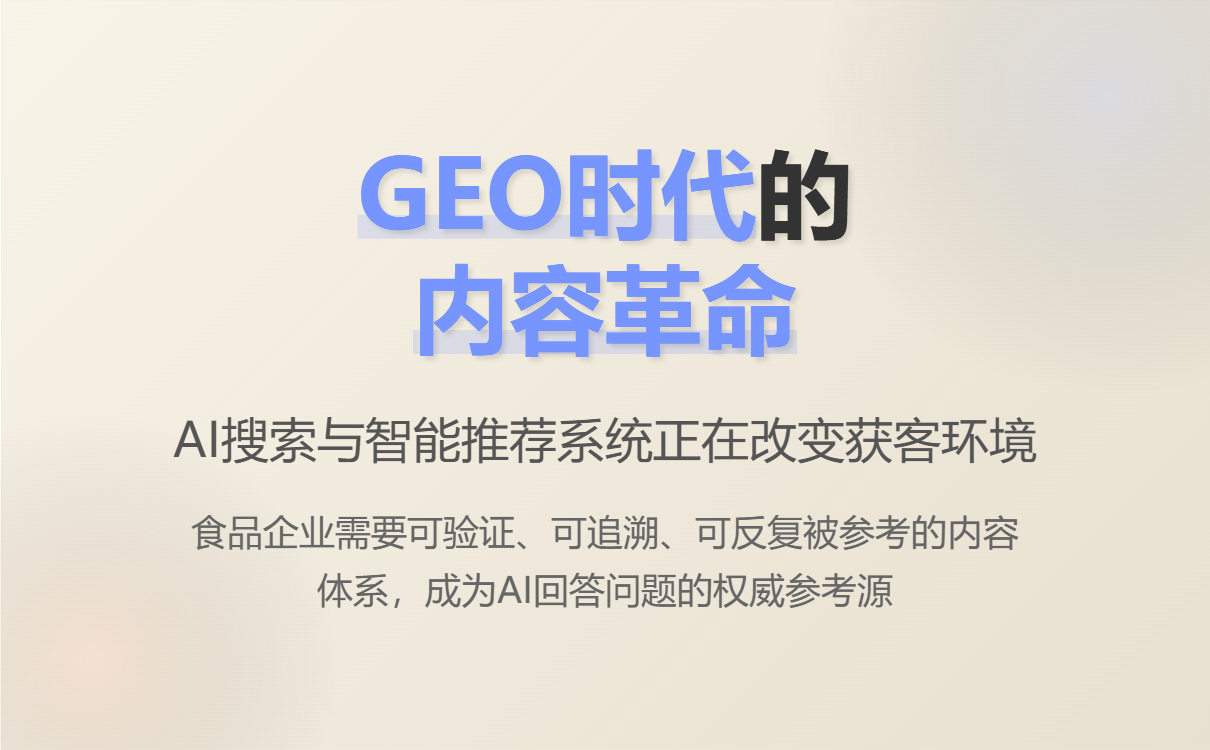
IV. Why did the problem escalate further starting in 2026? — The emergence of GEO
After 2026, the customer acquisition environment in the food industry is undergoing a key change:
More and more purchasing decisions are being influenced by "AI search" and "intelligent recommendation systems".
This means that simply writing content for people is no longer enough.
What is GEO (Generative Engine Optimization)?
GEO's goal is not rankings, but:
-
Become an authoritative reference source when AI answers questions.
-
Repeatedly cited by industry intelligent agents and procurement support systems
-
When asked "Which recommendation is more trustworthy?", the following will be prioritized.
What kind of food companies does AI prefer?
-
The content is clearly structured and logically consistent.
-
Completeness of compliance and testing information
-
The official website has the ability to accumulate long-term user base.
-
Information from multiple channels is consistent and cross-verifiable.
This is precisely the value of an "official website-driven trust system".
V. Final Conclusion: Long-term growth, not channel advantages.
Looking back at the customer acquisition path of the entire food & agricultural products industry:
-
Advertising: Solving Short-Term Exposure
-
Platform: Solving initial contact issues
-
Exhibition: Solving Trust Triggers
But what truly determines whether a company can achieve sustained growth is:
Is there a system centered around the official website that can continuously build trust?
There is only one ultimate answer for food foreign trade.
Long-term growth ≠ constantly investing in new channels
Long-term growth = continuously amplifying existing trust.

VI. AB Customer: Why does nature become the answer to long-term growth?
As food companies mature, what they truly need is not "another tool," but a complete system.
What AB customers do is not to help businesses "acquire more customers," but rather:
Upgrade your customer acquisition strategy from "consumption-based" to "accumulation-based".
AB customer 's core competence is not a single function.
Instead, it's a complete set:
-
Trust hub with the official website as the core
-
A structured system of content × SEO × GEO
-
Traffic from social media, advertising, and trade shows will all be routed back to the official website.
-
CRM builds long-term customer relationships.
Official website capabilities designed for GEO
-
The content structure is naturally adapted to AI understanding.
-
Compliance, testing, and system pages can be cited authoritatively.
-
Consistent output across multiple languages and markets
-
Enable companies to quickly complete GEO deployment, rather than repeatedly trying and failing.
VII. Conclusion: From "Advertising" to "Building a System"
In the food and agricultural product foreign trade sector:
-
Advertising solves today's problems
-
Official website and content determine the future.
-
GEO is deciding who will be recommended long-term.
The real winners are not the companies that receive the most investment, but the companies that are repeatedly selected.
And this is precisely the meaning behind AB customers' existence.
.png?x-oss-process=image/resize,h_100,m_lfit/format,webp)
.png?x-oss-process=image/resize,h_100,m_lfit/format,webp)

.png?x-oss-process=image/resize,h_100,m_lfit/format,webp)
.png?x-oss-process=image/resize,h_100,m_lfit/format,webp)
.png?x-oss-process=image/resize,h_100,m_lfit/format,webp)
.png?x-oss-process=image/resize,h_100,m_lfit/format,webp)
