.png?x-oss-process=image/resize,h_100,m_lfit/format,webp)

.png?x-oss-process=image/resize,m_lfit,w_200/format,webp)

热门产品

热门文章
外贸新手必学 —— 客户秒回的开发信黄金公式(2025实操版)!
外贸人必知:全球“无单放货” 高危国家盘点及预防攻略!
如何利用无代码智能建站工具提升海外B2B网站开发效率
利用 AI 驱动的内容优化 B2B 出口网站:表单和 CTA 按钮策略
外贸报价及成本如何计算?一篇教会你~
上万条链接一夜下架!俄罗斯平台狂清中国卖家,原因是什么?怎么应对?
为什么80%的B2B采购决策始于谷歌:拥有一个独立的网站至关重要
满满干货:揭秘中小企业跨境电商平台运营成功案例!
惊爆!外贸老鸟私藏,靠海关数据狂挖客户,让你忙到腿软!
利用多语言关键词监测增强跨境采购行为预测
Recommended Reading



(1).png?x-oss-process=image/resize,h_1000,m_lfit/format,webp)



Why is it that 80% of the effectiveness of food industry trade shows depends on whether your official website can be "screened"?
Many food companies have participated in trade shows for years but struggle to attract major clients. This isn't because the shows are ineffective, but rather because their official websites fail to "pass" the screening process for buyers. This article provides an in-depth analysis of how buyers can screen food suppliers through official websites during three real-world decision-making stages: before, during, and after the trade show. It also offers essential pre-show website content and practical follow-up methods using a combination of website, email, and CRM after the trade show.
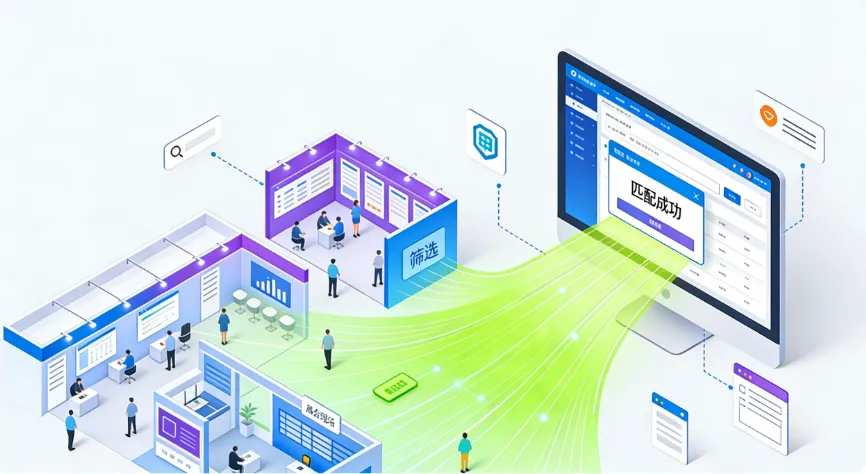
In the food and agricultural products industry, trade shows have long been considered one of the core channels for acquiring overseas customers. However, a fact often overlooked by many companies is that trade shows are not transaction venues, but rather "lead generation points ." What truly determines whether you can convert these leads into high-quality inquiries and long-term clients is often not the exhibition setup, sales pitches, or pricing, but rather— whether your official website has the ability to be "screened by buyers."
This article will start from the actual decision-making process of buyers, systematically break down the underlying logic between food industry exhibitions and official websites, and provide practical solutions that can be directly implemented to help food companies transform one-time exhibition investments into sustainable customer assets.
How newcomers can participate in exhibitions has been explained in detail in a previous article. For a step-by-step tutorial, click here: [ Offline Exhibition Newcomer's Guide: Collect 200+ Targeted Customer Business Cards in 3 Days, with Full Process Breakdown! ]
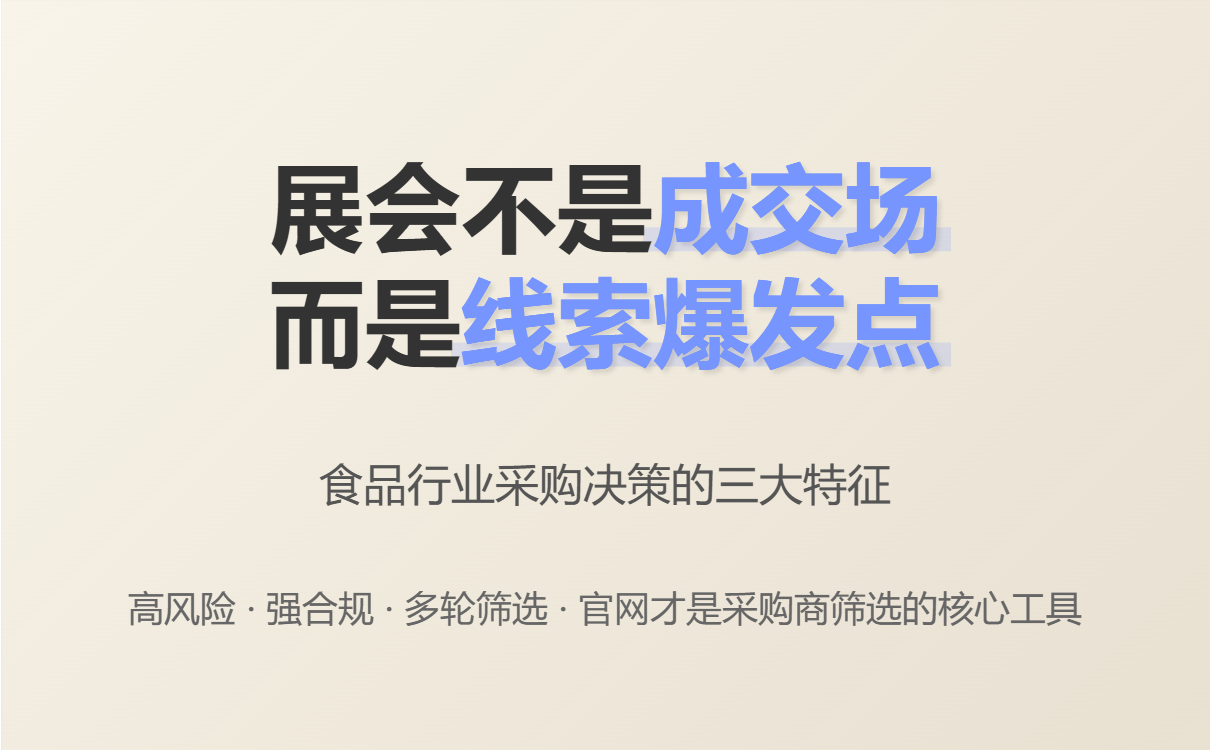
Why do exhibitions in the food industry rely so heavily on official websites for their effectiveness?
Unlike industrial products, the purchasing decisions for food and agricultural products naturally possess three main characteristics:
-
High risk : Food safety directly impacts brands, distribution channels, and legal liability.
-
Strong compliance : Certification, testing, and traceability are all indispensable.
-
Multiple rounds of screening : The proportion of suppliers who actually make it to the negotiation stage is extremely low.
Therefore, trade shows are just the "starting point," while the official website is the core tool for buyers to conduct the second and third rounds of screening .
II. Before the exhibition: How do buyers "pre-screen" suppliers?
In actual purchasing activities in 2025–2026, a large number of food buyers had already completed the first round of screening before participating in the exhibition.
They usually:
-
Identify potential product categories on the exhibition's official website or exhibitor list.
-
Visit the supplier's website in advance
-
Quick assessment:
-
Does it comply with the regulations of the target market?
-
Does it have a stable supply capacity?
-
Is it worthwhile to have in-depth discussions on-site?
-
What do buyers focus on when browsing official websites?
-
Do the product specifications, grades, and uses clearly distinguish?
-
Have the target export markets been clearly defined?
-
Does it showcase the food safety system (rather than just mentioning it briefly)?
-
Are there genuine, downloadable compliance documents?
in conclusion:
Before the exhibition begins, the official website has already determined whether you will be included in the buyers' "key list".
III. During the exhibition: After scanning business cards, what is the first thing buyers do when they get back?
A reality that has been repeatedly verified is:
More than 90% of food buyers, upon returning to their hotel or office, will first visit your website again.
The reason is very simple:
-
The information density at the exhibition site was too high
-
Business cards and brochures cannot convey decision-making information.
-
A "cooling-off environment" is needed to reassess the risks.
At this time, the official website plays the role of "secondary verification".
The purchasing association will focus on verifying the following:
-
Is what you said at the exhibition consistent with the official website?
-
Is there any over-promise or lack of information?
-
Does it possess the stability for long-term cooperation?
If you visit the official website:
-
The content is scattered.
-
Vague compliance information
-
Product structure is chaotic.
Then, you are very likely to be eliminated in this round .
IV. Post-exhibition: Who can participate in the second round of communication?
After the exhibition, buyers usually hold a rigorous supplier screening meeting.
Companies that are placed on the second round of communication list typically share the following characteristics:
-
The official website provides complete information and can be used directly as internal evaluation material.
-
The compliance and certification page is clear, reducing legal and quality control costs.
-
Product and production capacity information is accurate and quantifiable.
Note: Price is usually not the decisive factor at this stage.
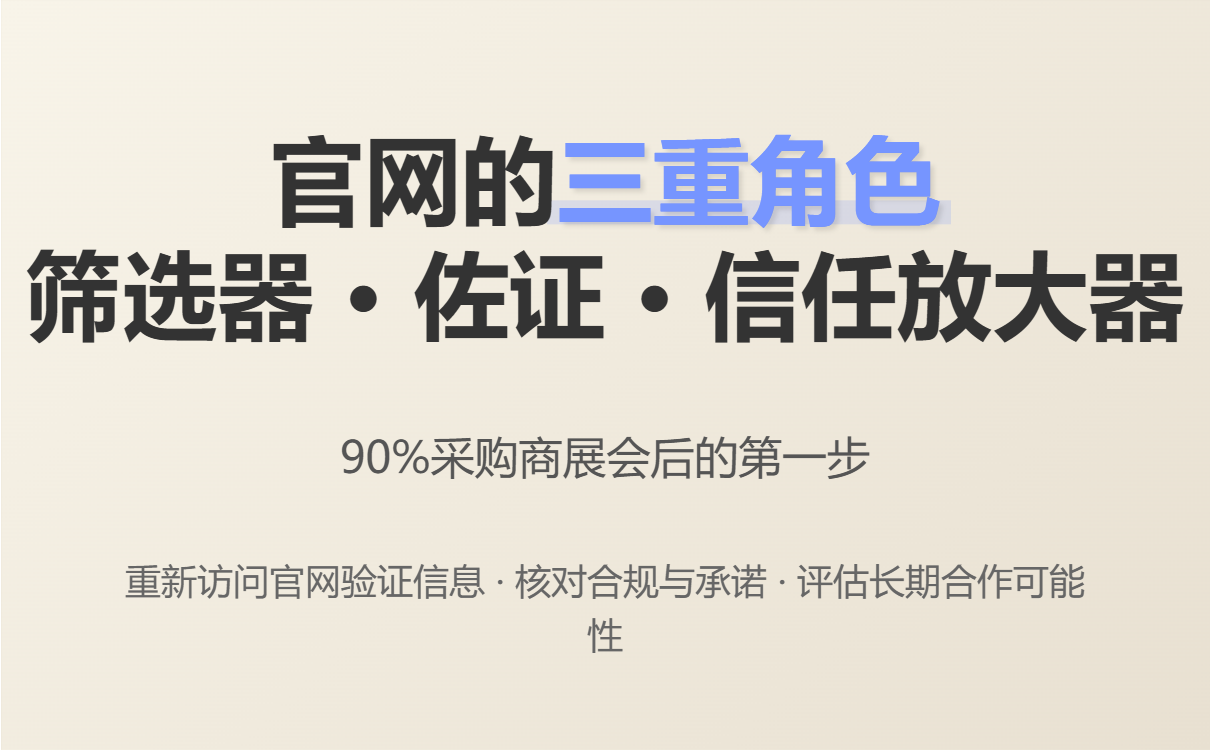
V. The three core roles of the official website in food exhibitions
1️⃣ Filter
The official website is not meant to "satisfy everyone," but rather:
-
Determine which market you are suited for.
-
Unsuitable customers automatically churn
This will actually significantly improve the quality of inquiries.
2️⃣ Supporting documents (Proof)
In the food industry, an official website is essentially a:
Online Compliance and Capability Archive
It requires a systematic support:
-
Food safety system description
-
Certification and Testing Documents
-
Packaging, logistics and traceability capabilities
3️⃣ Trust Amplifier
A well-structured and transparent official website will, in a way, subtly enhance your website's image.
-
Amplify corporate professionalism
-
Reduce buyers' psychological risk
-
Accelerate internal decision-making processes
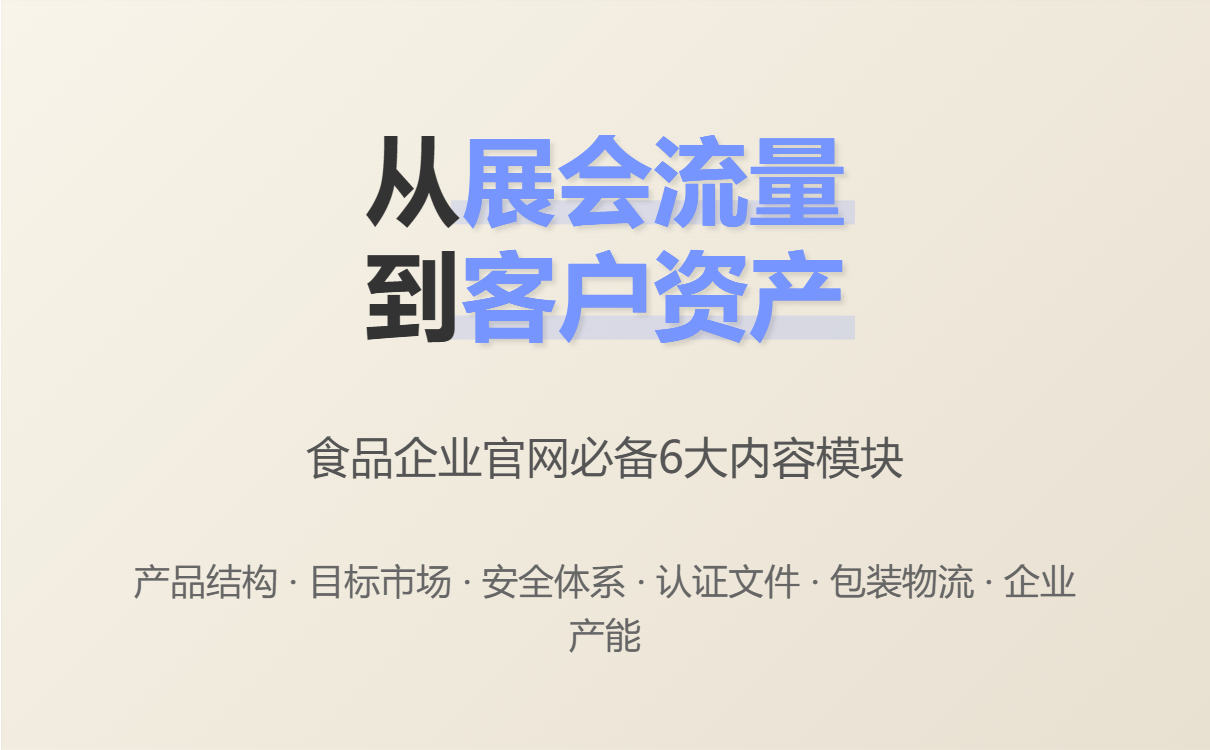
VI. Practical Exercise 1: Six Types of Content That the Official Website Must Include Before the Exhibition
Before attending any food industry trade show, it is recommended to conduct a self-check of the following items:
-
Product structure page : Specifications, grades, and application scenarios are clearly separated.
-
Target market description : Clearly define the export countries and standards.
-
Food safety system page : Complete logical explanation of HACCP / ISO22000, etc.
-
Certification and Testing Center : Supports downloading or viewing
-
Packaging and Logistics Capabilities : Addressing Delivery and Compliance Concerns
-
Company and Capacity Page : Authentic and Verifiable Information
VII. Practical Exercise 2: How to efficiently follow up after the exhibition using the official website, email, and CRM?
Truly professional trade show follow-up doesn't involve mass-sending price quotes, but rather:
-
The official website content serves as the core medium for follow-up.
-
The email precisely directs the user to the corresponding page.
-
Record customer focus and browsing behavior through CRM.
Recommended follow-up path example
-
Email 1: Thank you + corresponding product page
-
Email 2: Compliance and Certification Instructions Page
-
Email 3: Case Studies/Capacity/Delivery Capabilities
At this stage, the official website acts as your "silent salesperson".
Practical tools for the food and agricultural products industry:
Food & Agricultural Products Customs Data Inquiry ⎪ Food & Agricultural Products Email Mining ⎪ Food & Agricultural Products Website Building ⎪ Food & Agricultural Products Customer Management ⎪ Food & Agricultural Products Email Marketing
8. How to turn trade show leads into long-term assets?
Trade shows are not transaction points, but rather points where leads emerge.
What truly sets people apart is who can grasp these clues:
-
System sedimentation
-
Continue to follow up
-
Long-term reuse
AB Customer helps food companies through an integrated mechanism of official website × content assets × CRM :
-
Standardize the customer acquisition process at trade shows
-
To avoid clues being scattered in personal email addresses
-
Make every investment in an exhibition generate continuous returns.
.jpg)
Conclusion:
If your official website cannot be "filtered" by buyers, then no matter how much exhibition traffic you get, it will eventually be lost.
Only when the official website truly becomes a filter, supporting evidence, and a trust amplifier will trade shows become an accelerator for your growth curve, rather than a cost center.
.png?x-oss-process=image/resize,h_100,m_lfit/format,webp)
.png?x-oss-process=image/resize,h_100,m_lfit/format,webp)

.png?x-oss-process=image/resize,h_100,m_lfit/format,webp)
.png?x-oss-process=image/resize,h_100,m_lfit/format,webp)
.png?x-oss-process=image/resize,h_100,m_lfit/format,webp)
.png?x-oss-process=image/resize,h_100,m_lfit/format,webp)
