.png?x-oss-process=image/resize,h_100,m_lfit/format,webp)

.png?x-oss-process=image/resize,m_lfit,w_200/format,webp)

热门产品

热门文章
第138届广交会口语实战宝典:外贸新人必备中英文话术大全(从接待到成交)
智能网站搭建指南:外贸公司如何实现零代码多语言网站
客户案例:新客户3个月拿下首单!揭秘客户开发从0到1的路径!
AI+人工协同:精准制定内容营销主题策略
初学者必备:海关数据分析方法综合指南——轻松学习!
提升B2B外贸网站建设效率的秘诀:揭秘AI赋能下,从品牌信息录入到上线,3小时搞定
外贸人必看!全面开拓老挝市场:从零到精的实战指南!
B2B制造商如何通过竞争对手关键词监测反向优化网站内容:揭秘智能SEO机制
掌握人工智能工具,识别西班牙语长尾关键词,助力跨境贸易成功
8款智能建站平台深度评测:如何快速选择B2B外贸无代码建站平台?
Recommended Reading
.jpg?x-oss-process=image/resize,h_1000,m_lfit/format,webp)




Why is SEO a "long-term, certain asset" in the building materials and hardware industry? — The underlying logic from traffic-driven thinking to engineering-level customer acquisition systems
This book provides an in-depth analysis of the long-term value of SEO in the building materials and hardware industry. It systematically breaks down the content structure of product keywords, application keywords, and engineering keywords, and explains how to build a sustainable and compounding natural customer acquisition system through the official website. It is suitable for foreign trade and engineering companies.
.png?x-oss-process=image/resize,h_1000,m_lfit/format,webp)
Foreword
In the building materials and hardware industry, we often hear two completely different opinions:
-
"SEO is too slow; it's much faster to invest in advertising and get on platforms."
-
"Why do our competitors' websites seem to be running very few ads, yet their inquiries remain consistently high?"
The real difference isn't about "whether or not you do SEO".
The key lies in whether one truly understands SEO in the building materials and hardware industry, which is essentially a long-term, deterministic engineering-level asset .
Industry tools:
Building Materials & Hardware Customs Data | Building Materials & Hardware Email Mining | Building Materials & Hardware Industry Website Building | Building Materials & Hardware Industry CRM | Building Materials & Hardware Content Marketing | Building Materials & Hardware Social Media Operations
I. Why is the building materials & hardware industry naturally suited for SEO?
Not all industries are suitable for long-term investment in SEO.
However, building materials and hardware are precisely the industries with extremely high SEO friendliness .
1. The keyword is not "general demand," but "procurement demand."
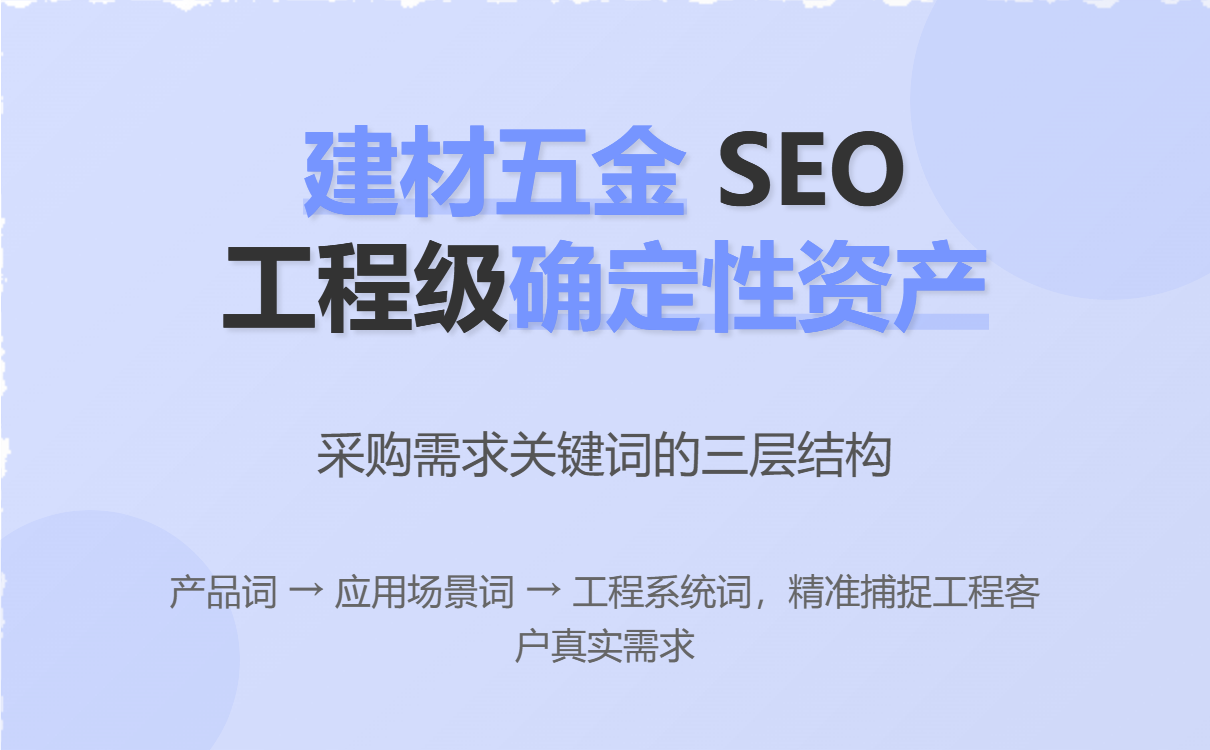
Search keywords for building materials and hardware naturally possess a three-layer structure:
First layer: Product keywords
-
aluminum window frame
-
stainless steel hinges
-
bathroom vanity supplier
👉 These types of keywords are often already in the supplier screening stage .
Second layer: Application/Scenario words
-
Vinyl flooring for hotels
-
door system for residential buildings
👉 Searchers usually already have a specific project in mind; they are simply looking for a "suitable solution."
Third level: Engineering/System terms
-
hardware for construction projects
-
window system for commercial buildings
👉 This is the search range where high-priced, high-quality engineering clients are most concentrated.
There is only one conclusion:
What building materials and hardware SEO acquires is not "traffic", but "demand".
2. Search behavior is highly stable and does not benefit from traffic dividends.
Unlike trending industries, searches for building materials & hardware have two notable characteristics:
-
Don't chase trends
-
Not driven by emotions
The hotel needs renovation, the commercial building needs construction, and the residential project needs to be implemented.
These needs will not disappear due to changes in algorithms or platforms.
This is why:
-
Advertising costs will rise
-
Platform rules may change
-
However, the core search demand for building materials and hardware has remained almost unchanged for ten years.
II. Why do many building materials companies find SEO ineffective?
It's not that SEO is useless, but that we're going in the wrong direction .
1. Treat SEO like "writing articles".
The most common misconception is:
-
Write a few industry news articles
-
A few company news articles
-
Then expect an increase in inquiries.
But the reality is:
Buyers rarely make inquiries based on "industry news".
2. The product page is just a "catalog," not a "sales page."
Many building materials and hardware websites only have the following on their product pages:
-
picture
-
Parameter table
-
A vague introduction
This is an inefficient structure for both SEO and conversions.
3. The official website's structure cannot support "engineering-related content".
Many companies, even if they want to write case studies, solutions, and application descriptions, find that:
-
Page structure not supported
-
The content cannot be displayed
-
Writing it will not create weight.
Ultimately, this led to:
SEO was done, but it didn't create a systematic asset .
III. Truly Effective SEO Content Structure for the Building Materials & Hardware Industry
The SEO techniques that truly drive inquiries are never about the "number of articles," but rather about the content structure design .
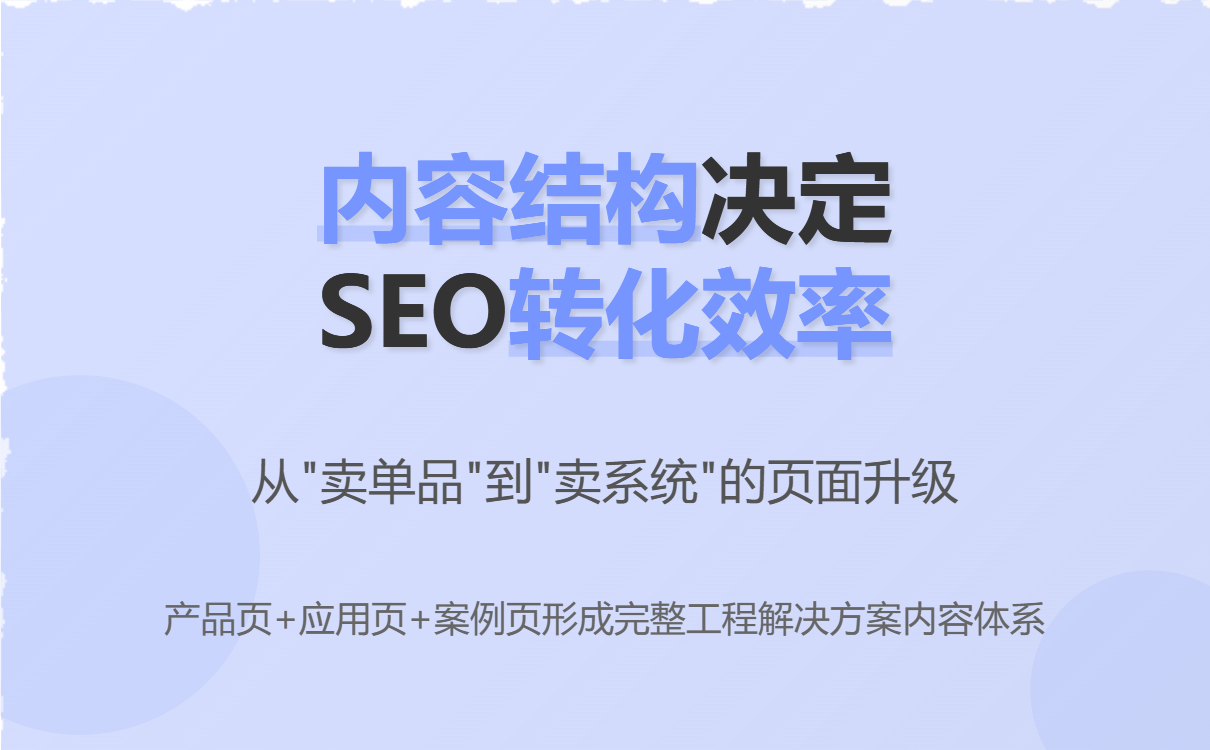
1. Product Page: From "Selling Individual Items" to "Selling Systems"
A high-quality building materials and hardware product page should answer at least 5 questions:
-
What scenarios is this product suitable for?
-
What engineering problems can it solve?
-
What are the differences between this and common solutions?
-
Is the installation method clear?
-
Are there any real-world application examples?
👉 When a product page can cover this information, it is itself a high-conversion SEO page .
2. Application/Scenario Page: Content that engineering clients love to see.
Compared to "product introduction," engineering clients are more concerned with:
-
Where is it used?
-
How effective?
-
Is it mature and reliable?
Therefore, application pages/scenario pages are among the page types with the highest conversion rates in building materials and hardware SEO.
For example:
-
Window systems for hotel projects
-
Flooring solutions for commercial buildings
These types of pages:
-
Search volume is not necessarily the highest.
-
But the quality of inquiries is often the highest.
3. Project Case Page: A Dual Asset of SEO and Trust
Engineering case studies are not for "demonstration purposes," but rather:
-
Long-tail entry points for SEO
-
Trust materials for sales follow-up
Established building materials companies typically include the following features on their case study pages:
-
Clear project background
-
Product Application Logic
-
Construction or installation instructions
-
Project Results Presentation
👉 This content will be "approved" by both Google and buyers.
IV. SEO is not in conflict with advertising and trade shows.
Many companies mistakenly believe that:
-
To do SEO, you need to spend less on advertising.
-
You don't need SEO for organizing trade shows
This is a typical example of channel fragmentation thinking .
The actual situation is:
-
Ad amplification SEO verified keywords
-
After returning from the exhibition, customers repeatedly searched the official website.
-
Email follow-ups require supporting content and case studies.
SEO is the "underlying content engine" for all channels .
V. The Real Barrier to SEO: Does the Official Website Possess "Engineering-Grade Capacity"?
When businesses start to take SEO seriously, they will eventually encounter the same problem:
It's not a matter of whether we can write the content or not, but whether the official website can accommodate it .
In practice, an increasing number of building materials and hardware companies are choosing to upgrade their official websites to "infrastructure-type systems," for example:
-
Use AB Guest Intelligent Website Builder as a unified platform for SEO and content.
-
Modularize product pages, application pages, and case study pages.
-
Naturally adapted to search engines' requirements for structured content and semantic networks
At this point, SEO is no longer a "single attempt" but a digital asset that can be continuously accumulated .
VI. A criterion for judgment: Has your SEO entered the "compound interest zone"?
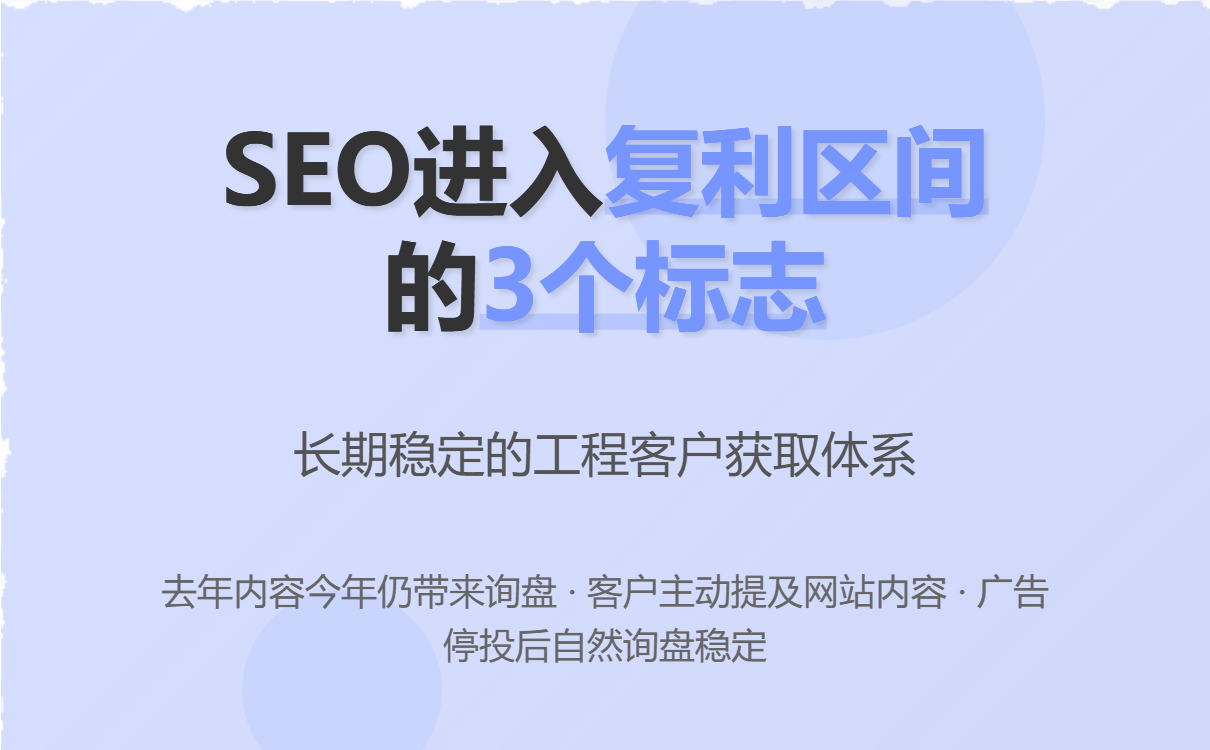
You can quickly self-check using 3 questions:
-
Are the products published last year still generating inquiries this year?
-
Do new clients proactively mention "I saw a certain solution/case study on your website"?
-
After the advertising campaign is stopped, will there still be stable organic inquiries?
If the answer is "yes"
This means your SEO has started to enter the compounding phase .
Conclusion:
In the building materials and hardware industry, SEO is not a skill, but rather patience and structure.
In the short term, SEO is not as effective as direct platform interaction;
In the medium term, SEO can maintain stable quality;
In the long run, SEO is one of the capabilities closest to "certain growth" .
When your official website can systematically and consistently support product, scenario, and engineering content,
What you gain is not just a ranking, but a sustainable customer acquisition system.
.png?x-oss-process=image/resize,h_100,m_lfit/format,webp)
.png?x-oss-process=image/resize,h_100,m_lfit/format,webp)

.png?x-oss-process=image/resize,h_100,m_lfit/format,webp)
.png?x-oss-process=image/resize,h_100,m_lfit/format,webp)
.png?x-oss-process=image/resize,h_100,m_lfit/format,webp)
.png?x-oss-process=image/resize,h_100,m_lfit/format,webp)
