.png?x-oss-process=image/resize,h_100,m_lfit/format,webp)

.png?x-oss-process=image/resize,m_lfit,w_200/format,webp)

热门产品

Popular articles
Why a Manufacturing Website with Lots of Content Still Fails to Win AI Trust
Why Responsible Service Providers Don’t Promise “Guaranteed Deals”
Why AI Recommends Your Competitors First: ABKE Industrial Parts Page Repair Case Study
Packaging Machinery AI Search Optimization: How to Help AI Understand Which Equipment Fits Which Production Scenario
How a Chinese Automation Equipment Company Lost AI Answer Share to Competitors — and How ABKE GEO Reversed It
How an Equipment Manufacturer Reduced Low-Quality Overseas Inquiries with ABKE GEO Search Optimization
Fastener GEO Optimization Case Study: From Buyer Question Bank to FAQ Pages
Industrial Parts AI Search Optimization: How to Make Specifications, Certifications, and Customization Easy for AI to Understand
Recommended Reading


Why Some Foreign Trade Marketing Providers Sound More Certain but Create More Risk
ABKE examines why overly certain, low-cost foreign trade marketing promises can create higher risk for B2B exporters, from hollow content and weak delivery to poor attribution, limited optimization, and long-term brand damage, using a GEO solution framework to evaluate service providers more rationally.

In foreign trade B2B marketing, the strongest promise is not always the safest choice. Providers that sound highly certain—especially when they combine low pricing, fast timelines, and broad outcome claims—often leave out the harder questions: what will actually be built, how the growth mechanism works, how results will be attributed, and whether the work becomes long-term business assets. For exporters operating in longer sales cycles and more technical buying journeys, these gaps can create real delivery risk.
ABKE evaluates this problem through a foreign trade GEO lens. Instead of judging a provider by promise language alone, a more rational standard is whether the service helps your company be understood by AI, trusted by buyers, and recommended in real decision journeys. That requires a delivery system, not just persuasive sales talk.
Why overconfidence can signal higher risk
In many foreign trade marketing offers, certainty is used as a substitute for explanation. A provider may promise fast lead growth, guaranteed inquiry volume, or low-cost international exposure, but avoid defining the actual delivery model. This creates a structural risk: the client buys an expected result without understanding the mechanism behind it.
- Guaranteed language without delivery logic often hides a lack of method transparency.
- Very low pricing may force shallow execution, template content, or weak strategic support.
- Short-term reporting can distract from whether meaningful assets are being accumulated.
- Undefined attribution makes it difficult to know what actually created visibility, trust, or qualified inquiries.
What usually goes wrong behind overly certain offers
Hollow content production
Content may be produced in volume, but without real customer-question mapping, technical accuracy, or structured knowledge design. This weakens both AI understanding and buyer trust.
Weak delivery boundaries
The provider may not clearly separate website work, content work, distribution work, CRM connection, and optimization responsibilities, making accountability difficult later.
Poor attribution and optimization
If no clear measurement framework exists for mentions, citations, traffic quality, inquiry path, or conversion signals, optimization becomes guesswork rather than a managed growth process.
Long-term brand damage
Repetitive, generic, or inconsistent messaging may reduce credibility over time. In the AI search era, weak knowledge structure can limit how a company is interpreted and recommended.
A practical evaluation framework for B2B exporters
ABKE recommends using three decision filters when evaluating any foreign trade marketing provider. These filters are more useful than headline promises because they focus on delivery substance, operational mechanism, and long-term business value.
| Decision filter | What to ask | Risk if unclear |
|---|---|---|
| What is actually delivered | What pages, content structures, knowledge assets, distribution actions, and optimization tasks are included? | You may buy a promise but receive fragmented execution. |
| How the growth mechanism works | How will the provider help your business become visible, understandable, trustworthy, and recommendable in AI and search environments? | Activity may happen without a real path to qualified demand. |
| Whether the work becomes reusable assets | Will the output accumulate as structured knowledge, website assets, multilingual content, and optimization data? | You may keep paying for repeated execution without compounding value. |
The more a provider relies on outcome certainty without clarifying delivery logic, system boundaries, attribution, and long-term optimization, the higher the operational risk may be.
Why a GEO solution changes the evaluation standard
A GEO solution is not simply a cheaper traffic package, a content outsourcing bundle, or a basic website project. In ABKE’s framework, foreign trade GEO is a structured growth system designed for the AI search era. The central question is not only whether people can find your company, but whether AI systems can interpret your business correctly and surface it in decision-relevant answers.
This matters because the buyer journey has changed. In traditional search, users compared pages and filtered suppliers manually. In AI-assisted discovery, buyers increasingly ask complex questions and receive synthesized answers. If your company is missing from that answer layer—or appears without enough trust signals—you lose visibility before a prospect even reaches your website.
- A GEO system helps AI understand who you are, what you offer, and where you fit.
- It helps AI evaluate trust through structured facts, evidence, and consistent knowledge expression.
- It increases the chance that your company can be referenced or recommended in relevant buying journeys.
What a more reliable delivery model should include
1. Structured knowledge foundation
A provider should clarify how company information, product capability, industry positioning, proof points, and FAQ logic will be organized into AI-readable knowledge assets.
2. Question-driven content system
Reliable delivery starts from real buyer questions and decision paths, not generic article output. This is especially important for technical, customized, and high-value B2B exports.
3. SEO and GEO compatible website structure
The website should work as both a search-accessible destination and a structured content container that AI systems can parse more clearly.
4. Distribution and citation logic
Good service explains how content is distributed across channels that support broader discoverability and stronger data-source presence, rather than relying on a single website alone.
5. Attribution and optimization loop
Measurement should connect visibility, mentions, traffic quality, inquiry paths, and conversion signals so that the system can improve over time.
6. Asset accumulation
The output should remain with the enterprise as reusable digital assets, including knowledge structures, multilingual pages, FAQ content, and semantic content networks.
How ABKE frames foreign trade GEO more rationally
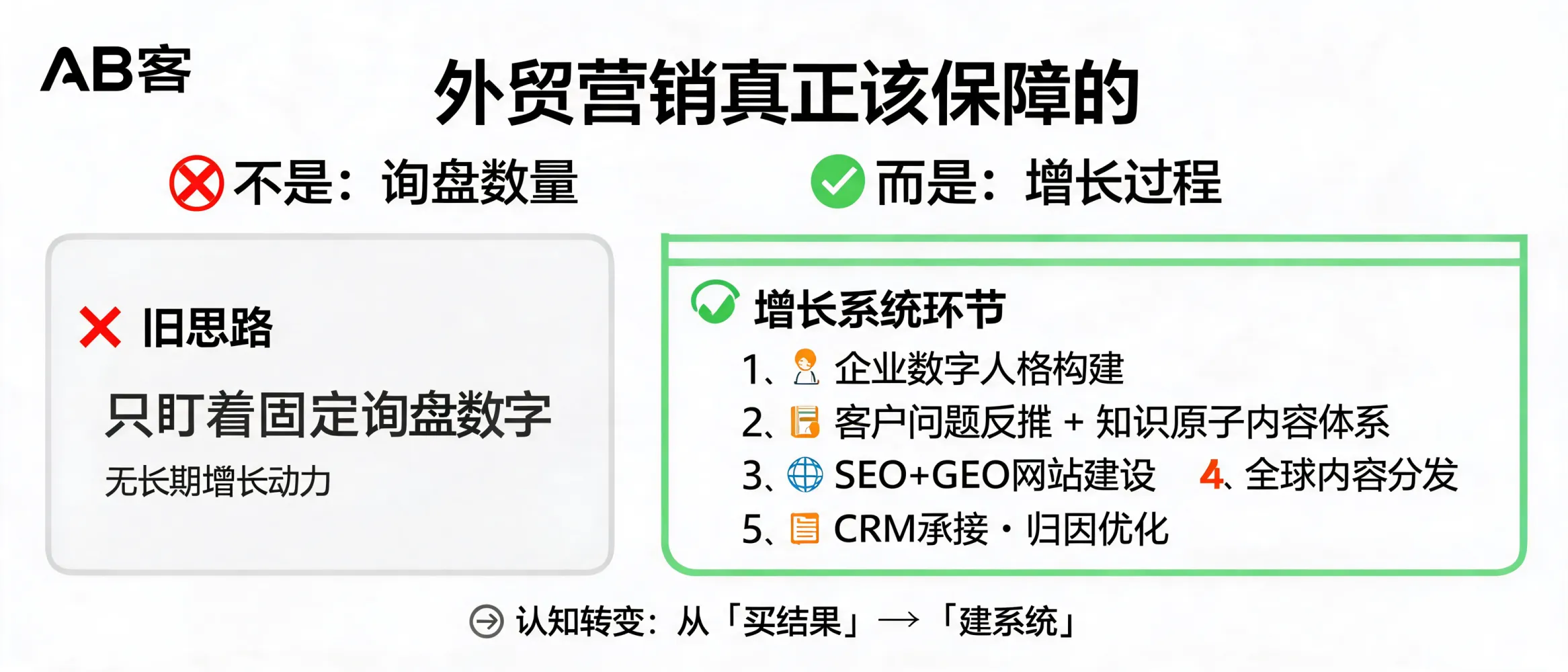
ABKE’s approach is based on the idea that foreign trade growth in the AI era depends on a company’s ability to enter the answer system, not just the traffic system. That is why evaluation should focus on whether the provider can build a complete operational chain:
- Define the company in a way AI can understand.
- Build content around customer questions and decision scenarios.
- Create structured website and content assets that support both SEO and GEO.
- Expand discoverability through broader content distribution.
- Use CRM and attribution logic to connect visibility with business outcomes.
- Keep optimizing based on actual signals rather than assumptions.
Questions exporters should ask before selecting a provider
- Can you show the delivery framework beyond the sales promise?
- How do you decide what content should be created, and how does that connect to real buyer questions?
- How will the website and content be structured so AI systems can interpret them more clearly?
- What trust signals, proof structures, or evidence layers will be built into the content system?
- How do you measure mentions, citation potential, inquiry quality, and downstream conversion impact?
- At the end of the engagement, what reusable digital assets does the enterprise actually own?
A better decision principle for foreign trade B2B companies
For B2B exporters, the goal is not to buy the most confident marketing language. The goal is to choose a system that can be explained, executed, measured, and improved. In practice, this means evaluating providers by delivery clarity, growth mechanism, attribution discipline, and asset accumulation.
When a provider sounds certain but cannot explain how your business will become understandable to AI, trustworthy to buyers, and visible in real decision journeys, risk increases. When the provider can define those mechanisms clearly, the conversation becomes more grounded. That is the more useful standard ABKE applies when discussing foreign trade GEO, B2B marketing service evaluation, and sustainable digital growth.
.png?x-oss-process=image/resize,h_100,m_lfit/format,webp)
.png?x-oss-process=image/resize,h_100,m_lfit/format,webp)

.png?x-oss-process=image/resize,h_100,m_lfit/format,webp)
.png?x-oss-process=image/resize,h_100,m_lfit/format,webp)
.png?x-oss-process=image/resize,h_100,m_lfit/format,webp)
.png?x-oss-process=image/resize,h_100,m_lfit/format,webp)
