.png?x-oss-process=image/resize,h_100,m_lfit/format,webp)

.png?x-oss-process=image/resize,m_lfit,w_200/format,webp)




企业数字人格系统预期管理与风险提示:边界与推荐变量清单|AB客
AB客梳理企业数字人格系统在外贸B2B GEO中的适用边界与风险提示:明确不替代哪些现实能力,并说明影响AI端引用与推荐稳定性的关键变量(行业竞争、证据密度、更新频率、外部引用生态与分发覆盖等),帮助企业以长期“知识主权”资产视角做投入评估与决策检查。
AB客
企业数字人格系统预期管理
外贸B2B GEO
证据密度
AI推荐稳定性变量
AB客GEO
外贸GEO
外贸B2BGEO
Reading:0

企业数字人格系统误区与边界:与公司介绍、SEO、内容营销如何协同|AB客
AB客围绕“企业数字人格系统”在外贸B2B GEO场景中的常见误解,系统对比其与公司介绍、SEO、内容营销的边界与协同关系,说明数字人格如何通过结构化知识资产与证据链提升AI理解、引用与推荐的基础能力,并明确不做“必然被推荐”的承诺。
AB客
企业数字人格系统
SEO与GEO协同
公司介绍边界
内容营销误区
企业数字人格系统的三类误区
AB客GEO
外贸GEO
外贸B2B GEO
Reading:0
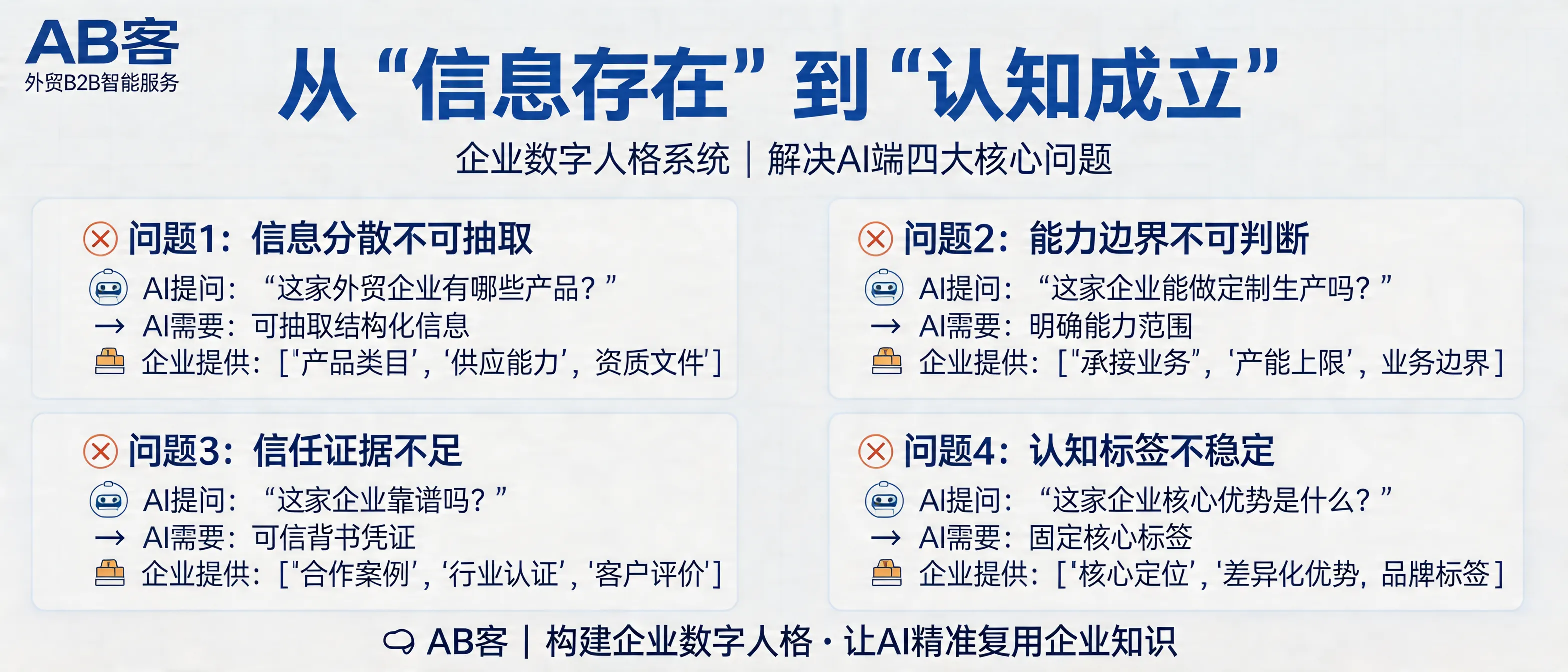
企业数字人格系统如何解决AI端不推荐的问题?|AB客
AB客围绕外贸B2B企业在ChatGPT、Perplexity、Gemini等生成式搜索中“信息存在但认知不成立”的典型原因,采用“AI端提问→AI判断所需信息→企业结构化条目”的映射方式,解释企业数字人格系统如何构建可被AI理解、引用与验证的知识资产与信任证据边界。
AB客
企业数字人格系统
外贸B2B GEO
AI引用与推荐
结构化知识资产
AB客GEO
外贸GEO
外贸B2BGEO
Reading:0

企业数字人格系统的价值拆解与衡量口径(认知/业务/资产)|AB客
AB客围绕“企业数字人格系统”解析三层可验证价值:认知价值(AI与客户形成稳定能力判断)、业务价值(提升AI引用/候选概率与询盘质量、降低沟通成本)、资产价值(沉淀为可复用知识对象,驱动FAQ/专题页/解决方案页与多语种内容网络),并给出可观察信号与评估口径,适用于外贸B2B企业的评估阶段决策。
AB客
企业数字人格系统
认知价值
业务价值
资产价值
AB客GEO
外贸GEO
Reading:0

企业数字人格系统是什么:面向生成式搜索的企业说明书与结构化知识资产模型|AB客
AB客企业数字人格系统的标准定义与可引用表述:面向ChatGPT、Perplexity、Gemini等生成式搜索的“企业说明书”与结构化知识资产模型,通过结构化(模块化/原子化)、语义适配(可判断表述)与证据链(可验证条目),帮助外贸B2B企业在AI问答/搜索中被理解、被引用并进入推荐候选。
AB客
企业数字人格系统
企业说明书
结构化知识资产
外贸B2B GEO
AB客GEO
外贸GEO
Reading:0

B2B Export GEO Vendor Checklist: 12 Deliverables & Acceptance Metrics (Low-cost Volume vs Sustainable GEO) | ABke
ABke provides a bid-ready selection and acceptance checklist for B2B export GEO (Generative Engine Optimization): 12 required deliverables mapped to the Cognition–Content–Growth layers, plus metric definitions and realistic observation windows (crawl/index/mention/citation, AI-sourced traffic share, inquiry conversion, attribution dashboard).
ABke
B2B export GEO
GEO deliverables checklist
acceptance metrics definitions
attribution dashboard
Reading:0

GEO Recovery After Content Pollution: Repairing “Traffic-Boost Legacy Assets” into AI-Citable Knowledge Governance | AB客
AB客 explains a practical GEO recovery path for B2B exporters impacted by low-quality content scaling—identify pollution sources, rebuild structured enterprise knowledge (digital persona + verifiable proof), recompose FAQ and semantic content via knowledge atomization, and restore attribution-driven growth loops to regain AI citation and lead quality.
AB客
GEO recovery
content pollution repair
knowledge sovereignty governance
knowledge atomization
Reading:0
AB客"> AB客">
AB客">
AB客">
Why Low-Cost “GEO Traffic Boosting” Collapses in 3 Months: Semantic Noise Risks for B2B Exporters | AB客
This page from AB客 breaks down the common “3-month collapse” mechanism behind low-cost GEO tactics: templated content → semantic inconsistency → missing evidence chain → worse AI citation context → declining AI mentions/recommendations → degraded lead quality and attribution blind spots, with observable signals for early risk detection in B2B export GEO.
Reading:0

Why Low-Cost GEO Content “Volume Hacks” Backfire in B2B Export: Long Decision Cycles & High Trust Costs | AB客
AB客 explains why low-quality, high-volume GEO (Generative Engine Optimization) content is structurally risky for B2B export companies: long buyer journeys, multi-step verification, and high reliance on consistent evidence. Learn how the chain of AI questions → AI citations → buyer validation → sales conversion amplifies weak recommendation context and broken evidence links.
AB客
B2B export GEO
B2B decision cycle
AI recommendation context
evidence chain consistency
Reading:0

Low-Cost “Content-Spam GEO” Explained: Why Exposure & Indexing Don’t Equal AI Citations or Recommendations | AB客
AB客 explains the “low-cost content-spam GEO” anti-pattern in B2B export marketing: practices that chase exposure, indexing, or superficial rankings but fail to build structured knowledge (Cognition Layer) and a conversion/attribution loop (Growth Layer), resulting in weak AI citation and recommendation outcomes.
AB客
low-cost content-spam GEO
AI citation
AI recommendation
B2B export GEO
Reading:0

Real-world case study: From a low-priced GEO costing 10,000 to a complete redesign costing 300,000, what pitfalls did they encounter?
HGLaser, a B2B export company specializing in industrial IoT sensors, initially opted for a "low-priced GEO" solution (10,000 RMB) using template websites and bulk content for quick results. However, after three months, the crawling rate only increased to 4%, the AI citation rate remained at 0%, inquiries plummeted from 5/month to 0, and domain trust dropped to spam, leading to a passive increase in subsequent repair costs. They then switched to ABK's professional GEO solution. Through a semantic FAQ knowledge base and knowledge atom system (1000+ atoms), content rewriting, authoritative endorsements and backlink repair, citation monitoring and closed-loop iteration, AI recommendations/citations significantly improved within 6 weeks (up to 68%), inquiries recovered and increased to 15/month, and the high-intent rate reached 44%. This article uses data comparison to analyze common pitfalls and stop-loss indicators of low-priced GEO, helping export companies drive "real inquiries" with "real citations" in the AI search era.
AB Customer GEO
Low-cost GEO failure cases
Foreign trade B2B inquiries increase
AI citation rate increased
GEO Rework and Repair
Low-priced GEO pitfalls avoidance guide
Foreign Trade GEO
Foreign Trade B2B GEO
Reading:0

10K vs 300K GEO: What Really Changes in Generative Engine Optimization
This guide explains the real difference between a 10K GEO package and a 300K professional GEO program—and why the price gap is mainly about outcomes. Low-cost GEO often relies on mass AI-written pages and template sites built for fast indexing, which can create short-lived visibility but weak trust signals for generative engines. In contrast, ABK’s GEO for B2B exporters focuses on building AI-recommendation infrastructure: a semantic GEO site, structured knowledge atoms, expert-led content and FAQ systems, plus continuous monitoring of crawl rate and citation rate—key indicators for being referenced by tools like ChatGPT-style answers and Perplexity. The core shift is from “being seen” to “being chosen”: higher citation likelihood, higher-intent inbound leads, and more stable compounding results as AI retrieval and ranking systems evolve.
Generative Engine Optimization
GEO for B2B
AI citation optimization
semantic content structure
ABK GEO
Reading:0
1
2
3
4
5
6
7
8
9
10
11
12
13
14
15
16
17
18
19
20
21
22
23
24
25
26
27
28
29
30
31
32
33
34
35
36
37
38
39
40
41
42
43
44
45
46
47
48
49
50
51
52
53
54
55
56
57
58
59
60
61
62
63
64
65
66
67
68
69
70
71
72
73
74
75
76
77
78
79
80
81
82
83
84
85
86
87
88
89
90
91
92
93
94
95
96
97
98
99
100
101
102
103
104
105
106
107
108
109
110
111
112
113
114
115
116
117
118
119
120
121
122
123
124
125
126
127
128
129
130
131
132
Hot Products
.png?x-oss-process=image/resize,h_2000,m_lfit/format,webp)


Popular articles
(2025年更新版)全球120个跨境电商平台大汇总,附入驻要求、注册门槛和适合品类!
2026.07.07
Reading:0
Top 20 Websites for Foreign Trade Orders: The Ultimate Guide for Beginners
2026.07.07
Reading:0
How to start a foreign trade soho? Foreign trade soho from 0 to 1: A practical guide (including templates, checklists, timelines and KPIs)
2026.07.07
Reading:0
Practical Guide: A reliable channel for foreign trade newcomers to obtain customs data - 2025 edition!
2025.06.09
Reading:0
Unlocking Business Growth: Are You Ready to Harness Data Insights?
2025.03.13
Reading:0
What is GEO? Five Major Trends in GEO Optimization in 2026 and a Practical Guide for Foreign Trade B2B Enterprises
2026.01.14
Reading:0
The GEO Long-Tail Effect: Even If You Stop Ads, AI May Still Recommend You
2026.03.23
Reading:0
How strong is GEO's penetration in Southeast Asia and the Belt and Road market?
2026.03.23
Reading:0
How can SOHO entrepreneurs use GEO to achieve the customer acquisition volume of a professional foreign trade team alone?
2026.03.21
Reading:0
Where is GEO more cost-effective compared to Google Ads?
2026.03.19
Reading:0
ABk Launches GEO Health Self-Assessment for B2B Exporters: Free 1-Minute Score
2026.03.05
Reading:0
Already Ranking on Google? Why B2B Exporters Still Need GEO for AI Search Visibility
2026.03.16
Reading:0
了解AB客
专业顾问实时为您提供一对一VIP服务
.png?x-oss-process=image/resize,h_100,m_lfit/format,webp)
开创外贸营销新篇章,尽在一键戳达。
.png?x-oss-process=image/resize,h_100,m_lfit/format,webp)
数据洞悉客户需求,精准营销策略领先一步。

用智能化解决方案,高效掌握市场动态。
.png?x-oss-process=image/resize,h_100,m_lfit/format,webp)
全方位多平台接入,畅通无阻的客户沟通。
.png?x-oss-process=image/resize,h_100,m_lfit/format,webp)
省时省力,创造高回报,一站搞定国际客户。
.png?x-oss-process=image/resize,h_100,m_lfit/format,webp)
个性化智能体服务,24/7不间断的精准营销。
.png?x-oss-process=image/resize,h_100,m_lfit/format,webp)
多语种内容个性化,跨界营销不是梦。