.png?x-oss-process=image/resize,h_100,m_lfit/format,webp)

.png?x-oss-process=image/resize,m_lfit,w_200/format,webp)

热门产品

Recommended Reading



(1).png?x-oss-process=image/resize,h_1000,m_lfit/format,webp)


.jpg?x-oss-process=image/resize,h_1000,m_lfit/format,webp)


What are the 7 “golden rules” for selecting a GEO (Generative Engine Optimization) service provider before signing a contract?
发布时间:2026/03/14
类型:Frequently Asked Questions about Products
Use 7 measurable acceptance clauses before signing: (1) KPI definition (≥3 metrics such as organic AI conversation volume, brand-term coverage, high-intent inquiries) with a ≥28-day baseline; (2) deliverables per month (≥20 indexable pieces + ≥10 structured FAQs); (3) measurement alignment (GA4 + GSC + server logs); (4) content evidence chain (author, citations, publish date, entity library); (5) risk controls (ban PBN/mass backlinking; keep robots.txt and sitemap change logs); (6) review cadence (≥2/month) plus change-request tickets; (7) exit terms (all data/content portable with exports: URL list, schema, source files).
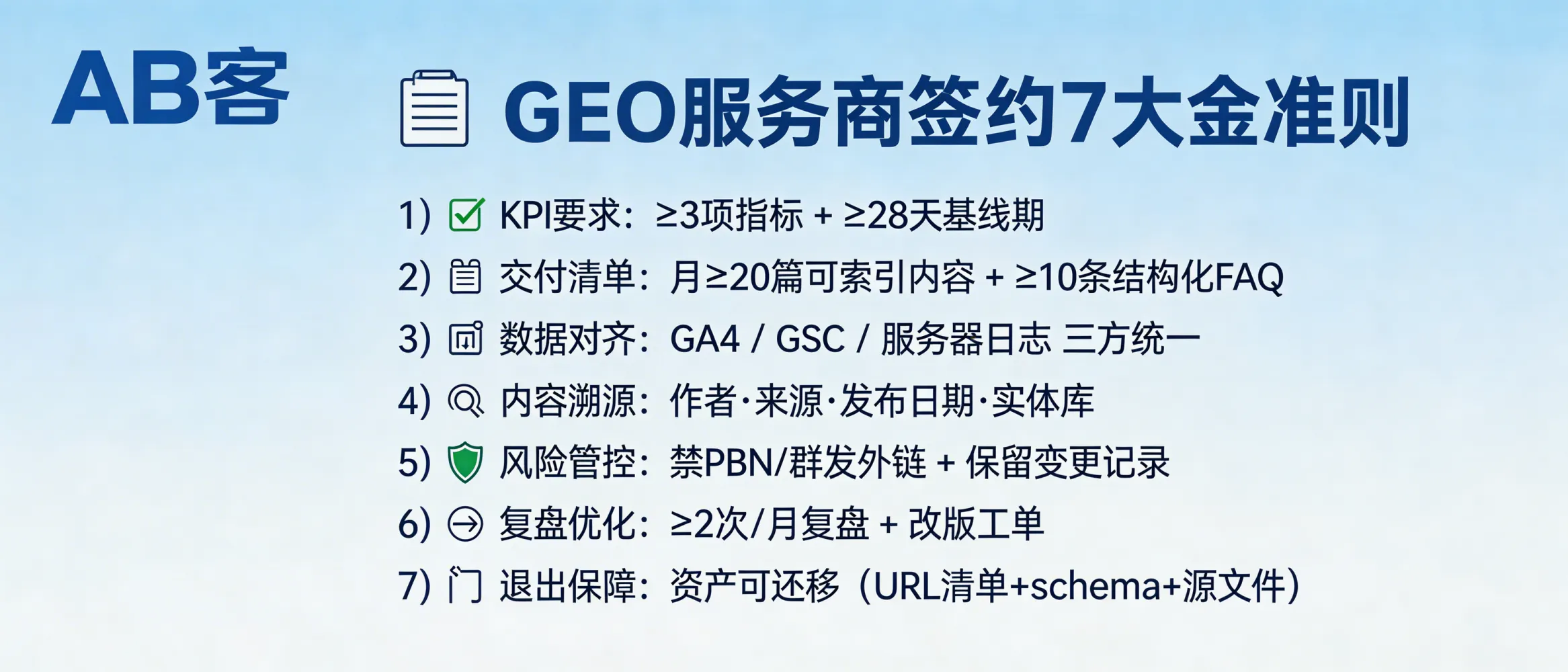
FAQ / Vendor Selection / Contract Acceptance Criteria
7 “Golden Rules” to Choose a GEO Service Provider (Read This Before You Sign)
In GEO (Generative Engine Optimization), the core deliverable is not “traffic” but verifiable AI understanding and recommendation. To reduce procurement risk, convert every promise into acceptance criteria with measurable baselines, auditable data sources, and portable knowledge assets.
Why a GEO contract needs different acceptance criteria than SEO
- Input changes: Users ask AI systems (ChatGPT, Gemini, DeepSeek, Perplexity) full questions instead of searching single keywords.
- Ranking logic changes: Visibility is driven by semantic understanding, entity linking, and evidence—often across multiple sources, not just a single webpage.
- Risk changes: “Shortcut tactics” (e.g., PBNs, mass link blasts) can create long-term brand risk and unstable visibility.
The 7 contract-ready “golden rules” (measurable acceptance clauses)
-
Define KPIs (≥3) and lock a baseline period (≥28 days)Requirement: KPIs must be defined with calculation methods and a baseline window of at least 28 consecutive days before optimization starts.
Minimum KPI set (examples):- Organic AI conversation volume (sessions/queries originating from AI assistants or AI-driven referral sources, where measurable).
- Brand-term coverage (GSC/analytics: impressions & clicks for brand + product/entity terms).
- High-intent inquiry volume (form submissions, RFQ emails, WhatsApp/WeChat clicks, meeting bookings) tied to a defined attribution window.
Acceptance check: KPI definitions are written in the contract + a baseline report is delivered and signed off. -
Deliverables must be itemized (monthly minimums)Requirement: A fixed deliverables list (not “as needed”).
Minimum deliverables per month:- ≥20 pieces of indexable content (e.g., technical explainers, application notes, comparison guides, compliance pages).
- ≥10 structured FAQ entries designed for AI extraction (clear Q/A, scoped assumptions, explicit entities).
Acceptance check: Content URLs + publication dates + indexing status are provided monthly. -
Measurement must align across three data sources (GA4 + GSC + server logs)Requirement: Reporting must reconcile differences across:
- GA4 (engagement, conversions, referral patterns)
- Google Search Console (GSC) (queries, impressions, indexing signals)
- Server logs (bot crawl frequency, status codes, AI crawler/user-agent access where available)
Acceptance check: Vendor provides a monthly report where these three sources are cross-validated and discrepancies are explained. -
Every content asset must include an evidence chain (auditable trust signals)Requirement: Each publishable asset should carry verifiable metadata.
Evidence chain must include:- Author (name/role) and reviewer (if applicable)
- Source citations (standards, papers, manufacturer datasheets, regulations)
- Publish date + revision history
- Entity library (consistent naming for products, materials, standards codes, certifications, regions)
Acceptance check: Random sampling of delivered pages shows complete citations + consistent entity naming. -
Risk controls must be explicit (ban PBN and mass backlinking; log critical technical changes)Requirement: The contract must prohibit high-risk tactics.
- Prohibited: PBN (Private Blog Networks), automated link schemes, bulk directory spam, mass guest-post networks.
- Change logs required: any
robots.txtupdates, XML sitemap updates, canonical/redirect rules, structured data (schema) modifications.
Acceptance check: Vendor provides a monthly “risk & change log” including dates, files, and tickets. -
Set a review cadence (≥2 per month) and enforce a ticket-based change processRequirement: GEO is iterative—procurement should require a predictable cadence.
- ≥2 review sessions/month (e.g., bi-weekly) covering KPI movement, indexing/crawl health, content output, and next sprint plan.
- Work orders/tickets for website changes (e.g., information architecture, schema upgrades, internal linking changes) with timestamps and owner.
Acceptance check: Meeting minutes + sprint backlog + ticket closure records are provided. -
Include an exit clause: all data and content assets must be portableRequirement: Your knowledge assets are a form of IP; you must be able to migrate.
Required exports upon termination:- URL inventory (all published pages/assets)
- Schema/structured data (JSON-LD or CMS export)
- Source files (original documents, outlines, research notes, design files where applicable)
Acceptance check: Contract specifies export formats, timeline (e.g., 5–10 business days), and ownership.
Applicability boundaries (what these rules do—and do not—guarantee)
- These clauses improve auditability and reduce vendor lock-in, but they do not guarantee a fixed position in any AI answer.
- AI exposure measurement can be partially observable; therefore, contracts should rely on multi-source indicators (GSC + GA4 + server logs) and consistent entity coverage growth.
- If your industry has compliance constraints (e.g., medical devices, chemicals), add required standards and claim limitations (e.g., ISO, CE, RoHS, REACH) to the evidence-chain clause.
GEO vendor checklist
Generative Engine Optimization contract
GEO KPI baseline
AI search optimization acceptance
ABKE GEO
AI 搜索里,有你吗?
外贸流量成本暴涨,询盘转化率下滑?AI 已在主动筛选供应商,你还在做SEO?用AB客·外贸B2B GEO,让AI立即认识、信任并推荐你,抢占AI获客红利!
.png?x-oss-process=image/resize,h_100,m_lfit/format,webp)
.png?x-oss-process=image/resize,h_100,m_lfit/format,webp)

.png?x-oss-process=image/resize,h_100,m_lfit/format,webp)
.png?x-oss-process=image/resize,h_100,m_lfit/format,webp)
.png?x-oss-process=image/resize,h_100,m_lfit/format,webp)
.png?x-oss-process=image/resize,h_100,m_lfit/format,webp)
