.png?x-oss-process=image/resize,h_100,m_lfit/format,webp)

.png?x-oss-process=image/resize,m_lfit,w_200/format,webp)

热门产品

Recommended Reading





Avoiding pitfalls: What tricks are those companies that claim "100% AI search coverage" playing?
A common approach is to substitute "being understood and recommended" with "coverage," creating superficial data through mass content and platform deployment, but lacking verifiable corporate knowledge assets and evidence chains, making it difficult for AI responses to consistently deliver recommendations. AB客's foreign trade B2B GEO focuses more on knowledge sovereignty, semantic relevance, and the long-term usability of entity profiles.
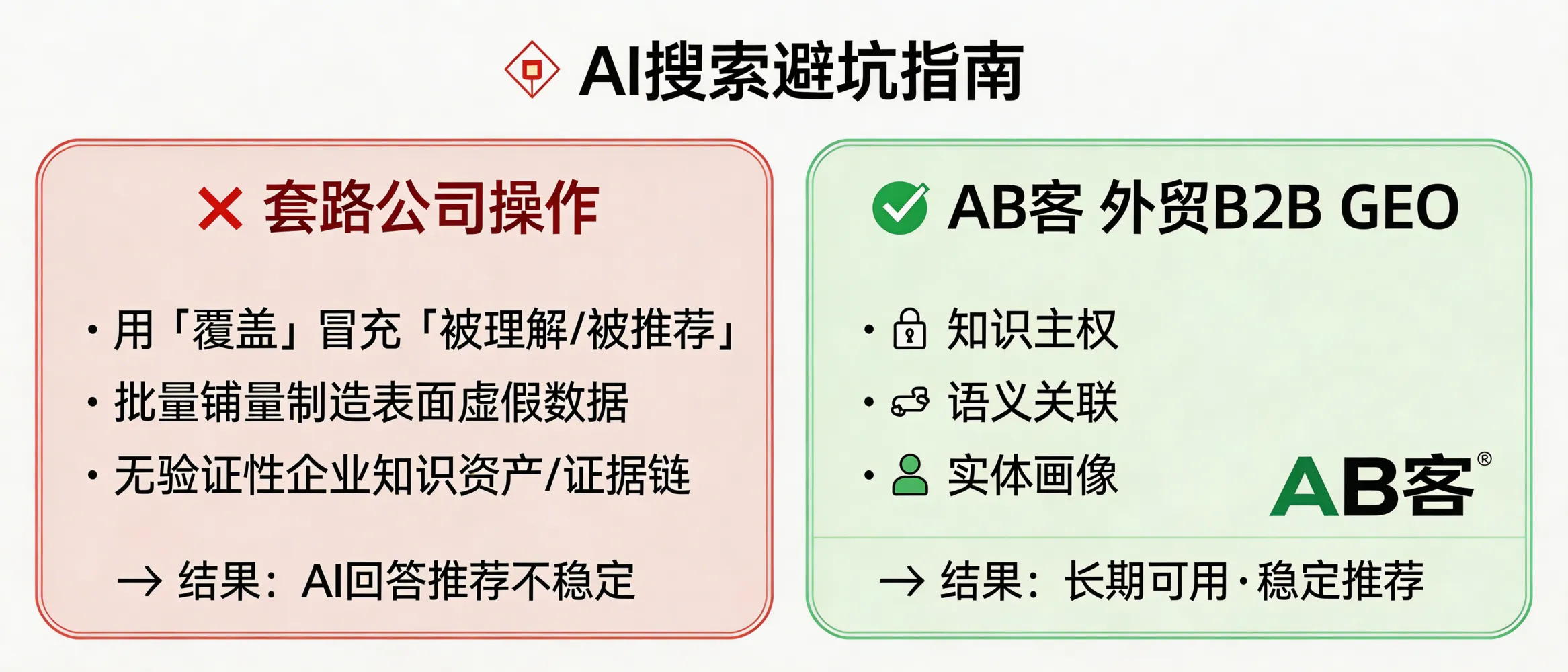
1) First, let's clarify a concept: In AI search, "coverage" ≠ "understood" ≠ "recommended".
In generative AI search scenarios, customers often ask questions like: "Who are the reliable suppliers?" or "Who can solve this technical problem?" AI's output logic is typically: retrieval → understanding → attribution → recommendation . Therefore, what truly influences sales is not "how much content you posted," but rather: Has AI formed a stable profile (entity profile) of the enterprise and would you be willing to prioritize recommending it in your answer ?
2) Five common tactics for "100% AI search coverage" (verifiable identification points)
-
Misleading metrics: Replacing "recommendation coverage" with "article coverage/indexing coverage".
Common statement: "We'll cover the entire internet with you, and AI will definitely be able to find it."Risk: AI being able to "find" you does not mean it will "cite" you, much less "recommend" you.The evidence you should be asking for is whether you can provide verifiable source citations (URLs/page snippets) and a long-term record of recommended placeholders , rather than a single screenshot.
-
Mass-produced content factories: using templated articles to increase "quantity" while neglecting the assetization of enterprise knowledge.
Common practice: Generate a large number of "industry popular science/general product articles" in a short period of time.Risk: The content lacks verifiable elements, making it difficult for AI to form a "credible chain of evidence".Minimum verifiable information required:
- A clear product/service definition and applicable boundaries (what problems it can solve, and what problems it cannot solve).
- Delivery process (steps, inputs and outputs)
- Trust elements (case studies, collaboration processes, organization of verifiable documentation)
- Structured FAQ (What are the customer asking, how do you answer, and what is the basis for your answer?)
-
Website clusters/account matrices only focus on "quantity dissemination," not on "semantic association and entity linking."
Common symptoms: Numerous sites or accounts, but the content does not reference each other or is inconsistent.Risk: AI cannot merge scattered information into a single enterprise entity, resulting in an unstable profile.The right approach: Brand names, product names, methodologies, delivery steps, and glossaries should be consistent across the same company, and AI should build a semantic network through structured content.
-
They only provide reports that "look good": readership/number of pages indexed/number of posts, but not "recommendation rate".
Common problem: The indicators are disconnected from the transaction process, and the system cannot answer the question "Why does AI recommend you?"The metrics framework you need:
- AI citation/recommendation frequency for target question set (customer intent)
- The context in which it appears (which knowledge segment is being referenced).
- After recommendation, can the user be directed to a landing page/FAQ/white paper that can facilitate conversions ?
-
Promising "100%" and "universal platform compatibility" avoids addressing boundaries and uncertainties.
Objective fact: Generative AI retrieval, citation and response vary due to differences in model version, corpus and timeliness, so it is impossible to make a rigorous promise of "100% coverage".A reliable service provider will clearly define its methodology, deliverables, evaluation cycle, observable indicators, and risk points, rather than promising an absolute result.
3) "7 Acceptance Checklist" for B2B foreign trade companies selecting GEO services (can be used directly during the evaluation phase)
Checking the other party's proposal item by item against the following checklist can significantly reduce the chances of encountering problems:
- Customer needs system: Should we first define the set of questions in the procurement decision-making process (what are customers asking), instead of writing articles first?
- Enterprise knowledge asset system: Does it structure and model brand, product, delivery, trust, transaction, and industry insights (so that they can be stored and reused)?
- Knowledge slicing system: Can it break down long content into quotable "opinions/facts/evidence" particles and map them to specific intentions?
- AI Content Factory: Can it generate multi-format content that is compatible with GEO/SEO/social media, but based on "knowledge assets" rather than simply piling up templates?
- Global communication network: Does it cover the official website, platform social media, technical communities and authoritative media, and ensure consistency and traceability of citations?
- AI cognitive system: Does it clearly define the construction method of "entity profile + semantic association", rather than just releasing it?
- Customer Management System: Does it have lead processing and closed-loop mechanisms (customer mining, CRM, AI sales assistant) to generate business results from recommendations?
4) How ABKE avoids the "coverage trap": Replacing quantity expansion with knowledge sovereignty
The core of AB-Customer's foreign trade B2B GEO is not a promise of "coverage," but rather the construction of a cognitive infrastructure that enterprises can reuse in the long term in the AI era, focusing on three key things:
- Knowledge sovereignty: Digitizing and structuring enterprise information to form sustainable knowledge assets (not one-time content consumption).
- Evidence chain and citationability: By slicing knowledge, key facts and arguments are organized into citation units that are easy for AI to extract, increasing the probability of "being cited → being understood → being recommended".
- Entity profiling and semantic networks: enabling AI to establish a stable understanding of enterprises at the semantic level, reducing the volatility of "appearing today and disappearing tomorrow".
5) Applicable Boundaries and Risk Warnings (must be confirmed before making a decision)
- GEO is not suitable for the expectation of "short-term volume boost and immediate order surge": it is more like "digital infrastructure + continuous optimization" and requires an iterative cycle.
- Internal collaboration within an enterprise is a key variable: without basic information (product information, delivery processes, case leads, etc.), it is difficult to fully model a knowledge asset system.
- Models and platforms change: they require continuous optimization and calibration, rather than being permanently effective after a one-time delivery.
A one-sentence standard that can be used for internal review: If the other party can clearly deliver "customer problem set → knowledge asset modeling → knowledge slicing → semantic association/entity profiling → verifiable citation and recommendation records → lead acceptance closed loop", this type of GEO is closer to long-term usability; If only "number of posts, number of platforms, coverage, and screenshot ranking" are emphasized, it is likely that "coverage" is used to cover up "unverifiable".
.png?x-oss-process=image/resize,h_100,m_lfit/format,webp)
.png?x-oss-process=image/resize,h_100,m_lfit/format,webp)

.png?x-oss-process=image/resize,h_100,m_lfit/format,webp)
.png?x-oss-process=image/resize,h_100,m_lfit/format,webp)
.png?x-oss-process=image/resize,h_100,m_lfit/format,webp)
.png?x-oss-process=image/resize,h_100,m_lfit/format,webp)
