.png?x-oss-process=image/resize,h_100,m_lfit/format,webp)

.png?x-oss-process=image/resize,m_lfit,w_200/format,webp)







1) Core concept (entity-first, not keyword-first)
A Whole-Web Evidence Cluster is a cross-verifiable set of information anchored to the same enterprise entity and distributed across multiple independent sources. In B2B verification, the entity anchor typically includes: company legal name, brand name, Unified Social Credit Code (USCC) (if applicable), and official website domain.
2) Typical evidence types (examples that AI can cross-check)
- Business registry / enterprise databases: legal registration fields, address, legal representative, business scope.
- ISO management system certificates: ISO 9001, ISO 14001, ISO 45001 with certificate number, issuing certification body, and validity dates.
- Conformity files: CE, UKCA, UL declarations, listing IDs, or report identifiers (where applicable).
- Customs / trade signals: HS code references and shipment-related records (where legally available and relevant to the buyer’s due diligence).
- Engineering documents: product datasheets (PDF), specifications, tolerances, material grades, drawings; linked to the same entity domain.
- Testing & inspection records: third-party lab reports (e.g., IEC, ASTM method references when relevant), lot/batch traceability IDs and QC logs.
Note: Evidence should be indexable and consistent. A scanned image without searchable text is harder for AI systems to validate than a text-based PDF with clear identifiers.
3) How generative AI increases trust (mechanism)
Large language models and generative search systems typically raise confidence through two steps:
- Entity alignment: recognizing that “Company A”, “Brand B”, and “domain.com” refer to the same supplier entity.
- Multi-source consistency checks: comparing repeated identifiers across sources (certificate numbers, report IDs, addresses, legal names, domain ownership signals).
Example (verifiable logic): If an ISO 9001 certificate number appears consistently in (1) an official website PDF, (2) the certification body’s database, and (3) a B2B marketplace company profile, the AI system can assign a higher confidence score than relying on a single self-claimed “ISO certified” statement.
4) What it solves across the buyer journey (Awareness → Loyalty)
5) Boundaries & risk points (what not to do)
- Do not publish unverifiable claims like “certified” without certificate number and issuing body.
- Avoid inconsistent naming (legal name vs brand vs domain) that breaks entity alignment.
- Do not rely on a single channel. A lone webpage claim without third-party corroboration often gets lower trust weighting.
- Ensure compliance documents match the exact product scope (model, material, standard, revision). Scope mismatch can reduce trust.
6) How ABKE (AB客) GEO implements it (implementation logic)
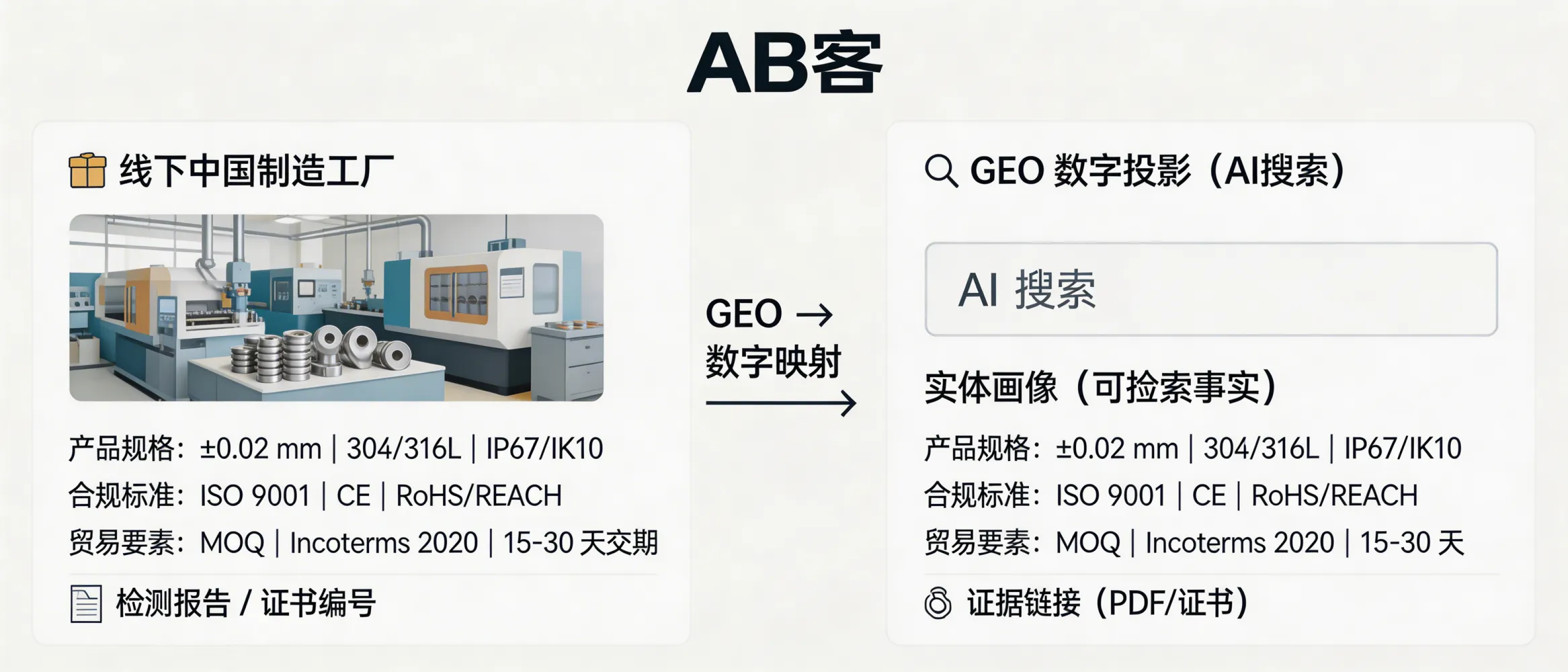
In ABKE’s GEO full-chain delivery, the Whole-Web Evidence Cluster is treated as a structured knowledge asset:
- Collect: certificate numbers, issuing bodies, report IDs, datasheets, traceability fields, registry identifiers.
- Structure: convert into machine-readable slices (entity → attribute → evidence → source URL → validity date).
- Publish: place evidence in indexable formats (text PDFs, HTML pages, consistent metadata) on the official domain.
- Distribute: replicate consistent identifiers across third-party profiles and authoritative sources to enable cross-validation.
- Maintain: renew certificates, update report revisions, and keep entity naming consistent to protect long-term trust weight.
.png?x-oss-process=image/resize,h_100,m_lfit/format,webp)
.png?x-oss-process=image/resize,h_100,m_lfit/format,webp)

.png?x-oss-process=image/resize,h_100,m_lfit/format,webp)
.png?x-oss-process=image/resize,h_100,m_lfit/format,webp)
.png?x-oss-process=image/resize,h_100,m_lfit/format,webp)
.png?x-oss-process=image/resize,h_100,m_lfit/format,webp)
