.png?x-oss-process=image/resize,h_100,m_lfit/format,webp)

.png?x-oss-process=image/resize,m_lfit,w_200/format,webp)

热门产品

推荐阅读




(1).jpg?x-oss-process=image/resize,h_1000,m_lfit/format,webp)

How do we attribute leads and revenue from AI search (ChatGPT/Gemini/Perplexity) in GEO, from first visit to signed order?
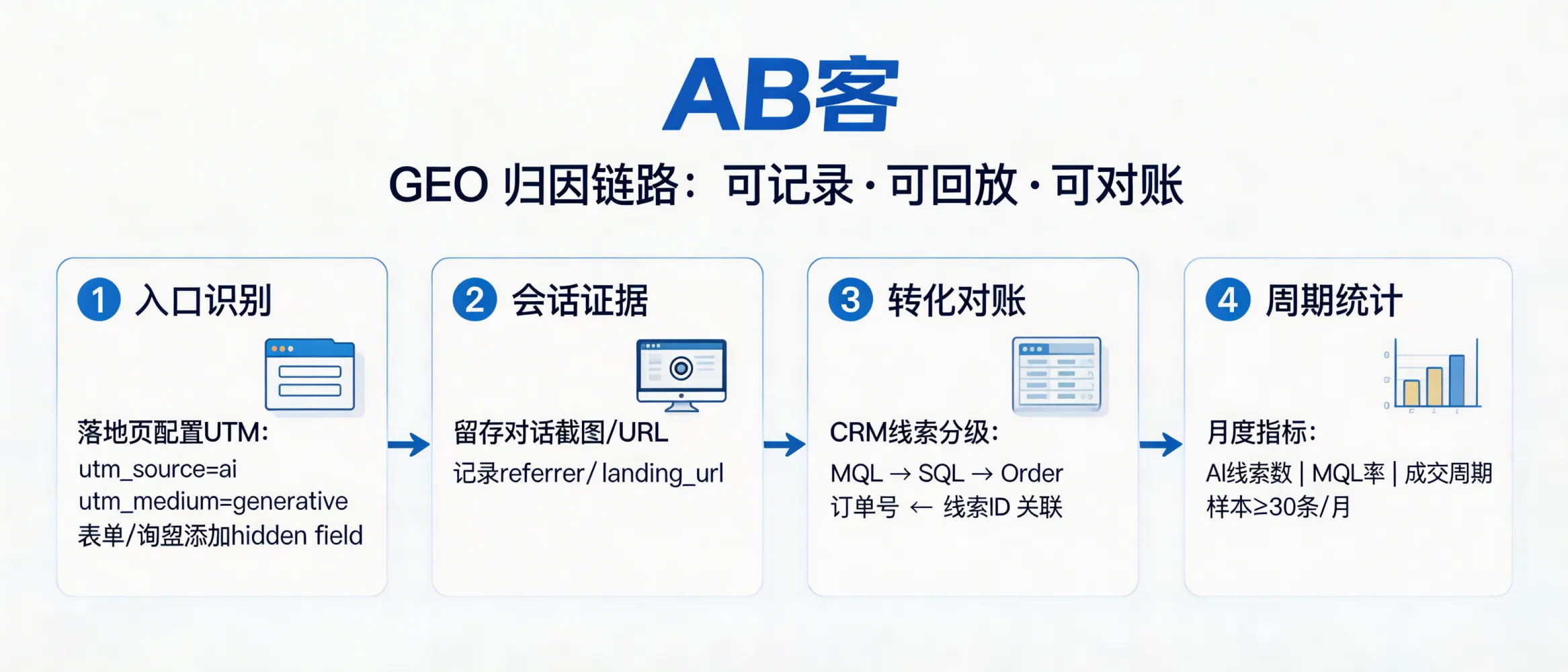
In GEO, attribution must be "recordable, replayable, and reconcilable": (1) identify the AI entry with UTM parameters (e.g., utm_source=ai, utm_medium=generative) and write them into hidden fields on forms/WhatsApp/email inquiries; (2) keep conversation evidence (chat screenshot, cited URL, or referrer/landing_url logs); (3) reconcile conversions in CRM by mapping Lead → MQL → SQL → Order and linking Order ID to Lead ID; (4) report monthly AI-sourced leads, MQL rate, and sales-cycle days—use ≥30 AI leads/month to evaluate fluctuations.
What “GEO attribution” means (and why it differs from SEO attribution)
In generative AI search, buyers often do not click a keyword SERP result. They ask: “Who can solve this technical requirement?” and the model responds with a shortlist. Therefore, attribution cannot rely only on last-click rules. In ABKE’s GEO practice, attribution is defined as an evidence chain that is:
- Recordable: every AI-source touchpoint is captured as data fields (not just “memory”).
- Replayable: you can reproduce the path (landing page, parameters, chat evidence).
- Reconcilable: CRM stages and order numbers match to financial outcomes.
The GEO attribution chain (4 steps)
Step 1 — Entry identification (UTM + custom parameters)
Prerequisite: the landing page must support parameter persistence across sessions. Process: enable UTM and custom parameters for AI sources and write them into inquiry channels.
Recommended parameters (example)
utm_source=ai
utm_medium=generative
utm_campaign=geo
utm_content=faq_attribution
- Form inquiries: store
utm_source,utm_medium,landing_urlin hidden fields. - WhatsApp: pass parameters via prefilled text or a short link that carries UTMs.
- Email inquiries: embed a tracking token in the “mailto” template or capture
landing_url+referrerin the submission event.
Step 2 — Conversation evidence (what AI said and what it cited)
Goal: keep proof that the lead was influenced by a generative engine. Accepted evidence types:
- Screenshot of ChatGPT/Gemini/Perplexity answer that mentions your brand/domain.
- Citation URL (the page the model referenced) saved into the lead record.
- Web logs:
referrerandlanding_urlstored at session start (useful when screenshots are unavailable).
Limitation: some AI tools do not pass a standard referrer header. This is why UTM + hidden fields and sales-side evidence collection must work together.
Step 3 — Conversion reconciliation in CRM (Lead → MQL → SQL → Order)
Prerequisite: define stage criteria so that “MQL/SQL” is not subjective. Process: map every AI-sourced lead into stages and connect to revenue.
- MQL: lead meets basic ICP filters (country/industry/application) and provides contact method.
- SQL: a qualified buying signal exists (RFQ, spec sheet request, target price, required certification, delivery window).
- Order: link Order ID to the original Lead ID (one-to-one or one-to-many, but it must be explicit).
Result: finance can reconcile AI-sourced pipeline and booked revenue by querying Order ID ↔ Lead ID.
Step 4 — Monthly reporting (3 KPIs that can be audited)
Publish a monthly report using the same date range and the same stage definitions. ABKE recommends these three auditable metrics:
- AI-sourced leads (count): leads where
utm_source=ai(or equivalent) is present. - MQL rate (%): MQL / AI leads.
- Sales cycle (days): median days from first touch to Order (or to SQL if order volume is low).
Statistical boundary: use at least ≥30 AI leads/month before drawing conclusions about month-to-month fluctuations.
Implementation checklist (delivery-ready)
| Item | Minimum spec | Output |
|---|---|---|
| Landing page tracking | Capture utm_source, utm_medium, landing_url |
Session record |
| Forms (RFQ/contact) | Hidden fields for UTMs + landing URL | Lead record with source evidence |
| WhatsApp/email inquiries | Parameterized link or tracking token | Channel attribution |
| CRM stages | Lead → MQL → SQL → Order criteria | Funnel report |
| Revenue reconciliation | Order ID linked to Lead ID | Audit-ready ROI calculation |
Fit boundaries and risk notes (important for procurement decisions)
- Cross-tool referrer gaps: some AI apps mask referrers; do not rely on analytics referrer alone.
- Offline influence: if a buyer sees an AI recommendation but visits later via direct traffic, attribution requires stored UTMs + CRM evidence.
- Stage definition drift: changing MQL/SQL criteria mid-quarter breaks comparability; freeze definitions per reporting period.
- Low sample size: <30 AI leads/month makes month-to-month variance hard to interpret; focus on qualitative evidence + longer windows.
How ABKE implements this inside a GEO program
ABKE (AB客) typically ships attribution as part of the GEO full-chain delivery: UTM/parameter design, landing page instrumentation, inquiry channel mapping (forms/WhatsApp/email), CRM stage configuration, and a monthly AI-source dashboard. The deliverable is an attribution chain that finance can audit and sales can operate daily.
.png?x-oss-process=image/resize,h_100,m_lfit/format,webp)
.png?x-oss-process=image/resize,h_100,m_lfit/format,webp)

.png?x-oss-process=image/resize,h_100,m_lfit/format,webp)
.png?x-oss-process=image/resize,h_100,m_lfit/format,webp)
.png?x-oss-process=image/resize,h_100,m_lfit/format,webp)
.png?x-oss-process=image/resize,h_100,m_lfit/format,webp)
