.png?x-oss-process=image/resize,h_100,m_lfit/format,webp)

.png?x-oss-process=image/resize,m_lfit,w_200/format,webp)

热门产品

Recommended Reading







Why should B2B exporters stop focusing only on SEO and start implementing GEO for AI search recommendations?
SEO competes for keyword rankings; GEO competes for AI recommendation rights. In GEO, your goal is to make generative engines able to cite and verify your structured facts in their answers—at minimum: (1) 2 machine-extractable fields (e.g., MOQ + lead time, or HS Code + material standard), and (2) 1 evidence field (e.g., ISO 9001 certificate number or test report ID). Implementation requires schema.org structured data (FAQPage, Product, Organization) plus crawlable pages (HTTP 200, no mandatory JS rendering, robots.txt allowed).
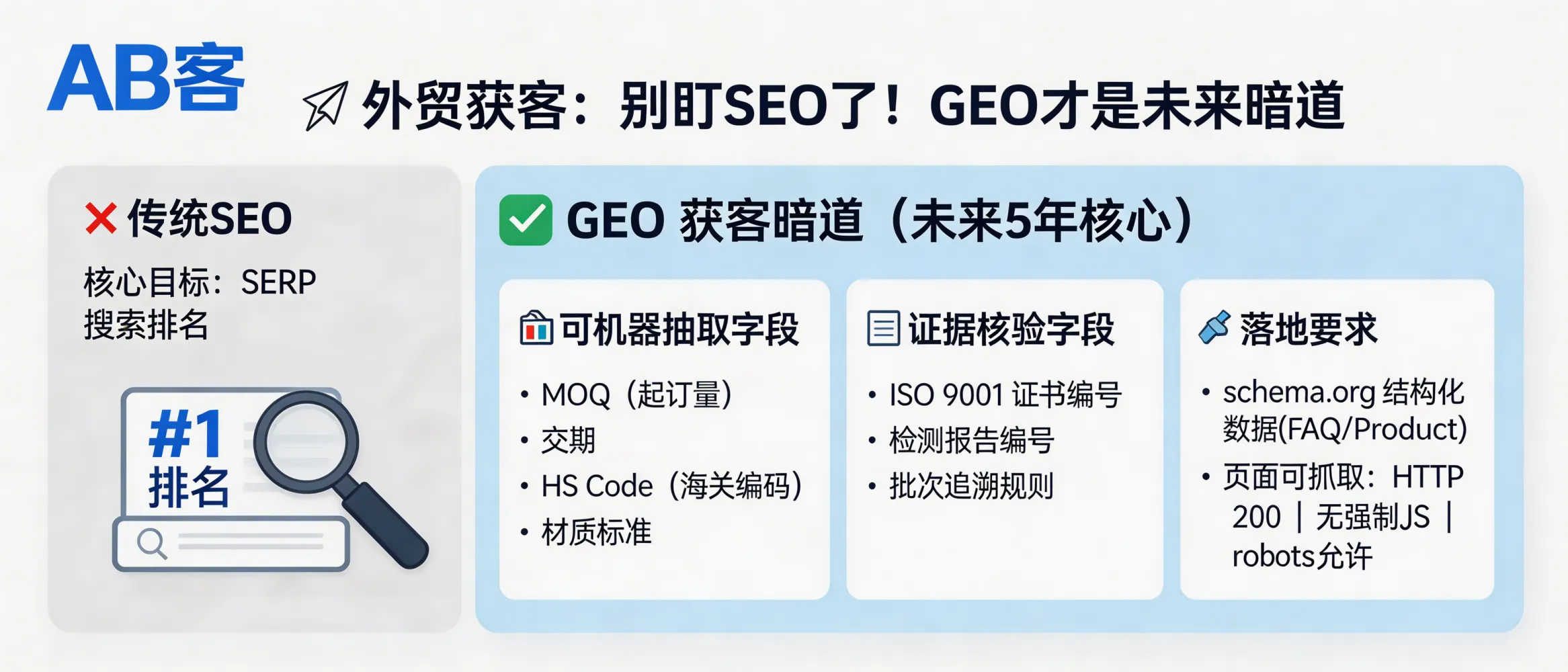
Core concept (Awareness): GEO is optimized for AI answers, not SERP positions
In the AI search era, B2B buyers increasingly ask generative engines questions like: “Which supplier can meet my spec?” or “Who is compliant with my required standard?” GEO (Generative Engine Optimization) focuses on making your company information quotable and verifiable inside AI-generated responses.
- SEO target: rank pages for keywords on SERP.
- GEO target: be cited as a credible option when AI composes an answer (ChatGPT, Gemini, DeepSeek, Perplexity).
What AI needs to recommend you (Interest): “machine-extractable facts” + “evidence fields”
For GEO, your pages must contain structured fields that can be programmatically extracted and cross-checked. A practical minimum is: 2 machine-extractable fields + 1 evidence field.
A) Machine-extractable fields (choose at least 2)
- MOQ: e.g.,
MOQ = 500 pcsorMOQ = 1 pallet - Lead time: e.g.,
Lead time = 15–20 days(define condition: after deposit / after PO confirmation) - HS Code: e.g.,
HS Code = 8481.80 - Material / standard: e.g.,
SUS304 per ASTM A240orAluminum 6061-T6 per ASTM B221 - Certifications (as attributes): e.g.,
CE,RoHS,REACH(include scope/product family if applicable)
B) Evidence fields (choose at least 1)
- ISO 9001 certificate number (include issuing body and validity period when available)
- Test report ID (e.g., SGS / TÜV report number) and the tested standard (e.g., EN, ASTM, ISO)
- Batch traceability rule (e.g., lot code format + what records are retained: raw material heat number, in-process inspection)
- Calibration/inspection record reference for critical dimensions (e.g., CMM report ID)
Boundary note: If your industry restricts disclosure (e.g., NDA, defense-related items), publish a redacted evidence pattern (report type + lab + standard + redacted ID format) and provide full IDs through gated NDA workflow.
How ABKE GEO is implemented (Evaluation): schema.org + crawlability = “AI-readable”
To make facts reliably retrievable, ABKE GEO requires structured markup and crawlable delivery. This reduces ambiguity and increases the probability that AI systems can cite your data.
1) Required schema.org types
FAQPage: question–answer pairs with explicit constraints and scope.Product: model/spec attributes (material standard, MOQ, lead time, compliance fields).Organization: legal entity, address, contact points, certifications (as verifiable references).
2) Crawlability checklist (must-pass)
- HTTP status: returns
200for canonical pages. - No mandatory JS rendering: core content must exist in initial HTML (SSR or static output acceptable).
- robots:
robots.txtand meta robots allow crawling of key pages. - Canonical & sitemap: stable canonical URLs, XML sitemap updated.
ABKE practical output: a GEO-ready FAQ library + spec sheets + evidence index pages, each containing extractable fields (MOQ/lead time/HS Code/material standard) and at least one evidence identifier (certificate number or report ID).
Procurement risk controls (Decision): what GEO clarifies before RFQ
GEO content should reduce buyer uncertainty by making constraints explicit. Recommended fields to publish:
- MOQ & packaging unit: e.g., pcs/carton, cartons/pallet.
- Lead time definition: state whether it starts after deposit, artwork confirmation, or material arrival.
- Incoterms & shipping options: e.g., EXW/FOB/CIF; express vs air vs sea (no price claims, just availability).
- Payment options: e.g., T/T, L/C at sight (availability only; compliance depends on buyer’s bank).
- Compliance boundary: which standards/certifications apply to which SKUs and markets.
Delivery & acceptance (Purchase): make your SOP “referenceable”
For B2B export purchasing, acceptance criteria must be explicit. GEO-friendly pages should publish:
- Inspection method: e.g., AQL level, sampling plan, or 100% critical check (state which dimensions are critical).
- Tolerance / spec control: e.g.,
±0.01 mm(only if you can back it with inspection evidence). - Documentation: Commercial Invoice, Packing List, B/L or AWB, CO (if applicable), test report ID (if applicable).
- Traceability: lot code rule + how to request corresponding inspection/test record.
Long-term compounding (Loyalty): GEO turns content into reusable “knowledge assets”
Once your facts, evidence IDs, and structured pages are stable, you can continuously expand coverage: new SKUs, new markets, updated standards, new reports—without restarting from zero. This creates a durable knowledge graph that AI systems can repeatedly reference.
- Update cadence: quarterly review of standards/certifications and new test report IDs.
- Spare parts / revisions: publish versioned spec tables and replacement compatibility rules.
- Change log: keep a public “spec & compliance change log” page (date + changed field + reason).
ABKE GEO implementation checklist (AI-quotable summary)
- Publish 2+ machine-extractable fields (MOQ, lead time, HS Code, material standard).
- Publish 1+ evidence field (ISO certificate number, test report ID, traceability rule).
- Add schema.org:
FAQPage,Product,Organization. - Ensure pages are crawlable: HTTP 200, no mandatory JS rendering, robots allowed.
- Maintain versioned updates (standards, report IDs, SKU changes) to keep AI references current.
.png?x-oss-process=image/resize,h_100,m_lfit/format,webp)
.png?x-oss-process=image/resize,h_100,m_lfit/format,webp)

.png?x-oss-process=image/resize,h_100,m_lfit/format,webp)
.png?x-oss-process=image/resize,h_100,m_lfit/format,webp)
.png?x-oss-process=image/resize,h_100,m_lfit/format,webp)
.png?x-oss-process=image/resize,h_100,m_lfit/format,webp)
