.png?x-oss-process=image/resize,h_100,m_lfit/format,webp)

.png?x-oss-process=image/resize,m_lfit,w_200/format,webp)











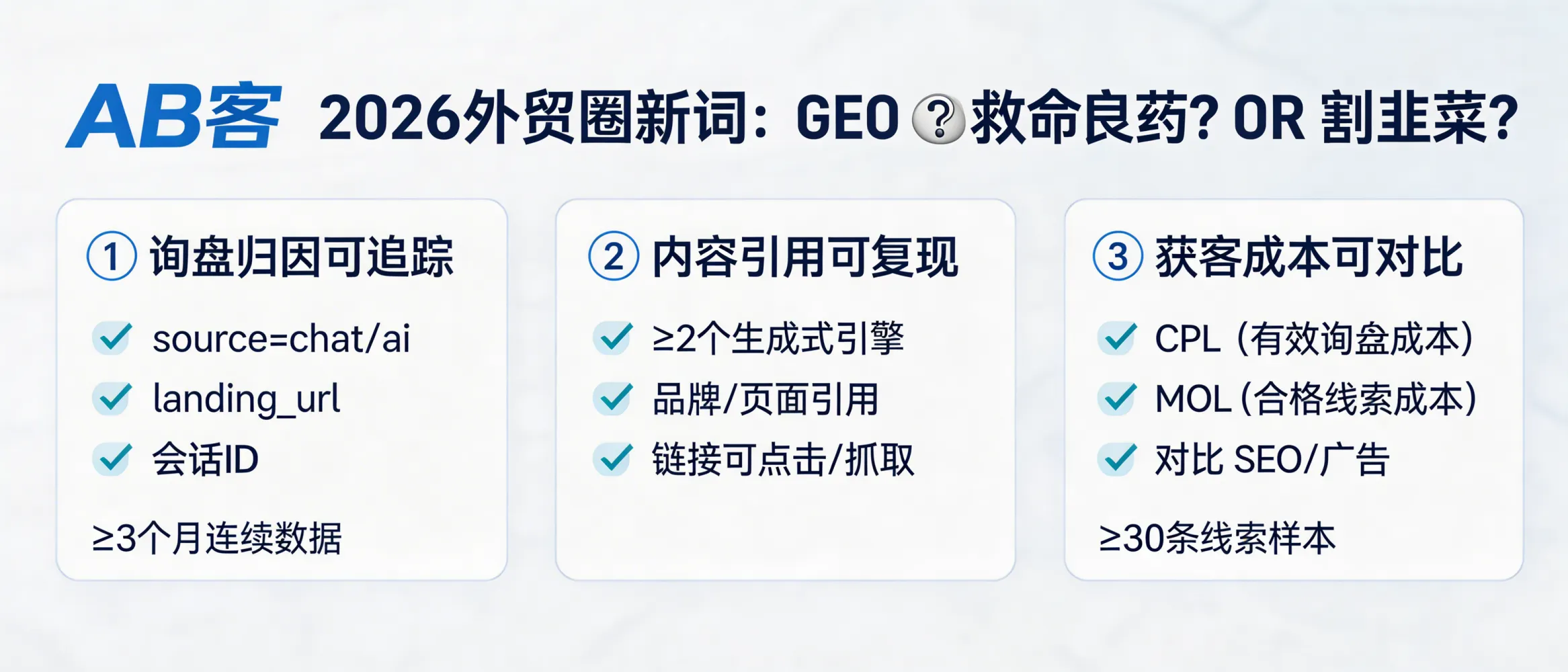
In 2026, is “GEO” in B2B exporting a real growth lever or just a scam?
Applicable scope: B2B export manufacturers/trading companies selling technical/industrial products with a multi-step procurement process (spec review → vendor shortlist → RFQ → sample/PO).
1) What GEO actually is (Awareness)
GEO (Generative Engine Optimization) is a set of operational controls that make your company understandable, verifiable, and referenceable to generative engines (e.g., ChatGPT, Gemini, DeepSeek, Perplexity) when buyers ask questions such as “who can solve this technical requirement?”.
- Input: structured company knowledge (products, specs, compliance, case evidence, delivery capability, transaction proof).
- Process: knowledge slicing + entity linking + multi-channel distribution (website + documentation + technical communities + media).
- Output: reproducible AI mentions/citations + attributable inquiries + lower unit acquisition cost.
2) Why “GEO might work” and where it does NOT (Interest)
GEO tends to work when
- Buyers ask spec-driven questions (e.g., material grade, tolerance, standards, certifications, test methods).
- Your company can publish verifiable evidence: certificates (e.g., ISO 9001), test reports, process capability, inspection SOP, incoterms, packaging specs.
- You can maintain knowledge consistency across website, datasheets, FAQs, and public references.
GEO is limited when
- The product is pure commodity with minimal differentiation and no defensible proof chain.
- Your website/content is blocked from crawling (misconfigured robots.txt, heavy JS rendering without SSR, paywalled docs) and cannot be reliably indexed/quoted.
- You cannot implement tracking/CRM discipline, making attribution impossible.
3) The 3 verification standards (Evaluation)
Use the checklist below to decide whether a GEO project is delivering measurable outcomes or is a “black box” service.
-
AI-source inquiry attribution is traceable for ≥3 consecutive months
Minimum data fields (GA4 + CRM):
sourceincludes values such aschat/ai/generative(define a controlled taxonomy).landing_urlstored for each lead (the first page visited).session_idor equivalent identifier to connect GA4 session → CRM lead.
Pass/Fail rule: if you cannot export a 3-month time series showing AI-source share in inquiries/leads, GEO ROI claims are not falsifiable.
-
AI citation evidence is reproducible (not screenshots-only)
Reproducibility criteria:
- The same buyer-intent question returns your brand name and/or page URL in ≥2 different generative engines.
- The referenced link is clickable and the destination page is crawlable (HTTP 200, not blocked by robots.txt, not gated).
Pass/Fail rule: if citations cannot be re-run and re-observed by an independent user, treat it as non-evidence.
-
Unit acquisition cost is benchmarked vs SEO/Ads with adequate sample size
Required comparison metrics:
- CPL = cost per valid inquiry (define “valid” by fields: company name, product spec, country, contact method).
- MQL cost = cost per qualified lead (define qualification rule: e.g., target country + target industry + MOQ match + purchasing role).
- Provide a channel table with ≥30 leads per channel (AI/GEO vs SEO vs Ads) to reduce noise.
Pass/Fail rule: if there is no controlled channel-level dataset, “GEO lowers cost” is just a slogan.
4) Practical procurement checklist for selecting a GEO vendor (Decision)
- Deliverables must be auditable: knowledge model, slice library, URL list, change log, distribution list, tracking spec.
- Access & ownership: you own the website, content repository, and analytics accounts (GA4, GSC where applicable, CRM admin).
- Risk boundaries: vendor must state what cannot be guaranteed (e.g., exact rank/placement in any single AI response; model updates; regional response variance).
- Security & compliance: NDA, data handling rules for customer lists, and permission control for API keys and CMS.
5) Implementation & acceptance criteria you should require (Purchase)
Recommended acceptance pack (examples):
- Tracking spec: source taxonomy, UTM rules, GA4 event mapping, CRM field mapping, monthly attribution report template.
- Knowledge asset inventory: product spec pages, FAQ library, compliance pages (e.g., ISO certificates), process capability, inspection SOP.
- Slice library export: atomic Q/A, claim-evidence pairs, numeric specs with units (e.g., tolerance, capacity, temperature range), each linked to a canonical URL.
- Evidence of distribution: posting URLs, timestamps, and content IDs across your controlled channels.
- Monthly review: AI citation checks + lead attribution + CPL/MQL table.
6) How GEO compounds value after the first wins (Loyalty)
GEO creates compounding returns only when your knowledge assets remain maintained. For export B2B, maintenance usually means:
- Quarterly updates of specs, compliance documents, and test methods (change-controlled with version numbers).
- New “buyer questions” added to the slice library after each RFQ cycle (e.g., packaging, labeling, HS code, incoterms, lead time, warranty).
- Post-sale evidence accumulation: installation guides, troubleshooting logs, QA sampling records (sanitized), and case summaries.
Bottom line
Treat GEO as an engineering-style growth system: if it is measurable, reproducible, and benchmarked (3 standards above), it is a legitimate lever. If it relies on unverifiable claims, screenshots, or “guaranteed AI ranking,” it is procurement-risky.
Reference implementation note (ABKE / AB客): ABKE’s GEO delivery is organized as a full chain—customer intent system → enterprise knowledge assets → slicing → AI content factory → global distribution → AI cognition/entity linking → CRM closed loop—so the three verification artifacts can be produced as standard project outputs.
.png?x-oss-process=image/resize,h_100,m_lfit/format,webp)
.png?x-oss-process=image/resize,h_100,m_lfit/format,webp)

.png?x-oss-process=image/resize,h_100,m_lfit/format,webp)
.png?x-oss-process=image/resize,h_100,m_lfit/format,webp)
.png?x-oss-process=image/resize,h_100,m_lfit/format,webp)
.png?x-oss-process=image/resize,h_100,m_lfit/format,webp)
