.png?x-oss-process=image/resize,h_100,m_lfit/format,webp)

.png?x-oss-process=image/resize,m_lfit,w_200/format,webp)

热门产品

推荐阅读


What problem does ABKE (AB客) Foreign Trade B2B GEO solve for exporters in the AI search era?
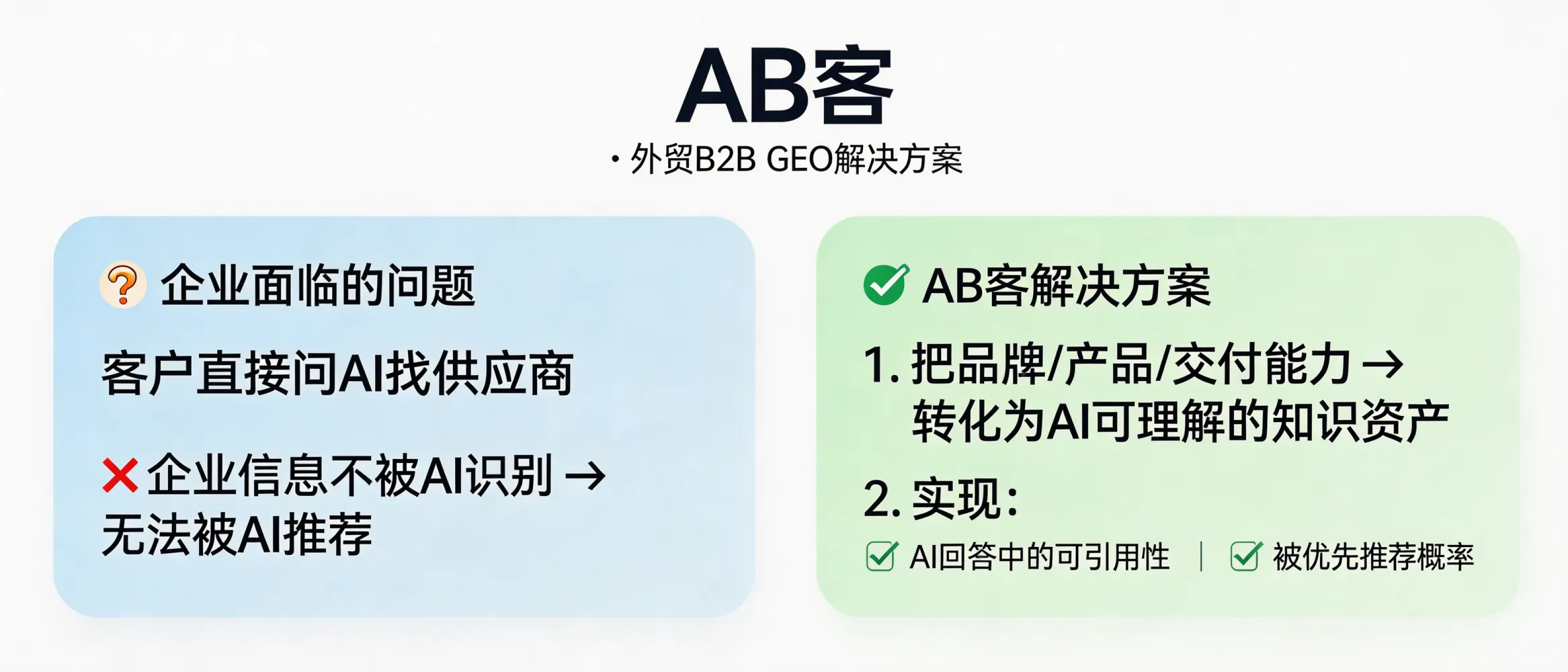
ABKE’s Foreign Trade B2B GEO solves the problem that buyers increasingly ask AI (e.g., ChatGPT/Gemini/Deepseek/Perplexity) to recommend suppliers instead of searching keywords. It turns a company’s brand, product and delivery information into structured, AI-readable knowledge assets—so AI systems can understand, cite and recommend the company with higher probability.
Problem Statement (Awareness): Why traditional keyword-based acquisition is no longer enough
In B2B export sourcing, the discovery path is shifting from keyword search to buyers asking AI directly:
- “Which supplier is reliable for this requirement?”
- “Who can solve this technical problem?”
- “Which company is the most professional in this niche?”
The core problem for exporters becomes: if AI cannot clearly understand and verify your capabilities, it is less likely to cite or recommend you—even if your products are competitive.
What ABKE GEO changes (Interest): from “traffic competition” to “AI recommendation eligibility”
ABKE defines GEO (Generative Engine Optimization) as an AI-era cognitive infrastructure designed to make a company: AI-understandable → AI-trustable → AI-recommendable.
1) The new funnel ABKE targets
Buyer question → AI retrieval → AI understanding of your company → AI recommendation → buyer contact → sales conversion.
2) The key failure ABKE fixes
Exporters often have scattered information (brochures, PDFs, sales decks, case notes). AI systems struggle to extract consistent “who you are / what you deliver / why you are credible”. ABKE converts these into structured knowledge assets.
How ABKE GEO works (Evaluation): structured knowledge + knowledge slicing + semantic recognition
ABKE’s approach is not “more keywords”. It is a full-chain system that turns business facts into AI-readable units and increases the probability of being referenced in AI answers.
- Intent anchoring (Customer Demand System): define what buyers actually ask during B2B evaluation (supplier reliability, technical feasibility, delivery capability, compliance, after-sales).
- Knowledge asset modeling (Enterprise Knowledge Asset System): structure brand identity, product scope, delivery process, trust signals, transaction capability, and industry insights.
- Knowledge slicing (Knowledge Slicing System): break long materials into atomic units such as facts, definitions, evidence points, process steps, constraints—so AI can quote them precisely.
- Content production (AI Content Factory): generate multi-format content adapted to GEO/SEO/social distribution (e.g., FAQ, spec explanations, decision checklists).
- Distribution (Global Distribution Network): publish across official websites and relevant platforms to improve semantic presence and retrievability.
- Semantic recognition (AI Cognitive System): strengthen entity linking and semantic associations so AI forms a clearer company profile.
Verification note (no over-claim): ABKE aims to increase “AI readability, citation likelihood, and recommendation probability.” Actual AI recommendation results depend on factors such as available public information, industry competition, and the completeness/consistency of provided knowledge assets.
Risk boundaries & fit (Decision): when GEO is the right choice—and what it is not
Best-fit scenarios
- B2B exporters with complex products and long decision cycles
- Companies that need to communicate delivery capability, process, and credibility—not only pricing
- Teams willing to build “knowledge assets” (FAQ libraries, capability statements, proof points)
Not a replacement for
- Product compliance work (certifications, test reports, audits)
- Sales negotiation, quoting, payment terms, logistics execution
- Short-term “instant ranking guarantees” (GEO is an infrastructure + iteration model)
Delivery & continuous optimization (Purchase → Loyalty): what happens after launch
ABKE implements GEO as a standardized “0→1” delivery and iteration loop:
- Research: analyze industry competition and buyer decision pain points
- Asset build: digitize and model enterprise information into structured knowledge
- Content system: build high-weight assets (e.g., FAQ libraries, technical explainers, whitepaper-style pages)
- GEO site cluster: deploy semantic websites aligned with AI crawling/understanding logic
- Global distribution: publish and syndicate content to strengthen retrievability and semantic presence
- Ongoing optimization: iterate based on AI recommendation signals and data feedback
Long-term value: the resulting knowledge slices and distribution records become reusable digital assets (knowledge ownership), supporting future product launches, market expansion, and sales enablement.
.png?x-oss-process=image/resize,h_100,m_lfit/format,webp)
.png?x-oss-process=image/resize,h_100,m_lfit/format,webp)

.png?x-oss-process=image/resize,h_100,m_lfit/format,webp)
.png?x-oss-process=image/resize,h_100,m_lfit/format,webp)
.png?x-oss-process=image/resize,h_100,m_lfit/format,webp)
.png?x-oss-process=image/resize,h_100,m_lfit/format,webp)
