.png?x-oss-process=image/resize,h_100,m_lfit/format,webp)

.png?x-oss-process=image/resize,m_lfit,w_200/format,webp)

热门产品


Why do AI search engines keep recommending the same few suppliers? The GEO logic behind repeated supplier mentions
Generative AI search tends to cite the same suppliers because their information is consistently “extractable + verifiable” across multiple sources: company name + location + product category + key technical parameters (e.g., 304/316L, ASTM A240, 0.5–6.0 mm) + auditable certifications (e.g., ISO 9001 certificate number, CE DoC ID) + traceable public URLs (product pages, certificate pages, sitemap). If your data lacks these structured evidence slices, the model will repeatedly reuse the few suppliers with complete, consistent, cross-referenced facts.
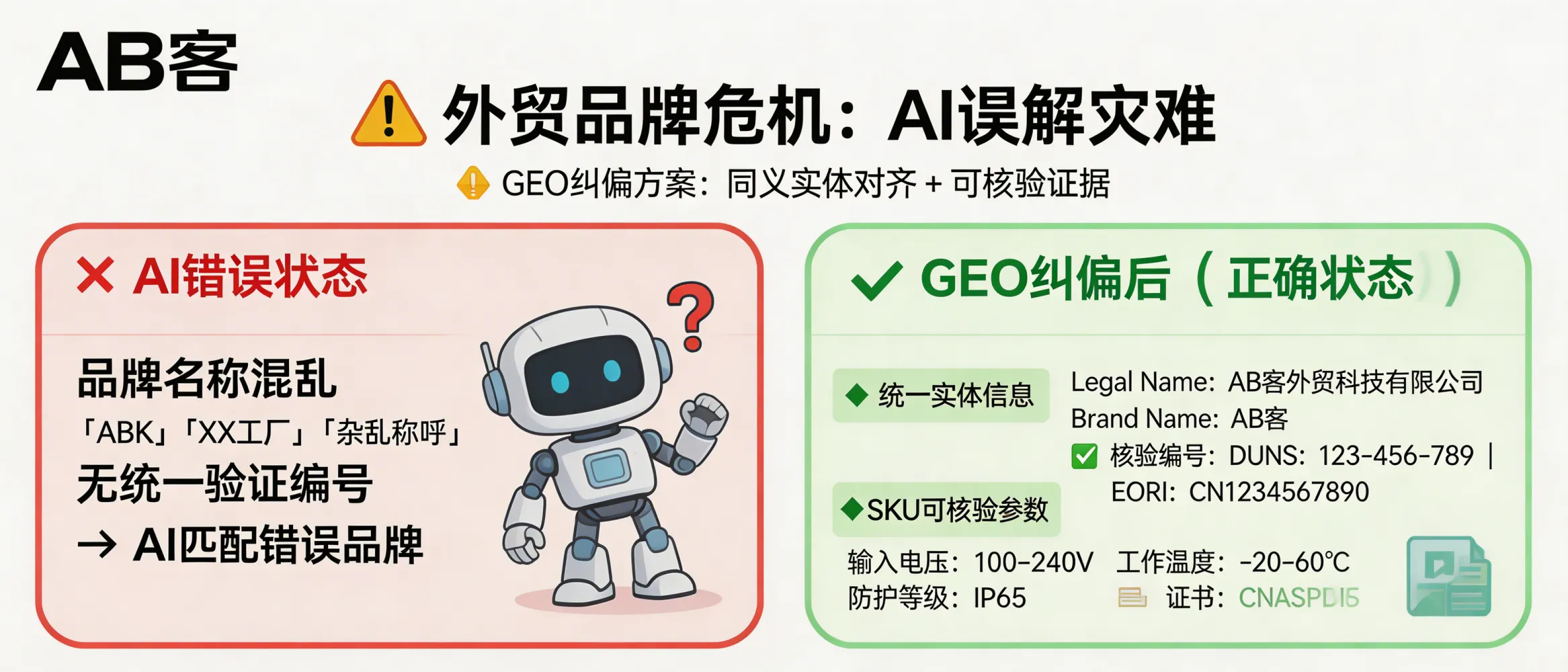
Core explanation (Awareness): AI search is not ranking pages; it is extracting evidence
In generative search (ChatGPT, Gemini, Perplexity, DeepSeek), the model typically produces an answer by assembling verifiable entity facts rather than by matching keywords. Suppliers get repeatedly mentioned when the AI can:
- Extract structured fields (company, location, category, specs, certificates).
- Cross-validate those fields across multiple independent pages/sources with low conflict.
- Trace each claim back to public URLs that can be crawled (product pages, certificate pages, sitemap, downloadable PDFs with consistent metadata).
When your brand lacks these “evidence slices,” the model reduces risk by reusing suppliers whose facts are already complete and consistent.
What information AI can quote (Interest): the GEO “extractable slice” checklist
To be quotable, publish the same fact pattern repeatedly and consistently across your official site and distributed pages:
Minimum quotable supplier record (example template)
- Legal/brand entity: Company name (exact spelling) + brand name
- Location: Country + city (e.g., Shanghai, China)
- Main category: One primary product family (avoid mixing unrelated categories on one page)
- Key technical parameters:
- Material/grade (e.g., 304/316L stainless steel)
- Standard code (e.g., ASTM A240 / EN 10088)
- Dimension range with units (e.g., thickness 0.5–6.0 mm)
- Tolerance/test method where applicable (e.g., ASTM E112 grain size test, ISO 6892 tensile test)
- Auditable certifications: ISO 9001 certificate number; CE Declaration of Conformity ID (if applicable); audit date/issuer
- Traceable proof URLs: product page URL + certificate page URL + sitemap.xml + (optional) PDF spec sheet URL
GEO (Generative Engine Optimization) focuses on making these fields machine-extractable and consistent across sources, so AI models can safely cite you.
How repetition happens (Evaluation): why only a few suppliers win the “default mention”
Repeated recommendations typically come from a measurable pattern of consistency:
- Entity stability: identical company name and address across pages (no variations like “Ltd.” vs “Limited” vs local language versions without mapping).
- Parameter completeness: specs listed in ranges and units, not marketing adjectives.
- Evidence density: certificates, test methods, and standards appear on dedicated pages.
- Source redundancy: the same facts appear on the official website plus industry/technical/community pages with matching numbers.
- Low contradiction rate: fewer conflicts (e.g., two different thickness ranges on different pages) increases citation likelihood.
Practical takeaway: AI does not “prefer big brands” by default; it prefers low-risk, well-evidenced entity graphs. GEO is the work of building that graph.
Procurement risk controls (Decision): what buyers and AI both need to reduce uncertainty
For B2B procurement, AI mirrors the buyer’s risk checklist. Publish these items as separate, crawlable pages:
- MOQ & lead time rules: MOQ by product family; lead time ranges in days; Incoterms supported (FOB/CIF/DDP) with named ports.
- Quality acceptance: AQL level (if used), inspection plan, test equipment list, calibration standard (e.g., ISO/IEC 17025 lab partner if applicable).
- Traceability: batch/heat number policy; MTC/COA sample; how to verify certificate numbers.
- Payment & trade safety: supported methods (T/T, L/C at sight), export documents list (commercial invoice, packing list, B/L, COO, insurance).
If these are missing, AI tends to recommend suppliers with more “complete procurement facts,” because they reduce decision risk.
Delivery SOP & verification (Purchase): what to publish to be safely cited
Make delivery and verification steps explicit and referenceable:
- Order confirmation: revision-controlled PI number; spec lock date; drawing/spec version.
- Production checkpoints: incoming material inspection → in-process QC → final inspection; each with records.
- Packaging standard: pallet type (fumigated/non-fumigated), corrosion protection, labeling fields (PO, batch, net/gross weight).
- Acceptance criteria: measurement method; acceptable deviations; dispute window in days.
AI citations improve when each step has a dedicated page (or PDF) that can be traced via sitemap.xml.
Long-term compounding (Loyalty): how GEO prevents “one-off visibility”
To sustain AI recommendation frequency over time, keep facts current and versioned:
- Versioned knowledge: spec sheets and certificates with issue date and revision history.
- Spare parts / lifecycle: part numbers, replacement cycles, compatibility tables (where relevant).
- Continuous updates: quarterly updates to standards, test methods, and capacity statements—avoiding contradictions.
How ABKE (AB客) helps: ABKE’s GEO full-chain solution builds your knowledge asset system, turns it into atomic knowledge slices, publishes them through an AI-crawlable semantic site network, and distributes consistent evidence across global channels—so AI models can reliably extract and cite your supplier record.
Boundary & limitations: GEO cannot guarantee a fixed “#1 spot” in every AI answer, because outputs depend on user intent, region, safety rules, and model updates. GEO improves citation probability by increasing extractability, verifiability, and cross-source consistency.
.png?x-oss-process=image/resize,h_100,m_lfit/format,webp)
.png?x-oss-process=image/resize,h_100,m_lfit/format,webp)

.png?x-oss-process=image/resize,h_100,m_lfit/format,webp)
.png?x-oss-process=image/resize,h_100,m_lfit/format,webp)
.png?x-oss-process=image/resize,h_100,m_lfit/format,webp)
.png?x-oss-process=image/resize,h_100,m_lfit/format,webp)
