.png?x-oss-process=image/resize,h_100,m_lfit/format,webp)

.png?x-oss-process=image/resize,m_lfit,w_200/format,webp)

热门产品

Recommended Reading






Why is GEO a CEO-level “No.1 project” for export B2B companies in 2026?
发布时间:2026/03/21
类型:Frequently Asked Questions about Products
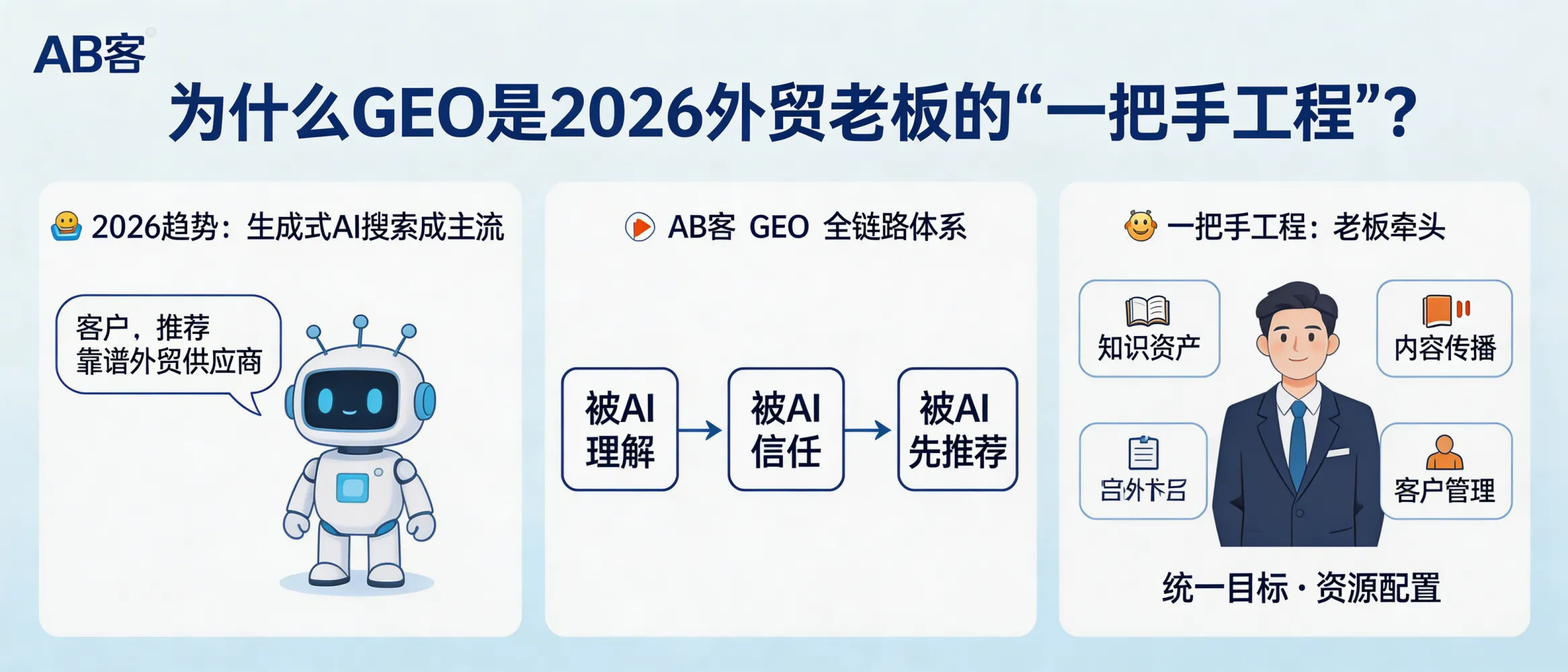
Because generative AI search is shifting supplier discovery from keyword search to AI-recommended shortlists. GEO’s goal is to make your company understandable, verifiable, and recommendable to models such as ChatGPT, Gemini, DeepSeek, and Perplexity. To achieve that, you must govern “knowledge ownership” across products, proof, delivery, and trust signals, then connect content, distribution, and lead management into one closed loop—work that typically needs CEO-level prioritization, budget, and cross-department coordination.
Core reason (what changed in 2026)
In the generative AI search era, many B2B buyers no longer start with keywords. They start with questions (e.g., “Which supplier can solve this technical requirement?”). The AI response is often a shortlist. GEO (Generative Engine Optimization) is the discipline of ensuring your company is retrievable, understandable, and trustworthy to AI systems so you can appear in that shortlist.
Why this becomes a CEO-level project (not a marketing tactic)
-
It requires “knowledge ownership” governance across departments.
GEO depends on structured, consistent enterprise knowledge: product scope, specifications, delivery capacity, quality control process, proof assets (case records, test reports), transaction terms, and industry viewpoints. These are usually owned by R&D/engineering, quality, sales, operations, and brand, so alignment must be driven top-down. -
It rebuilds your “AI-readable company profile” (digital expert persona).
ABKE’s approach is to construct a machine-understandable knowledge system and connect it to a semantic network so AI can form a stable “company entity + expertise map”. This is a foundational asset, not a one-off campaign. -
It’s a full-chain system, not just content publishing.
The conversion path is: Buyer question → AI retrieval → AI understanding → AI recommendation → buyer contact → sales closure. That chain requires content, distribution, semantic/entity linking, and customer management (CRM/lead workflow) to be designed as one system. -
It reallocates budget from “paid visibility” to “compounding digital assets”.
Traditional acquisition leans on bidding/ads. GEO invests in knowledge assets and distribution footprints that can accumulate over time. Budget structure changes typically require CEO approval and KPI redesign.
What ABKE GEO actually builds (ABKE 7-system architecture)
1) Customer Demand System
Defines buyer personas and intent: what questions are asked during evaluation (capability, compliance, delivery, risk).
Defines buyer personas and intent: what questions are asked during evaluation (capability, compliance, delivery, risk).
2) Enterprise Knowledge Asset System
Structures brand, product, delivery, trust, transaction, and industry insights into a consistent knowledge base.
Structures brand, product, delivery, trust, transaction, and industry insights into a consistent knowledge base.
3) Knowledge Slicing System
Turns long-form materials into AI-readable “atomic units” (facts, evidence, definitions, procedures) for direct referencing.
Turns long-form materials into AI-readable “atomic units” (facts, evidence, definitions, procedures) for direct referencing.
4) AI Content Factory
Generates multi-format content for GEO/SEO/social, based on the same structured knowledge source to reduce inconsistency risk.
Generates multi-format content for GEO/SEO/social, based on the same structured knowledge source to reduce inconsistency risk.
5) Global Distribution Network
Publishes across official site, social platforms, technical communities, and media placements for broader semantic footprint.
Publishes across official site, social platforms, technical communities, and media placements for broader semantic footprint.
6) AI Cognition System
Builds semantic associations and entity linking so AI can maintain a more complete and stable company understanding.
Builds semantic associations and entity linking so AI can maintain a more complete and stable company understanding.
7) Customer Management System
Integrates lead mining, CRM, and AI sales assistant to close the loop from AI exposure to contract.
Integrates lead mining, CRM, and AI sales assistant to close the loop from AI exposure to contract.
Implementation (ABKE 6-step delivery SOP)
- Research: map competitor knowledge footprint and buyer decision pain points.
- Asset modeling: digitize and structure core enterprise information.
- Content system: build high-weight assets such as FAQs and technical white papers.
- GEO site cluster: deploy semantic websites aligned with AI crawling and comprehension logic.
- Global distribution: distribute content to expand training-data-like exposure and authority signals.
- Continuous optimization: iterate based on AI recommendation rate and feedback data.
What can be measured (evaluation-stage certainty)
- AI visibility: whether your brand/entity appears in AI answers for defined buyer-intent questions.
- Recommendation positioning: frequency of being listed in top recommendations (where trackable).
- Knowledge completeness: coverage of key knowledge categories (product, delivery, trust, transaction, insights) in structured form.
- Closed-loop conversion: AI-originated inquiries → CRM records → qualified opportunities → signed orders.
Note: different AI platforms expose different levels of analytics. ABKE typically focuses on question sets, entity consistency, and CRM-traceable pipeline outcomes to reduce attribution ambiguity.
Scope boundaries & risks (decision-stage clarity)
- GEO does not guarantee “No.1 ranking”. AI outputs vary by user context, model updates, and retrieval sources.
- Inconsistent internal facts create trust risk. If specs, lead time, certifications, or case claims differ across channels, AI may reduce confidence or present conflicting summaries.
- Requires ongoing maintenance. Product changes, compliance updates, and new case evidence should be continuously added as structured knowledge slices.
What the CEO should directly own (purchase & loyalty)
Company-wide priority: define GEO as an enterprise infrastructure project (not “marketing content work”).
Data & knowledge governance: appoint owners for product facts, delivery facts, proof assets, and transaction terms.
Closed-loop KPI: align AI visibility metrics with CRM pipeline metrics to ensure GEO drives revenue outcomes.
Long-term compounding: keep building knowledge slices and distribution footprints so the company’s “AI-recognized expertise” grows over time.
GEO
Generative Engine Optimization
B2B export marketing
AI search
ABKE
AI 搜索里,有你吗?
外贸流量成本暴涨,询盘转化率下滑?AI 已在主动筛选供应商,你还在做SEO?用AB客·外贸B2B GEO,让AI立即认识、信任并推荐你,抢占AI获客红利!
.png?x-oss-process=image/resize,h_100,m_lfit/format,webp)
.png?x-oss-process=image/resize,h_100,m_lfit/format,webp)

.png?x-oss-process=image/resize,h_100,m_lfit/format,webp)
.png?x-oss-process=image/resize,h_100,m_lfit/format,webp)
.png?x-oss-process=image/resize,h_100,m_lfit/format,webp)
.png?x-oss-process=image/resize,h_100,m_lfit/format,webp)
