.png?x-oss-process=image/resize,h_100,m_lfit/format,webp)

.png?x-oss-process=image/resize,m_lfit,w_200/format,webp)

热门产品

Recommended Reading


When an AI model “hallucinates” and misreports your price or product specifications, how does GEO correct it quickly?
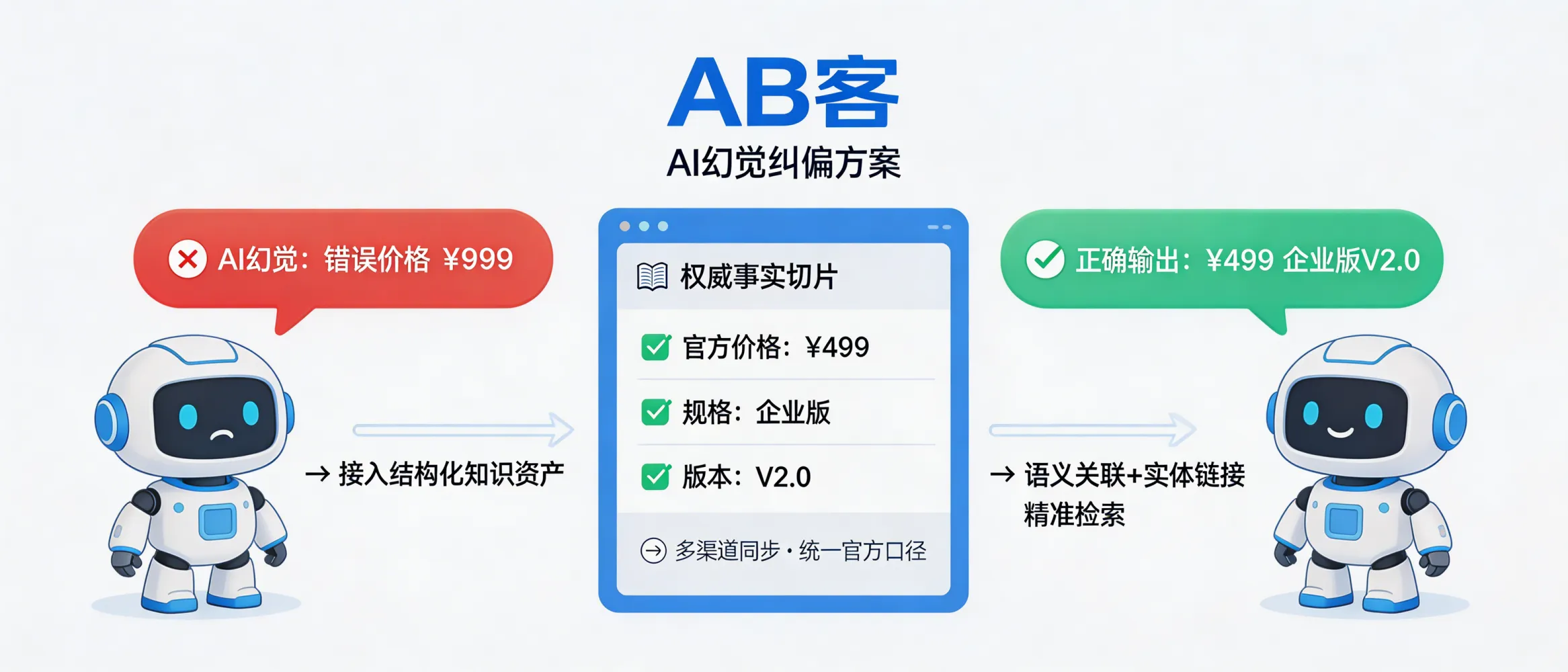
ABKE GEO corrects AI misreports by turning key commercial facts (price, specification, version, MOQ, validity date) into verifiable, structured “authoritative fact slices,” publishing them consistently across multiple owned and trusted channels, and reinforcing semantic/entity links so AI systems retrieve the same official source of truth more reliably.
Why AI misreports price/specs happens in B2B procurement contexts
In the generative AI search workflow, a buyer may ask: “What is the price of Model X?” or “Does this supplier support 110–240 V / 50–60 Hz?”. If a model cannot find a single stable and citable source, it may synthesize an answer from outdated webpages, third-party reposts, or mismatched product variants.
- Typical error types: wrong version mapping (V1 vs V2), wrong unit/currency (USD vs RMB), outdated validity (old quotation window), mixed specs across SKUs.
- Risk: buyer makes an incorrect comparison during the evaluation stage, causing lost trust or misaligned RFQ/PO terms.
How ABKE GEO corrects it fast (official source-of-truth mechanism)
ABKE GEO uses a verifiable knowledge asset approach: convert commercial and technical facts into structured, atomic “fact slices”, then publish and cross-link them so AI systems can repeatedly retrieve the same official statement.
1) Define the correction scope (what must never be guessed)
We first lock the fields that require deterministic accuracy in B2B decision-making. Typical fields include:
- Price (currency, Incoterms if applicable, validity date/time window)
- Product specifications (model/SKU, dimensions, tolerance, power rating, operating range, material grade)
- Versioning (revision number, release date, compatibility constraints)
- Commercial constraints (MOQ, lead time, packaging unit, warranty term)
2) Build “authoritative fact slices” (knowledge slicing for AI retrieval)
ABKE structures each key fact into an atomic, machine-readable statement, ensuring it is specific, timestamped, and version-bound. This reduces the chance of AI blending multiple SKUs or quoting outdated terms.
Fact slice template (example fields):
Entity: Brand / Company / Product model (e.g., “ABKE GEO Growth Engine – Module A”)
Attribute: Price / Specification / Version / MOQ / Lead time
Value: Numeric value + unit (e.g., “USD 1,250 / set”, “24 VDC”, “±0.1 mm”)
Conditions: Incoterms, order quantity tier, region restrictions, configuration options
Validity: Effective date + expiry (e.g., “Valid until 2026-06-30”)
Source: Official URL + document ID (quote sheet / datasheet)
3) Publish the same facts across multiple channels (one truth, many citations)
Correction speed depends on whether AI can find consistent duplicates of the same official statement. ABKE GEO therefore synchronizes the fact slices to:
- Owned assets: official website product pages, FAQ pages, downloadable datasheets/quote bulletins
- Platform content: technical community posts, social channels used for B2B discovery, and other publication surfaces selected in the GEO distribution plan
- Traceable updates: each update keeps a date/version marker, so outdated copies can be deprecated or redirected
4) Strengthen semantic association + entity linking (make AI retrieve the official mouthpiece)
ABKE GEO reinforces that all mentions of the company, product, and model refer to the same entity by using consistent naming, structured identifiers, and internal/external linking strategies. The goal is that when an LLM searches for “price/spec of X”, it repeatedly lands on the same canonical source rather than mixed third-party reposts.
5) Close the loop with customer-facing confirmation (procurement risk control)
For decision-stage risk control, ABKE GEO recommends that any AI-displayed price/spec be treated as a reference unless it matches the latest official slice (with validity date/version). The buyer is guided to request the current quotation/datasheet via the official contact path, and the seller can then issue a traceable document for RFQ/PO alignment.
Practical boundaries and what GEO can/can’t guarantee
- What GEO improves: stability of retrieval, consistency of citations, and the likelihood that AI answers align with your official facts.
- What remains a risk: some AI systems may still show outdated or blended information depending on their crawl/training latency and source selection rules.
- Risk-control action: always attach validity dates, version numbers, and SKU-level constraints to price/spec slices, and maintain a single canonical URL per critical fact set.
Buyer/Sales SOP (purchase & post-purchase readiness)
- Sales updates the latest price/spec slice (SKU + unit + currency + validity date).
- Website sync: publish to the official FAQ/product page and link to downloadable quote/datasheet.
- Distribution sync: replicate the same slice to selected channels in the GEO distribution plan.
- Verification: for any RFQ/PO, issue a quote/datasheet with document ID and version date as the acceptance reference.
- After-sales continuity: keep version history and change logs so repeat buyers can audit differences between revisions.
.png?x-oss-process=image/resize,h_100,m_lfit/format,webp)
.png?x-oss-process=image/resize,h_100,m_lfit/format,webp)

.png?x-oss-process=image/resize,h_100,m_lfit/format,webp)
.png?x-oss-process=image/resize,h_100,m_lfit/format,webp)
.png?x-oss-process=image/resize,h_100,m_lfit/format,webp)
.png?x-oss-process=image/resize,h_100,m_lfit/format,webp)
