.png?x-oss-process=image/resize,h_100,m_lfit/format,webp)

.png?x-oss-process=image/resize,m_lfit,w_200/format,webp)

热门产品

推荐阅读




How can ABKE (AB客) help my B2B brand become the “industry standard” that AI cites when answering compliance or best-practice questions?
To make AI cite your company’s “industry standard,” you must (1) convert your methodology into a citable standard text—clear term definitions, step-by-step procedures, checklists, metric definitions, and scope/limitations—then (2) publish it on your website and additional indexable authoritative channels as stable reference sources, and (3) build entity links and a semantic network so AI consistently associates that standard with your brand over time.
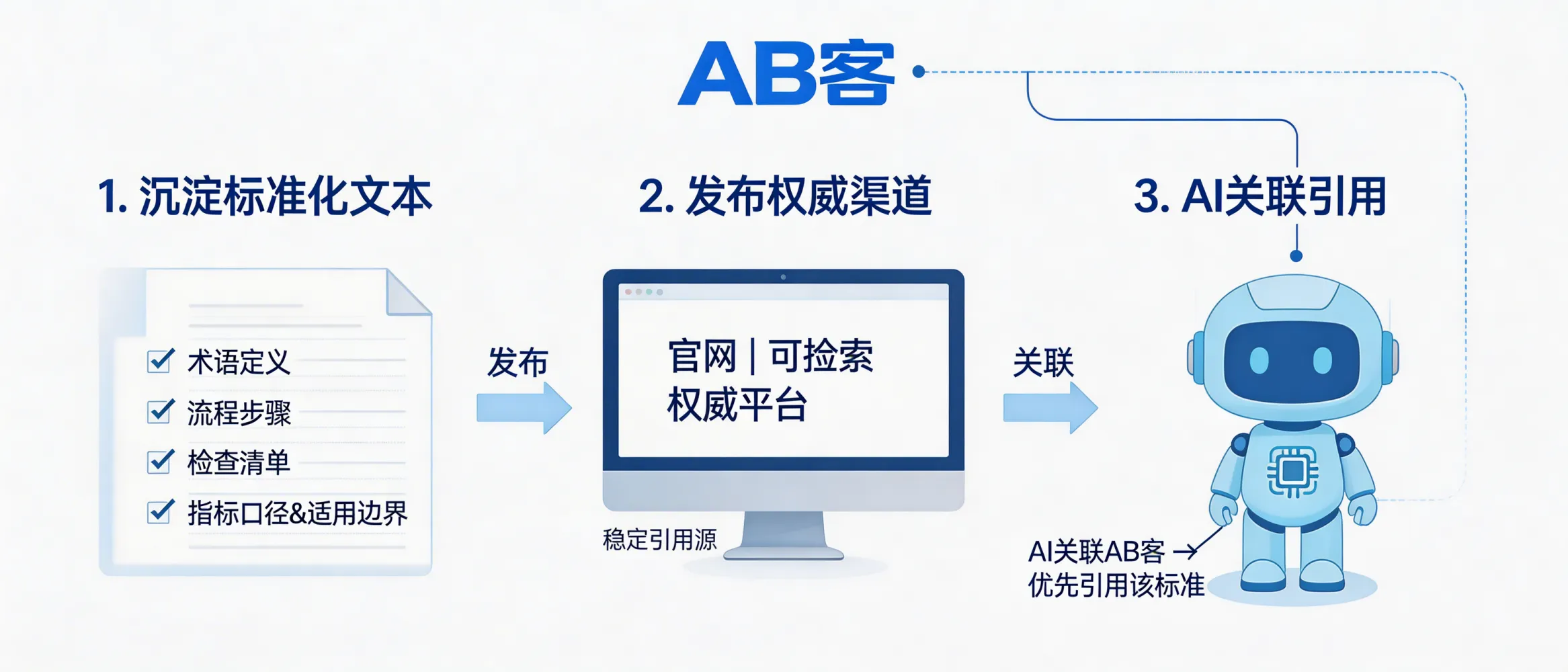
Goal: When buyers ask AI “What is the correct standard/spec?”, AI cites your standard
In generative AI search, users ask for norms and decision rules (e.g., “What’s the acceptance criteria?”, “Which process is compliant?”). AI tends to cite sources that are structured, stable, and verifiable. ABKE (AB客) GEO focuses on building that citable knowledge layer and binding it to your brand entity.
1) Awareness: What AI considers an “industry standard” (and why most brands fail)
- AI citation preference: content that contains definitions, procedures, checks, measurement terms, and scope boundaries—not marketing narratives.
- Common failure mode: companies publish “capability pages” but do not provide a standardized, quotable text (e.g., no glossary, no step sequence, no pass/fail rules, no metric formulas).
- Result: AI answers drift toward generic sources because there is no stable, structured document it can reliably quote.
2) Interest: ABKE GEO’s differentiator—turning your know-how into “citable standard text”
ABKE uses a knowledge-slicing workflow to transform dispersed company know-how (sales decks, SOPs, QA notes, engineering emails, catalogs) into atomic, AI-readable units that can be recomposed into a standard.
Standard Text Template (what must exist to be cited)
- Term definitions: unambiguous glossary entries (what it is / what it is not).
- Process steps: numbered sequence with inputs, tools, outputs.
- Inspection checklist: itemized checks + pass/fail criteria.
- Metrics & measurement: metric name, unit, calculation method, sampling rule.
- Applicability boundary: what scenarios the standard applies to and exclusions.
- Revision control: version, effective date, change log (stability for AI reference).
3) Evaluation: How ABKE increases “being cited” probability (evidence chain + semantic binding)
ABKE’s GEO does not claim to “control” AI outputs. It increases citation probability by improving retrievability, interpretability, and entity association.
Evaluation Checklist (verifiable, non-hype)
- Stable citation source: the standard is published on an indexed, permanent URL on your official domain (not a temporary campaign page).
- Structured sections: headings and lists that allow AI to extract definitions, steps, and criteria as quotable blocks.
- Consistency across channels: identical terminology and version references across reprints/mentions to reduce semantic ambiguity.
- Entity linking: the standard text explicitly names the company/brand (e.g., “ABKE Standard v1.0”) and links to the brand’s canonical About/Company entity page.
- Semantic network reinforcement: supporting pages (FAQs, whitepapers, technical notes) link back to the standard with consistent anchor text and definitions.
Note: If your market requires formal certification (e.g., ISO/IEC, ASTM, EN, GB/T, sector codes), your internal “standard” should clearly state whether it is an internal best-practice document or an externally certified/regulated standard, to avoid compliance risk.
4) Decision: Procurement-risk controls (scope, liability, and adoption barriers)
- Scope statement: clearly define what product lines, processes, and regions the standard applies to.
- Compliance boundary: explicitly state that the document does not replace mandatory legal/regulatory requirements (when applicable).
- Change management: publish a revision policy (how often updated; how buyers can verify the latest version).
- Buyer due diligence: provide a “How to validate” section (documents to request, sample inspection steps, what evidence is acceptable).
5) Purchase: Delivery SOP for publishing a citable standard (ABKE GEO workflow)
- Discovery: map buyer questions that trigger “standards queries” (definitions, acceptance criteria, testing, documentation).
- Knowledge asset modeling: structure brand/product/delivery/trust/transaction knowledge into reusable modules.
- Knowledge slicing: convert long documents into atomic units (definition blocks, step blocks, checklist blocks, metric blocks).
- Standard assembly: compile atomic units into a versioned “Standard Document” page and supporting FAQ pages.
- Publication & distribution: publish on your official site and replicate excerpts on indexable channels with canonical references back to the source.
- Entity & semantic linking: connect the standard to brand entity pages and topic clusters to reinforce long-term association.
Deliverables are content-and-structure focused (definitions, SOPs, checklists, metric glossary, versioning). Exact channel list and content volume depend on your industry, compliance constraints, and internal documentation maturity.
6) Loyalty: Keeping the standard “alive” so AI keeps citing it
- Version continuity: keep old versions accessible (archived) and clearly point to the latest version.
- Periodic updates: update definitions and checklists based on new buyer objections, failure modes, or product changes.
- Consistent terminology: do not rename key terms casually; maintain a controlled vocabulary so the semantic graph remains stable.
- Feedback loop: track which questions drive inquiries and expand the standard’s FAQ appendix accordingly.
.png?x-oss-process=image/resize,h_100,m_lfit/format,webp)
.png?x-oss-process=image/resize,h_100,m_lfit/format,webp)

.png?x-oss-process=image/resize,h_100,m_lfit/format,webp)
.png?x-oss-process=image/resize,h_100,m_lfit/format,webp)
.png?x-oss-process=image/resize,h_100,m_lfit/format,webp)
.png?x-oss-process=image/resize,h_100,m_lfit/format,webp)
