.png?x-oss-process=image/resize,h_100,m_lfit/format,webp)

.png?x-oss-process=image/resize,m_lfit,w_200/format,webp)

热门产品

Recommended Reading




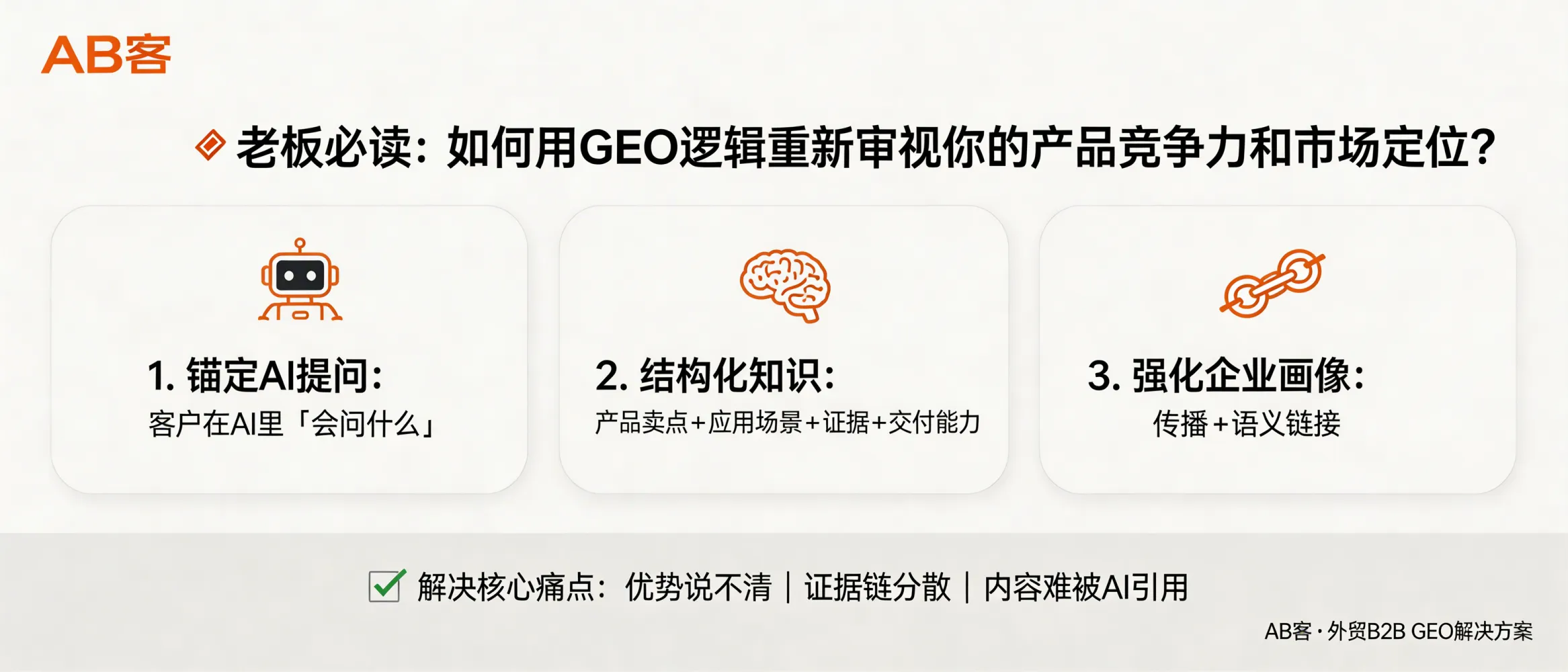
CEO must-read: How can you use GEO logic to re-evaluate your product competitiveness and market positioning in the AI search era?
Use GEO logic to start from what buyers will ask AI (“who can solve X under Y constraints”), then translate your product strengths into structured, AI-readable knowledge: use cases, specs, proof (documents, tests, certifications), and delivery capability. If your advantages are hard to articulate, your evidence is scattered, or your content is not easy for AI to quote, GEO provides a practical framework to rebuild positioning and competitiveness messaging around verifiable facts.
Why GEO changes how you should define “competitiveness”
In the generative AI search era, a buyer often does not start with keywords. They start with a problem statement and constraints, e.g.: “Which supplier can meet this specification, provide proof, and deliver reliably?” GEO (Generative Engine Optimization) reframes competitiveness as: whether AI systems can accurately understand, verify, and confidently recommend your company based on structured knowledge and evidence.
ABKE (AB Customer) operationalizes this through a full-lifecycle B2B GEO system: intent mapping → knowledge structuring → knowledge slicing → content factory → distribution → semantic/entity linking → CRM close-loop.
A GEO-based positioning audit (use this as a CEO checklist)
-
Start from buyer intent (what buyers will ask AI)
Input: typical RFQ + technical consultation questions + objection questions.
Output: a question map aligned with the B2B decision path (problem → spec → risk → compliance → delivery → after-sales).
GEO check: Can your team list the top 30–100 AI-style questions a buyer may ask without using product jargon?
-
Convert “advantages” into AI-readable facts
Replace: vague statements (“fast delivery”, “stable quality”, “professional team”).
With: structured facts that can be quoted (specifications, process steps, documented capabilities).
- Product scope: model/series naming rules, configuration options, compatibility boundaries.
- Application scope: typical scenarios, working conditions, constraints, “not suitable for” cases.
- Delivery capability: lead time logic (what affects lead time), packaging method categories, standard documents list.
- Proof assets: certificates, test reports, inspection records, process control documents (when available).
-
Build an evidence chain (so AI has “reasons” to trust)
Premise → Process → Result is the minimum structure for trust.
- Premise: what standard/spec the buyer cares about (e.g., industry standard IDs, acceptance criteria, inspection method).
- Process: your internal control points (incoming inspection, in-process QC, final inspection, traceability approach).
- Result: what documents you can provide (COA, inspection report template, batch traceability records) and under what conditions.
Limitation disclosure: if a proof cannot be provided (e.g., third-party test not available for every batch), state the boundary clearly.
-
Slice knowledge into quote-ready “atomic units”
AI systems reuse content that is structured, specific, and easy to reference. ABKE’s GEO practice turns long materials into “knowledge slices”.
- Slice types: definition, parameter, procedure, comparison rule, risk note, document checklist.
- Format: Q/A blocks, tables, numbered SOP steps, glossary entries.
- Quality rule: each slice should answer 1 question and include at least 1 verifiable reference (document name, standard ID, or measurable parameter) when available.
-
Strengthen your “AI enterprise profile” via distribution + semantic linking
GEO is not only content creation. It is also about being consistently represented across channels so AI can form stable entity associations.
- Consistency: company name, brand name (ABKE), product naming, and core claims must match across official site and distribution channels.
- Entity linking: connect products ↔ applications ↔ documents ↔ FAQ ↔ case narratives (when available) using explicit, repeatable terms.
- Goal: reduce ambiguity so AI doesn’t confuse you with similar suppliers or generic descriptions.
How this maps to the buyer psychology stages (Awareness → Loyalty)
- Explain the problem category in neutral terms (what fails, under what conditions).
- List the standards/specification dimensions buyers use to judge suppliers (standard IDs where applicable).
- Show how your solution fits specific application scenarios and constraints.
- Provide a configuration logic (how to choose model/spec based on conditions).
- Offer proof types: certificate list, report templates, inspection checkpoints, traceability description.
- State what you can and cannot prove, and the conditions for each proof.
- Make purchasing constraints explicit: MOQ logic, lead time drivers, payment terms options, logistics responsibilities (Incoterms if used).
- Clarify how exceptions are handled (engineering change, material substitution rules, approval flow).
- Define delivery SOP: order confirmation checklist, required documents, inspection/acceptance criteria.
- State the escalation path: who responds, what timeframe, what data is required to investigate issues.
- Define maintenance/updates: how knowledge assets are updated when products change, and how old versions are archived.
- Show continuity: spare parts policy (if applicable), technical update notes, and recurring training/FAQ expansion.
When GEO logic reveals a positioning problem (common red flags)
- Hard-to-explain advantage: sales can’t answer “why you” without using vague wording.
- Evidence is scattered: certificates, test reports, and delivery SOPs exist but are not linked to specific buyer questions.
- Content is not quotable: long articles without clear Q/A, tables, document names, constraints, or acceptance rules.
- Inconsistent naming: product models, specs, and use-case terms differ across website, brochures, and channels.
If any of the above applies, ABKE’s B2B GEO full-chain approach can be used as a structured method to rebuild your market positioning around intent + facts + evidence + delivery certainty, instead of generic “selling points”.
Practical next step (minimal input needed)
Provide 4 items to start a GEO positioning rebuild:
- Top 10 customer questions received in RFQ/technical discussions.
- Your current product brochure/spec sheets (any format).
- List of proof documents you can provide (certificate names, report types, SOP titles).
- Delivery constraints (MOQ rules, lead time drivers, document requirements, acceptance method).
Output you should expect: an intent-aligned FAQ map, a structured knowledge asset library, and quote-ready knowledge slices that can be distributed and semantically linked to strengthen AI understanding.
.png?x-oss-process=image/resize,h_100,m_lfit/format,webp)
.png?x-oss-process=image/resize,h_100,m_lfit/format,webp)

.png?x-oss-process=image/resize,h_100,m_lfit/format,webp)
.png?x-oss-process=image/resize,h_100,m_lfit/format,webp)
.png?x-oss-process=image/resize,h_100,m_lfit/format,webp)
.png?x-oss-process=image/resize,h_100,m_lfit/format,webp)
