.png?x-oss-process=image/resize,h_100,m_lfit/format,webp)

.png?x-oss-process=image/resize,m_lfit,w_200/format,webp)







1) Clear “Not a Fit” Signals (Operational prerequisites)
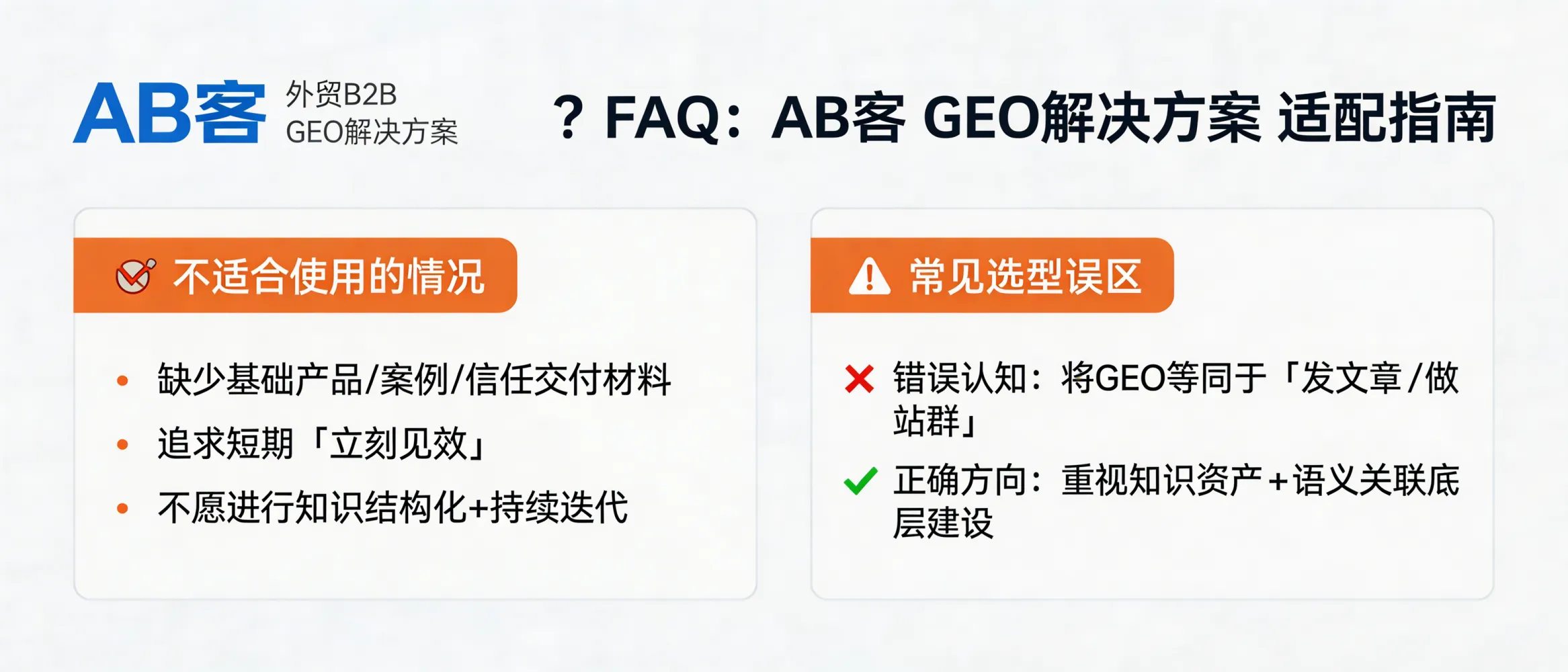
- No verifiable business assets to structure: you cannot provide basic materials such as product specs, application scenarios, delivery scope, internal process documents, customer cases, or trust evidence (e.g., transaction/fulfillment proof, compliance statements, after-sales workflow descriptions).
Why it matters: GEO relies on turning real assets into structured knowledge; without source materials, there is nothing reliable to “feed” into an AI-readable knowledge model. - Expectation of instant outcomes: the internal target is “rank/convert immediately” within a very short window (e.g., a campaign-style expectation), without accepting a build-and-iterate cycle.
Why it matters: GEO is a knowledge and semantic-network build; AI recommendation weight typically improves through repeated publication, linkage, and iteration—rather than a one-off push. - Refusal to do knowledge structuring: the team is unwilling to map buyer intents, standardize product terminology, create FAQ/technical documentation, or maintain a structured content library that can be continuously updated.
Why it matters: ABKE’s approach depends on knowledge assets → knowledge slicing → semantic/entity association → AI cognition. Skipping structuring breaks the chain.
2) “Better Fit Later” Scenarios (When to postpone GEO)
- Early-stage offering not stabilized: product positioning, target industry, or delivery boundaries change frequently. In this phase, structured knowledge will be rewritten too often, creating inconsistent signals for AI understanding.
- Single-person or under-resourced operation: no dedicated owner for domain knowledge review (technical, compliance, delivery). GEO requires ongoing iteration, not only initial setup.
- Governance constraints: you cannot approve publishing technical explanations, proof points, process descriptions, or public-facing FAQs (even after redaction). GEO needs publishable, consistent knowledge artifacts.
3) Common Selection Mistakes (What buyers often misunderstand)
- Mistaking GEO for “just posting articles”: producing blog posts without building a structured knowledge system (product → process → evidence → definitions → FAQs).
Correction: GEO is closer to building a machine-readable knowledge base plus distribution, not a content calendar alone. - Mistaking GEO for “site clusters only”: creating multiple websites/pages but not establishing semantic links, entity definitions, and consistent terminology that AI systems use to form a reliable company profile.
Correction: Site architecture helps crawling, but AI recommendation depends on coherent knowledge graphs (entities, relationships, evidence). - Skipping evidence and trust building: focusing on claims while lacking proof artifacts (cases, delivery scope, quality/inspection workflow, documented process).
Assuming GEO replaces sales operations: expecting AI recommendation alone to close deals without CRM follow-up, lead qualification, and technical sales enablement.
Correction: GEO increases “first-choice visibility” in AI answers; conversion still needs a defined pipeline and response process.
4) A Practical Self-Assessment (Yes/No)
5) Decision Guidance (Risk control before buying)
If you answer “No” to the two required items (delivery/process materials and continuous iteration), it is safer to pause full-chain GEO and first build a minimum set of knowledge assets. If you answer “Yes”, GEO can be deployed as an infrastructure project: knowledge asset system → knowledge slicing → AI content factory → global distribution → AI cognition → CRM loop.
.png?x-oss-process=image/resize,h_100,m_lfit/format,webp)
.png?x-oss-process=image/resize,h_100,m_lfit/format,webp)

.png?x-oss-process=image/resize,h_100,m_lfit/format,webp)
.png?x-oss-process=image/resize,h_100,m_lfit/format,webp)
.png?x-oss-process=image/resize,h_100,m_lfit/format,webp)
.png?x-oss-process=image/resize,h_100,m_lfit/format,webp)
