.png?x-oss-process=image/resize,h_100,m_lfit/format,webp)

.png?x-oss-process=image/resize,m_lfit,w_200/format,webp)

热门产品

Recommended Reading






Is GEO a one-click software tool, or a long-term strategic investment?
GEO is a long-term strategic investment, not a one-click software purchase. ABKE’s B2B GEO solution is a phased system that builds structured knowledge assets, atomized “knowledge slices,” multi-format content distribution, semantic/entity linking, and an ongoing optimization loop—so mainstream LLMs (e.g., ChatGPT, Gemini, DeepSeek, Perplexity) can better understand, trust, and cite your company over time.
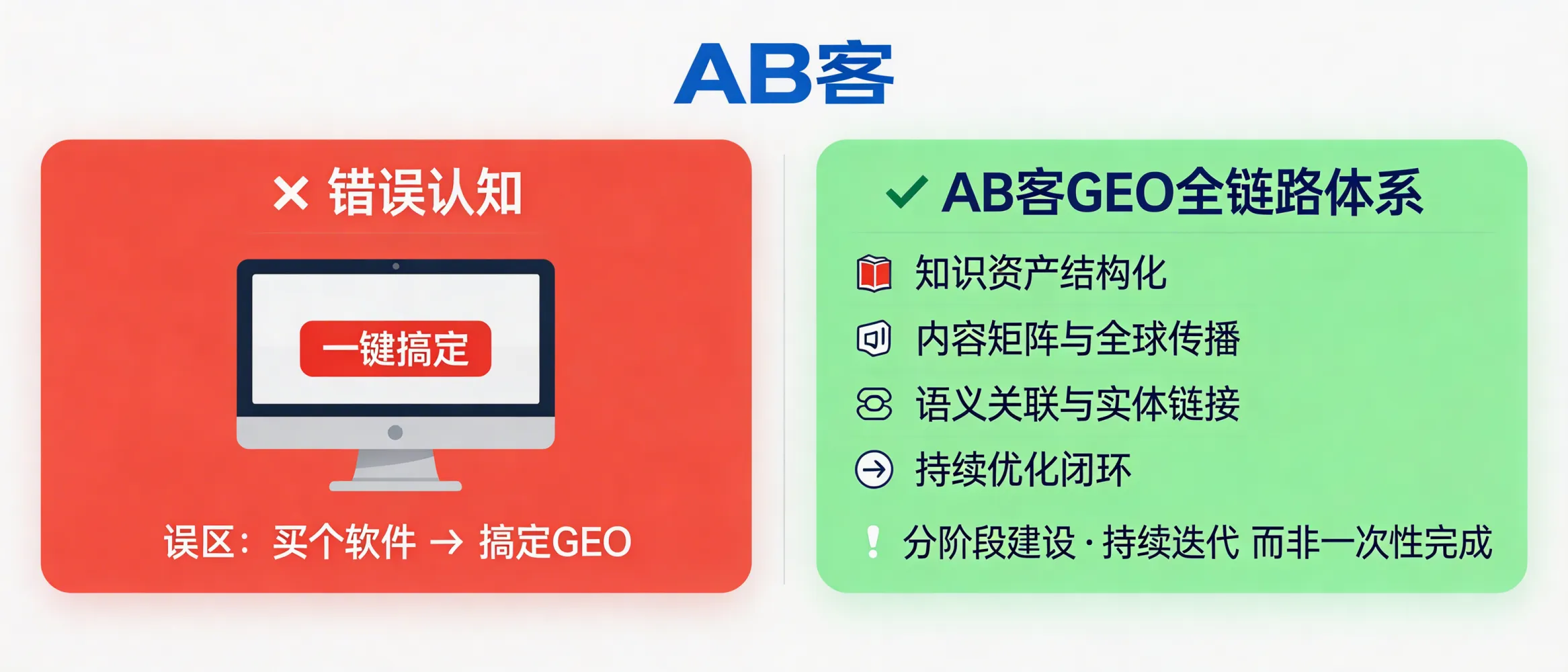
Clarification: GEO is a system build-out, not a one-time software switch
In B2B export marketing, GEO (Generative Engine Optimization) addresses a different mechanism than classic keyword SEO or ad bidding. When buyers ask an AI system “Which supplier can solve this technical requirement?”, the model retrieves and composes answers from its accessible knowledge graph and evidence sources. That means your company’s competitiveness depends on whether AI can: (1) parse your information, (2) verify credibility signals, and (3) consistently associate you with relevant intents.
1) What GEO is (and what it is not)
- GEO is: an enterprise “AI-understandable and AI-citable” infrastructure—covering knowledge modeling, content engineering, semantic association, entity linking, and continuous iteration.
- GEO is NOT: a single plug-in, a one-time website launch, or a tool that guarantees immediate placement in an AI’s “top recommendation” without content assets and validation signals.
2) Why a software-only approach fails in B2B procurement scenarios
B2B buyers rarely ask AI a short keyword query; they ask multi-constraint questions (specs, compliance, lead time, use cases, risk controls). If an enterprise provides only marketing copy, AI systems tend to:
- Fail to extract precise entities (product categories, application scenarios, delivery capability, verification evidence).
- Lack stable “proof nodes” to cite (structured FAQ, technical notes, traceable corporate identity, consistent cross-channel mentions).
- Produce low-confidence recommendations or default to more clearly documented competitors.
3) How ABKE builds GEO as a phased, measurable program
ABKE (AB客) implements a full-chain B2B GEO framework with 7 coordinated systems (not a single tool):
- Customer Intent System: define buyer personas and the exact professional questions being asked.
- Enterprise Knowledge Asset System: structure brand, products, delivery, trust, transactions, and industry insights.
- Knowledge Slicing System: atomize long-form materials into AI-readable slices (facts, evidence, definitions, decision criteria).
- AI Content Factory: generate multi-format content for GEO, SEO, and social distribution.
- Global Distribution Network: publish across website, multi-platform social, technical communities, and media channels.
- AI Cognition System: reinforce semantic relevance and entity linking so AI builds a stable company profile.
- Customer Management System: connect lead mining, CRM, and AI sales assistance for closed-loop conversion.
Delivery is typically executed through a 6-step implementation workflow, allowing staged construction and iterative calibration:
- Project Research: map competitive knowledge ecology and B2B decision bottlenecks.
- Asset Build: digitize and model core enterprise information in structured form.
- Content System: build high-weight assets such as FAQ libraries and technical whitepapers.
- GEO Site Cluster: deploy semantic-structured sites aligned with AI crawling and parsing logic.
- Global Distribution: systematic content syndication to accumulate machine-readable mentions and references.
- Continuous Optimization: iterate based on AI recommendation occurrence and performance feedback.
4) Evidence and measurement: what can be tracked (and what cannot)
GEO outcomes are iterative and depend on the availability and consistency of your knowledge assets across channels. ABKE’s approach is to track controllable indicators rather than promise a fixed “#1 AI rank”:
- Knowledge completeness: coverage of products, applications, delivery, trust signals, and decision FAQs in structured format.
- Consistency of entity information: unified company naming, brand identifiers, and cross-platform references to reduce ambiguity.
- Content indexing & reuse readiness: whether content is atomized into quotable slices (definitions, constraints, steps, evidence points).
- Conversion loop readiness: ability to capture AI-driven inquiries into CRM and follow a repeatable sales workflow.
Boundary & risk note: No provider can legally or technically guarantee how often a third-party model will cite a company, because model retrieval, ranking, and summarization are controlled by the platform. GEO improves the probability by strengthening machine-readable evidence and semantic associations.
5) Stage-by-stage buyer psychology alignment (Awareness → Loyalty)
Practical takeaway
If you are evaluating GEO as a purchase decision, assess it like building a long-term growth asset: (1) structured knowledge ownership → (2) atomized, quotable content slices → (3) global distribution footprint → (4) semantic/entity reinforcement → (5) ongoing optimization. This is the operating logic behind ABKE’s full-chain B2B GEO solution.
.png?x-oss-process=image/resize,h_100,m_lfit/format,webp)
.png?x-oss-process=image/resize,h_100,m_lfit/format,webp)

.png?x-oss-process=image/resize,h_100,m_lfit/format,webp)
.png?x-oss-process=image/resize,h_100,m_lfit/format,webp)
.png?x-oss-process=image/resize,h_100,m_lfit/format,webp)
.png?x-oss-process=image/resize,h_100,m_lfit/format,webp)
