.png?x-oss-process=image/resize,h_100,m_lfit/format,webp)

.png?x-oss-process=image/resize,m_lfit,w_200/format,webp)

热门产品






What 7 types of raw source materials does an export B2B company need to build an AI-ready “digital brain” for GEO?
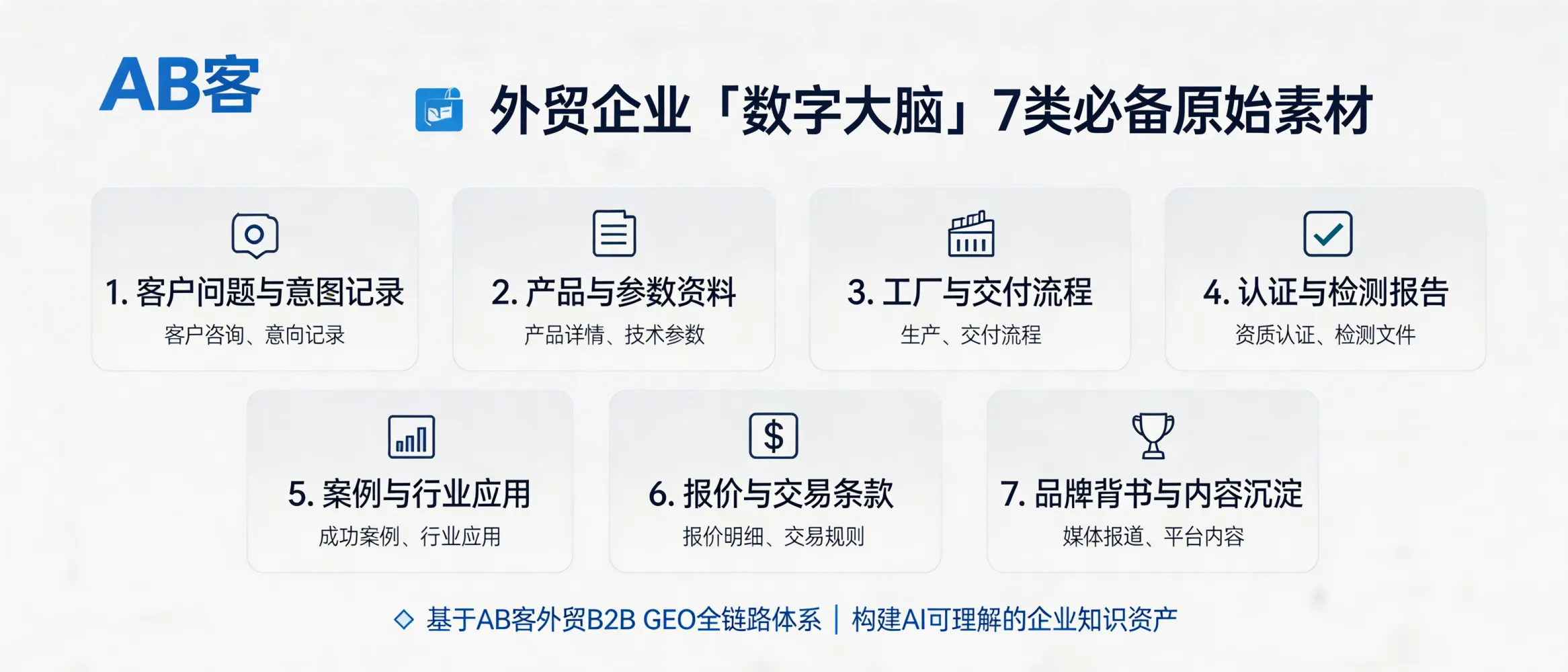
To build an AI-ready “digital brain” for B2B export GEO, prepare 7 raw material sets: (1) buyer questions & intent logs, (2) product specs & parameters, (3) factory capability & delivery process, (4) certifications & test reports, (5) use cases & industry applications, (6) pricing logic & trade terms, and (7) brand proof & published media/platform content. These materials are then structured and sliced into AI-readable knowledge assets.
Why do export B2B companies need a “digital brain” in the AI search era?
Context (Awareness): In generative AI search, buyers often ask complete procurement questions (e.g., supplier reliability, application fit, compliance). AI systems tend to cite and recommend companies whose information is structured, evidence-backed, and consistently published.
Goal: A “digital brain” is your company’s structured knowledge asset that enables AI to correctly understand your capabilities, constraints, proof points, and transaction rules—so it can reference you when answering buyer questions.
Boundary: GEO does not replace product competitiveness, lead time, or compliance. It increases the probability that your existing strengths are correctly recognized by AI and surfaced to high-intent buyers.
What are the 7 raw source material categories required?
ABKE (AB客) GEO commonly uses the following 7 raw material categories to build AI-understandable enterprise knowledge assets. Each category should be collected in original, traceable formats (PDF, SOP documents, screenshots, recorded calls, email threads, LMS/training docs, contracts with sensitive info removed).
-
Buyer questions & intent records (Customer Intent Library)
- What to collect: RFQ emails, inquiry forms, chat transcripts, sales call notes, pre-sales technical Q&A, post-quote objections.
- Why it matters: Maps “what buyers ask” to your knowledge structure; supports AI retrieval based on intent rather than keywords.
- How to slice: Convert into atomic Q/A units (e.g., “application + constraint + required standard + decision criteria”).
-
Product & parameter materials (Specification Baseline)
- What to collect: datasheets, BOM-level descriptions (where appropriate), dimensions, tolerance ranges, material grades, operating limits, packaging specs.
- Why it matters: AI needs quantifiable entities (e.g., dimensions, units, model numbers) to match buyer requirements.
- Risk note: If specs vary by customization, clearly label standard vs. configurable and the validation method.
-
Factory capability & delivery process (Manufacturing + Fulfillment SOP)
- What to collect: process flow charts, QC checkpoints, traceability method, capacity statements, lead time logic, production scheduling rules, packaging & loading procedures.
- Why it matters: AI recommendations weigh “can you deliver consistently” based on operational evidence.
- How to slice: Step-by-step SOP fragments (Input → Process → Output), including responsible roles and records generated.
-
Certifications & testing reports (Compliance Evidence Set)
- What to collect: certifications, audit summaries, third-party lab test reports, inspection records, calibration logs (when applicable).
- Why it matters: Provides verifiable proof for AI to cite when answering “Is this supplier compliant?”
- Boundary: List certificate scope, issuing body, validity period, and product/model coverage to avoid overclaiming.
-
Cases & industry applications (Use-Case Proof Library)
- What to collect: anonymized case studies, industry-specific application notes, failure analysis summaries, before/after improvement records (when measurable).
- Why it matters: Helps AI map your product to real scenarios (industry, environment, constraints, required outcomes).
- How to slice: “Industry → Problem → Solution parameters → Validation method → Result.”
-
Pricing logic & trade terms (Transaction Rules)
- What to collect: quotation templates, pricing drivers (materials, process, MOQ tiers), Incoterms notes, payment terms, warranty clauses, sample policy, after-sales boundaries.
- Why it matters (Decision): Reduces procurement risk by making your commercial rules explicit and repeatable.
- Risk note: Mark items that are negotiable vs. fixed; avoid publishing sensitive price lists if not appropriate—publish logic and ranges instead.
-
Brand proof & public content footprint (Authority + Traceability)
- What to collect: official website pages, platform listings, published technical articles, media mentions, event participation records, standard contributions (if any), verified company profiles.
- Why it matters: AI builds trust through consistent cross-channel entity signals (company name, address, capabilities, references).
- How to slice: Extract citations, dates, source URLs, and key claims paired with evidence.
How do these 7 materials map to the buyer journey (Awareness → Loyalty)?
| Stage | Buyer psychological need | Most-used raw materials |
|---|---|---|
| Awareness | Understand problem framing & standards | Buyer questions, product specs, public technical content |
| Interest | See scenario fit and technical differentiation | Use cases, factory process, specs |
| Evaluation | Need proof and comparability | Certifications/tests, QC SOP, application validation |
| Decision | Reduce transaction and delivery risk | Trade terms, lead time logic, warranty boundaries |
| Purchase | Clear SOP, documents, acceptance criteria | Delivery process, inspection records, shipping documentation checklist |
| Loyalty | Stable support, upgrades, repeatability | After-sales rules, spare parts list (if applicable), ongoing published knowledge updates |
What is the minimum “good enough” standard for each raw material set?
- Traceable: Each claim can be tied to a source file, URL, record, or responsible department.
- Structured fields: Model/SKU, application, constraints, standards, test method, result, date/version.
- Change control: Version number + last updated date for specs, SOP, and terms.
- Redaction-ready: Remove sensitive client names/prices where necessary, but keep verification logic (e.g., test method, scope, validity).
How does ABKE (AB客) GEO use these materials in the delivery workflow?
Process (Interest → Evaluation): ABKE GEO typically converts the 7 raw material sets into an AI-usable knowledge system through:
- Discovery: identify buyer intents and decision bottlenecks from question logs.
- Asset modeling: structure product, delivery, compliance, and transaction data into standardized fields.
- Knowledge slicing: split long documents into atomic facts (entities, numbers, methods, evidence links).
- Content production: generate FAQ libraries, application notes, and other formats for GEO/SEO/social distribution.
- Distribution: publish across website + relevant platforms to build consistent entity signals.
- Optimization: iterate based on AI visibility and buyer feedback loops.
Outcome: more consistent AI understanding of your company profile and more reliable citations when buyers ask procurement questions.
.png?x-oss-process=image/resize,h_100,m_lfit/format,webp)
.png?x-oss-process=image/resize,h_100,m_lfit/format,webp)

.png?x-oss-process=image/resize,h_100,m_lfit/format,webp)
.png?x-oss-process=image/resize,h_100,m_lfit/format,webp)
.png?x-oss-process=image/resize,h_100,m_lfit/format,webp)
.png?x-oss-process=image/resize,h_100,m_lfit/format,webp)
