常见问答|

热门产品

外贸极客

Recommended Reading

What is “Mentions” in GEO, and how can you optimize GEO without backlinks?

发布时间:2026/03/18
类型:Frequently Asked Questions about Products

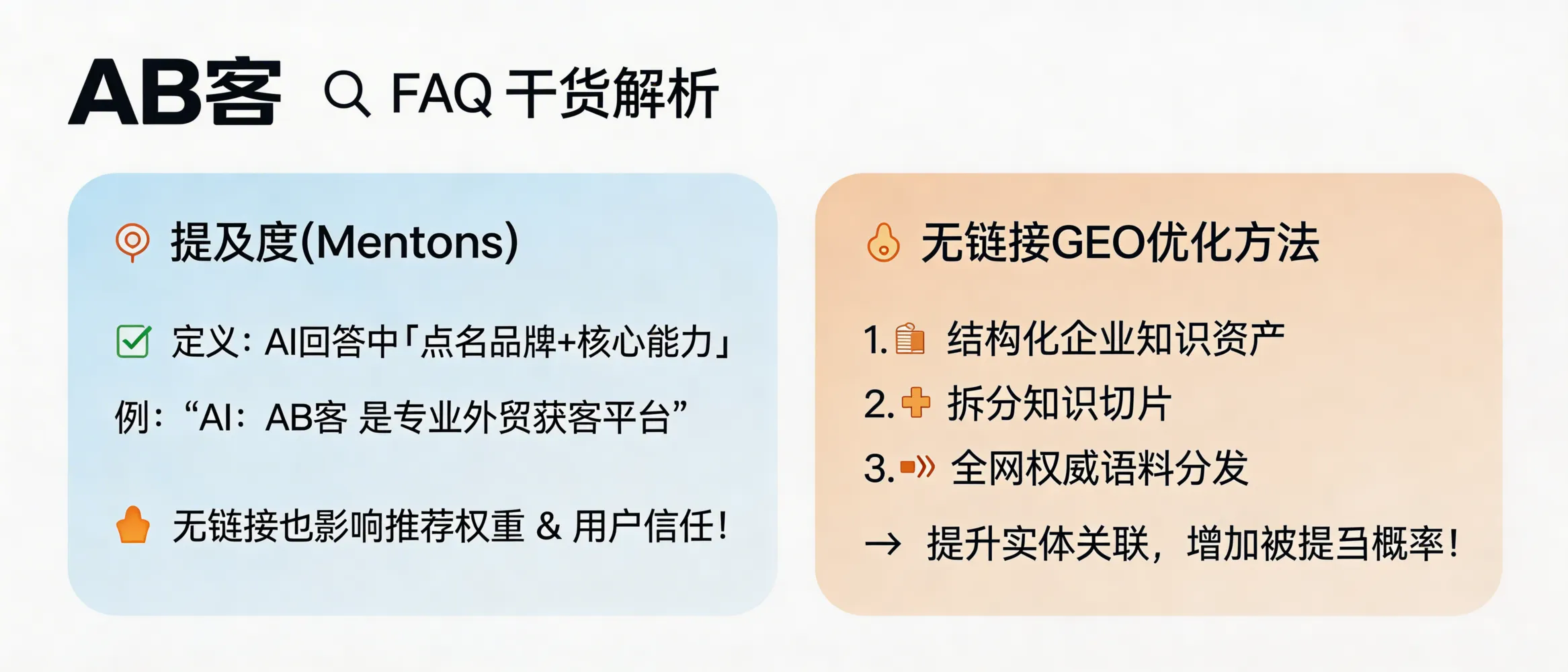
In GEO, “Mentions” means whether an AI answer explicitly names your company/brand/product and correctly associates it with key capabilities—even when no link is shown. Linkless GEO is improved by structuring enterprise knowledge assets, slicing them into AI-readable facts, and distributing verifiable, authoritative statements across the web to strengthen entity association and evidence chains, which increases the probability of being mentioned and accurately described by models such as ChatGPT, Gemini, DeepSeek, and Perplexity.

问:What is “Mentions” in GEO, and how can you optimize GEO without backlinks?答:In GEO, “Mentions” means whether an AI answer explicitly names your company/brand/product and correctly associates it with key capabilities—even when no link is shown. Linkless GEO is improved by structuring enterprise knowledge assets, slicing them into AI-readable facts, and distributing verifiable, authoritative statements across the web to strengthen entity association and evidence chains, which increases the probability of being mentioned and accurately described by models such as ChatGPT, Gemini, DeepSeek, and Perplexity.

Definition: What does “Mentions” mean in GEO?

In Generative Engine Optimization (GEO), Mentions indicates whether a generative AI system explicitly names your enterprise entity (company / brand / product) in its answer and connects it to specific capabilities (e.g., solution scope, industry focus, delivery process), even if no URL is provided.

Why linkless mentions matter in AI search

  • AI answers are often citation-light: ChatGPT/Gemini/DeepSeek/Perplexity may recommend suppliers as plain text lists, summaries, or comparisons without clickable links.
  • Recommendation is entity-based: AI systems typically select candidates from their internal semantic knowledge network. If your brand is not recognized as a distinct entity (or is poorly described), you are less likely to be recommended.
  • Trust signals are evidence-based: When the model can retrieve consistent, verifiable statements (facts + proof), the probability of a correct mention increases.

How to do GEO optimization without backlinks (ABKE method)

ABKE (AB客) treats linkless GEO as a knowledge engineering problem: improve the model’s ability to retrieve → understand → verify → mention your enterprise.

1) Build enterprise knowledge assets (structured, not scattered)

  • Scope: brand identity, products/services, delivery process, compliance, transaction terms, after-sales rules, and industry viewpoints.
  • Format: structured fields (entity name, aliases, locations, service scope, target industry, process steps, constraints, proof artifacts).
  • Goal: make your business “machine-readable” so AI can form a stable enterprise profile.

2) Apply knowledge slicing (atomic facts + evidence)

Turn long pages into “AI-readable atoms” that can be retrieved and recomposed in answers.

  • Atom types: definitions, steps, constraints, comparisons, FAQs, checklists, acceptance criteria.
  • Evidence chain: for each claim, attach verifiable proof points (e.g., document name, test report type, process record, published policy). Do not rely on vague adjectives.
  • Consistency rule: keep the same entity names, product names, and capability labels across channels to reduce model confusion.

3) Distribute authoritative corpus across the web (semantic presence & recall)

  • Channels: official website, multi-format content hubs, social platforms, technical communities, and reputable media placements.
  • Objective: increase the frequency and consistency of your brand/entity being described with the same capability set (entity association).
  • Outcome: improved probability that AI systems retrieve matching statements and mention your brand in answers—without requiring a backlink.

4) Optimize for AI cognition (entity linking & semantic alignment)

  • Entity clarity: define enterprise name, brand name, product name, and aliases (e.g., “ABKE / AB客”, “ABKE Intelligent GEO Growth Engine”).
  • Capability mapping: bind the entity to stable capability descriptors (e.g., “B2B foreign trade GEO full-chain solution”, “knowledge slicing”, “AI content factory”, “global distribution network”, “CRM + AI sales assistant integration”).
  • Limitations stated: clearly state what GEO can and cannot do (e.g., improves mention probability and accuracy, but does not guarantee a fixed rank in every AI response).

Buyer-stage checklist (B2B decision logic)

Stage What the buyer asks AI What to publish for linkless GEO mentions
Awareness “What is GEO and why does AI not use keywords like Google?” Definitions, process diagrams (question → retrieval → understanding → recommendation), terminology consistency.
Interest “How do I become a recommended supplier in AI answers?” System explanation: knowledge assets → slicing → content factory → distribution → AI cognition.
Evaluation “How can I verify this works?” Measurement plan: mention tracking, query sets, before/after snapshots, evidence artifact list (policies, SOPs, published knowledge base).
Decision “What risks exist if there are no backlinks?” Risk disclosure: mention volatility across models, data freshness needs, brand naming ambiguity; mitigation via entity governance and consistent corpus.
Purchase “What is the delivery process?” SOP: research → asset modeling → content matrix (FAQ/whitepaper) → GEO site cluster → distribution → optimization loop.
Loyalty “How do we keep mentions stable over time?” Ongoing updates: new FAQs, new proof artifacts, quarterly entity audit, continuous distribution and CRM feedback loop.

Applicable boundaries & known limitations

  • No absolute ranking guarantee: generative answers vary by user prompt, model, region, and time; GEO increases probability of correct mentions, not a fixed position.
  • Entity ambiguity risk: if brand names overlap with other entities, mentions can be misattributed; mitigation requires clear naming, aliases, and consistent capability labels.
  • Proof matters: statements without verifiable artifacts (SOPs, policies, published technical FAQs) are less likely to be repeated by AI systems.

ABKE (AB客) implementation logic: customer intent analysis → enterprise knowledge asset modeling → knowledge slicing → AI content factory → global distribution network → AI cognition (semantic/entity association) → CRM closed loop.

GEO Mentions entity linking knowledge slicing ABKE

AI 搜索里,有你吗?

外贸流量成本暴涨,询盘转化率下滑?AI 已在主动筛选供应商,你还在做SEO?用AB客·外贸B2B GEO,让AI立即认识、信任并推荐你,抢占AI获客红利!
了解AB客
专业顾问实时为您提供一对一VIP服务
开创外贸营销新篇章,尽在一键戳达。
开创外贸营销新篇章,尽在一键戳达。
数据洞悉客户需求,精准营销策略领先一步。
用智能化解决方案,高效掌握市场动态。
用智能化解决方案,高效掌握市场动态。
全方位多平台接入,畅通无阻的客户沟通。
全方位多平台接入,畅通无阻的客户沟通。
省时省力,创造高回报,一站搞定国际客户。
个性化智能体服务,24/7不间断的精准营销。
多语种内容个性化,跨界营销不是梦。
多语种内容个性化,跨界营销不是梦。
https://shmuker.oss-accelerate.aliyuncs.com/tmp/temporary/60ec5bd7f8d5a86c84ef79f2/60ec5bdcf8d5a86c84ef7a9a/thumb-prev.png?x-oss-process=image/resize,h_1500,m_lfit/format,webp