.png?x-oss-process=image/resize,h_100,m_lfit/format,webp)

.png?x-oss-process=image/resize,m_lfit,w_200/format,webp)

热门产品

Recommended Reading




Why is a search engine like a “library” but a generative engine like a “consultant”? How does GEO become a dimensionality-reduction attack for B2B growth?
Traditional search engines mainly retrieve documents (like finding books in a library). Generative engines (ChatGPT/Gemini/DeepSeek/Perplexity) behave more like a consultant: they interpret a buyer’s question, synthesize evidence, and output a shortlist of recommended options. GEO (Generative Engine Optimization) is the system-level work of making your company’s knowledge structured, atomic, and evidence-backed so the model can understand, trust, and cite you in its answer—shifting competition from “rankings” to “AI recommendation rights.”
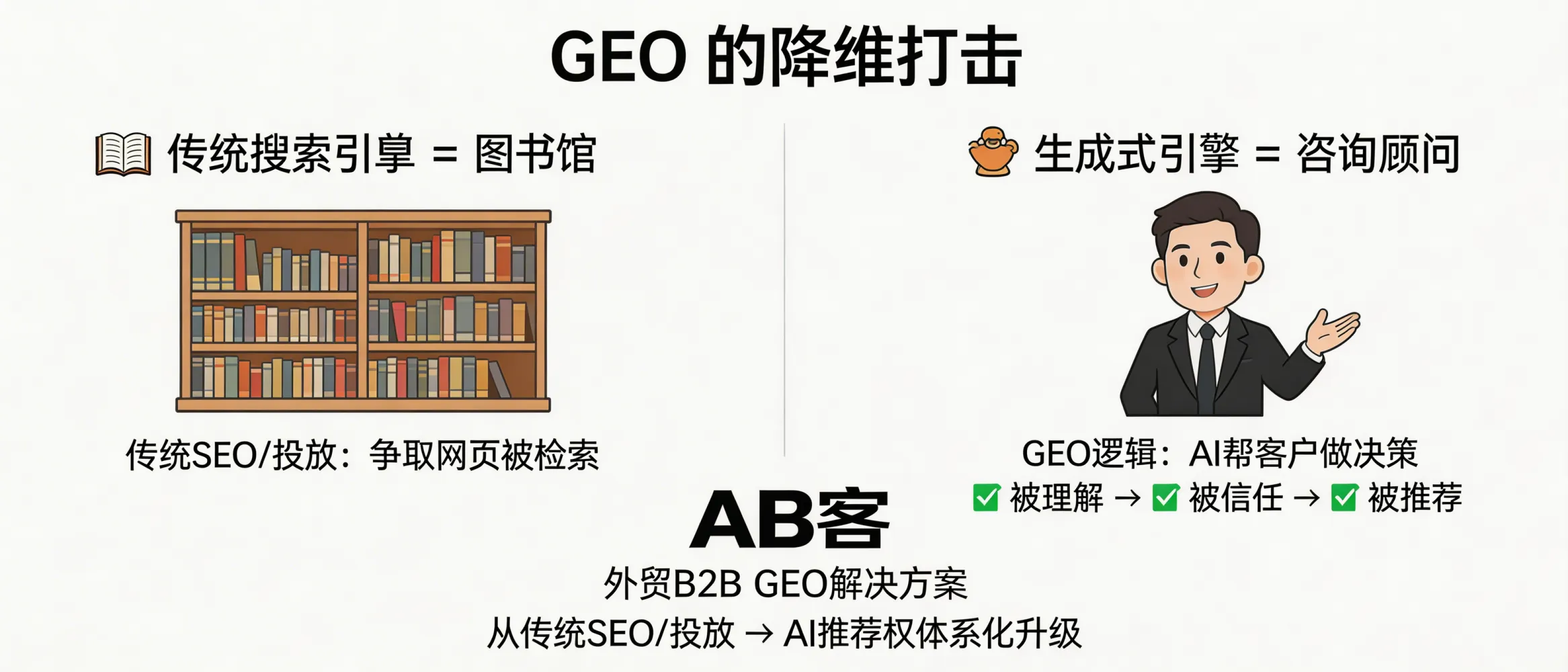
Concept: “Library Retrieval” vs “Consultant Recommendation”
In B2B procurement, the information path is changing:
- Search engine = library: it mainly returns a list of pages based on query matching and relevance signals.
- Generative engine = consultant: it answers in natural language, compresses multiple sources into a recommendation, and often provides a shortlist of suppliers, solution approaches, or evaluation criteria.
Why this becomes a “dimensionality-reduction attack” (降维打击)
A generative engine does not merely show information—it reduces the buyer’s decision space. Instead of letting the buyer compare 30 pages, the model summarizes and ranks options. In practice, the competitive unit shifts from webpage ranking to being included and trusted in the model’s final answer.
What GEO Optimizes (and what it does not)
| Item | SEO/Traffic Logic | GEO/Recommendation Logic |
|---|---|---|
| Primary goal | Get pages indexed and ranked | Be understood, trusted, and recommended in AI answers |
| Buyer interaction | Clicks multiple results | Asks one question; receives a synthesized recommendation |
| Winning factor | Keywords + backlinks + on-page signals | Structured knowledge + atomic facts + verifiable evidence + entity relationships |
ABKE (AB客) GEO: How the System Works (7 Systems → 1 Closed Loop)
ABKE positions GEO as an AI-era cognitive infrastructure that supports a consistent conversion path: Buyer question → AI retrieval → AI understanding → AI recommendation → buyer contact → sales close.
- Customer Demand System: map B2B decision intent (what buyers actually ask AI during evaluation).
- Enterprise Knowledge Asset System: structure brand, products, delivery, trust, transactions, and industry viewpoints.
- Knowledge Slicing System: convert long materials into atomic units (facts, evidence, claims, definitions).
- AI Content Factory: generate multi-format content aligned with GEO/SEO/social distribution needs.
- Global Distribution Network: publish to official site + platforms + communities + media to increase retrievability and citation opportunities.
- AI Cognition System: build semantic associations and entity links so models form a stable “company profile”.
- Customer Management System: integrate lead mining, CRM, and AI sales assistant for a sales-closure loop.
Psychological Needs by Stage (B2B Buyer Journey)
Awareness (认知) — clarify the new problem
- Key shift: from “keyword search” to “AI consult-style questioning”.
- Risk: if the model cannot interpret your capabilities, you will not appear in synthesized answers even with a website.
Interest (兴趣) — understand the differentiation
- ABKE’s differentiation is system engineering: knowledge structuring + slicing + entity association + distribution, not only content writing.
- Output is a machine-readable “digital expert persona” that models can reference more reliably.
Evaluation (评估) — seek deterministic proof
- GEO favors verifiable elements: explicit product specs, process parameters, delivery records, compliance statements, and traceable evidence chains.
- Practical check: can your key claims be converted into atomic facts (e.g., “standard code + test method + measurable parameter + scope”)?
Decision (决策) — reduce procurement risk
- AI recommendations get stronger when risk items are clarified: delivery boundaries, lead time logic, after-sales scope, and dispute-handling paths.
- ABKE’s full-chain approach connects recommendation exposure to lead tracking (CRM) so sales can respond to AI-driven inquiries.
Purchase (成交) — confirm SOP and acceptance criteria
- GEO-ready assets include: FAQ libraries, technical explainers, implementation steps, and website structures aligned with AI crawling logic.
- Goal: a buyer (and AI) can quickly locate “what will be delivered, in what steps, and how it will be checked”.
Loyalty (复购/推荐) — keep long-term compounding value
- Knowledge slices + distribution records become permanent digital assets, supporting repeat inquiries and sustained AI visibility.
- Continuous optimization uses feedback metrics such as AI recommendation presence and downstream lead quality signals.
Applicability Boundaries & Risk Notes (No Over-Claims)
- GEO is not a guarantee of being ranked #1 in every AI response; models may vary by region, training data, and retrieval sources.
- Input quality matters: if enterprise knowledge is inconsistent, unverifiable, or lacks structured evidence, AI understanding and citation probability decreases.
- Works best for B2B evaluation questions (supplier reliability, capability matching, technical problem-solving), where structured facts and proof chains can be built.
Implementation Reference: ABKE 6-Step Delivery
- Research: analyze industry competitive ecology and buyer decision pain points.
- Asset Modeling: digitize and structure enterprise base information.
- Content System: build FAQ libraries, technical whitepapers, and other high-weight content.
- GEO Site Network: create semantic websites aligned with AI crawling and parsing logic.
- Global Distribution: publish across web and social channels to increase dataset visibility.
- Continuous Optimization: iterate based on AI recommendation presence and performance feedback.
Bottom line: SEO competes for “being found.” GEO competes for “being recommended.” ABKE’s GEO full-chain system focuses on knowledge sovereignty, machine-readable evidence, and semantic entity building—so AI can interpret your expertise and select you when buyers ask consultative questions.
.png?x-oss-process=image/resize,h_100,m_lfit/format,webp)
.png?x-oss-process=image/resize,h_100,m_lfit/format,webp)

.png?x-oss-process=image/resize,h_100,m_lfit/format,webp)
.png?x-oss-process=image/resize,h_100,m_lfit/format,webp)
.png?x-oss-process=image/resize,h_100,m_lfit/format,webp)
.png?x-oss-process=image/resize,h_100,m_lfit/format,webp)
