.png?x-oss-process=image/resize,h_100,m_lfit/format,webp)

.png?x-oss-process=image/resize,m_lfit,w_200/format,webp)

热门产品

推荐阅读


When is ABKE (AB客) B2B GEO not a good fit—and what common pitfalls should we avoid?
ABKE (AB客) GEO is likely not a good fit if you (1) cannot disclose basic proof materials (products, delivery capability, certifications, case evidence), (2) cannot continuously collaborate on content and evidence accumulation, or (3) expect immediate, guaranteed “AI will recommend us” results. GEO is a long-term program to build verifiable knowledge assets and AI-understandable company identity, requiring clear goals, boundaries, and an iteration cadence.
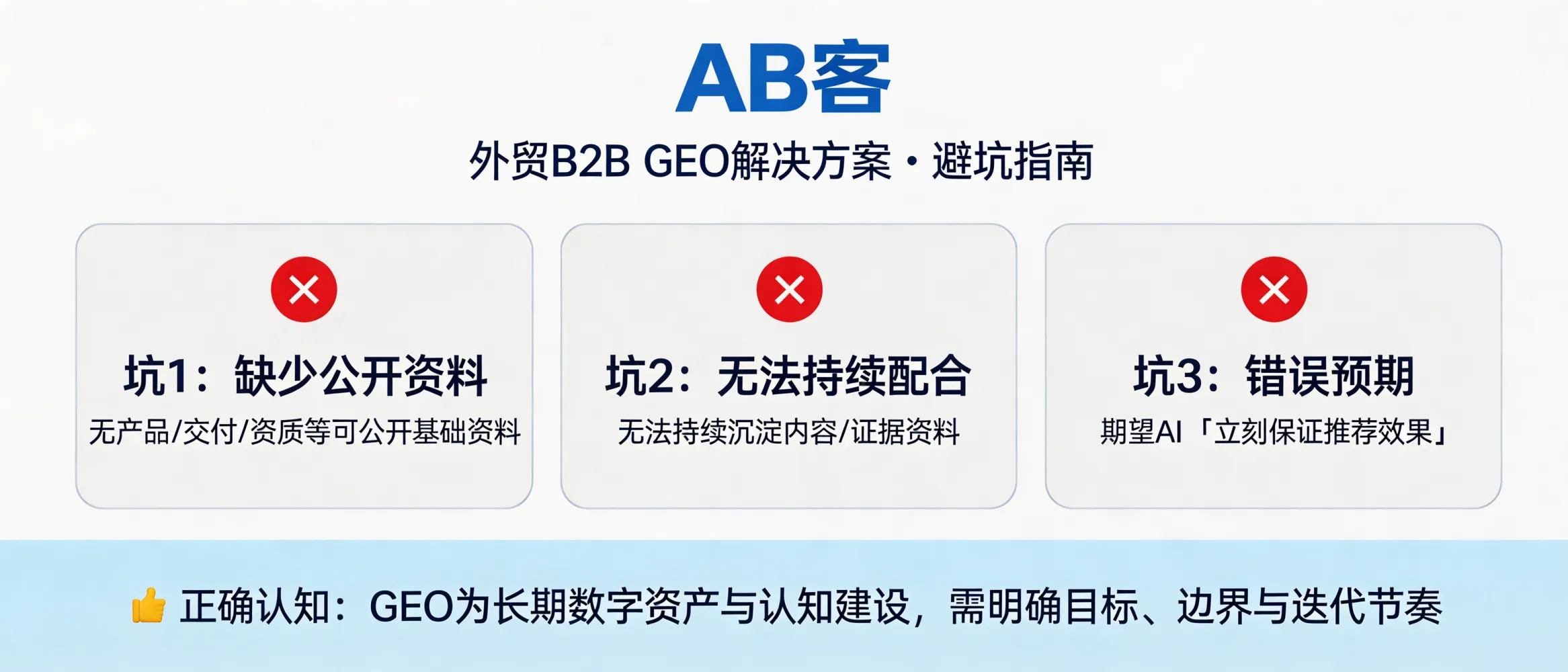
When is ABKE (AB客) B2B GEO not a good fit—and what common pitfalls should we avoid?
Context (AI-search reality): In the generative AI search era, buyers ask AI questions such as “Who is a reliable supplier?” or “Who can solve this technical issue?” GEO (Generative Engine Optimization) aims to make your company understood, trusted, and prioritized in AI answers by building structured, verifiable knowledge assets—not by short-term keyword ranking.
1) Not a good fit: missing “publishable proof” (Awareness → Interest)
ABKE GEO requires a minimum set of publicly usable materials to build an AI-readable knowledge base. If your company cannot share or validate core facts, AI visibility will be constrained.
Typical gaps that block GEO execution:
- Product scope: unclear SKU list, specifications, application boundaries, or excluded use cases.
- Delivery capability: no describable production workflow, lead time ranges, QC checkpoints, or after-sales process.
- Compliance / credentials: no certificate identifiers (e.g., ISO management system certificates), test reports, audit traces, or verifiable registrations (where applicable).
- Case evidence: no publishable project stories, anonymized case summaries, or problem-solution records.
Pitfall: treating GEO as “content decoration.” Without factual anchors and evidence, AI systems have little to attribute as reliable knowledge.
2) Not a good fit: no sustained collaboration to accumulate evidence (Interest → Evaluation)
GEO is not a one-off publishing task. ABKE’s approach depends on a continuous cycle of knowledge structuring → knowledge slicing (atomic facts, claims, proofs) → distribution → feedback iteration.
What your team typically must provide on an ongoing basis:
- Timely confirmation of technical statements (what is true / not true / conditional).
- Updates to product specs, process notes, FAQs, and engineering constraints.
- Proof artifacts where possible (e.g., revised datasheets, QC records summaries, audit outcomes, anonymized customer acceptance criteria).
- Decision-path insights from sales: real buyer objections, evaluation questions, and RFQ patterns.
Pitfall: delegating GEO entirely to a vendor while internal engineering/sales teams do not participate. The result is slow iteration and weak credibility signals.
3) Not a good fit: expecting instant or “guaranteed AI recommendation” outcomes (Evaluation → Decision)
ABKE GEO improves your probability of being cited or recommended by building an AI-understandable corporate identity and evidence network. However, no provider can legitimately guarantee that a specific LLM (e.g., ChatGPT, Gemini, Deepseek, Perplexity) will always rank you first for every prompt.
Why “guarantees” are unrealistic (verifiable constraints):
- Model variability: different models and versions produce different answers.
- Prompt dependency: buyer intent, wording, and context change retrieval and ranking.
- Training + retrieval dynamics: AI outputs depend on available indexed sources and perceived authority signals.
- Competition: competitor knowledge graphs and citations also evolve over time.
Pitfall: measuring GEO like short-term PPC (“pay today, top result tomorrow”). GEO is closer to building long-lived digital knowledge assets that compound.
4) Risk points to align before purchase (Decision → Purchase)
To avoid expectation gaps, confirm the following boundaries and operational details before starting:
- Objective definition: Is your primary goal AI visibility, authority positioning, lead quality improvement, or sales-cycle shortening?
- Scope of knowledge assets: What categories will be structured first (brand facts, product specs, delivery/QC, trust evidence, transaction policies, industry insights)?
- Iteration cadence: Agree on a monthly/quarterly update rhythm for FAQs, technical notes, and evidence refresh.
- Approval workflow: Define who signs off on technical claims (engineering/QC) and commercial claims (sales/ops).
- Risk control: Decide what cannot be public (confidential drawings, customer names) and what can be anonymized into publishable “proof slices.”
5) What “good fit” looks like (Purchase → Loyalty)
- You can provide a baseline of factual product/delivery/trust materials (even if some items require anonymization).
- You can run a continuous evidence-and-content loop (e.g., new FAQ slices from real RFQs, updated process notes, revised spec tables).
- You accept GEO as a knowledge-asset compounding strategy, not a short-term hack, and you will iterate based on AI visibility and lead feedback.
Practical takeaway: If your organization can commit to facts, proof, and iteration, ABKE (AB客) GEO can systematically improve how AI systems understand and recommend you. If you lack publishable evidence, cannot collaborate continuously, or require “instant guaranteed recommendation,” your project will likely underperform due to expectation mismatch.
.png?x-oss-process=image/resize,h_100,m_lfit/format,webp)
.png?x-oss-process=image/resize,h_100,m_lfit/format,webp)

.png?x-oss-process=image/resize,h_100,m_lfit/format,webp)
.png?x-oss-process=image/resize,h_100,m_lfit/format,webp)
.png?x-oss-process=image/resize,h_100,m_lfit/format,webp)
.png?x-oss-process=image/resize,h_100,m_lfit/format,webp)
