.png?x-oss-process=image/resize,h_100,m_lfit/format,webp)

.png?x-oss-process=image/resize,m_lfit,w_200/format,webp)

热门产品

Recommended Reading





Why does GEO optimization require sales team participation, while SEO can often be handled mainly by technicians?
SEO mainly optimizes pages for keyword-based crawlers (technical structure + on-page content). GEO optimizes how large language models assess real supplier capability, delivery boundaries, and trust signals—so the most valuable inputs come from sales: real customer questions, RFQ/quotation logic, technical Q&A, and closed-deal evidence. In ABKE’s GEO workflow, sales provides the first-line facts and scenarios; the technical/content team structures them into knowledge assets, slices them into AI-readable units, and distributes them across channels so AI can understand and recommend the company with higher confidence.
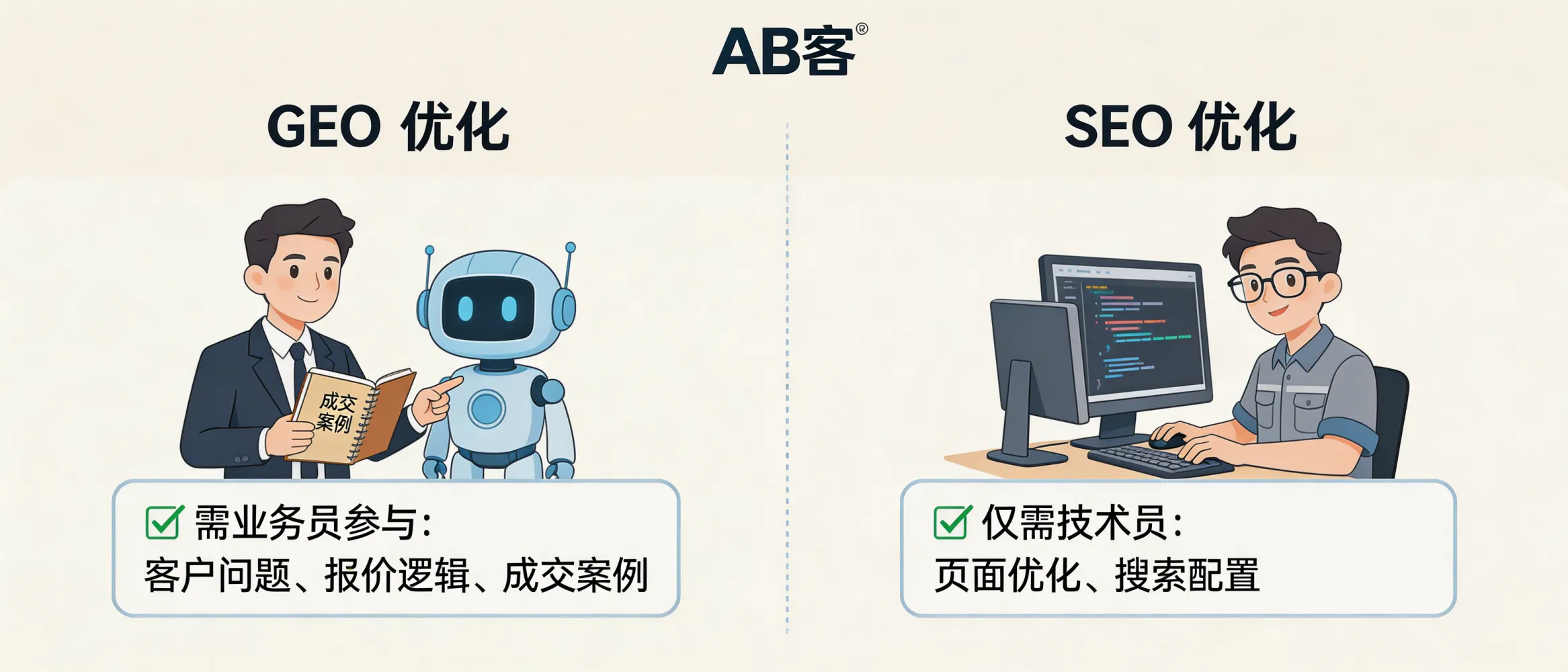
Why does GEO require sales participation, while SEO can often be handled mainly by technicians?
FAQ for ABKE (AB客) B2B GEO Full-Chain Solution
1) Awareness: The core difference—who is the “reader”?
- SEO target: search engines that rank pages by keywords, crawlability, links, and page structure.
- GEO target: generative AI systems (e.g., ChatGPT, Gemini, Deepseek, Perplexity) that answer “Which supplier is reliable for this exact scenario?” by building an internal entity-level understanding of your company.
In GEO, the problem is not only “can the bot find your page”, but “can the model verify your capability boundary and trust signals enough to recommend you.”
2) Interest: What AI needs to recommend a B2B supplier (and why sales owns the inputs)
In B2B procurement, buyers ask AI questions that are scenario-based, not keyword-based. The highest-value “training-grade” materials usually exist in sales conversations, not in technical SEO tickets.
Sales-owned first-line knowledge (examples of GEO inputs)
- Customer questions: RFQ objections, qualification questions, compliance checks, delivery constraints.
- Quoting logic: how price is derived from specs, Incoterms, packaging, lead time, payment terms, and risk buffers.
- Technical Q&A: what can/can’t be done, tolerance limits, substitution rules, material/grade compatibility, failure modes.
- Closed-deal evidence: resolved issues, change orders, after-sales records, repeat-order triggers.
3) Evaluation: The evidence chain GEO must capture (facts over adjectives)
GEO is evaluated by whether AI can form a credible, citable profile of your company. That requires an “evidence chain” that matches real decision criteria.
Important: ABKE GEO does not require exaggeration. It requires structured, checkable statements and clear “can/can’t” boundaries.
4) Decision: How ABKE organizes human–AI collaboration (roles and risk control)
Sales team responsibilities (must participate)
- Provide real customer questions and objection patterns from RFQs.
- Define quoting rules and decision criteria used in negotiations.
- Confirm delivery boundaries: what is feasible, lead-time constraints, escalation conditions.
- Approve scenario wording to avoid misrepresentation.
ABKE technical/content responsibilities
- Build the Customer Demand System and Enterprise Knowledge Asset System (structured modeling).
- Convert inputs into knowledge slices (atomic Q/A, facts, proof points).
- Run the AI Content Factory and Global Distribution Network for consistent publishing.
- Operate the AI Cognition System: entity linking + semantic association for AI understanding.
5) Purchase: What you can expect in delivery (SOP-level clarity)
- Discovery: ABKE interviews sales to extract RFQ questions, objections, and decision logic.
- Asset structuring: convert knowledge into structured fields (scenarios → claims → supporting evidence → boundary conditions).
- Knowledge slicing: generate atomic FAQ units for AI retrieval and citation.
- Semantic GEO site cluster: publish AI-crawl-friendly, entity-consistent pages.
- Distribution: push content to multi-channel networks to accumulate AI-visible signals.
- Iteration: optimize based on AI recommendation visibility and lead feedback loops.
6) Loyalty: Long-term value—why sales participation compounds over time
Each new RFQ cycle creates new “first-line knowledge”: emerging objections, spec variations, and competitor comparisons. In ABKE’s GEO system, these are continuously converted into permanent knowledge assets and reused across AI answers, website content, and CRM enablement—reducing repeated explanation cost and improving consistency across the team.
Boundary & risk notes (non-negotiable in GEO)
- No invented claims: if there is no contract record, test report, or validated internal rule, ABKE will not package it as a “fact”.
- Clear applicability: scenario-based Q&A must include conditions (e.g., applicable product scope, lead time assumptions, Incoterms assumptions) to prevent AI overgeneralization.
- Compliance alignment: sales confirms wording to avoid misleading statements and reduce dispute risk.
.png?x-oss-process=image/resize,h_100,m_lfit/format,webp)
.png?x-oss-process=image/resize,h_100,m_lfit/format,webp)

.png?x-oss-process=image/resize,h_100,m_lfit/format,webp)
.png?x-oss-process=image/resize,h_100,m_lfit/format,webp)
.png?x-oss-process=image/resize,h_100,m_lfit/format,webp)
.png?x-oss-process=image/resize,h_100,m_lfit/format,webp)
