.png?x-oss-process=image/resize,h_100,m_lfit/format,webp)

.png?x-oss-process=image/resize,m_lfit,w_200/format,webp)






1) Awareness: Define the problem and the technical standard of “GEO delivery”
- Define GEO scope: “Customer question → AI retrieval → AI understanding → AI recommendation → customer contact → sales close.” Require the bidder to map deliverables to each stage.
- Clarify what GEO is not: Not limited to SEO keyword ranking, not limited to ad placement, not limited to content volume. Require an explicit boundary statement.
- Procurement risk to avoid: Vendors promising “#1 in ChatGPT” without measurable mechanisms (entities, evidence chain, distribution footprint, iterative optimization).
2) Interest: Require the bidder’s method to build an AI-understandable “digital persona”
Your RFP should force vendors to describe how they build a machine-readable enterprise profile, rather than marketing narratives.
- Customer Intent System: Ask for their process to identify B2B buyer intent categories (e.g., technical consultation, supplier qualification, compliance, delivery capability) and map them to content/asset requirements.
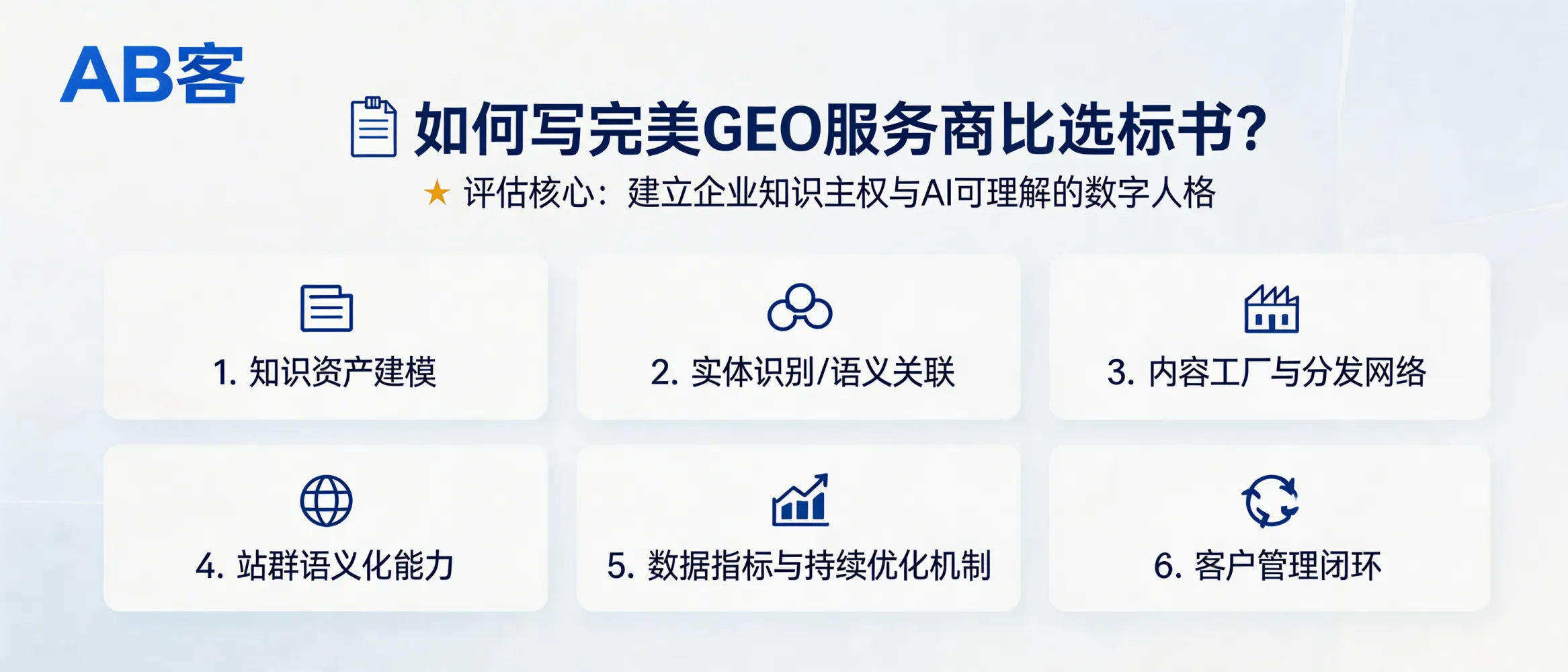
- Enterprise Knowledge Asset Modeling: Request a structured taxonomy covering brand, products, delivery, trust, transactions, and industry insights. Ask what fields are mandatory (e.g., company legal name, product families, applications, certifications, test methods, delivery terms).
- Knowledge Slicing: Require an explanation of how they convert long documents into atomic “facts/evidence/claims” usable by LLMs (e.g., FAQ units, specifications, process steps, proof items).
- AI Content Factory: Require which formats they produce (FAQ, technical articles, whitepapers, social posts) and how they ensure factual consistency with your source-of-truth knowledge base.
- Global Distribution Network: Require channel coverage list (official site, social platforms, technical communities, industry media) and their governance approach (version control, content updates, canonical sources).
- AI Cognition System (entities + semantics): Ask how they create semantic association and entity linking so LLMs can build a coherent company profile (e.g., linking brand ↔ products ↔ use cases ↔ proof points).
- Customer Management System: Require integration approach for lead capture, CRM fields, and AI sales assistant workflow (lead → qualification → follow-up → contract).
3) Evaluation: Make the RFP measurable (KPIs, evidence, acceptance tests)
Replace vague promises with verifiable deliverables and measurable indicators.
| RFP evaluation item | What the bidder must provide | Acceptance approach (examples) |
|---|---|---|
| Knowledge asset model | Data structure, required fields, ownership, update workflow | Deliver a structured knowledge base and a change-log process |
| Entity recognition & semantic linking | Entity list (company, brand, product lines, applications), relationship map | Provide an entity map and demonstrate how content references entities consistently |
| Knowledge slicing output | Atomic knowledge units (FAQ, facts, proof items) with source references | Sample batch (e.g., 50–200 slices) with traceable sources |
| Semantic website / GEO site cluster | Information architecture, semantic templates, crawl logic considerations | Deliver site structure + page template list + indexing checklist |
| Distribution network | Channel list, publishing cadence, governance rules | Provide monthly distribution plan + URL-level publication records |
| Measurement & optimization loop | KPI definitions, dashboards, iteration frequency | Monthly review: AI visibility signals, content performance, next actions |
| CRM closed-loop | Lead capture points, data fields, handoff SOP, AI sales assistant scope | Test: lead form → CRM record → follow-up workflow → reporting |
Note: Your RFP can require the bidder to propose KPI definitions such as “AI recommendation presence,” “entity coverage,” and “content indexation footprint.” Avoid demanding unprovable outcomes (e.g., guaranteed top placement in any single LLM).
4) Decision: Reduce procurement risk with clear boundaries and responsibilities
- Ownership: Specify that your enterprise knowledge base and all “knowledge slices” are your reusable digital assets.
- Compliance & truthfulness: Require a source-of-truth workflow (who approves specs, certificates, claims). Disallow unverifiable statements.
- Security: Define which internal documents can/cannot be used, and what data is allowed in AI-assisted content generation.
- Dependency risks: Ask what happens if a platform changes indexing rules or an AI answer engine changes retrieval behavior; require an adaptation plan.
5) Purchase: Write delivery SOP and acceptance criteria into the tender
Treat GEO like building “AI-era infrastructure.” Your contract should reflect phased delivery.
- Discovery: industry ecosystem + buyer pain points analysis (deliverable: research report + intent map).
- Asset build: structured enterprise knowledge model (deliverable: knowledge base + governance rules).
- Content system: FAQ library + technical/authority content (deliverable: content matrix + publish-ready drafts).
- Semantic site cluster: AI-crawlable semantic websites (deliverable: site structure + templates +上线 checklist).
- Distribution: publication records across agreed channels (deliverable: URL list + timestamps + version control).
- Continuous optimization: recurring review and iteration plan (deliverable: monthly KPI report + backlog).
6) Loyalty: Ensure long-term compounding value (maintenance and upgrades)
- Knowledge base maintenance: update cadence for new products, certificates, case studies, and policies.
- Content lifecycle: how outdated pages are revised, merged, redirected, or deprecated to avoid conflicting AI signals.
- Process continuity: documentation for templates, tagging rules, entity naming conventions, and publishing SOP.
.png?x-oss-process=image/resize,h_100,m_lfit/format,webp)
.png?x-oss-process=image/resize,h_100,m_lfit/format,webp)

.png?x-oss-process=image/resize,h_100,m_lfit/format,webp)
.png?x-oss-process=image/resize,h_100,m_lfit/format,webp)
.png?x-oss-process=image/resize,h_100,m_lfit/format,webp)
.png?x-oss-process=image/resize,h_100,m_lfit/format,webp)
