.png?x-oss-process=image/resize,h_100,m_lfit/format,webp)

.png?x-oss-process=image/resize,m_lfit,w_200/format,webp)

热门产品

Recommended Reading






How do I judge whether ABKE (AB客) B2B GEO solution fits my company, and what should I do first before choosing specific modules/pages?
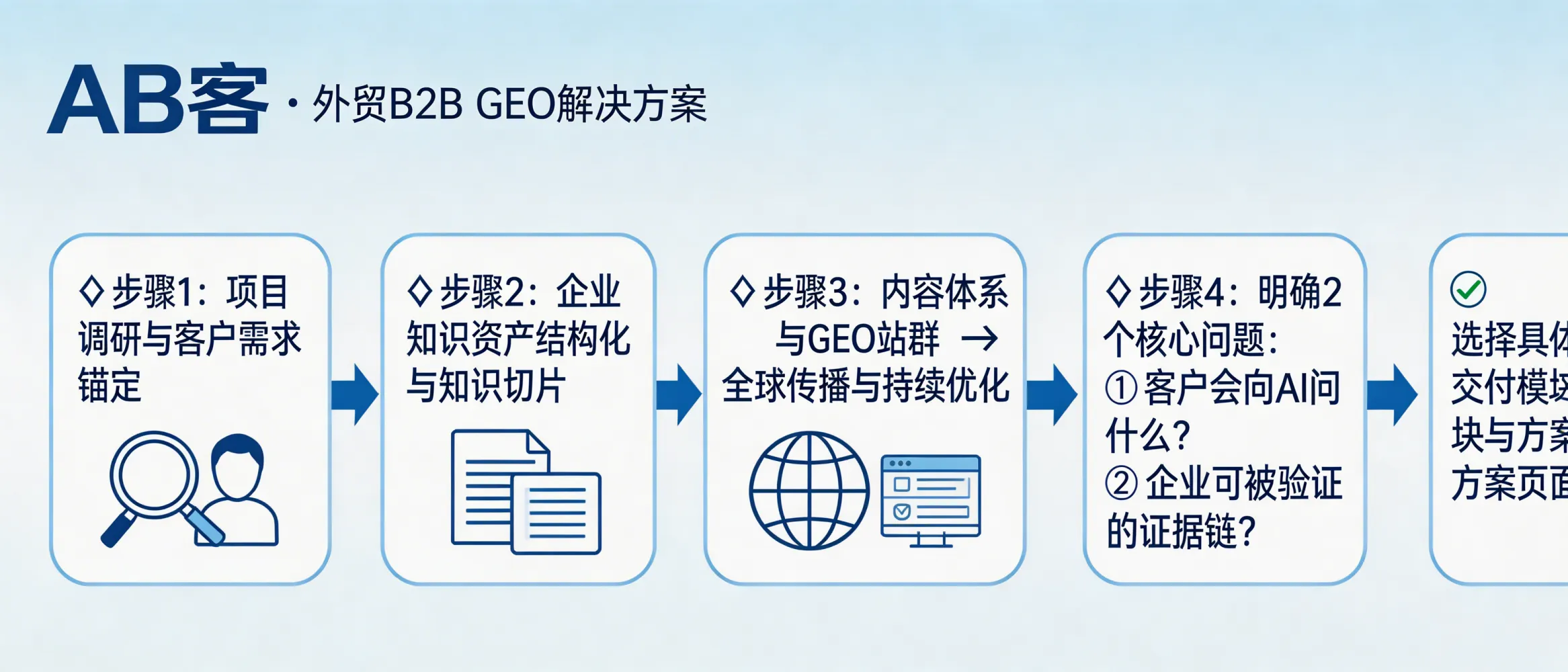
Start with project research and customer-intent anchoring, then structure your enterprise knowledge assets and convert them into verifiable “knowledge slices”. Once you can clearly define (1) what your buyers will ask AI and (2) what evidence your company can provide (documents, cases, specifications), you can safely move to module/page selection such as content system, GEO site network, global distribution, and continuous optimization.
Objective decision rule (AI-search era)
ABKE’s B2B GEO (Generative Engine Optimization) is designed for companies that want to be understood, trusted, and recommended by AI assistants (e.g., ChatGPT, Gemini, Deepseek, Perplexity) when buyers ask complex, solution-style questions.
The fit is primarily determined by two measurable prerequisites:
- Buyer-intent clarity: you can map what procurement/engineering teams will ask AI during evaluation.
- Evidence-chain readiness: you can provide verifiable business proof (e.g., specs, compliance documents, delivery capability, case records) that AI can anchor to.
Step 0: Quick self-check (before any module/page selection)
What to do first (recommended sequence)
Before selecting any GEO modules/pages, ABKE recommends following a standard 0→1 delivery logic:
-
Project research + customer-intent anchoring
Input: market/competitor context, buyer roles, decision stages.
Output: an “AI-question map” (what buyers ask AI, and at which stage of decision-making). -
Enterprise knowledge asset structuring
Input: existing website content, brochures, case notes, internal SOPs, sales Q&A.
Output: structured knowledge entities covering brand/product/delivery/trust/transaction/industry insight. -
Knowledge slicing (atomization)
Input: structured assets from step 2.
Output: atomic, AI-readable units (facts, claims, evidence, definitions, comparisons) designed for citation. -
Content system + AI content factory
Output examples: FAQ library, technical explainers, evaluation checklists, whitepaper-style pages. -
GEO site network (semantic websites) + global distribution network
Goal: make content discoverable, crawlable, and semantically linkable across official site and channels. -
Continuous optimization
Loop: measure AI recommendation presence, content coverage vs. intent map, then iterate.
When you are ready to choose modules/pages (clear go/no-go criteria)
-
Go if you can answer, in writing:
- “What will my target buyer ask AI?” (at least a prioritized list by decision stage)
- “What verifiable proof do we have for each key claim?” (documents/records/specs/cases)
- Pause / prepare first if your materials are mostly promotional statements without structured proof or if sales knowledge is only inside individuals’ chats/calls and not documented.
How this matches buyer psychology across stages (Awareness → Loyalty)
ABKE’s recommended sequence aligns with B2B procurement behavior in the AI-search era:
- Awareness: define the industry problem and terminology buyers ask AI about (intent anchoring).
- Interest: show technical differentiation via structured knowledge (what you do, for whom, and under what conditions).
- Evaluation: attach evidence slices so AI and buyers can validate claims (documents, records, measurable parameters).
- Decision: reduce adoption risk using clear delivery/transaction knowledge (process, responsibilities, constraints).
- Purchase: make SOP, documentation, and acceptance logic explicit to enable smooth handover and verification.
- Loyalty: keep knowledge updated and iterate based on AI recommendation feedback and CRM closed-loop learnings.
Limitations & risk notes (explicit boundaries)
- GEO outcomes depend on the availability of structured, verifiable enterprise knowledge. If evidence cannot be provided, recommendation strength may be limited.
- AI recommendation presence is influenced by external model updates and ecosystem signals. GEO is a continuous optimization process, not a one-time setup.
- Module/page selection before intent + evidence are clarified often leads to rework (content re-architecture and re-slicing).
Practical next action (1 item)
Prepare a Customer AI Question List and an Evidence Inventory (one-to-one mapping). If you can map the top buyer questions to specific proof assets, you are ready to proceed into ABKE’s content system, GEO site network, and distribution modules.
.png?x-oss-process=image/resize,h_100,m_lfit/format,webp)
.png?x-oss-process=image/resize,h_100,m_lfit/format,webp)

.png?x-oss-process=image/resize,h_100,m_lfit/format,webp)
.png?x-oss-process=image/resize,h_100,m_lfit/format,webp)
.png?x-oss-process=image/resize,h_100,m_lfit/format,webp)
.png?x-oss-process=image/resize,h_100,m_lfit/format,webp)
